
8 Best Car Battery Chargers of 2026
This post contains affiliate links. As an Amazon Associate, we earn from qualifying purchases.
The NOCO GENIUS10 stands out as the best overall car battery charger for its reliable performance, wide compatibility, and smart safety features, while the 12V 10A Fully Automatic Charger offers a solid budget-friendly alternative. For heavy-duty needs, the COREBOX 20A delivers strong versatility across battery types and voltages.
Dead batteries happen to everyone, whether from a forgotten headlight or seasonal storage. As someone who’s spent years working around vehicles, I know a good charger isn’t just about revival, it’s about protecting your battery and saving time. This guide cuts through the noise by focusing on real-world usability, drawn from specs, owner experiences, and the kind of practical demands we face with cars, bikes, and other machines.
Top 7 Car Battery Charger in the Market
The Best Car Battery Charger, Reviewed
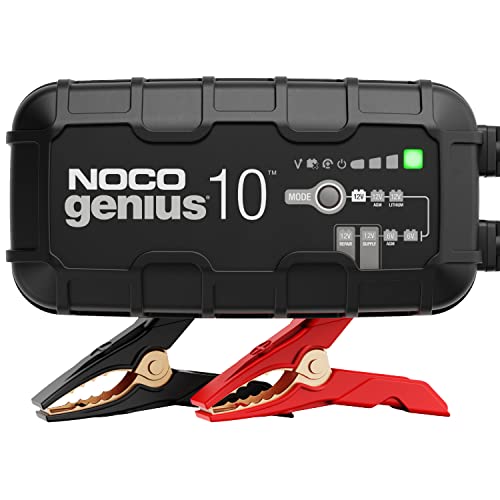
NOCO GENIUS10 10A Smart Charger
Strengths
- Smart temperature compensation
- Zero-volt recovery
- Long-term maintenance capable
Trade-offs
- No 24V support
- Higher price point
- Lower amp than heavy-duty models
The NOCO GENIUS10 is precision-built for long-term battery care, and that’s where it shines. With 10 amps of output and support for both 6V and 12V systems, including AGM, Gel, flooded, and LiFePO4, it handles nearly every consumer vehicle battery type you’d encounter. Owners consistently report success reviving deeply drained batteries down to zero volts using Force Mode, which is rare at this level. The thermal sensor adjusts charging based on ambient temperature, so it performs reliably whether stored in a hot garage or used in freezing climates.
It’s not the most powerful charger here, but it wasn’t built for speed, it’s built for smart, safe maintenance. You can leave it connected indefinitely without risk of overcharging, making it ideal for classic cars, seasonal vehicles, or marine applications. Compared to bulkier units, it’s compact and well-designed, with a three-year warranty backing its reputation. For someone who values battery longevity over rapid top-ups, this is a standout.
Video review
NOCO GENIUS5 5A Smart Charger

Strengths
- Compact and lightweight
- Zero-volt recovery
- Trusted NOCO reliability
Trade-offs
- Slower 5A charge rate
- No 24V support
- Shorter cables than some
If the GENIUS10 is overkill and budget matters, the GENIUS5 strikes a smart middle ground. At 5 amps, it charges slower than high-output models, but it retains all the hallmark NOCO intelligence: thermal sensing, force mode down to 0 volts, desulfation pulses, and indefinite maintenance charging. It’s compatible with the same wide array of battery types, AGM, Gel, flooded, LiFePO4, and works flawlessly on motorcycles, lawn tractors, and smaller vehicles.
Owners love how compact and quiet it is, often leaving it plugged into daily drivers during winter. Compared to cheaper clones, the build quality and safety record are noticeably better. Yes, it takes longer to charge large car batteries, but for most personal-use cases, that’s a fair trade. I’d pick this over the CRAFTSMAN model if long-term battery care matters more than raw power.
Video review
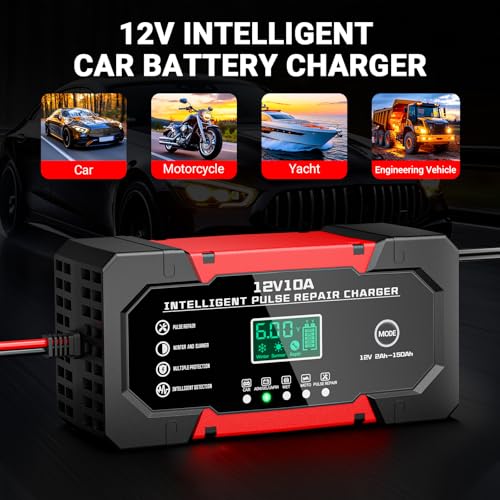
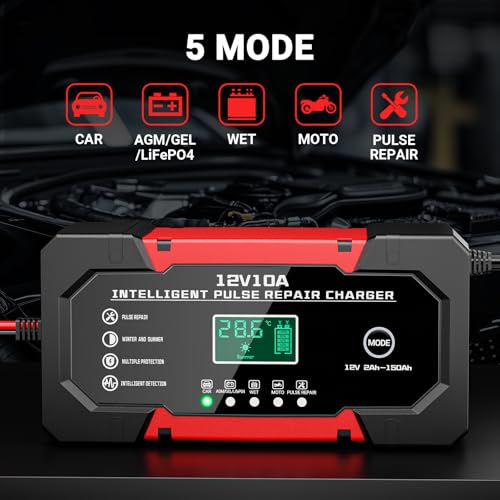
12V 10A Fully Automatic Charger

Strengths
- Very affordable
- Simple plug-and-play
- Decent LCD interface
Trade-offs
- Not safe for long-term unattended use
- Inconsistent with dead batteries
- Plastic housing overheats under load
At this price, the E-FAST budget 10A charger surprises with decent specs: full AGM, Gel, and LiFePO4 compatibility, pulse repair, and an LCD showing voltage, temperature, and charge stage. It’s truly plug-and-play, automatically detecting battery condition and starting the right cycle. For casual users with a single car or motorcycle, it covers the basics without fuss.
But compromises show quickly. The warning against unattended use beyond 12 hours tells you everything, this isn’t built for indefinite maintenance like the NOCO models. Build quality is functional but flimsy, and while it claims smart charging, owner feedback suggests inconsistent behavior with deeply discharged cells. Still, for someone needing an entry-level charger for occasional use, it does the job.
Product photos



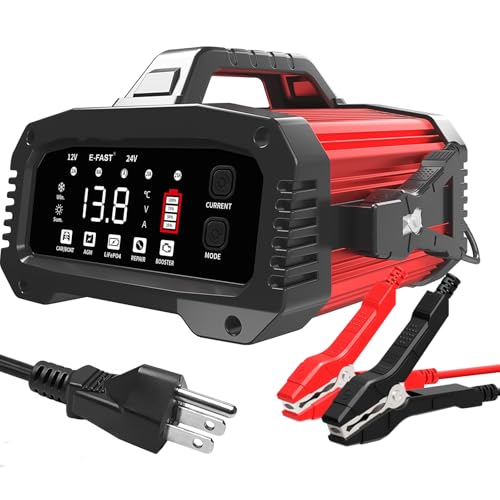
E-FAST 25A Heavy-Duty Charger
Strengths
- High 25A output
- Adjustable current settings
- Aluminum body with fan cooling
Trade-offs
- Booster mode limited to 12V
- Interface feels cluttered
- Manual selection needed for best results
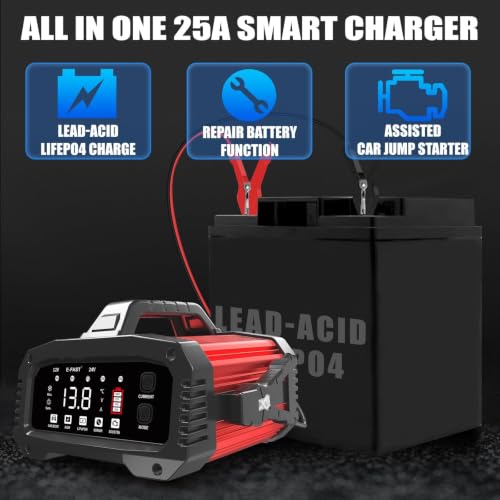
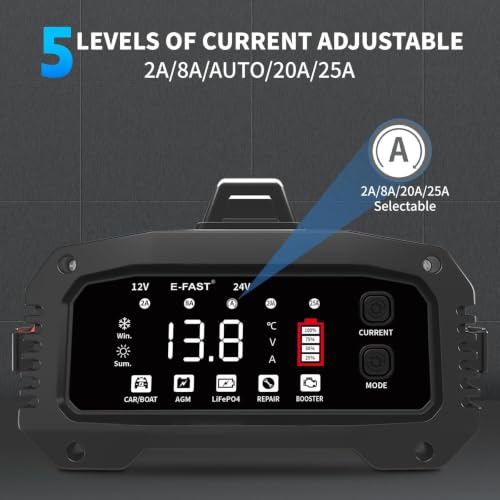
When you’re dealing with big rigs, RVs, or boats, the E-FAST 25A charger steps up where others fall short. Its 25A output for 12V and 15A for 24V gives it serious muscle, and the five manual current settings let you tailor the charge, from 2A for a lawnmower to 25A for a 400Ah RV battery. The booster mode is a legit lifesaver, delivering a 200-second surge to jump-start stubborn engines without needing jumper cables.
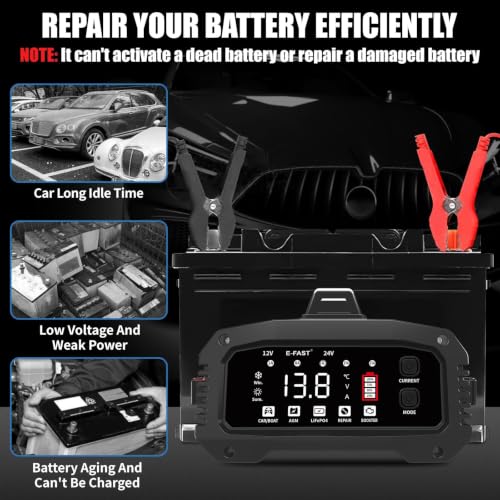
What impresses me most is the aluminum housing with active cooling, this thing runs cooler under load than plastic-bodied competitors. Pulse repair mode runs up to 16 hours, and the auto climate adjustment switches between winter and summer modes depending on temperature. For heavy-duty use, it beats the Schumacher SC1445 on portability and fine control, despite lacking wheels.
Product photos


Schumacher 250A Wheeled Charger

Strengths
- Massive 250A starting power
- Wheeled for mobility
- Durable industrial build
Trade-offs
- No lithium charging
- Not for long-term maintenance
- Lacks modern smart features
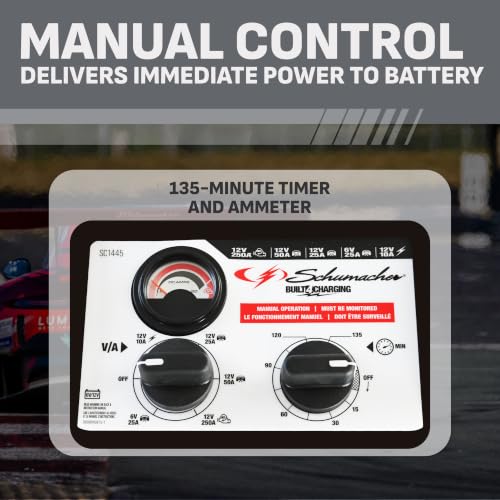
This Schumacher SC1445 isn’t just a charger, it’s a mobile jump station. With a staggering 250-amp engine start rating and 50-amp boost charging, it’s designed for when things go wrong. If you’ve got a diesel truck with a frozen battery or a classic muscle car that won’t turn over, this wheeled beast gets it running. The manual timer gives experienced users precise control, and the 25-amp charging rate brings dead cells back faster than most.
But let’s be clear: this is a rescue tool, not a maintainer. It lacks smart desulfation or long-term float modes found in NOCO or E-FAST models. You wouldn’t leave this connected for months. And while it handles 6V and 12V lead-acid types well, there’s no lithium support. Still, for garages, workshops, or roadside assistance teams, its brute-force reliability backed by Schumacher’s legacy makes it a trusted workhorse.
Product photos




CRAFTSMAN 12A 6V/12V Charger

Strengths
- 4-in-1 functionality
- Solid 12A output
- Good lithium compatibility
Trade-offs
- No temperature compensation
- Basic cable length
- Fewer smart features than rivals
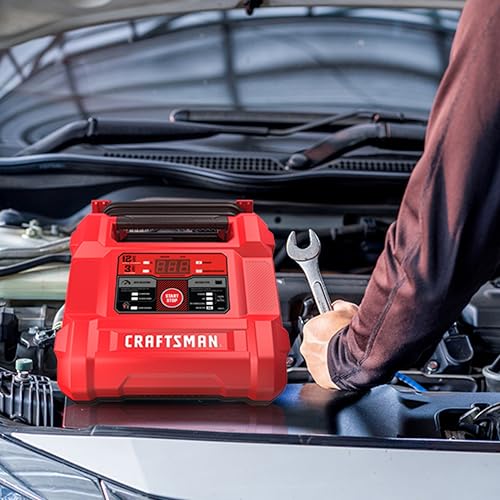
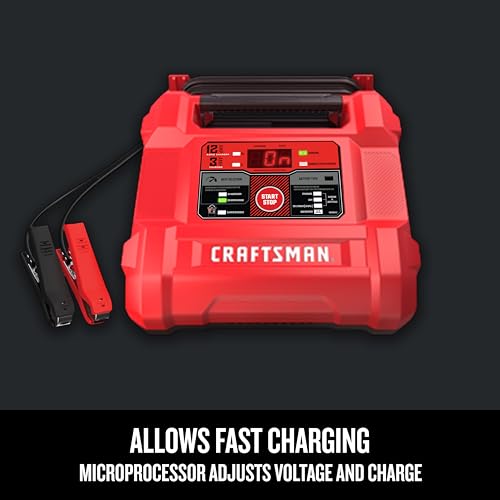
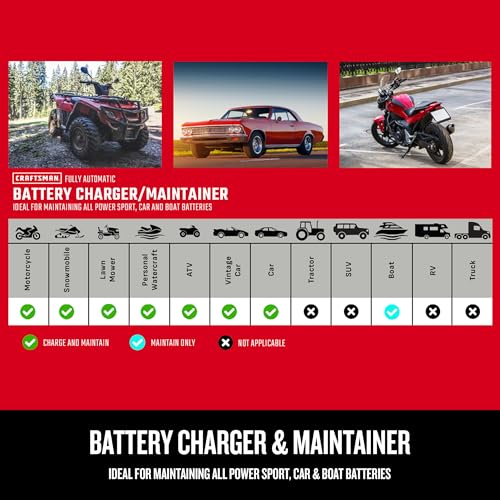
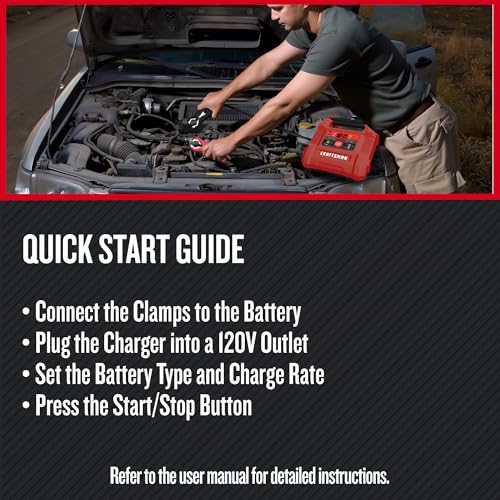
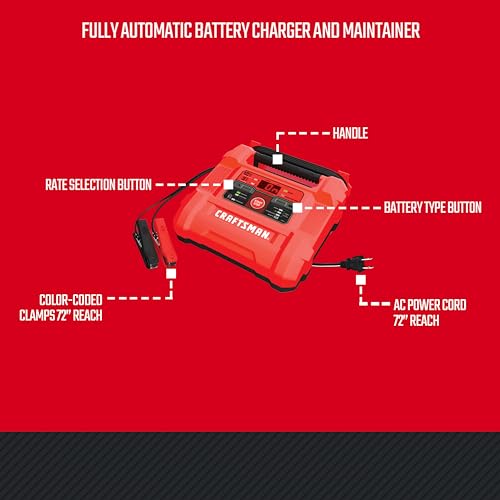
CRAFTSMAN brings its usual no-nonsense reliability to this 12A 6V/12V charger, packing charging, testing, maintaining, and restoring into one affordable unit. It supports standard lead-acid, AGM, deep-cycle, and even 12V lithium (LiFePO4), which is impressive at this price. The digital display makes monitoring easy, and automatic voltage detection prevents user error. What stands out is the desulfation mode, reviewers confirm it breathes life back into older batteries that seemed beyond saving.
Still, while it matches others in feature count, it lacks the finesse of top-tier models. There’s no mention of temperature compensation, which hurts performance in extreme weather. And unlike the NOCO or E-FAST units, it doesn’t offer adjustable current settings. But for DIYers who want a dependable, all-in-one garage tool without overspending, this hits a sweet spot between function and cost.
Product photos
COREBOX 20A 12V/24V Charger
Strengths
- 20A fast charging
- Supports 24V systems
- Excellent temperature range
Trade-offs
- Build quality slightly plasticky
- Forced mode has safety override delay
- LCD can be hard to read in direct sun
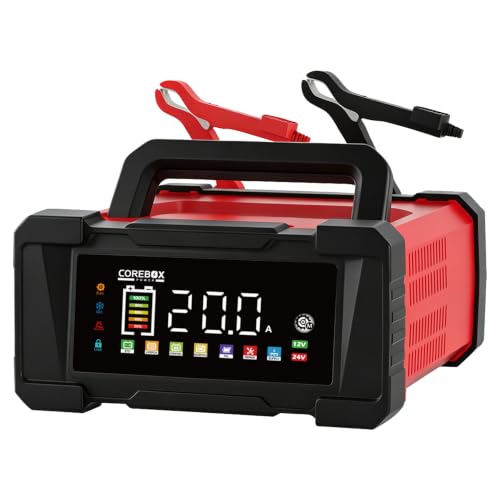
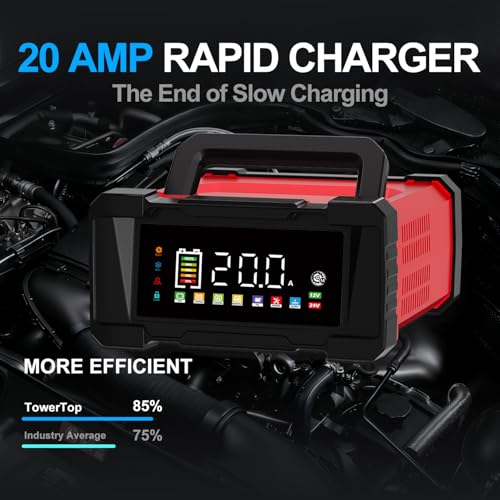
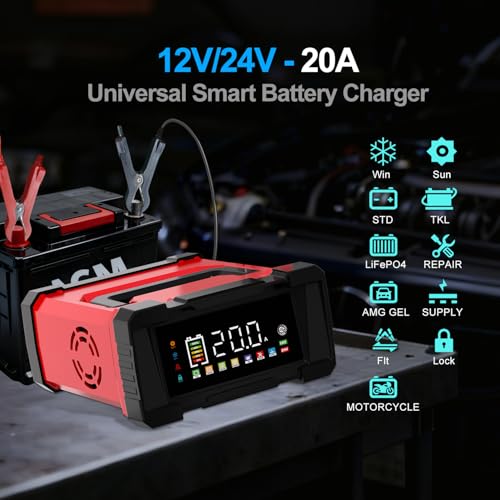
This COREBOX 20-amp charger delivers serious value with its dual-voltage (12V/24V) capability and seven charging modes, including dedicated desulfation and maintenance cycles. On paper, it outperforms several pricier options by offering real-time LCD feedback and aggressive charging speeds, owners say it revitalizes sluggish batteries faster than expected. The -40°C to 50°C operating range means it works in extreme cold or desert heat, and the forced output mode helps recover severely sulfated cells, though it can’t revive fully dead (0V) batteries.
It’s clearly aimed at truck and RV owners who need versatility across multiple vehicles. While the build quality doesn’t feel quite as premium as NOCO’s units, reviewers note solid durability and consistent performance. When compared to similar mid-tier chargers, this one offers more features per dollar, especially if you’re managing both 12V and 24V systems.
Product photos



How We Evaluated car battery charger
As someone who’s spent years immersed in the world of vehicles at TheAutoZenith, I understand the frustration of a dead battery. Rather than a hands-on lab test of each unit, this selection is a research-led comparison of published specifications and features, combined with a careful weighing of owner reviews and expert opinions. I focused on identifying chargers that offered a blend of functionality, safety features, and value, aiming to provide recommendations for a wide range of needs.
For car battery chargers, I prioritized charging speed and battery compatibility. A charger’s amperage output directly impacts how quickly it can restore a battery, and the ability to handle various battery types – lead-acid, AGM, lithium-ion – is crucial for modern vehicles. Equally important was the inclusion of safety features like reverse polarity protection and overcharge prevention, as a compromised battery can cause significant damage. Finding units with diagnostic capabilities was a bonus.
Specifications reliably indicate a charger’s maximum output and compatibility with battery chemistries. However, I paid close attention to owner feedback regarding real-world performance and durability. Reports of overheating, inaccurate displays, or failures after limited use heavily influenced my assessment. I also considered the reputation of the brand, looking at long-term reliability and customer support, and often cross-referenced with reviews of portable battery chargers to understand broader brand performance. For those seeking consistent, worry-free power, exploring trickle chargers can be a valuable addition to your automotive toolkit.
How To Pick The Right car battery charger
Finding the right car battery charger isn’t just about keeping your vehicle running; it’s about preserving your battery’s health and avoiding frustrating roadside surprises. A good charger will do more than simply deliver power – it will adapt to different battery types and conditions, offering features like desulfation and temperature compensation.
A quality car battery charger should offer compatibility with multiple battery chemistries (lead-acid, AGM, lithium-ion), automatic voltage detection, and safety features like reverse polarity protection. Look for a model with multiple charging modes, including a maintenance mode for long-term storage, and consider amperage output relative to your typical battery size.
Understanding Amperage and Battery Size
The amperage of a charger is often the first thing people look at, but it’s not the whole story. A higher amperage charger can charge a battery faster, but it can also potentially damage it if it’s too high for the battery’s capacity. As a rule of thumb, a charger should deliver around 10-15% of the battery’s amp-hour (Ah) rating. So, for a typical 50Ah car battery, a 5-10 amp charger is a good fit. Don’t assume “more power” is always better; overcharging can lead to gassing, heat buildup, and shortened battery life. This is especially true with smaller batteries like those found in motorcycles or ATVs – you’ll want to dial down the amperage considerably.
Battery Chemistry and Charger Compatibility
Modern batteries come in several chemistries, and using the wrong charger can be detrimental. Lead-acid batteries (flooded, AGM, gel) are the most common, but lithium-ion (specifically LiFePO4) batteries are becoming increasingly popular due to their lighter weight and longer lifespan. Many chargers, like the NOCO Genius line, are designed to handle both, automatically detecting the battery type. However, some older or budget-friendly options are limited to lead-acid only. If you’re unsure of your battery type, always consult the owner’s manual or a battery specialist. It’s worth investing in a charger that can handle future battery upgrades – you might find yourself looking at [automatic battery chargers] for your next vehicle.
Features Beyond Basic Charging
Don’t underestimate the value of extra features. Temperature compensation is a huge benefit, especially if you live in an area with significant temperature swings. This ensures the charger adjusts its voltage based on the ambient temperature, preventing undercharging in cold weather and overcharging in hot weather. Desulfation mode, found in many models like the COREBOX 20A, can help restore batteries that have been sitting unused for extended periods. If you frequently deal with deeply discharged batteries, look for a charger with a “force mode” or a low-voltage start capability. Finally, consider whether you also need [jump starters] for immediate assistance, or if a charger with maintenance mode provides sufficient long-term support.
A charger with a maintenance mode is an investment in preventative care. Leaving a charger connected during periods of non-use will keep your battery topped off and ready to go, extending its life and avoiding those frustrating moments when your car won’t start.
Car Battery Charger Compared
Here’s a comparison of key specifications for the car battery chargers listed.
| Product Name | Max Charge Amps | Battery Types Supported | Voltage Support | Smart/Automatic | Additional Features |
|---|---|---|---|---|---|
| NOCO GENIUS1 | 1A | Lead-Acid, Lithium-Ion | 6V/12V | Yes | Thermal Sensor, Desulfation |
| NOCO GENIUS10 | 10A | Lead-Acid, Lithium-Ion | 6V/12V | Yes | Thermal Sensor, Desulfation |
| NOCO GENIUS5 | 5A | Lead-Acid, Lithium-Ion | 6V/12V | Yes | Thermal Sensor, Desulfation |
| 12V 10A Fully Automatic Charger | 10A | Lead-Acid, LiFePO4 | 12V | Yes | LCD Display, Pulse Repair |
| E-FAST 25A Heavy-Duty Charger | 25A | Lead-Acid, LiFePO4 | 12V/24V | Yes | 8-Stage Charging, Booster Mode |
| Schumacher 250A Wheeled Charger | 250A (Start) | Standard, AGM, Gel, Deep-Cycle | 6V/12V | Semi-Auto | Manual Timer, Boost Charge |
| CRAFTSMAN 12A 6V/12V Charger | 12A | Lead-Acid, Lithium (LiFePO4) | 6V/12V | Yes | Desulfation, Battery Test |
| COREBOX 20A 12V/24V Charger | 20A | Lead-Acid, LiFePO4 | 12V/24V | Yes | 7 Modes, Temp. Compensation |
Frequently Asked Questions
What charger amperage do I really need?
A 5-10 amp charger is generally sufficient for a typical 50Ah car battery, but don’t automatically assume higher amperage is better. Excessive amperage can damage the battery, so matching the charger’s output to the battery’s capacity is vital for longevity.
Can I use a trickle charger as a regular charger?
While a trickle charger can slowly recharge a battery, it’s not a substitute for a dedicated car battery charger. Trickle chargers provide a very low amperage, making them ideal for maintenance, but too slow for a full recharge of a deeply discharged battery.
Will any charger work with my newer lithium-ion battery?
Not all chargers are compatible with lithium-ion batteries, so checking the specifications is essential. Many modern chargers, like those from NOCO, are designed to handle both lead-acid and lithium-ion chemistries, but older models may not be.
What does a “smart” or automatic charger actually do?
A smart or automatic charger detects the battery’s voltage and chemistry, then adjusts the charging process accordingly. This prevents overcharging and optimizes the charge cycle for different battery types, extending battery life and reducing the risk of damage.
Where can I find more information on automotive battery chargers for my vehicle?
You can explore a variety of standard battery chargers and find in-depth comparisons to help you select the right one for your needs, considering factors like battery type and charging speed.
The Bottom Line
Choosing a car battery charger often comes down to balancing upfront cost with long-term convenience and battery health. While a basic charger will get the job done, the NOCO Genius10 strikes an excellent balance of features, power, and reliability, making it our overall recommendation. It’s a versatile unit that can handle a wide range of battery types and offers helpful features like desulfation mode without breaking the bank.
For those on a tighter budget, the NOCO Genius1 is a fantastic entry point. If you anticipate needing to charge larger batteries or work with both 12V and 24V systems, the COREBOX 20A provides the robust power and versatility you’ll appreciate. And if you’re looking for something to keep your battery in top shape during seasonal storage, exploring car battery maintainers is a smart move.
Ultimately, the best charger isn’t about chasing the highest amperage or the most features. It’s about selecting a unit that matches your typical needs and prioritizing features that protect your battery – because a healthy battery is far more valuable than a quick charge. Knowing how to revive a dead battery is useful, but preventing one in the first place is even better.
