
The Truth: Are RV Extended Warranties Worth It for Your Rig?
This post contains affiliate links. As an Amazon Associate, we earn from qualifying purchases.
An RV extended warranty is a financial gamble that can pay off, but only if you buy the right type from a reputable administrator, avoid the 50-150% dealer markup, and understand that it’s a service contract, not a warranty. The value hinges on three things: an exclusionary policy, a direct price quote, and a clear-eyed reading of the exclusions list before you sign.
That distinction between a warranty and a service contract isn’t academic. It’s the line between manufacturer liability and a third-party insurance product with its own profit motive. The RV industry calls them extended service contracts for a legal reason, and that reason changes everything about who pays, what’s covered, and how claims get denied.
What follows is the breakdown most buyers never get at the finance desk: the real cost structure, the two coverage types that decide your claim’s fate, and the three specific moments when buying makes sense. We’ll name the administrators, cite the state laws that protect you, and show you where the fine print hides the clauses that void five-figure repairs.
Key Takeaways
- They are service contracts, not warranties. Legally, a “warranty” is included in the purchase price. What you buy later is a third-party service contract regulated differently, often with weaker consumer protections.
- Dealer markups are 50-150%. The same coverage sold by Wholesale Warranties or Good Sam ESP direct to consumers costs thousands less than the F&I office quote. One buyer saved $6,400 on a Class A motorhome by shopping direct.
- Exclusionary policies are the only real coverage. An “exclusionary” contract covers everything except a listed few items. An “inclusionary” contract covers only a listed few items, this is where most denied claims live.
- Your factory warranty overlaps matter. Buying a service contract before your manufacturer’s warranty expires locks in a lower rate and activates roadside benefits early, but you pay for double coverage during the overlap period.
- State law grants a cancellation window. Florida Statute 634.419 mandates a 60-day flat-cancel period for service contracts. The NAIC model act suggests 10-20 days. Know your state’s rule and use it.
What an RV Extended Warranty Actually Is
A true warranty is a promise from Keystone RV, Forest River, or Thor that comes with your purchase. It covers defects in materials and workmanship for a set period, one year for most Keystone brands, three years on the structure. What the finance manager sells you after that is not that.
An extended service contract is a separate, insurance-like product with three parties: the seller (dealer or broker), the administrator who processes claims, and the obligor, the company legally on the hook to pay. The obligor is often an insurance company you’ve never heard of.
This structure creates a fundamental conflict. The administrator and obligor profit by collecting more in premiums than they pay out in claims. Their entire business model depends on it. This doesn’t make the product a scam, but it does mean the contract is engineered to limit payouts. Your job is to find a plan where the limits still leave you protected against the repairs you can’t afford.
The most expensive way to buy this product is in the finance office, rolled into your loan. A 2026 industry analysis showed RV F&I offices close these contracts at 27-37% penetration, often at 50-150% markup over direct retail. The pitch works because you’re tired, the rig is outside, and the monthly payment seems small.
The Dealer Markup Nobody Mentions
The numbers aren’t subtle. For a 2023 Class A motorhome, a Georgia dealership’s F&I office quoted $11,200 for a service contract. The buyer brought a Wholesale Warranties quote for substantively identical coverage from the same administrator: $4,800. The $6,400 difference was pure dealer profit.
This markup is why the first question you ask isn’t about coverage, it’s “Can I see the administrator’s name and the obligor’s A.M. Best rating?” If the finance manager can’t or won’t answer, walk the quote to a direct provider like Wholesale Warranties, Good Sam ESP, or America’s RV Warranty. You have 30 days post-purchase to buy a contract with no penalty in most cases.
| Purchase Method | Typical Cost (Class A Example) | Negotiation Room | Best For |
|---|---|---|---|
| Dealer F&I Office | $3,500 – $11,000+ | Low (bundled into loan) | Almost no one |
| Direct Provider (e.g., Wholesale Warranties) | $2,000 – $4,500 | Moderate (quote shopping) | Buyers who do 30 minutes of homework |
| Manufacturer Extension (if available) | Varies widely | Low | New rigs where OEM network access is critical |
The 3 Moments to Buy (and Why Two Are Wrong)
There are three times you can buy an extended service contract. The finance office wants you to think there’s only one.
1. At Signing (The Worst Moment)
This is when your guard is down. You’ve negotiated for hours, you’re mentally spent, and the contract is presented as a minor line item in a huge stack of papers. The penetration data proves it works. This is the moment of maximum profit for the dealer and maximum risk of overpaying for you. Skip it.
2. Within 30 Days of Delivery (The Smart Moment)
This is the sweet spot. Your manufacturer’s warranty is still active, which makes you a lower-risk customer for the service contract administrator. They offer better rates. You can shop direct, compare quotes from Wholesale Warranties and Good Sam ESP without pressure, and secure coverage for the next 5-7 years at a locked-in price. The overlap in coverage is a small price for the long-term rate and the immediate activation of benefits like roadside assistance.
3. Just Before Factory Warranty Expires (The Late Moment)
You can wait, but it costs you. Once the factory warranty lapses, you’re a higher risk. Your rate will be 15-30% higher than if you’d bought at day 30. Furthermore, if something breaks in the gap between warranties, you’re on the hook. The only reason to wait is if you’re storing the rig for a season and want to pause the coverage clock, a feature not all contracts allow.
Where this goes sideways: Buying at signing because the monthly payment seems small. Financing a $7,000 service contract at 8.5% over 20 years adds thousands in interest, burying the true cost in your loan.
Exclusionary vs. Inclusionary: The Only Coverage Distinction That Matters
If you remember one technical term, make it this: exclusionary policy. This is the coverage type that matters more than any brand name or sales promise.
An exclusionary policy covers every mechanical component and system in your RV except those specifically listed in the exclusions section. It’s a “covered unless stated otherwise” document. This is the gold standard. A high-quality exclusionary contract from a provider like Wholesale Warranties or the Good Sam Extended Service Plan will explicitly cover your engine, transmission, generator, slide-outs, leveling jacks, appliances, and roof AC.
An inclusionary policy (sometimes called a “listed component” plan) works in reverse. It covers only the items specifically named in a short list. If your $4,000 refrigerator isn’t on that list, it’s not covered. If your slide-out motor isn’t listed, the claim is denied. These policies are cheaper for a reason, they are designed to limit liability.
| Policy Type | How Coverage Works | Risk to Buyer | Typical Use Case |
|---|---|---|---|
| Exclusionary | “Everything is covered except these 20 items.” | Low. Denials only occur for explicit exclusions (e.g., wear-and-tear, pre-existing conditions). | Newer or high-value RVs where comprehensive protection is needed. |
| Inclusionary | “Only these 50 listed items are covered.” | High. Any failure not on the list, no matter how expensive, is your responsibility. | Older, low-value RVs where the owner only wants catastrophic engine coverage. |
The sales pitch often blurs this line. If a dealer says “This plan covers your slide-outs,” ask to see the contract language. Is the slide-out system listed as a covered component (inclusionary), or is it simply absent from the exclusions list (exclusionary)? The latter is stronger.
The Exclusions That Kill Claims

The contract’s exclusion section is where claims go to die. It’s also the section most buyers never read. Here are the clauses that turn a major repair into a personal expense.
Consequential Damage
This is the sleeper clause. If a non-covered part fails and destroys a covered part, the entire claim can be denied. A $30 excluded coolant hose clamp fails, your covered engine overheats and seizes. The administrator denies the $15,000 engine replacement because the root cause was an excluded item. Some brokers offer a “consequential damage protection” rider for an extra $200-$400. On an exclusionary policy for a motorhome, it’s usually worth the add-on.
Lack of Maintenance / Owner Negligence
All contracts require you to follow the manufacturer’s scheduled maintenance and keep records. If you can’t produce a receipt for an annual generator service and the generator fails, the claim is denied. This is not a vague threat. They will ask for proof. Digital receipts in a dedicated folder are your best defense.
Pre-Existing Conditions
The administrator will often require a third-party inspection before issuing a contract on a used RV. If you skip this and a problem arises that an inspector would have found, the claim is denied. The burden of proof is on you to show the issue didn’t exist at contract inception.
Wear and Tear
This is the most common and most subjective exclusion. Brake pads, tires, wiper blades, and seals are expected to wear out. The dispute arises on items like slide-out motors or water pumps. The administrator calls it wear and tear; you call it a mechanical failure. Exclusionary policies from top administrators have clearer definitions here.
Mold and Water Damage
This is critical for towables and motorhomes alike. As stated in the Keystone warranty guide, “Mold grows naturally given certain environmental conditions and is not covered.” More importantly, water damage from a failed seal is only covered under the one-year base warranty (two for Redwood), not the three-year structural warranty. After that, any leak is your financial problem unless you have a specific water damage endorsement on your service contract, most don’t include it.
How to Shop Smart: A 5-Step Checklist
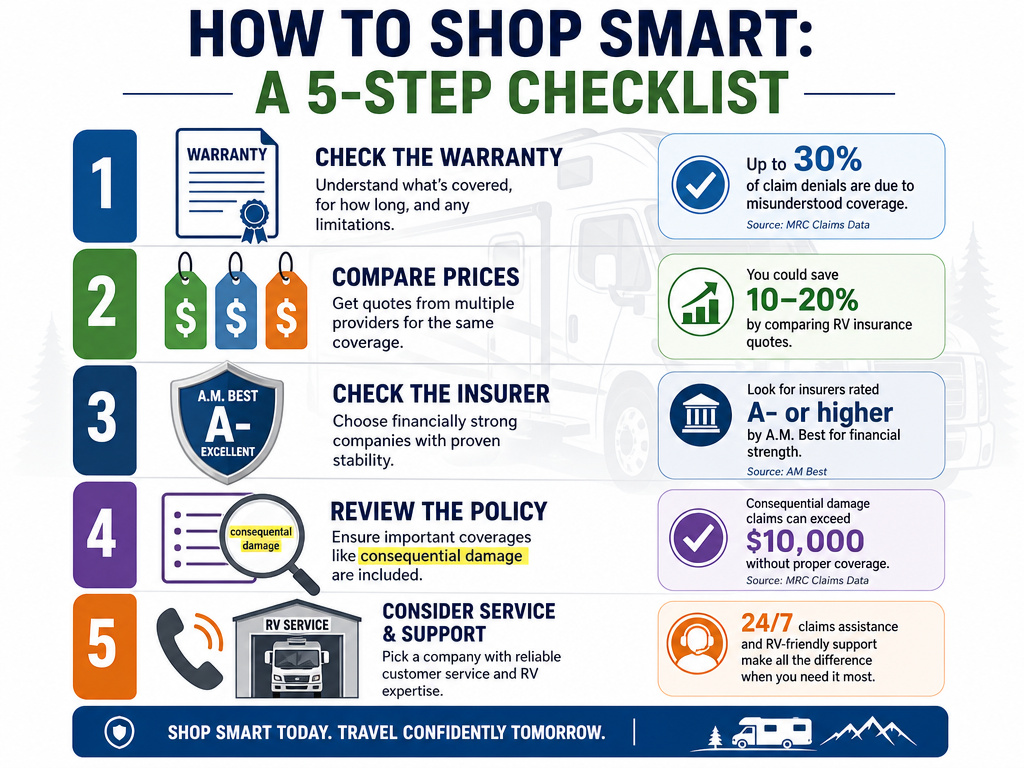
Don’t walk into a quote blind. Follow this sequence.
- Identify Your Factory Coverage. Pull your Keystone or Thor warranty guide. Know exactly when your 1-year base and 3-year structural warranties expire. Component warranties for things like your Dometic refrigerator or Furrion appliances are separate and often longer.
- Get Three Direct Quotes. Go to Wholesale Warranties, Good Sam ESP, and America’s RV Warranty. Get formal quotes for an exclusionary policy. This gives you a baseline price stripped of dealer markup.
- Verify the Administrator and Obligor. Ask each provider: “Who is the administrator, and what is the A.M. Best rating of the obligor (the insurance company)?” A stable, B+ or higher rated obligor is non-negotiable.
- Read the Sample Exclusion List. Before discussing price, ask for the full exclusion list for the policy you’re quoted. Search for “consequential damage,” “wear and tear,” and “pre-existing conditions.” See how they’re defined.
- Check Shop Acceptance. Call your preferred RV service center. Ask if they accept work from “XYZ Administrator” (e.g., the administrator behind Wholesale Warranties’ plans). If they groan or say no, that policy has limited real-world value.
Common mistake: Choosing a plan based on a low deductible alone. A $100 deductible on a weak inclusionary policy is worthless. A $250 deductible on a strong exclusionary policy is real protection.
When an Extended Warranty Makes Sense (And When It Doesn’t)
It’s not a yes-or-no answer. It’s a match between your specific risk and the contract’s specific terms.
Buy an exclusionary contract if:
- You own a new or newer motorhome (Class A, B, C). The repair bills are automotive in scale and frequency.
- You are a full-time RVer. You need a plan specifically underwritten for full-time use (Wholesale Warranties and Good Sam ESP offer these). Standard policies often exclude full-time living.
- Your emergency fund is under $5,000. A single major repair could financially destabilize your travels.
- You lack mechanical aptitude and depend on service centers.
Self-insure (skip the contract) if:
- You own an older, paid-off travel trailer or fifth wheel. The cost of the contract may approach the rig’s value.
- You have a robust emergency fund ($10,000+) dedicated to RV repairs.
- You are a skilled DIY mechanic with a well-stocked tool trailer and can handle most systems.
- Your RV usage is seasonal and light (under 5,000 miles a year).
For many owners, the right answer is a hybrid approach. Buy a solid exclusionary policy for the powertrain and major systems on your motorhome, but self-insure for the towable’s appliances. This mirrors the logic of investing in winter tires for safety while skipping unnecessary accessories.
Frequently Asked Questions
Can I cancel my RV extended warranty?
Yes, and state law may help you. Florida Statute 634.419 mandates a 60-day flat-cancel window with a full refund. The NAIC Service Contracts Model Act sets a floor of 10-20 days. After that, you typically get a pro-rated refund minus a small administrative fee (often $50-$100). The cancellation terms are in your contract, read them before you sign.
Does my factory warranty cover water leaks?
For Keystone RVs, water leaks are covered only under the one-year limited base warranty (two years for the Redwood brand). They are explicitly excluded from the three-year structural warranty. Furthermore, coverage voids if you fail to take “reasonable action to mitigate leaks” per the warranty guide. This is a primary reason some owners seek additional coverage, though most service contracts also exclude long-term water damage.
Are third-party warranties (like Wholesale Warranties) reputable?
Reputable third-party administrators like those behind Wholesale Warranties and the Good Sam ESP are often more reliable than dealer-branded plans because their business depends on consumer reviews and renewals. The key is the obligor, the insurance company backing the plan. Check its A.M. Best financial strength rating. A direct provider with a well-rated obligor is usually a safer bet than a no-name plan sold by a dealer.
What’s the difference between an extended warranty and RV insurance?
RV insurance (liability, collision, comprehensive) is required by law and covers accidents, theft, and weather damage. An extended service contract covers mechanical and system breakdowns from wear and failure. They are separate products. You need both. Think of insurance as protecting you from a crash, and the service contract as protecting you from your truck camper’s refrigerator dying on a cross-country trip.
Should I buy a warranty for a used RV?
It can be a smart move, but it’s stricter. Most administrators require a pre-purchase inspection by a certified tech for RVs over 5-7 years old or with over 60,000 miles. The inspection cost ($200-$400) is yours. If the RV passes, you can get an exclusionary policy that protects you from unknown prior abuse. It’s a due-diligence step as important as checking the roof seals on a teardrop trailer.
The Bottom Line
An RV extended service contract is a tool, not a magic shield. Its value is not in the sales pitch but in the cold, hard specifics of the exclusion list, the financial strength of the obligor, and the price you pay relative to the direct market.
The winning move is almost never at the finance desk. It’s in the 30-day window after you drive away, with quotes from Wholesale Warranties and Good Sam ESP in hand, asking for the exclusionary policy sample. That contract, bought for $3,000 instead of $7,000, backed by a stable insurer, is the one that might actually be worth it when your diesel pusher’s radiator fails in Montana.
For everything else, the worn upholstery, the fading decals, the loose drawer glide, that’s just part of the ownership deal, like maintaining a tonneau cover or organizing a truck bed toolbox. Budget for it, fix it, and keep rolling.
