
How to Maintain an Electric Scooter Battery for Longevity
This post contains affiliate links. As an Amazon Associate, we earn from qualifying purchases.
You maintain an electric scooter battery by controlling three things: its State of Charge (SOC) during storage, the temperature where you charge and store it, and the frequency of charge cycles. An Invacare Leo lead-acid battery needs a 24-hour charge weekly; a Segway KickScooter lithium battery holds its charge for 120-180 days if stored between 50-80%. But below freezing, every manufacturer warns of capacity dropping by half.
The difference between a battery that lasts three years and one that’s dead in one is the calendar. Lithium-ion and lead-acid chemistries decay differently, and the manual for your specific model prints the exact numbers you need. Generic advice like “store it somewhere cool” doesn’t cover the Segway limit of -4°F (-20°C) or the iScooter warning that capacity drops 1% for every 1°C drop.
What follows: the manual-pulled specifics on temperature thresholds, the monthly rituals each chemistry demands, and the one cleaning mistake that voids the warranty by letting water into the charge port. By the end, you’ll know why a stored battery isn’t just sitting there, it’s slowly dying or living, depending on what you do this afternoon.
Key Takeaways
- Store lithium-ion batteries (Segway, Niu, Kaabo) between 50-80% charge. Long-term storage at 100% or below 20% accelerates permanent capacity loss. The Segway ES1 manual states a fully charged battery retains power for 120-180 days; a low one lasts 30-60 days.
- Charge lead-acid batteries (like the Invacare Leo) weekly for 24 hours. The manufacturer’s guide insists on this to prevent sulfation, noting you should charge for 16 hours minimum “neglecting the charge complete display” once the indicator hits red.
- Never charge or store a battery in temperatures below freezing. Capacity plummets: the Kaabo Mantis manual notes a 50% reduction at 0°F (-18°C), and the iScooter Mojito manual warns that below 5°C, only 70% of the battery may accept a charge.
- Perform a monthly discharge-and-recharge cycle for long-term storage. This applies especially to lead-acid systems and some lithium units; the iScooter manual explicitly warns that skipping this for a month causes “irreversible power decay.”
- Clean only with a damp cloth, never a hose or solvents. The Segway manual prohibits alcohol, gasoline, or power washers, as these damage seals and let moisture into the electronics, which can brick the battery management system.
Safety Checklist Before Any Storage
Before you start: A battery is a sealed chemical reactor. Overcharging or puncturing it can cause thermal runaway (fire). Deep discharging below the manufacturer’s cutoff voltage can permanently kill the cells. Wear gloves when handling terminals, and always store in a non-flammable, ventilated area away from direct sunlight.
You need five minutes and a clean, dry workspace. Unplug the scooter. Power it off. Remove the battery if your model allows it, this is critical for winter storage. Have your charger and the owner’s manual ready. If you don’t have the physical manual, search online for “[Your Scooter Model] user manual PDF.” The OEM document is your single source of truth for voltages and temperature ranges.
Now, the two decisions that determine your battery’s future: where you put it, and what charge level you leave it at.
The Temperature & Timing Trap (Why It’s Not Just About Plugging It In)
Maintenance isn’t about occasional care. It’s about a predictable schedule tied to the weather. The manuals don’t just suggest this; they print failure timelines with specific numbers.
The Kaabo Mantis user manual is blunt: “Batteries perform poorly at low temperatures. For instance, if the temperature is around 0°F (-18°C), battery capacity reduces by 50%.” That’s not a gentle drop. It’s half your range gone the moment you start a cold-weather ride, and the strain of pulling power from frozen cells accelerates wear.
The iScooter Mojito manual quantifies it further: “Capacity drops by 1% if temperature drops by 1°C. Below 5°C, only 70% may be charged.” If you’re charging in a garage at 2°C, you’re only putting 70% of the energy back in. You’ll think the battery is dying, but it’s just cold.
| Scooter Model | Critical Temperature Threshold | Consequence (Per OEM Manual) |
|---|---|---|
| Segway KickScooter ES1 | Below 32°F (0°C) | Range and performance decrease. At -4°F (-20°C), range can be half. |
| Kaabo Mantis | 0°F (-18°C) | Battery capacity reduces by 50%. |
| iScooter Mojito | Below 5°C | Only 70% of the battery may be charged. |
| Invacare Leo (Lead-Acid) | Below 10°C | Not recommended for charging. |
The “why” is electrochemistry. Lithium ions move sluggishly through the electrolyte when cold. Charging forces them into the anode, but if they can’t move fast enough, they plate as solid lithium on the surface, a process called lithium plating. This permanently reduces capacity and can create internal shorts. That’s why so many manuals, like the one for the Niu N1S, tell you to stop charging if the battery hasn’t fully charged within a set time and the indicator lamp doesn’t change.
Heat is the other destroyer. The Invacare Leo manual says not to charge above 30°C. High temperatures accelerate the side reactions that break down the electrolyte and expand the electrodes. A battery stored in a hot shed over the summer ages two years in one season.
So the rule is simple, but absolute: charge and store at room temperature. If you can’t, you must adjust the schedule. Which leads to the next concrete number: the calendar.
The Monthly Ritual: Lithium vs. Lead-Acid
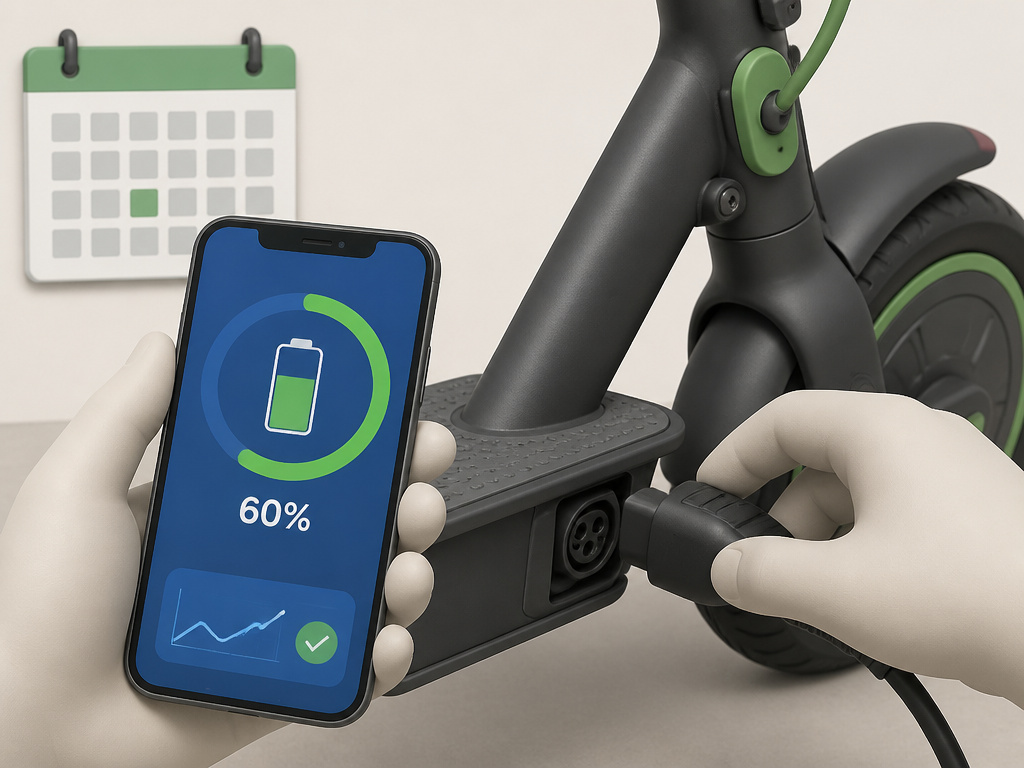
Your battery chemistry dictates your calendar. Get this wrong, and the damage is measured in permanent percentage points lost per month.
For Lithium-Ion Scooters (Segway, Niu, Kaabo, most modern models):
The goal is to avoid extremes at the top and bottom of the charge curve. The sweet spot for storage is between 50% and 80% State of Charge. The Segway ES1 manual provides a clear benchmark: “Fully charged battery retains charge for 120-180 days in Standby Mode. Low-power battery retains charge for 30-60 days in Standby Mode.”
Common mistake: Storing a scooter for the winter with a “full” 100% charge. The high voltage stresses the cathode, causing gradual oxygen loss and capacity fade. By spring, you might have lost 5-10% of your total range before you even take the first ride.
Instead, before storage, charge or discharge to about 60%. Then, every 1-3 months, plug in the charger. Let it top up to 80-90%, then unplug it. You’re not doing a full cycle; you’re giving the battery management system a chance to balance the cells and keep them out of the deep-discharge danger zone.
The iScooter manual is explicit about the consequence of skipping this: “For long-term storage… Charge and discharge completely at least once a month; otherwise, irreversible power decay may occur.”
For Lead-Acid Scooters (Invacare Leo and some older models):
The ritual is more demanding. Lead-acid batteries sulfate when left partially charged. Crystals form on the plates, increasing internal resistance and killing capacity.
The Invacare Leo user manual doesn’t mince words. It lays out a strict schedule: – “Charge 18 hours prior to initial usage.” – “When the battery indicator reached the red LED range, charge the batteries for 16 hours minimum, neglecting the charge complete display!” – “Try to provide a 24 hour charge once a week to make sure that both batteries are fully charged.”
This weekly deep charge is non-negotiable. It’s the only way to reverse mild sulfation and keep the plates clean. For storage, the manual says to “Always store fully charged.” Then, “If not used for more than two weeks, charge at least once a month.”
Here’s the head-to-head breakdown:
| Battery Type | Ideal Storage SOC | Maintenance Cycle | Biggest Risk if Ignored |
|---|---|---|---|
| Lithium-ion | 50-80% | Top-up charge every 1-3 months. Full discharge/charge monthly for long storage. | Irreversible capacity decay (iScooter manual). |
| Lead-acid | 100% (Fully Charged) | 24-hour charge weekly. Monthly top-up during storage. | Sulfation, permanent voltage drop, inability to hold a charge. |
Step-by-Step: The Pre-Storage Shutdown (And The One Step Nobody Skips)
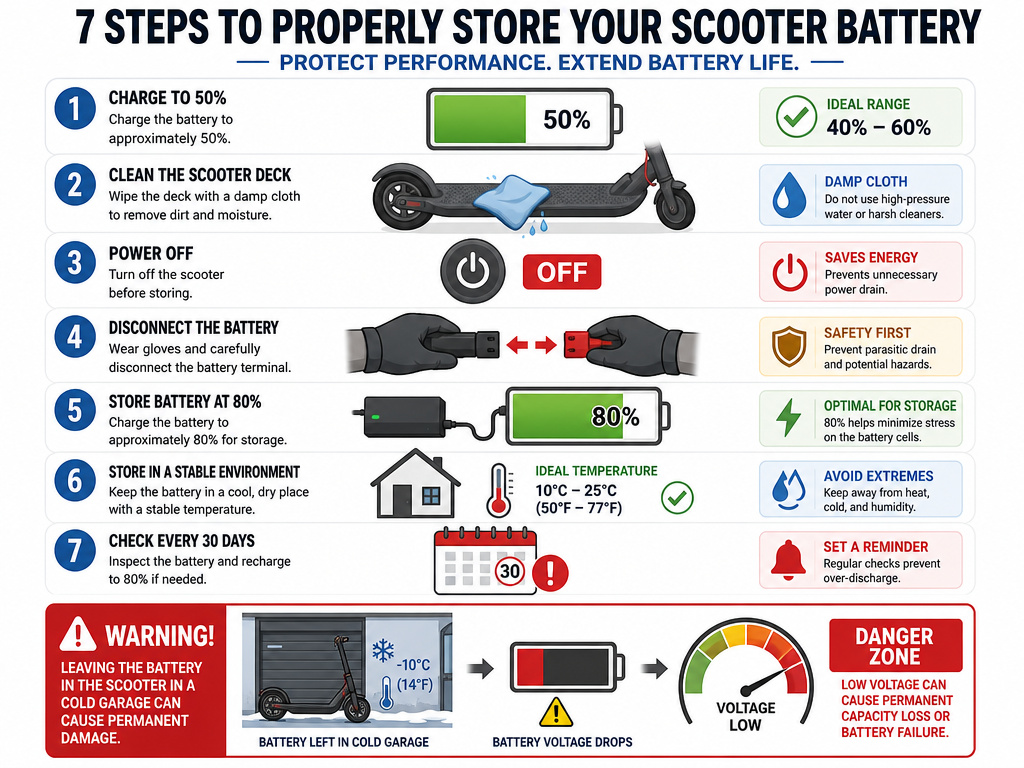
This isn’t just turning it off. It’s a seven-step handshake with the battery to ensure it sleeps safely.
- Give it one last ride. Don’t store it with an unknown charge level. Drain the battery down to about 40-50% for lithium-ion. For lead-acid, follow the manual: run it down, then prepare for the long charge.
- Clean it thoroughly, but correctly. Use a damp cloth only. The Segway manual explicitly warns: “Do not wash with alcohol, gasoline, acetone, or other corrosive/volatile solvents… Do not use a power washer or hose.” Water in the charge port is a death sentence.
- Power down completely. Turn the scooter off. Remove the key if it has one. This cuts parasitic drain from the dashboard or controllers.
- Disconnect or remove the battery. If your scooter allows battery removal, do it. This is the single best thing you can do for long-term health. Store the battery indoors. If you can’t remove it, disconnect the main terminals (wear gloves, consult your manual first).
- Charge to the target storage level. For lithium: charge to 60-80%. For lead-acid: give it the full 24-hour charge until the charger light is solid green.
- Find the right storage location. A dry, temperature-stable indoor space. Not a garage that swings from freezing to 100°F, not a damp basement. A closet or under a bed works.
- Set a calendar reminder for your first maintenance charge. In one month, you need to check the voltage or plug it in. This is the step every single guide mentions and most people forget. Forget it, and you’re already behind.
Where this goes sideways: Leaving the battery connected in the scooter frame in an unheated garage. The circuit board still draws a tiny current (milliamps), which slowly drains the battery into the danger zone below the minimum voltage. By the time you check it in spring, it’s unchargeable. The repair cost is a new battery.
Tools & Checks: What to Monitor and When
You don’t need fancy gear. A basic multimeter is the most powerful tool in your kit.
Monthly Check (5 minutes):
- Visual inspection: Look for swelling, leaks, or corrosion on the terminals. A swollen lithium pack is a fire risk, do not charge it.
- Voltage check (with multimeter): Set to DC Volts. For a nominal 36V lithium pack, you should see ~38V+ at 80% charge. For a 48V system, look for ~50V+. If voltage has dropped more than 2-3V since last month, your battery is self-discharging too fast or something is draining it.
- Ambient temperature: Is the storage spot still cool and dry?
Every 3-6 Months (The Big Check):
- Perform a partial discharge and recharge. Take the scooter for a short ride to use 20-30% of its charge, then recharge fully. This exercises the battery management system and keeps the digital fuel gauge accurate.
- Check tire pressure and mechanical parts. A flat tire left for months can develop a permanent flat spot. This isn’t battery-related, but it’s part of the same ecosystem of neglect.
When to Call It: The Replacement Threshold
The Kaabo Mantis manual states the obvious: “Please replace with a new battery once capacity drops below 50% of what you experienced initially.” If your 20-mile range is now 10 miles even after a full charge and balanced cells, the battery is a consumable. It’s done. Continuing to use it risks a sudden failure during a ride.
The Cleaning Rule That Isn’t Optional
Dirt and moisture are a battery’s natural enemies. Grime holds moisture against metal contacts, leading to corrosion. A corroded terminal increases resistance, which creates heat and voltage drop.
The procedure is simple but unforgiving: 1. Power off and unplug everything. 2. Use a dry, soft brush to dislodge loose dirt. 3. Dampen a cloth with clean water, not dripping wet, just damp. 4. Wipe down the battery case and the scooter’s contact points. 5. Dry immediately with a separate, clean cloth. 6. Ensure the charge port cover is sealed tightly before you consider the job done.
Never, ever spray anything directly onto the scooter. The water will find a seam. The Segway manual’s warning about “damage to electronic components” isn’t theoretical, it’s the bill you get when the charge port corrodes and the controller shorts.
Frequently Asked Questions
How often should I charge my scooter if I don’t use it daily?
Charge it at least once a month to keep the battery out of the deep-discharge zone. For lead-acid batteries like the Invacare Leo, the manual mandates a 24-hour charge weekly, regardless of use. Lithium-ion batteries have lower self-discharge, but a monthly top-up to 80% is the safe play.
Is it bad to leave the charger plugged in all the time?
Yes. Modern chargers usually stop supplying current when full, but leaving it connected for weeks on end keeps the battery at 100% voltage, which stresses lithium-ion cells. The Kaabo manual warns not to leave the charger plugged in for more than 24 hours. Unplug it once the light turns green.
Can a completely dead lithium scooter battery be revived?
Sometimes, but it’s risky. If the battery management system has cut off output to protect the cells, a special charger might be able to apply a slow, low-voltage “trickle” to bring the pack above its minimum voltage. However, cells that have been deep-discharged are often permanently damaged. Your battery lifespan is directly tied to avoiding this scenario.
What’s the single biggest factor that kills scooter batteries?
Temperature extremes during storage. Storing a battery in a freezing garage or a hot attic does more long-term damage than riding habits. The cold saps capacity and makes charging inefficient; the heat permanently accelerates chemical degradation. Always store indoors at room temperature.
Do I need to fully discharge my new scooter battery before charging it?
No. That “memory effect” myth applies to old nickel-cadmium batteries, not modern lithium-ion. In fact, the Invacare Leo manual for lead-acid batteries says to charge for 18 hours prior to initial use. For lithium, just start using it and follow normal proper charging routines.
The Bottom Line
Maintaining an electric scooter battery is a matter of calendar discipline and climate control. Forget generic tips. Pull the manual for your Segway, Niu, Kaabo, or Invacare model. Find its specific temperature limits and charge-cycle mandates. Then set monthly reminders.
Store lithium packs at 60% charge in a closet, not a garage. Give lead-acid batteries their mandated weekly 24-hour soak. Never let either chemistry sit in the cold. This isn’t complicated upkeep, it’s the predictable outcome of following the numbers the engineers already printed.
For most commuters with a Segway or Niu, that means one ritual: before a season of inactivity, charge to 60%, stash it inside, and plug it in for a few hours once a month. That’s it. That routine alone will outlast the scooter’s frame. Ignore it, and you’ll be shopping for a new best electric scooter models a lot sooner than you planned.
