
How to Break in a New Motorcycle for Peak Performance
This post contains affiliate links. As an Amazon Associate, we earn from qualifying purchases.
Breaking in a new motorcycle requires matching three things: manufacturer-specified throttle limits, varied engine speed, and strict adherence to the first service interval. The break-in period, typically the first 500 to 1,000 miles, allows internal parts like piston rings and cylinder walls to seat and mate under controlled stress, setting the foundation for engine longevity, oil consumption, and overall performance. Deviating from these guidelines risks permanent performance loss and accelerated wear.
That factory throttle limit. Suzuki says less than half throttle for the first 500 miles on an ADDRESS 110, for example, exists to manage heat. An engine’s worst enemy during the initial miles is excessive thermal load on parts that haven’t fully mated. The metal expands and contracts, and forcing it too hard too soon can glaze surfaces or create uneven wear patterns that never fully correct. This isn’t about babying the bike. It’s about controlled stress.
The guide that follows translates those OEM manual tables into a real-world ride plan. We’ll cover throttle staging, the often-missed tire procedure, the non-negotiable first service, and the mistakes that cost power and oil later on. By the end, you’ll have a schedule that turns a collection of new parts into a reliable, tight-running engine.
Key Takeaways
- Throttle limits are progressive: Suzuki specifies less than 1/2 throttle for the first 500 miles, then less than 3/4 throttle up to 1,000 miles. These limits control heat and wear.
- Vary your engine speed constantly. Avoid steady RPMs on the highway; loading and unloading the parts aids the mating process and prevents glazing.
- New tires are dangerously slippery for the first 100 miles. Avoid hard acceleration, cornering, and braking until the mold release wears off.
- The first service at 600 miles (or 2 months) is critical. It includes an oil and filter change to flush out initial metal wear particles.
- “Lugging” the engine, running at very low RPM in a high gear, creates damaging cylinder pressure during break-in and must be avoided.
The Core Principle: Throttle Limits & Engine Speed
The throttle isn’t just a power control during break-in. It’s a heat management tool. Factory limits, like Suzuki’s less than 1/2 throttle for the first 800 km (500 miles) on the ADDRESS 110, are calculated to keep combustion temperatures in a range that allows microscopic high spots on piston rings and cylinder walls to wear down evenly. Exceed that, and the added heat can cause those spots to melt slightly and smear, creating a glazed surface that never seals properly.
The Suzuki ADDRESS 110 Owner’s Manual (99011-01K58-01A) specifies maximum throttle operation during break-in: “Initial 800 km (500 miles): Less than 1/2 throttle. Up to 1600 km (1000 miles): Less than 3/4 throttle.”
This graduated approach lets the engine components handle progressively greater loads as they mate. The goal is smooth, complete seating, not maximum speed. Polaris warns specifically against “overloading the engine at low RPM and/or running the engine prematurely at high RPM,” as both can damage pistons and bearings.
Common mistake: Holding a steady highway RPM for long stretches. This applies constant, unchanging pressure to the same spots on the rings and cylinder.
Vary the engine speed. Accelerate gently through the gears, then let the bike engine-brake back down. This “load and unload” cycle, as Suzuki’s manual describes it, lets parts press together under pressure, then cool slightly, which is essential for proper wear-in. A steady state doesn’t provide this cycling and can lead to glazing.
Tires Are Part of the Break-In
Your new motorcycle likely has new tires, and they represent a separate, equally critical break-in. The factory mold release agent left on the tread is slick, and the tire’s tread blocks haven’t been scuffed or heat-cycled. The grip isn’t there yet.
Where this goes sideways: Assuming new tires grip like broken-in ones. The first hard corner or panic brake on day one can result in a low-side crash.
Every major manufacturer, from Suzuki to Honda, calls out a 100-mile tire break-in period. The Suzuki GSX1300R manual is explicit: “Avoid hard acceleration, hard cornering, and hard braking for the first 160 km (100 miles).” You should gradually increase your lean angle over that distance, scrubbing the slick surface off and letting the rubber adapt to operating temperature. Treat every input with about 70% of the aggression you normally would. This period isn’t just about the engine.
The process for breaking in new tires is the same whether you’re on a sportbike or a cruiser. The physics of mold release and unscuffed rubber don’t change. After this 100-mile scrub-in, you can trust the tire’s stated performance. Before that, it’s a hazard.
The Schedule: What to Do and When
Break-in is a process, not an event. It follows a timeline dictated by mileage, and each phase has a specific goal. The most critical mistake is rushing it.
Phase 1: The First 100 Miles
This is the tire-centric phase. Your focus is on the rubber, not the redline. * Throttle: Stay well under half throttle. Use the bike to get a feel for the controls and ergonomics. * Riding Style: Gentle. No full-throttle launches, no aggressive cornering, no hard braking. Vary your route to include different speeds and gentle curves. * Goal: Scrub in the tires and complete the initial engine heat cycles.
Phase 2: 100 to 500 Miles
Now the engine break-in takes center stage. * Throttle: Remain under the half-throttle limit. This is where most of the piston ring seating occurs. * Riding Style: Actively vary engine speed. Take back roads instead of interstates. Accelerate smoothly up to 50-60 mph, then decelerate using engine braking. Avoid “lugging” the engine, don’t let it chug at very low RPMs in high gear. * Goal: Complete the primary ring and cylinder wall mating under controlled load.
Phase 3: 500 to 1,000 Miles
The final seating phase. * Throttle: You can progressively use more throttle, up to the 3/4 limit specified by many manuals. Introduce short, harder accelerations, but still avoid sustained wide-open throttle. * Riding Style: You can explore the bike’s performance more, including higher-speed runs and more spirited cornering, as the tires are now scrubbed. * Goal: Finalize the break-in of bearings and other internal components under higher loads.
| Phase (Miles) | Primary Focus | Throttle Limit | Key “Don’t” |
|---|---|---|---|
| 0-100 | Tire Scrubbing | < 1/2 | Hard cornering or braking |
| 100-500 | Ring & Cylinder Seating | < 1/2 | Constant highway RPM |
| 500-1000 | Final Component Seating | < 3/4 | Sustained wide-open throttle |
The Non-Negotiable First Service
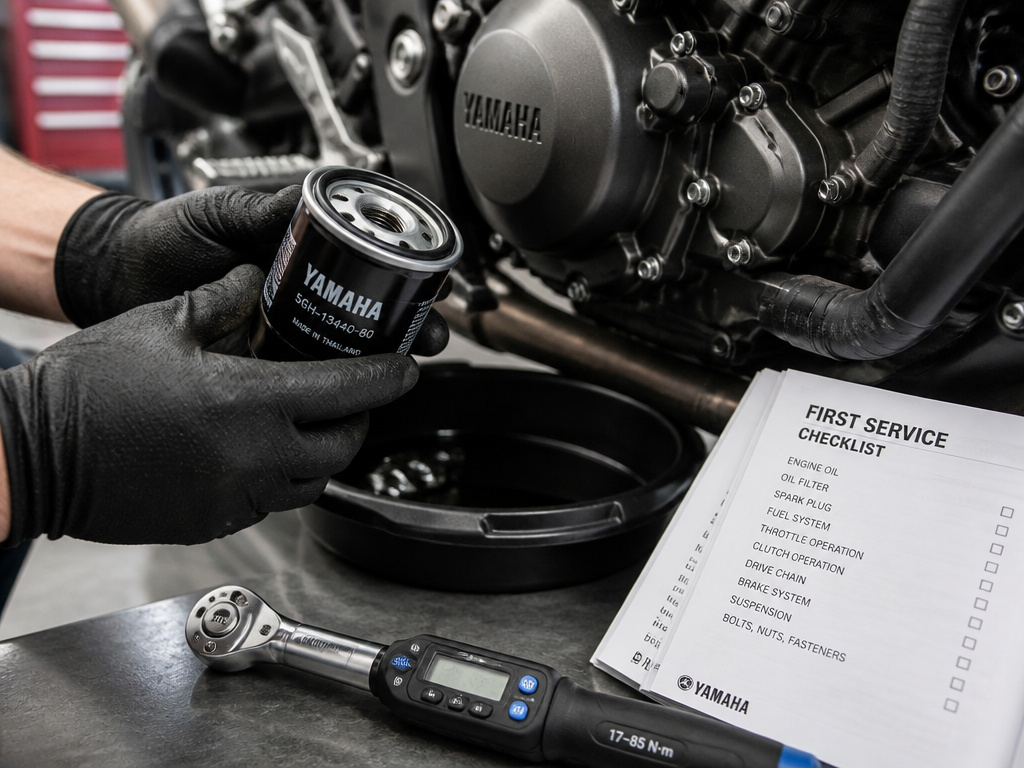
The first service is the most important maintenance event in your motorcycle’s life. It’s not a suggestion. Suzuki mandates it at 1000 km (600 miles) or 2 months, whichever comes first. This service is where the break-in process is validated and sealed.
Skip this if: You enjoy accelerated wear and potential warranty claims. The dealership’s inspection and documented service is often required to keep your warranty valid.
Here’s what happens during that first visit, and why each step matters: 1. Oil and Filter Change: This is the core action. The oil after break-in is contaminated with microscopic metal particles from the initial wear-in of gears, rings, and bearings. Flushing it out removes this abrasive slurry. Your future motorcycle oil changes will be much cleaner because of this. 2. Fastener Check: Everything that can vibrate loose will be retorqued, from axle nuts to engine mounts. Initial heat cycles and vibration settle parts. 3. Full Inspection: A technician looks for leaks, unusual wear, and any other issues that may have appeared during the initial run-in. 4. System Checks and Adjustments: Clutch, throttle, and brake cables are adjusted, and fluid levels are confirmed.
Performing this service yourself is possible if you’re skilled, but having a dealer stamp your book is invaluable for resale and warranty. This principle is the same whether you’re learning how to break in a new ATV engine or a diesel truck break-in, the first oil change is critical.
What Most People Get Wrong About Break-In
Two misconceptions persist, and both can shorten your engine’s life.
Myth 1: “You need to ride it hard to seat the rings.”
This is an old hot-rodder mantra that doesn’t translate to modern, precision-machined motorcycle engines. The factory throttle limits exist because the required “load” for proper seating is far lower than full power. Hard, high-heat running risks glazing and distortion. The Honda CRF250R manual simply says to “avoid full-throttle starts and rapid acceleration” during its break-in. Hard running is for after the parts have mated, not before.
Myth 2: “Just take it easy, no specifics needed.”
“Taking it easy” is too vague. It leads to the twin sins of constant-RPM highway cruising and engine lugging. “Lugging” means running the engine at very low RPMs while demanding power, like climbing a hill in too high a gear. This creates extreme cylinder pressure without the piston speed to dissipate heat, a great way to score cylinder walls during the delicate break-in period. Polaris explicitly warns against “running the engine at extremely low RPM in higher gears” during break-in.
Easy to miss: The engine isn’t the only thing breaking in. Brake pads, suspension seals, and even the drive chain are wearing in during these first miles. Listen and feel for changes.
Your riding during this period should be deliberate and varied. If you’re on a best beginner motorcycle, this is also your chance to build fundamental skills in a controlled, low-risk environment.
Tools, Fluids, and Preparation
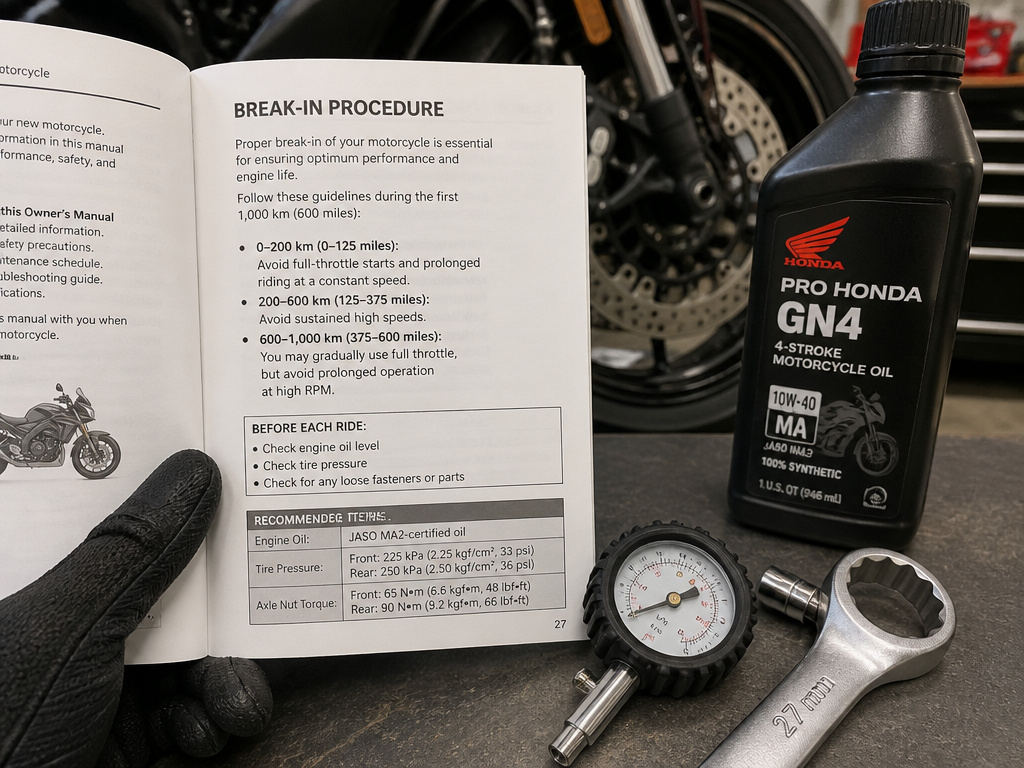
You don’t need a garage full of tools to break in a bike correctly, but you do need the right supplies and mindset.
Before the First Start:
- Read the owner’s manual. Find the break-in section and the first service interval. This is your single most important tool.
- Perform a pre-ride check: Verify tire pressure, brake function, fluid levels, and that all fasteners (like axle nuts) are tight.
- Use the correct oil for the first fill and change. Most modern bikes require a JASO MA2-certified motorcycle oil. This standard ensures the oil works with a wet clutch. Car oil can cause clutch slippage.
During the Break-In Period:
- Plan your routes. Avoid long, straight highways. Seek out routes with hills, curves, and varying speed limits to naturally vary engine load.
- Keep a simple log: starting mileage, date, and notes on any unusual sounds or feelings. This is helpful data for the first service tech.
- Have a plan for the first service. Schedule the appointment early, as dealer service departments can book up.
A well-maintained bike starts here. The habits you form during break-in, checking pressures, listening for changes, following schedules, carry forward into long-term care, whether you’re prepping for motorcycle winter storage or just routine chain maintenance.
Troubleshooting Break-In Concerns
Things don’t always go perfectly. Here’s how to diagnose common early issues.
| Symptom | Likely Cause During Break-In | Action |
|---|---|---|
| High oil consumption | Piston rings not yet seated. Some consumption in first 1,000 miles is normal. | Monitor level closely. If it’s excessive (more than 1 qt per 500 miles), mention it at first service. |
| Unusual engine noise | Normal “tight” mechanical sounds as parts wear in, or something loose. | Note the type and condition of the noise. Check for obvious loose parts. Report at first service. |
| Difficulty finding neutral | Clutch plates bedding in. Common on new bikes. | It should improve within the first few hundred miles. Ensure clutch cable is properly adjusted at first service. |
| Rear brake feels soft | Brake pads and rotor wearing in together. | Bed in brakes with a series of gentle, progressively harder stops from low speed. |
If something feels genuinely wrong, a major leak, a knocking sound, a severe loss of power, stop riding and consult a dealer immediately. It’s better to have it checked than to cause catastrophic damage. This cautious approach is just as valid for selecting your first bike as it is for running it in; getting the right motorcycle size and fit prevents control issues from the start.
Frequently Asked Questions
How long is the break-in period for a motorcycle?
Most modern motorcycles have a break-in period of 500 to 1,000 miles. The specific mileage and throttle restrictions are detailed in your owner’s manual. Suzuki commonly uses a 1,000-mile (1,600 km) period with progressive throttle limits.
Can you break in a motorcycle by just riding on the highway?
No. Highway riding at a constant RPM is one of the worst things you can do during break-in. It prevents the “load and unload” cycle needed for parts to seat properly and can lead to glazed cylinder walls. You must vary engine speed.
What happens if you don’t break in a motorcycle?
Skipping or ignoring proper break-in risks permanent engine damage. This includes poor ring sealing (leading to high oil consumption and low compression), accelerated bearing wear, and potentially glazed cylinders that never achieve full power. It may also void parts of your warranty.
Is the first service really that important?
Yes. The first service is critical. It involves changing the oil to remove initial wear metals, retorquing fasteners that have settled, and a full inspection for any early issues. Many manufacturers require a dealer-performed first service to keep the warranty valid.
Do I need to break in new tires even if the motorcycle itself is used?
Absolutely. New tires, regardless of the bike’s mileage, have a mold release compound on the tread and need about 100 miles of gradual scrubbing to achieve full grip. The break-in procedure for tires is separate from the engine’s.
Can I use synthetic oil for the first oil change?
Consult your manual. Some manufacturers recommend against full synthetic for the very first change, as the slower wear-in rate of synthetic oil might slightly delay ring seating. Many riders and dealers use a quality conventional or semi-synthetic motorcycle oil (JASO MA2) for the first change, then switch to full synthetic thereafter.
Before You Go
Break-in isn’t a mysterious ritual. It’s a scheduled, mechanical process of controlled wear. Follow the throttle limits in your manual, vary your riding, scrub in the tires, and get that first service done on time. The payoff is an engine that uses less oil, makes full power, and lasts for tens of thousands of miles.
The bike you end up with after a careful break-in is measurably better than one that was run in without care. It’s the difference between a collection of parts and a fully integrated machine. Now go put those first miles on, deliberately.
