
Are Low Profile Tires Good in Snow? The Truth About Winter Wheels
This post contains affiliate links. As an Amazon Associate, we earn from qualifying purchases.
No. Low-profile tires are actively bad in snow and dangerous on ice. The standard answer points to shallow tread depth, which is incorrect, the real liability is a triple failure: their rubber compound hardens below 45°F (7°C) as per Kia and Ford manuals, their short sidewalls offer zero cushion against potholes (voiding warranty), and their wide footprint floats on snow instead of biting through it. Your vehicle’s handling and safety degrade below freezing regardless of tread pattern.
That 45°F (7°C) threshold isn’t a suggestion. It’s the temperature at which the summer-biased rubber in most low-profile tires loses elasticity. The tread can’t conform to micro-imperfections in packed snow or black ice, so grip vanishes. You feel it first in braking, the pedal goes long, the ABS chatters more, and stopping distances stretch.
What follows is a breakdown of why this happens at a molecular level, what your owner’s manual actually says about warranty coverage (hint: it denies it), and the three proven paths forward if you face winter with sporty wheels.
Key Takeaways
- Low-profile tires fail in winter primarily because their rubber compound is optimized for warm, dry grip and turns brittle below 45°F (7°C), regardless of an M+S marking.
- Their short sidewalls transmit road impacts directly to the wheel, making them highly susceptible to pothole damage that most manufacturers explicitly state is not covered under warranty.
- For genuine snow traction, a narrower winter tire on smaller steel rims (“winter wheel package”) outperforms any low-profile all-season or summer tire, driven by higher contact pressure.
- Check your door jamb or manual for approved “winter tire sizes” from the manufacturer, swapping to a taller sidewall is often an endorsed, safer alternative.
- The Three-Peak Mountain Snowflake (3PMSF) symbol is the only reliable indicator of severe snow service performance; M+S alone is a marketing term with no enforced standard.
The Cold-Physics Problem: Sidewall Stiffness & Contact Pressure
The first failure is chemical. The specialized high-silica compounds in performance tires, including many all-season variants fitted as OEM low-profiles, are designed for maximum dry-road adhesion at high temperatures. As temperatures drop, these polymers lose plasticity.
The Kia LQ2AH owner’s manual states directly: “Do not use summer tires at temperatures below 45 °F (7 °C) or when driving on snow or ice. At temperatures below 45 °F (7 °C), summer tires can lose elasticity, and therefore lose traction and braking power.”
This isn’t hypothetical. You’ll notice the steering feels numb on a cold morning before any snow falls. The tire literally cannot flex at a microscopic level to mesh with the road surface. On ice, it’s like skating on hard plastic.
The second failure is mechanical. The sidewall’s job is to absorb impacts. A 35-series tire has almost no cushion between the wheel rim and the road.
| Road Hazard | Standard Tire (e.g., 205/55R16) | Low-Profile Tire (e.g., 235/35R19) | Winter Consequence |
|---|---|---|---|
| Pothole | Taller sidewall flexes, absorbing energy. | Sidewall collapses, rim strikes pavement. | Bent wheel, immediate air loss, stranded. |
| Packen Snow / Ice Chunk | Tire rolls over, pushes obstacle aside. | Rigid sidewall transmits shock, risks sidewall bruising. | Internal ply damage, slow leak, blowout risk. |
| Black Ice Lip | Gradual transition, maintained footprint. | Abrupt edge can pinch sidewall against rim. | Sidewall cut, sudden failure. |
The Kia manual for low-aspect-ratio tires is blunt: “If you damage the tires by driving on a rough road, off-road, or over a pothole, manhole, or curb stone, they are not covered by your warranty.” Winter roads are a minefield of these obstacles, often hidden under snow.
The part nobody mentions: A wide, low-profile tire is the worst possible shape for snow. Traction on packed snow isn’t about big footprints; it’s about contact pressure. A narrow tire concentrates your vehicle’s weight, punching through the soft top layer to find grip on the firmer surface beneath. A wide tire spreads that weight out, causing the car to “float” on top like a sled. This is why professional winter rally cars use tires as narrow as 135mm.
What Does “M+S” or “3PMSF” Actually Mean for Low-Profiles?
If your tire has an M+S (Mud + Snow) marking, you might assume it’s winter-capable. That assumption has gotten people stuck. The M+S symbol is a self-certified marketing claim with no government-enforced performance standard. A manufacturer can put it on nearly any tire.
The real standard is the Three-Peak Mountain Snowflake (3PMSF) symbol. To earn this, a tire must meet a minimum traction requirement on packed snow in a controlled test (ASTM F1805). This is a pass/fail benchmark for severe snow service.
A University of Michigan Transportation Research Institute study noted that M+S tires without the 3PMSF symbol had 40% longer stopping distances on snow than M+S tires with the symbol, despite similar tread patterns.
The rubber compound matters more than the tread blocks. A low-profile tire with a 3PMSF rating exists, but it’s rare. Most are ultra-high-performance all-seasons with a mild tread pattern and a compound that still suffers in extreme cold. The symbol guarantees snow traction, but not ice traction or cold-weather flexibility. For true winter performance, you need a tire built from the compound up for sub-freezing temperatures.
Your Real-World Winter Options (Ranked Worst to Best)
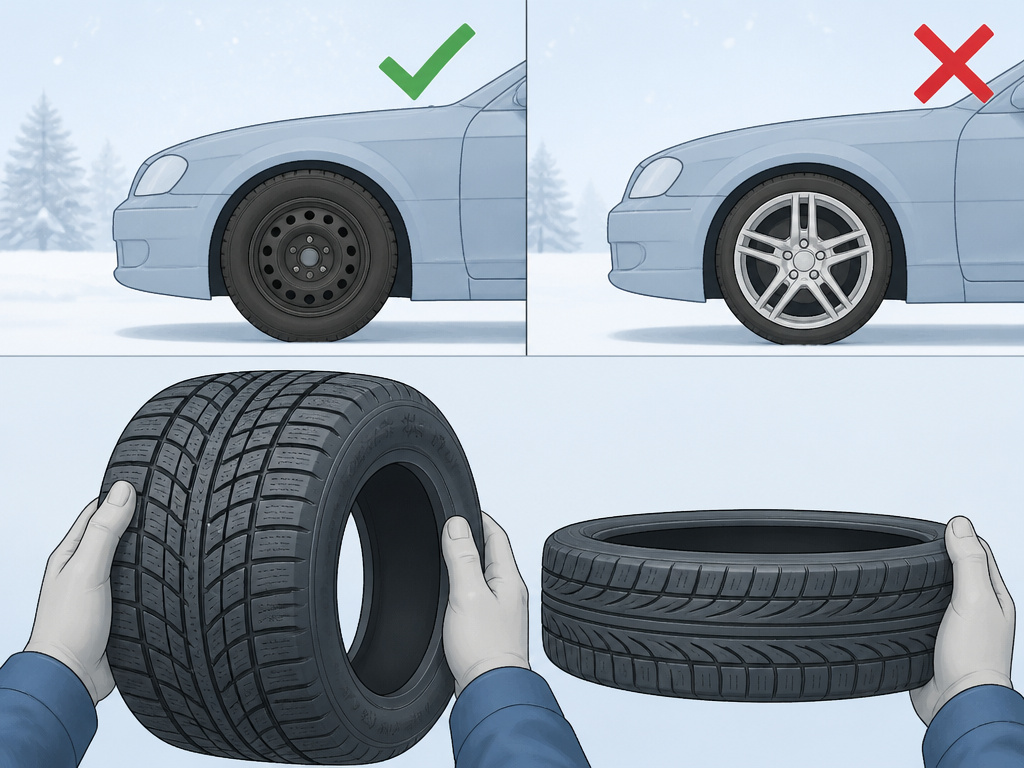
You have three paths, only one of which is correct for consistent winter safety. This is where most owners compromise and lose.
Option 1: Keep the Low-Profiles On All Winter
This is the default, expensive mistake. You’ll experience: * Poor braking and cornering on any cold surface below 45°F. * Zero safety margin on ice or hard-packed snow. * High probability of pothole-related wheel or tire damage. * Rapid, uneven tread wear from driving on too-cold rubber.
Verdict: Don’t.
Option 2: Swap to Low-Profile “Winter” Tires
Yes, they exist (e.g., Pirelli Winter Sottozero 3, Michelin Pilot Alpin). They use a softer, colder-flexing compound and a winter-specific tread. The improvement is real but limited. * Pros: Better cold-weather grip than summer tires, preserves sporty looks and handling feel. * Cons: Still vulnerable to pothole damage, expensive, and their wide footprint still compromises deep-snow traction compared to a narrower dedicated tire. * For: Mild winter climates with occasional snow, primarily plowed roads, and an owner willing to dodge every pavement imperfection.
Option 3: Downsize to a Dedicated Winter Wheel & Tire Package
This is the gold standard. You purchase a set of smaller-diameter steel or alloy wheels and mount narrower, taller winter tires. Your owner’s manual likely lists approved “winter tire sizes.” * Example: A car with OEM 235/35R19 might have an approved winter size of 225/40R18. The taller 40-series sidewall provides impact protection. * Why it wins: Narrower tire cuts through snow, taller sidewall absorbs blows, specialized rubber stays pliable below -30°C, and you save your expensive summer wheels from salt and curb damage. * The move: Buy a dedicated set of winter snow tires like the Bridgestone Blizzak WS90 or Michelin X-Ice Snow, mounted on cheap steel rims. The initial cost is offset by doubling the life of both sets of tires.
| Option | Snow Traction | Ice Braking | Pothole Resistance | Overall Winter Safety | Best For |
|---|---|---|---|---|---|
| Keep OEM Low-Profiles | Poor | Dangerous | Very Poor | Unacceptable | No one. |
| Low-Profile Winter Tires | Good | Fair | Poor | Moderate | Mild winters, cleared roads. |
| Downsized Winter Package | Excellent | Excellent | Good | High | Anywhere with snow, ice, or temps below 45°F. |
The Manufacturer’s Fine Print on Pressure, Speed, and Chains
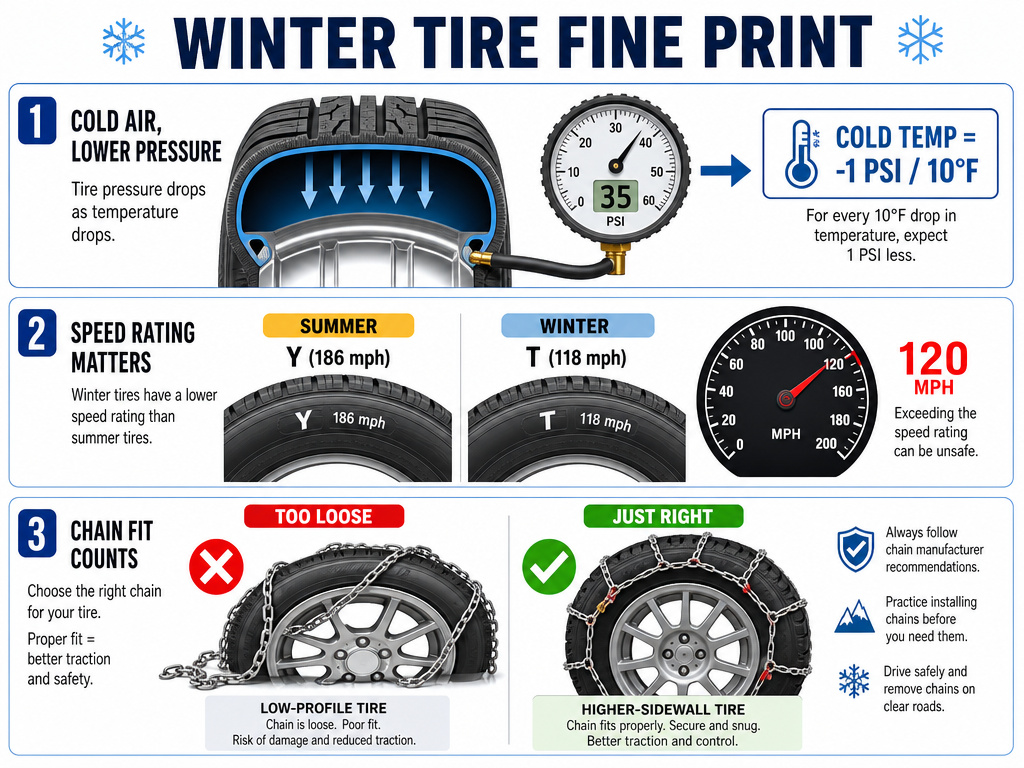
If you do run winter tires, of any kind, following the manual is non-negotiable on three points.
First, pressure. The Kia manual specifies snow tires should carry 4 psi (28 kPa) more than the standard tire pressure listed on your door jamb. Colder air contracts, and under-inflation is a leading cause of winter tire failure. Ford notes a 10°F (6°C) temperature drop can cause a 1 psi (7 kPa) loss in pressure. Check it monthly.
Second, speed rating. Winter tires often have a lower speed rating (e.g., T, rated for 118 mph) than your summer performance tires (Y, rated for 186 mph). The manual will tell you not to exceed the maximum speed of the tire, regardless of your car’s capability.
Third, chains. If you need them, you must have enough sidewall clearance. Some manuals explicitly require a smaller-diameter winter tire to legally and safely fit chains. Forcing chains onto a low-profile tire will destroy the fender liner and the tire itself.
Where this goes sideways: Running a winter tire with a lower speed rating like “Q” (99 mph) and then cruising at highway speeds in a high-performance car. The tire can overheat and fail. Match the speed rating to your driving, even in winter.
What About All-Weather or All-Terrain Tires?
These are distinct categories that sometimes get confused as winter solutions. All-weather tires carry the 3PMSF symbol and are designed for year-round use, including moderate snow. They are a legitimate step up from all-seasons but use a harder, longer-lasting compound that won’t match a dedicated winter tire on sheer ice.
All-terrain tires, like the popular BFGoodrich KO2 or Toyo Open Country, often have the 3PMSF symbol. They are excellent for snow-covered dirt roads and light plowing, but their stiff, blocky tread and heavy construction usually make them a poor choice for a low-profile sports car application. The ride and handling trade-offs are severe.
For a performance vehicle, the hierarchy is clear: dedicated winter tire on downsized wheels > performance winter tire > all-weather tire >>> keeping the summer low-profiles on.
Frequently Asked Questions
Can I just drive more carefully on my low-profile tires in snow?
You can try, but physics doesn’t negotiate. Careful driving doesn’t change the rubber’s glass transition temperature or the sidewall’s lack of cushion. It might help you avoid a spin, but it won’t shorten your stopping distance or prevent a pothole from cracking your wheel. The risk is binary: the tire either grips or it doesn’t.
Are wider tires better for snow?
No, absolutely not. This is a persistent myth. As covered in the physics section, wider tires increase floatation on snow. For maximum snow traction, you want the narrowest tire appropriate for your vehicle’s weight. This is why winter tire sizes are often one width narrower than the summer setup.
My car has AWD, so do I still need winter tires?
AWD helps you go. It does nothing to help you stop or turn. All cars have four-wheel brakes and four-wheel steering (the front tires). AWD with summer tires just means you’ll get stuck moving forward at a higher speed before you hit the tree you can’t avoid. Winter tires are for controlling the car, not just propelling it.
How bad is it to use snow tires in summer?
Very bad. The soft compound will overheat, wear out incredibly fast (you might kill a set in one hot summer), and handling will feel mushy and unsafe. This is why the downsized winter package is key, you should not drive snow tires all year. Swap them in spring.
Are studded snow tires the ultimate solution for ice?
Studded tires provide unmatched grip on sheer ice. However, they are illegal in many areas during warmer months due to road damage, are very loud on dry pavement, and perform worse than modern studless winter tires on wet or dry cold roads. Check your local laws on studded snow tires before considering them.
The Bottom Line
Low-profile tires and winter are opposites. One is about maximizing contact for dry grip and looks; the other is about survival on broken, slippery, cold roads where flexibility and bite matter more than cornering stiffness. The manufacturer warnings are in the manual for a reason, they’ve seen the warranty claims for bent rims and cracked sidewalls.
The safe, sane choice is a dedicated winter wheel and tire package. It transforms your car’s winter capability, protects your expensive summer wheels, and pays for itself over a few seasons in avoided damage and extended tire life. The alternative is a season of white-knuckle driving, a likely tow bill, and a repair invoice for a wheel your warranty won’t touch.
