
Are New Tires Slippery? The Wet Braking Gap & Safety Tips
This post contains affiliate links. As an Amazon Associate, we earn from qualifying purchases.
New tires can be slippery for the first 50 to 100 miles of driving. The smooth tread surface from manufacturing and the cooler rubber compound are the culprits, not leftover factory grease. This temporary reduction in mechanical grip means you should avoid hard acceleration, maximum braking, and aggressive cornering during the initial break-in period.
That initial slipperiness is a documented, measurable reduction in grip, especially in wet conditions. The time it takes for new tires to reach their full potential varies by compound.A soft performance tire may be ready after a dozen corners; a long-wearing touring tire might need a full tank of fuel.
The rest of this guide covers the exact physics behind that break-in, specific performance data on worn versus new tires, and the real-world procedure to follow.
Key Takeaways
- The break-in period for new tires is 50-100 miles, focusing on varied driving, not just distance.
- New tread lacks microscopic texture, reducing its ability to interlock with the road surface.
- Tires worn to 4/32” of tread, twice the legal limit, require 40% more distance to stop on wet roads than new ones.
- Sanding new tires is ineffective. The only way to properly scuff the tread is by driving on it.
- Modern manufacturing uses polished molds, not slippery release agents on the tread.
The Slippery Truth: Measured Losses and Real-World Stakes
The question is how much grip new tires lose out of the box, and what that gap costs you in a real emergency. The research gives us blunt numbers.
In a test from 100 km/h (62 mph) on wet pavement, tires with 2-3 mm of tread left, still above the 1.6 mm legal limit, had stopping distances 16 to 18 percent longer than new tires. At the point a car on new rubber came to a full stop, a vehicle on these worn tires was still traveling at roughly 30 km/h (19 mph). That’s the difference between a controlled stop and a serious impact.
A separate study by AAA compared new tires to tires artificially worn to 4/32” of tread, a depth many drivers consider safe. The results were worse. For a Toyota Camry, stopping distance from 60 mph on a wet surface increased by 42 percent. A Ford F-150 needed 44 percent more room to stop. At the moment the new tires brought the car to a halt, the worn-tire vehicles were still moving at 39 mph and 37 mph, respectively. That’s not a small margin for error.
Where this goes sideways: Thinking “half-worn” is safe. The performance cliff is steep, and it starts long before the tread bars are flush.
That data is for worn tires, but it establishes a crucial principle: grip is a gradient, and new tires start at one point on that curve. The smooth, virgin rubber compound and tread block surface have less initial mechanical bite.Ignoring that gradient for the first hundred miles is a gamble with the same physics that govern a worn-out tire. The gap is smaller, but the mechanism is similar.
What’s the Break-In Period for New Tires?
Every major tire manufacturer recommends a break-in period, typically printed on a label stuck to the new tread. The universal advice is to avoid sudden acceleration, hard braking, and aggressive cornering for the first 100 miles. This is a timeline based on how rubber wears.
The process is about action. Driving 100 miles in a straight line on a freeway does almost nothing to scuff the shoulders of the tread, which bear the load during cornering.The goal is to wear down the glossy, smooth surface of each tread block, creating a microscopic landscape of peaks and valleys. This rough texture provides mechanical grip by interlocking with the equally rough surface of the road.
Break-in duration depends entirely on the tire’s compound and purpose.
| Tire Type | Typical Break-in Mileage | Why It Varies |
|---|---|---|
| Ultra-Soft Track / Race Tire | 1-2 laps (after warmers) | Compound is designed to be sticky immediately when hot; molding skin is minimal. |
| Max Performance Summer (e.g., Michelin Pilot Sport 4S) | 50-100 miles | Soft compound scuffs quickly, but needs heat cycles to settle. |
| Grand Touring All-Season | 100-300 miles | Harder, longer-lasting compound takes more energy and time to abrade. |
| Heavy-Duty Touring / Mileage Tire | Up to 500 miles | Very hard compound designed for 80,000 miles; initial slickness is most pronounced. |
The right way to break in a set is to find a route with a mix of gentle curves and straight-line acceleration and braking. Start slow, gradually increasing your lean angle and braking force over the first tank of gas. You’re looking for a uniform dullness across the entire tread surface, not just the center. You’ll feel the steering become more communicative and the grip more predictable.
Easy to miss: The “vent spews.” Those little rubber hairs on new tires aren’t for traction. They’re vents from the molding process. They break off during the first few drives, and their absence is a visual cue that some scuffing has occurred.
The Engineering Behind Initial Grip
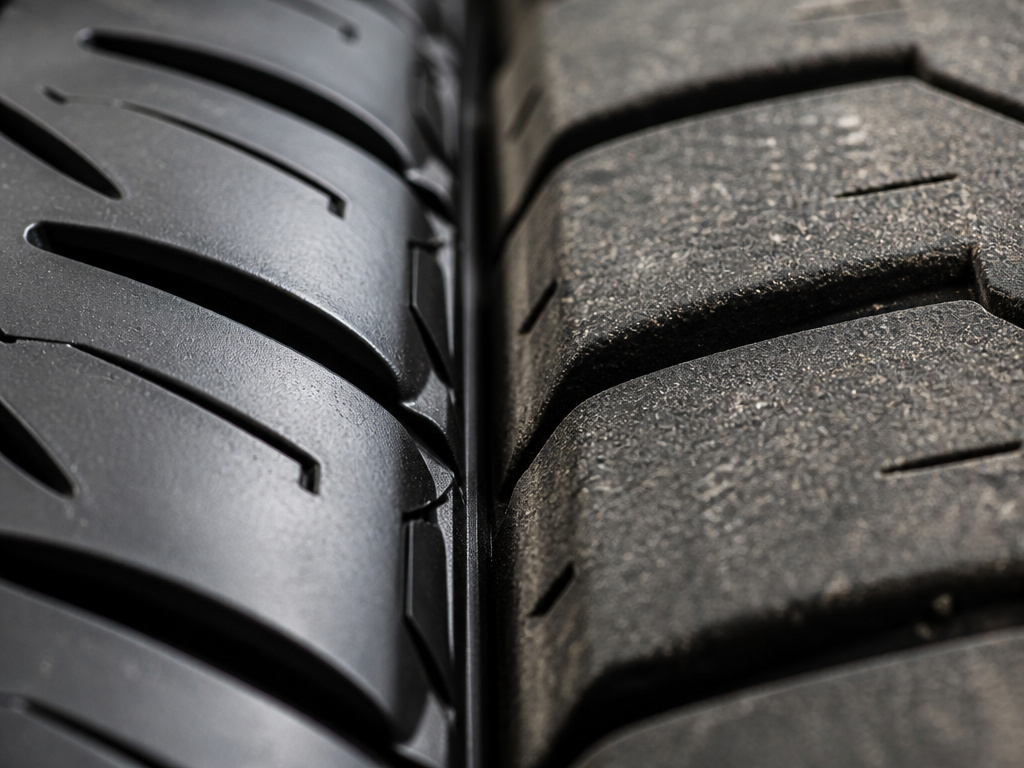
The release agent myth is stubborn. The story goes that new tires are coated in a slippery grease to help them pop out of the mold, and you must wear that off. For modern tires from reputable brands, this is almost entirely false.
Manufacturers like Pirelli and Michelin now use highly polished molds or apply a permanent non-stick coating, similar to Teflon. No external lubricant is needed on the tread area. The shiny, slick appearance of a fresh tire is simply the texture of uncured rubber meeting a perfectly smooth mold surface. Any release agent used is strictly confined to the sidewall area to ensure branding and mold line details release cleanly.
The real engineering reason is twofold: texture and temperature.
A new tread block is a smooth plane. Under a microscope, a properly broken-in tread block looks like coarse sandpaper. This roughness multiplies the surface area in contact with the road’s own microscopic roughness. The initial driving cycles grind down the high points, creating that key texture. This is why sandpapering a tire is pointless, the force and friction from hand-sanding are orders of magnitude less than a 3,000-pound car loading the contact patch.
Temperature is the other half. Rubber’s grip is highly temperature-dependent. A cold performance tire, even if scuffed, is far less sticky than one at its ideal operating temperature. The break-in period naturally allows the tires to go through multiple heat cycles, which can help stabilize the internal structure of the compound, especially in bias-ply designs sometimes found on classic cars and touring bikes.
Common mistake: Confusing mold shine for grease and trying to clean it off with solvents. You’ll damage the rubber and achieve nothing. The shine wears off through driving, not washing.
This focus on the fundamental material science is what separates a proper evaluation from a list of tips. The ASTM F1649 wet braking standard acknowledges that traction is the “link between the ABS and the pavement.” A tire that hasn’t developed its full mechanical grip is a weaker link, regardless of the vehicle’s safety systems.
How Tread Wear Changes Everything
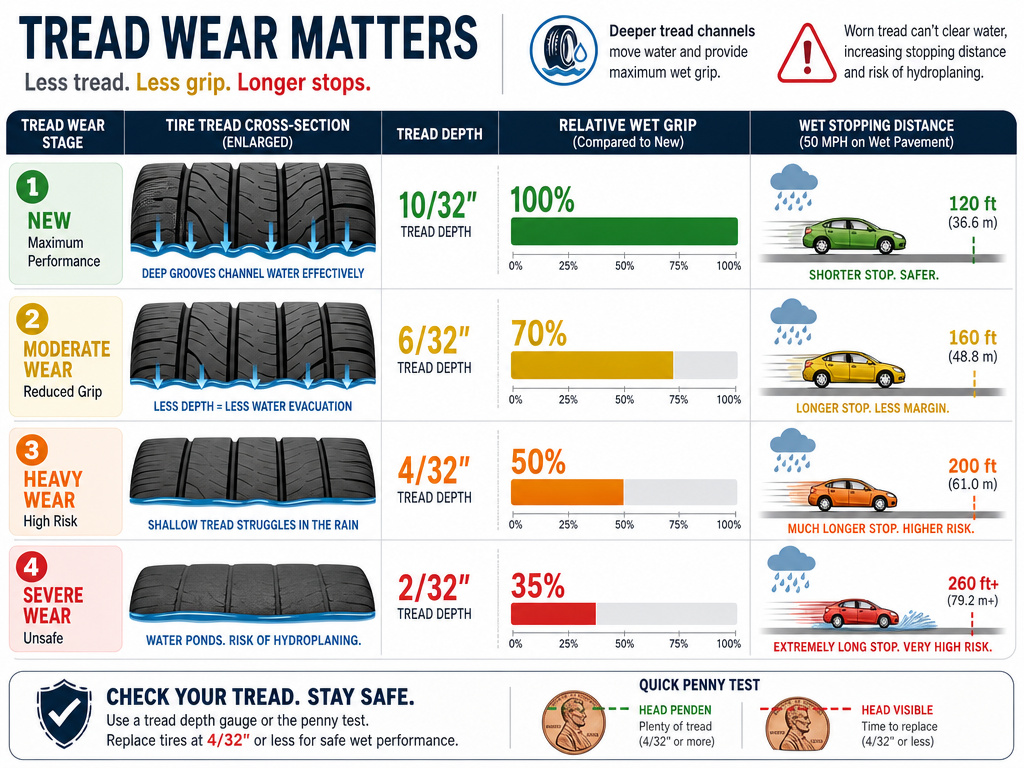
New tire slipperiness is a short-term concern. The long-term story is how grip evolves, and eventually degrades, over the tire’s life. The relationship isn’t linear.
When new, a tire has full tread depth and a pliable, fresh compound. As it wears, the surface texture improves, actually increasing dry grip for a period. This is why race tires are often “shaved” to a certain depth before use. However, wet grip is a different equation. It relies on tread grooves to evacuate water. As depth decreases, the risk of hydroplaning rises and the rubber’s ability to bite into a wet surface diminishes.
The legal minimum tread depth in the U.S. Is 2/32 of an inch (1.6 mm), marked by the tread wear indicators. But the dangers of bald tires begin long before that. The AAA study showed a 40%+ stopping distance increase at 4/32″. This is why many experts recommend replacing tires at 4/32″ for wet climates, and why the SAE technical paper on tire grip evolution studies performance at 50% and end-of-life wear stages.
Consider tread depth as your tire’s bank account for wet weather safety. A new tire is a hefty deposit. Every mile withdraws a tiny amount. By 4/32″, you’re running low. At 2/32″, you’re overdrawn. Driving on winter tires in summer or using all-terrain tires on highway compounds the issue, as those treads are optimized for specific conditions and wear differently.
| Tread Depth | Relative Wet Grip | Practical Implication |
|---|---|---|
| 10/32″ (New All-Season) | 100% Baseline | Full groove depth for water evacuation. |
| 6/32″ | ~90-95% | Still very capable in heavy rain. |
| 4/32″ | ~60-65% | Significant increase in stopping distance; time to shop for replacements. |
| 2/32″ (Legal Minimum) | <50% | High hydroplaning risk; dangerously long stopping distances. |
This degradation curve is backed by the SAE tire grip evolution study, which systematically measures how traction changes under dry, wet, and snow conditions as wear progresses.
Your Action Plan: Buying, Mounting, and Running In New Tires
Knowing the science is one thing. Applying it is another. Here’s the sequence from purchase to full confidence.
First, buy the right tire for your driving. A high-performance summer tire will have a stickier, faster-warming compound than a long-life touring tire. If you face cold mornings, remember that summer and winter tire compounds behave very differently outside their design temperature range. The initial slipperiness of a cold performance tire on a 45°F morning is more pronounced.
At the shop, check the date code. The DOT number on the sidewall ends with four digits: the week and year of manufacture. Tires older than six years from this date, even if never mounted, can have degraded rubber. Fresh is best.
Mounting and immediate drive. Once mounted, your first 5 miles should be gentle. This lets the bead seat fully and allows you to feel for any vibration. Then, dedicate the next 50-100 miles to active break-in. Mix highway driving (for light centertread scuffing and straight-line temperature cycles) with gentle back-road curves (to work the shoulders). Avoid panic stops and launch-control starts.
Post-break-in check. After a few hundred miles, do a visual inspection. The tread should have a uniform, matte finish. Check inflation pressure again, as new tires can sometimes settle. Now they’re ready for normal use.
This process applies whether you’re fitting wider tires for snow traction or replacing the low profile tires on a sports car. The compound and construction change the timeline, not the necessity.
Frequently Asked Questions
Do I need to break in winter tires?
Yes, but the process is the same and the cold compound may feel particularly slippery initially. The siping and tread blocks also need to scuff in. Take it easy for the first 100 miles, especially as the snow tires in rain performance relies on those sharp edges.
Are expensive tires less slippery when new?
Not necessarily. A softer, stickier performance compound might scuff in quicker but can be more temperature-sensitive when cold. The mold process is similar across price points. The real difference in all-terrain tire performance or noise levels emerges after break-in.
Can I accelerate break-in by doing burnouts or driving on gravel?
No. This is destructive and uneven. A burnout only overheats and glazes a small section of tread. Gravel can cut or chunk the rubber. Controlled, varied driving on pavement is the only effective method.
How does tire pressure affect new tire grip?
Overinflation reduces the contact patch, concentrating wear on the center and delaying proper scuffing of the shoulders. Underinflation causes excessive sidewall flex and uneven wear. Always set pressure to the vehicle manufacturer’s recommendation (on the door jamb, not the tire sidewall) when the tires are cold.
My new tires still feel slippery after 200 miles. Is something wrong?
Possibly. If you’ve followed a good break-in routine, consider the tire type. A very hard 80,000-mile tire will take longer. Also, evaluate the weather. Summer tires in cold temps are inherently less grippy. If concern persists, have the alignment and mounting checked.
Before You Go
New tires are a safety upgrade, but they’re not at their best on day one. That initial slipperiness is a real, physical characteristic of the manufacturing process, not an old wives’ tale. Respecting the 50-100 mile break-in window is a small investment for the thousands of miles of confident driving that follow.
The data doesn’t lie. Tires lose measurable grip long before they’re legally worn out, so the initial care you give a new set is just the first step in a longer relationship. Check pressures monthly, rotate every 5,000 to 8,000 miles, and start shopping for replacements when tread depth hits 4/32″. Your safety depends on four postcard-sized patches of rubber. Make sure they’re always ready to work.
