
Safety Recalls and the Evolving Path for Robotaxi Automobiles
This post contains affiliate links. As an Amazon Associate, we earn from qualifying purchases.
Robotaxi automobiles are purpose-built or retrofitted vehicles equipped with a Level 4 or 5 Automated Driving System (ADS) designed to operate a driverless ride-hailing service. They are not sold to consumers; companies like Zoox, Waymo, and Cruise own and operate the entire fleet. The core promise is on-demand, point-to-point mobility without a human driver, but the path is paved with specific, documented software failures and unprecedented regulatory challenges.
That fleet-ownership model is the whole game. It changes everything about how these machines are designed, maintained, and regulated. A car you never have to drive is also a car you can never personally fix, and its safety is a continuous software update cycle, not a static certification.
What follows is a breakdown of the core technology, the specific failure modes pulled straight from federal recall documents, the regulatory tightrope these companies walk, and what it all means for the near future of automated mobility. This isn’t speculation. It’s a report from the trenches, based on the incidents that forced official recalls.
Key Takeaways
- Robotaxis are fleet-owned, not consumer-sold. This allows for radical redesigns, like Zoox’s symmetrical, carriage-style interior, but also means safety is managed via over-the-air software updates.
- The most critical failures happen in edge cases: heavy smoke obscuring emergency scenes, stopped vehicles failing to detect a fallen pedestrian, or software misreading freeway construction zones.
- Regulatory bodies like NHTSA are granting temporary exemptions from traditional safety standards (FMVSS) to allow these novel designs, but with strict operational oversight.
- Hardware is not immune. The Hyundai IONIQ 5 ROBOTAXI has a known, specific failure of its Integrated Charging Control Unit (ICCU) that can strand the vehicle.
- The timeline from incident to fix is now measured in weeks, not years, due to mandatory reporting and software deployment capabilities.
The Core Technology: What Makes a Robotaxi Work?
Forget the steering wheel. The defining component of a robotaxi is its Automated Driving System (ADS). This is a suite of hardware and software that performs the entire dynamic driving task. Think of it as the driver’s brain, eyes, and nervous system, baked into the vehicle’s architecture.
The hardware stack is expensive and redundant. It typically includes: * LiDAR: Spinning units that paint a 3D point-cloud map of the environment, excelling at measuring distance and detecting object shapes in all lighting conditions. * Cameras: Provide color, texture, and signage recognition. Systems use multiple cameras for a 360-degree view. * Radar: Penetrates fog, rain, and dust to detect the speed and position of objects, crucial for adaptive cruise control and collision avoidance. * Ultrasonic Sensors: Short-range sensors for low-speed maneuvering, parking, and detecting curbs. * GNSS/IMU: A high-precision GPS and inertial measurement unit for localization, often fused with pre-mapped HD geospatial data.
The ADS fuses data from LiDAR, radar, and cameras to create a real-time, 4D model of the world. It must identify static objects, predict the paths of dynamic actors (cars, bikes, pedestrians), and plot a safe, lawful, and comfortable trajectory hundreds of times per second.
This sensor fusion is processed by onboard computing hardware that can draw more power than a dozen modern laptops. The software stack is the proprietary magic—the perception, prediction, and planning algorithms that turn sensor data into driving commands. It’s this software that is the subject of nearly every safety recall.
The business model is just as important as the tech. Because companies like Zoox own the fleet, they can design vehicles that would be illegal to sell to you. The Zoox robotaxi has no traditional front or back; it’s symmetrical. The interior has two rows of seats facing each other. This design is possible only under a specific Zoox FMVSS temporary exemption order granted by NHTSA, which waives requirements for standard controls and mirrors.
The Real-World Hurdles: Sourced Failure Modes
The theory is flawless. The practice is messy. The NHTSA recall database is the most honest ledger of where the technology currently fails. These are not hypotheticals. They are specific, dated incidents that triggered official Part 573 Safety Recall Reports.
The flaws almost always live in the software’s ability to handle rare, high-complexity scenarios—the “edge cases” that human drivers find confusing but usually navigate with cautious intuition.
| Recall / Issue | Specific Failure Mode | Documented Consequence & Timeline |
|---|---|---|
| Zoox 26E044 (2026) | Software may not detect/respond to heavy smoke, particularly at active emergency scenes. | An unoccupied Zoox AV encountered heavy smoke obscuring a fire scene on June 20, 2026. Reduced visibility near an emergency increases crash risk. A fix was deployed by July 15, 2026. |
| Zoox 25E037 (2025) | When stopped or moving <0.5 m/s, may lose tracking of a prone Vulnerable Road User (VRU) adjacent to the vehicle. | On May 8, 2025, a stopped Zoox was struck by an e-scooterist who fell beside it. The vehicle started moving but made no contact. The NHTSA recall for stopped vehicle was filed after a software update by May 21, 2025. |
| Waymo 26E035 (2026) | May enter and drive at speed in freeway construction zones by mis-prioritizing hazards or failing to recognize the zone. | Driving at speed in a construction zone increases collision potential. Waymo’s Safety Board reviewed the issue June 1-8, 2026, and a remedy was applied to all driverless-capable vehicles by June 29, 2026. |
| Cruise (2024) | In rare cases with close-following cyclists/vehicles, could command an unexpected braking maneuver. | This Cruise automated vehicle recall report notes eight related collisions from 2021-2023. Software updates in 2023 and during their 2023-2024 operational pause significantly reduced the risk. |
Where this goes sideways: The assumption that a sensor suite sees everything. Heavy smoke doesn’t just block a camera; it scatters LiDAR beams and becomes opaque noise. A person lying still next to a tire blends into the “ground” class for an algorithm trained on upright, moving humans. These aren’t bugs. They are fundamental sensory limitations.
The common thread? Each failure is a scenario where the AI’s world model diverges from reality. The software prioritizes the wrong hazard, classifies a critical object as background, or its sensors are physically blinded. The response time is impressive—fixes are deployed in weeks—but each public incident erodes the trust the entire industry needs to survive.
When the Hardware Fails: The Hyundai IONIQ 5 ROBOTAXI ICCU Problem
Not every fault is in the code. Sometimes, the metal and silicon give out. A clear example is the Hyundai IONIQ 5 ROBOTAXI (NER) and its Integrated Charging Control Unit (ICCU).
This is not an ADS problem. The ICCU is a hardware component that charges the 12-volt auxiliary battery. In certain electrical load conditions, an internal MOSFET can fail, blowing a fuse. The result: the 12V battery doesn’t charge. The vehicle will give warnings, enter a reduced-power “fail-safe” mode, and if driven until the 12V battery dies, it will lose all motive power on the road.
The diagnostic trigger is a specific fault code: DTC P1A9096 (DC/DC Converter Input Voltage Sensor Fault). The repair procedure is meticulously outlined in Technical Service Bulletin 24-01-086H-1:
- Connect the Global Diagnostic System (GDS).
- Check for DTC P1A9096.
- If NO: Perform an ICCU software update. (0.4 mechanic hours)
- If YES: Replace the ICCU and the high-voltage fuse. (2.1-2.4 mechanic hours)
Common mistake: Installing the new fuse before the ICCU replacement. The TSB explicitly warns this will cause a different fault (DTC P1B77) and damage the Battery PRA. The coolant (up to 3.7 liters of pink fluid) is also reimbursed as part of the repair.
This issue affects IONIQ 5 ROBOTAXI vehicles built between October 9, 2023, and October 29, 2024. It’s a reminder that even the most advanced electric vehicles rely on conventional, fallible automotive parts. A robotaxi is still a car, subject to the same wear, thermal stress, and component fatigue as any other machine on the road. This reality complicates the maintenance cycle for fleet operators and contrasts with the purely software-centric issues plaguing other companies.
The Regulatory Tightrope: Exemptions and Oversight
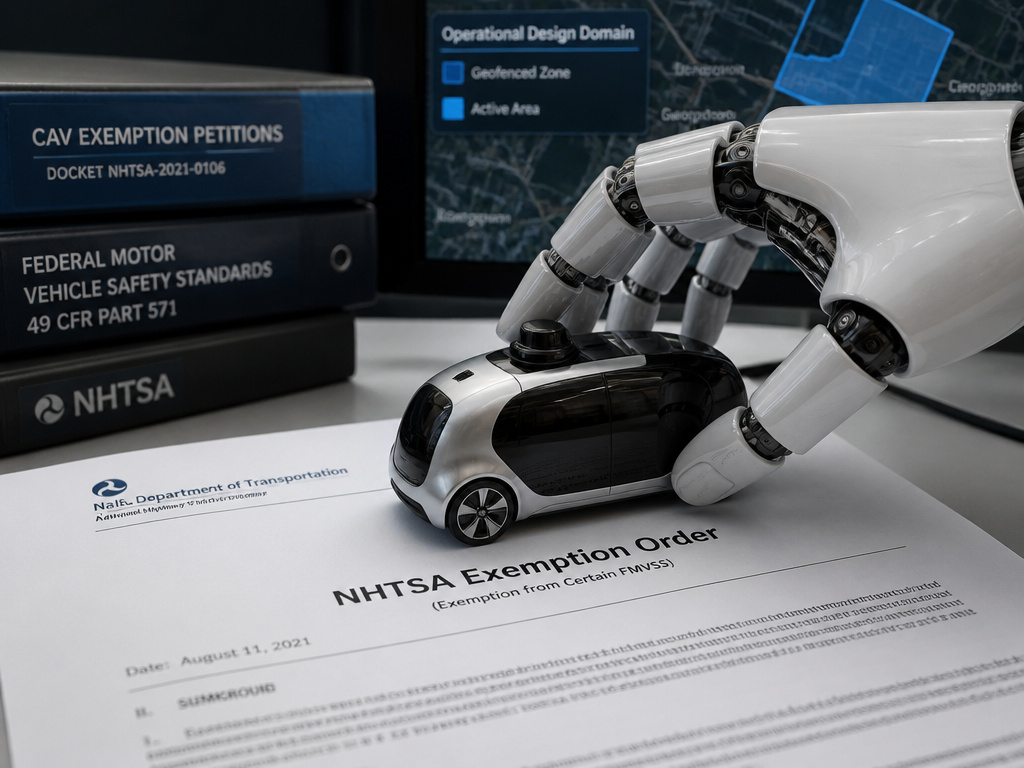
How do you regulate a car with no driver’s seat? U.S. Regulators at the National Highway Traffic Safety Administration (NHTSA) are writing the rulebook in real time, using a mix of existing recall authority and case-by-case exemptions.
The foundational framework is the Federal Motor Vehicle Safety Standards (FMVSS). These are the hundreds of rules that govern everything from windshield wipers to airbag deployment. They assume a human driver. A vehicle with no steering wheel, pedals, or mirrors cannot comply.
Enter the exemption. NHTSA has the authority to grant temporary exemptions if it finds the vehicle provides an “equivalent level of safety.” The Zoox FMVSS temporary exemption order, active from July 2026 to July 2028, is the first of its kind for a passenger-carrying robotaxi. It exempts Zoox from portions of eight FMVSS, covering things like windshield defrosting and controls location.
The trade-off is intense, ongoing oversight. NHTSA doesn’t just sign a paper and walk away. It issues “Operational Authorizations” that dictate exactly where, when, and how the exempted vehicles can run. These authorizations can be modified or revoked based on performance data. It’s a dynamic, conditional permit, not a blanket approval.
This regulatory dance is critical for the entire sector’s evolution. It allows for the kind of innovation seen in the Zoox vehicle’s design while theoretically keeping a tight leash on safety. The same NHTSA that grants the exemption is also the agency that issues the recalls for heavy smoke detection and prone VRU failures. They are both promoter and police.
Robotaxis vs. Everything Else: Where They Fit
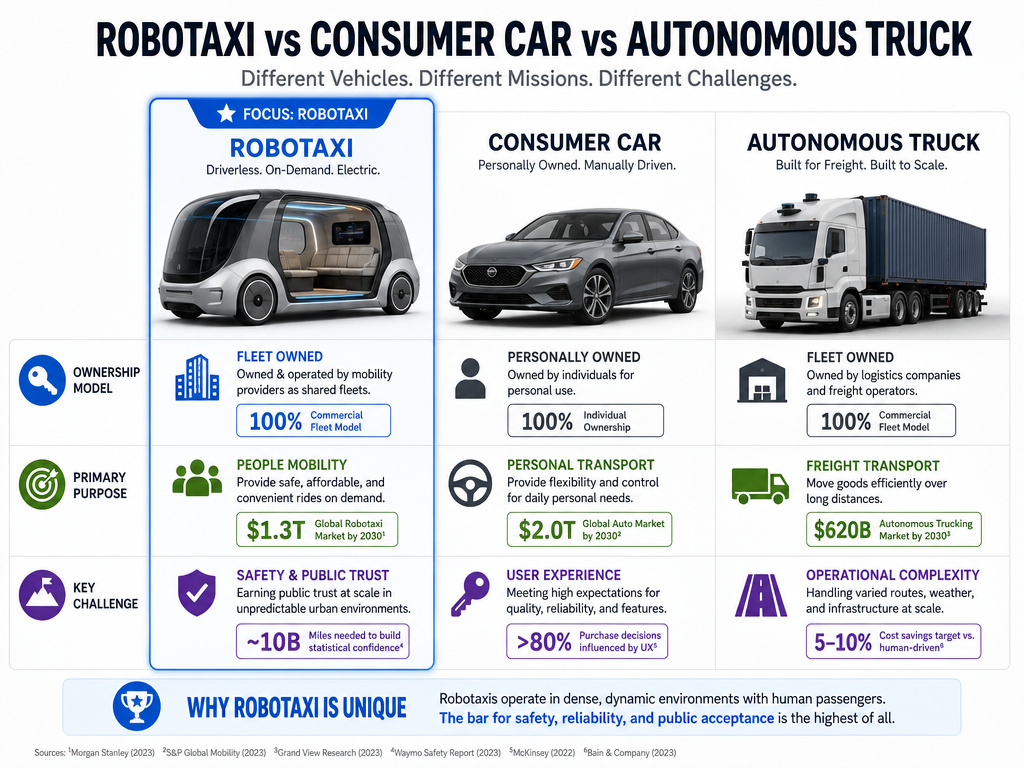
It’s easy to lump all automated vehicles together. The distinctions matter for understanding their near-term impact.
| Vehicle Type | Ownership Model | Primary Purpose | Design Freedom | Key Challenge |
|---|---|---|---|---|
| Robotaxi (Zoox, Waymo) | Fleet-owned, operated as service | Ride-hailing, mobility-as-a-service | High (can reinvent interior) | Scaling service safely, managing public perception after incidents. |
| Consumer ADAS (Tesla FSD) | Consumer-owned | Personal transportation, driver assistance | Low (must suit consumer tastes) | Achieving robust reliability across billions of driver-miles in unknown environments. |
| Commercial AV Trucks | Fleet-owned | Freight logistics, hub-to-hub | Moderate (focused on cargo) | Mastering highway driving and complex dock maneuvers. |
Robotaxis are not directly competing with the used car market. They offer a substitute for ownership, not necessarily for the car itself. Their success hinges on convenience and cost beating the equation of car payments, insurance, and maintenance.
They also represent a different engineering philosophy than the gradual evolution of hybrid powertrains or even advanced electric car technology. A Toyota Prius or a Ford Mustang with driver-assist features is an incremental improvement on a century-old paradigm. A robotaxi is a attempt to delete the driver entirely and rewrite the rulebook. One path is about optimization; the other is about replacement.
The Road Ahead: What Comes Next?
The next five years will be defined by scaling and scrutiny. Companies that have spent billions on R&D must now prove they can operate profitable, large-scale services without making headlines for the wrong reasons.
The hardware will consolidate. The rooftop “cottage” of sensors will shrink and become more integrated into the vehicle’s bodywork for aesthetics and aerodynamics. Computing will become more efficient. But the real battle remains in the software.
Every mile driven generates data, and every incident—like the one that triggered the NHTSA heavy smoke detection recall—feeds back into simulation and training environments. The cycle is: encounter edge case, diagnose, simulate fix, test, deploy. The speed of this cycle is the primary competitive advantage.
Regulation will get more sophisticated. Expect to see new FMVSS categories written specifically for ADS-equipped vehicles, moving beyond the patchwork of exemptions. Cities will also play a larger role, setting geofencing rules, curb access fees, and data-sharing requirements.
The dream of a truly driverless future is alive, but it’s being built one cautious, legally-mandated software update at a time. The machines are here. Now they have to learn the rest of the world.
Frequently Asked Questions
Are robotaxis safer than human drivers?
The data is still emerging and highly contextual. In routine driving, they eliminate risks from impairment, distraction, and speeding. However, they currently exhibit failure modes that are rare or non-existent for alert human drivers, such as the documented inability to handle heavy smoke or certain static obstacles. Their overall safety record in limited deployment areas is promising, but the scale is too small to declare a definitive winner.
Can I buy a robotaxi?
No. Companies like Zoox, Waymo, and Cruise do not sell their robotaxis to consumers. They own and operate the entire fleet as a service. This is a core tenet of their business and safety model; it allows them to control maintenance, software updates, and operational boundaries directly.
What happens if a robotaxi gets into a crash?
Protocols vary by company and jurisdiction, but generally: the vehicle is designed to come to a safe stop. It will communicate its status and location to a remote operations center. First responders are notified if needed. The incident data (sensor logs, system state) is secured for investigation. Liability is typically borne by the company operating the service, not a “driver.”
How do robotaxis handle bad weather?
Performance degrades with severity. Heavy rain or snow can obstruct cameras and challenge LiDAR. Most systems have a defined “Operational Design Domain” (ODD) that excludes certain weather conditions. If encountered unexpectedly, the vehicle will attempt to navigate cautiously to a safe stop or, if it has a fallback, request remote assistance. They are not all-weather vehicles yet.
What is the difference between a robotaxi and a car with Tesla Full Self-Driving?
The key difference is the “Operational Design Domain.” A robotaxi’s ADS is designed and certified for fully driverless operation within a specific, often geofenced, area. Tesla’s FSD is a Level 2 driver-assistance system; the human driver is legally responsible for supervision at all times, everywhere. One is a replacement driver under specific conditions; the other is a sophisticated tool for a human driver.
Before You Go
Robotaxi automobiles are more than a new type of car. They are the leading edge of a complete re-imagining of personal mobility, built on a foundation of complex sensors, relentless software iteration, and novel regulatory frameworks. The technology is real and operating today, but its growth is punctuated by very public, very specific stumbles documented in official recalls.
The trajectory is clear: incremental expansion of service areas, continuous refinement of the software brain, and a slow, cautious dance with regulators and the public. They won’t replace the manual transmission joy of a classic Nissan GT-R or the personal statement of a new electric SUV. Instead, they aim to replace the chore of the daily commute, offering a glimpse of a future where transportation is a service you summon, not a machine you own.
