
Understanding Personal Injury Protection (PIP) Insurance
This post contains affiliate links. As an Amazon Associate, we earn from qualifying purchases.
Personal Injury Protection (PIP) insurance covers your medical bills, lost wages, and related expenses after a car accident, regardless of who caused the crash. It’s mandatory in 15 states and Puerto Rico, functions as “no-fault” coverage that pays before your health insurance, and has specific coverage limits—like $10,000 for medical costs in Washington state. PIP does not cover vehicle damage or injuries from intentional acts, organized races, or felonies.
That “regardless of fault” clause is the whole point. It turns a messy blame game into a straightforward medical bill payment system, at least for the initial costs. The trade-off is that your right to sue the other driver for minor injuries is usually restricted in these no-fault states.
What follows is a breakdown of the hard numbers, the states where you must have it, the exact line between PIP and your health plan, and the specific situations where this coverage walks away. By the end, you’ll know whether your policy has a gap you need to plug.
Key Takeaways
- PIP pays first, before your health insurance, for accident-related medical costs in most states where it’s available.
- Coverage extends to you, your household members, passengers, and even pedestrians hit by your car, but the vehicle must be listed on your policy.
- Standard limits are specific and often low—like $200 per week for lost wages—which can run out fast after a serious injury.
- PIP has glaring exclusions: it won’t cover injuries from using farm equipment, motorcycles, committing a felony, or during an organized race.
- In states that don’t offer PIP, Medical Payments Coverage (MedPay) is a common, but more limited, alternative.
What Does PIP Insurance Actually Cover?
PIP is designed as a first-response financial cushion. It kicks in immediately after an accident to handle the direct human costs, not the metal and plastic. The Washington state insurance regulator guide provides a clear, state-specific blueprint that many policies mirror.
Official PIP coverage explanation: Personal Injury Protection covers medical and hospital expenses, funeral costs, lost wages, and loss of services. In Washington, it pays up to $10,000 per person for medical costs, available for three years from the accident date. It covers you, relatives in your household, passengers, and pedestrians, provided the car involved is listed on your policy.
The coverage breaks down into four buckets, each with its own cap.
| Coverage Type | Standard Limit (WA Example) | What It Pays For | Key Condition / Timeline |
|---|---|---|---|
| Medical & Hospital | Up to $10,000 per person | Ambulance, ER, surgery, X-rays, physical therapy, prescriptions. | Expenses must be incurred within 3 years of the accident date. |
| Lost Wages | Up to $200 per week ($10,000 max) | Income replacement if injury causes disability. | Disability must last 14 consecutive days; benefits last up to 1 year. |
| Loss of Services | Up to $200 per week ($5,000 max) | Payment for hired help for household chores you can’t perform (e.g., cleaning, childcare). | Paid to non-family members performing necessary services. |
| Funeral Expenses | Up to $2,000 per person | Burial or cremation costs resulting from the accident. | Paid to the estate or surviving dependents. |
The “loss of services” benefit is the one most people never think about until they need it. If a broken leg means you can’t mow the lawn, shuttle kids, or clean the house, PIP can pay for someone else to do it. That’s a tangible, non-medical cost that health insurance would never touch.
Where this goes sideways: Insurers only pay for services they deem “reasonable, necessary, and related to the accident.” Submit a receipt for a weekly housekeeper when you pulled a back muscle, and the adjuster will want a doctor’s note explicitly linking the injury to the need. Without that paper trail, the claim stalls.
The Core Difference: PIP vs. Health Insurance vs. Liability
This is where choosing the right types of coverage matters. PIP, health insurance, and liability insurance are often confused, but they play completely different positions on the field.
- PIP (Personal Injury Protection): Covers you and your passengers’ injuries. No-fault. Pays quickly after an accident. Primary payer over health insurance in PIP states.
- Bodily Injury Liability: Covers other people’s injuries when you are at fault. Required in almost every state. This is what protects your assets if you cause a crash.
- Health Insurance: Covers your injuries from any cause (accident, illness). Usually has deductibles, copays, and networks. Pays after PIP is exhausted in most PIP states.
The payout order is the critical detail. In a PIP state, your auto insurance handles your initial medical bills. Your health plan only becomes the primary payer once your PIP limits are maxed out. This keeps health insurance premiums from spiking due to frequent auto-accident claims.
Do you need PIP if you have great health insurance? Often, yes. Your health plan might have a $5,000 deductible and exclude certain therapies. PIP has no deductible (in most policies) and covers a broader range of expenses, like lost wages. It fills the gaps your health plan deliberately leaves open.
Who and What Does PIP Protect?
PIP casts a wider net than standard liability insurance. It’s not just for the person named on the policy.
- You, the named insured.
- Relatives living in your household, even if they’re not listed as drivers on your car insurance coverage declaration page.
- Passengers in your car, regardless of who they are.
- Pedestrians or cyclists injured in an accident involving your insured vehicle.
The part nobody mentions: To make a PIP claim, the car you or a relative was driving must be listed on your policy’s declaration page. Lend your truck to a friend not in your household? If they crash, their own PIP (if they have it) applies, not yours. Your policy follows the vehicle, but only for the people it defines as insureds.
There are hard stops, though. PIP explicitly does not cover: – Injuries from using farm equipment, mopeds, motorcycles, or off-road vehicles (separate policies exist for these). – Injuries an insured person causes on purpose. – Injuries sustained during an organized race or speed contest. – Injuries sustained while committing a felony.
These exclusions are non-negotiable. An insurer will investigate the circumstances, and a felony arrest report voids the claim on the spot.
PIP State Requirements and the No-Fault System
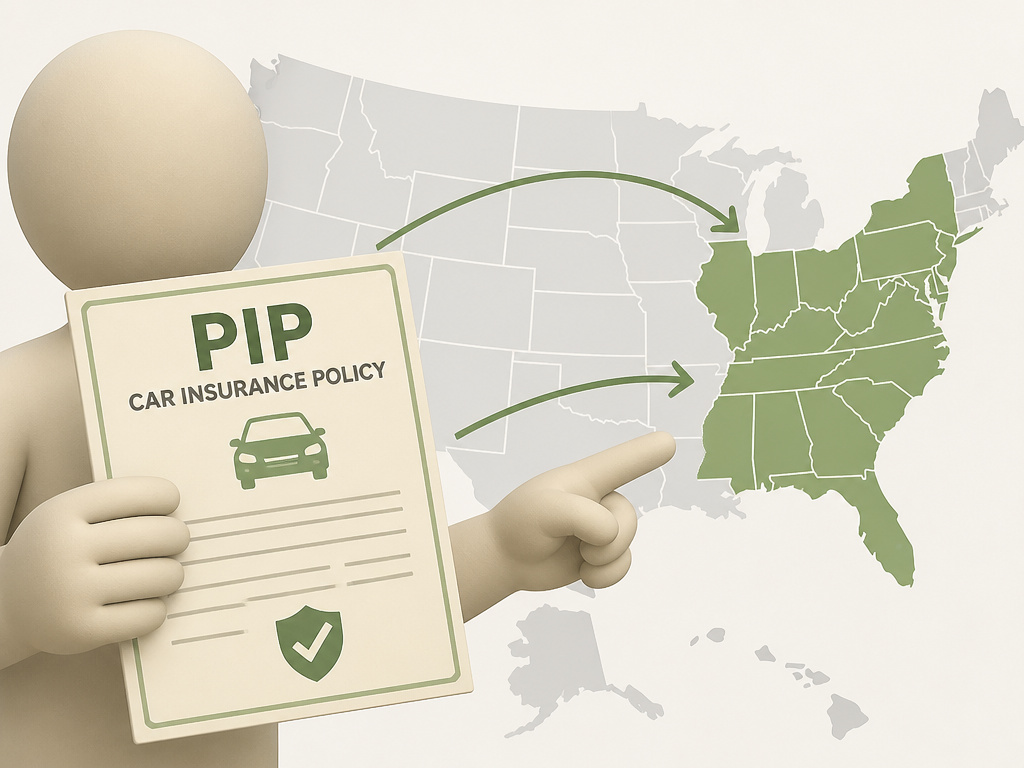
PIP isn’t a national standard. It’s mandatory in 15 states and Puerto Rico as part of a “no-fault” auto insurance system. The intent is to reduce lawsuits over minor injuries by having each driver’s own insurer pay their initial costs.
The common no-fault states are Delaware, Florida, Hawai’i, Kansas, Kentucky, Massachusetts, Michigan, Minnesota, New Jersey, New York, North Dakota, Oregon, Pennsylvania, and Utah. Laws change, so verify with your state’s department of insurance.
Common mistake: Thinking “no-fault” means no one is ever at fault. It only applies to initial injury claims. Police still determine fault for the crash report, and it absolutely matters for property damage claims and serious injury lawsuits. Your insurance rates after an accident can still go up if you’re deemed at-fault.
In these states, your right to sue the other driver for pain and suffering is restricted. You can typically only sue if the injury meets a certain threshold, like “significant disfigurement” or “permanent disability.” This is the trade-off for faster, guaranteed medical payments.
In “at-fault” or “tort” states, PIP is often optional or not offered at all. In those places, you rely on your health insurance and your right to sue the at-fault driver’s liability insurance for recovery.
PIP vs. Medical Payments Coverage (MedPay)
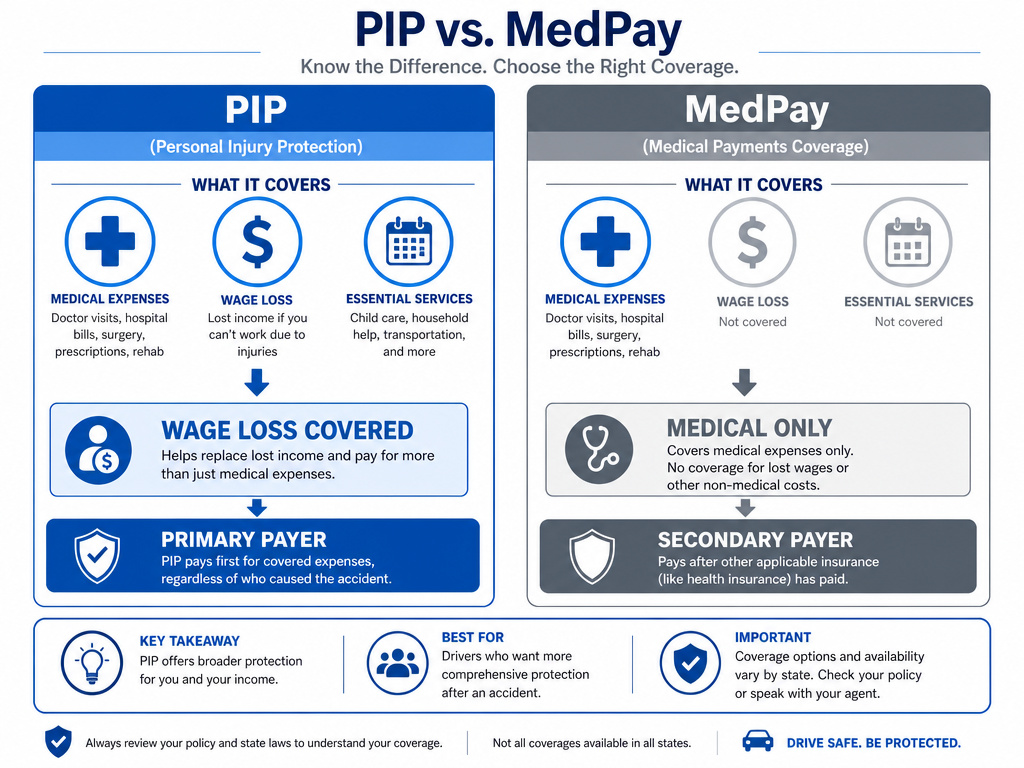
If your state doesn’t require or offer PIP, you’ll likely see “Medical Payments Coverage” or “MedPay” on your policy options. They’re cousins, not twins.
| Feature | Personal Injury Protection (PIP) | Medical Payments Coverage (MedPay) |
|---|---|---|
| Core Coverage | Medical expenses, lost wages, loss of services, funeral costs. | Medical and funeral expenses only. |
| Fault Requirement | No-fault. Pays regardless of who caused the accident. | No-fault. Pays regardless of fault. |
| Primary vs. Health Insurance | Usually primary payer. | Usually secondary payer (pays after health insurance). |
| Availability | Mandatory in no-fault states; optional in some others. | Optional in most at-fault states. |
| Typical Limits | Often $10,000 – $100,000+. | Often $1,000 – $10,000. |
MedPay is simpler and narrower. It’s essentially a small medical-benefit rider on your auto policy. It won’t replace your income or pay for a housekeeper. For a driver with robust health insurance and short-term disability coverage, MedPay might be sufficient to cover an auto insurance deductible or copays. For anyone else, the lack of wage loss coverage is a critical gap.
How to Choose the Right PIP Coverage Level
Selecting PIP limits isn’t a guessing game. It’s a math problem based on your existing safety nets and your state’s minimums.
- Check Your State’s Minimum. Start with the mandatory amount if you’re in a no-fault state. In Washington, that’s the $10,000/$2,000/$200-week structure.
- Audit Your Health Insurance. What’s your deductible? Your out-of-pocket maximum? Does it have strong coverage for physical therapy, which is common after accidents? If your health plan is weak, higher PIP limits act as a buffer.
- Calculate Your Wage Risk. The standard $200/week lost wage benefit is a joke for most full-time workers. If you earn $1,000 a week and are out for a month, PIP covers $800 of a $4,000 loss. Higher PIP options (e.g., $700/week) exist for a reason.
- Consider an Umbrella. If you have significant savings or assets, higher PIP limits can protect them. Exhausting PIP and health insurance might leave you paying bills out-of-pocket, which could lead to dipping into savings you’d rather protect.
Worth knowing before you start: Increasing your PIP limits usually costs less than you’d think. Adding $25,000 in medical coverage might only be a few extra dollars a month. Call your agent and get the quote. It’s the cheapest catastrophic injury coverage you’ll ever buy.
When you file a claim, these limits are the ceiling. Once you hit $10,000 in medical bills, the PIP well is dry. The rest falls to your health insurer, or you.
Frequently Asked Questions
Is PIP the same as no-fault insurance?
Yes, the terms are used interchangeably. PIP is the specific coverage that fulfills the requirements of a no-fault insurance system. The “no-fault” part refers to the rule that your own insurer pays your initial injury claims, regardless of who caused the accident.
Does PIP cover me if I’m hit as a pedestrian?
Yes. If you are a pedestrian hit by a car insured with PIP, that driver’s PIP coverage can apply to your injuries. This is a key protection that liability insurance wouldn’t trigger if the driver wasn’t at-fault.
Can I use PIP for massage therapy or chiropractic care?
Maybe. PIP covers “reasonable and necessary” medical treatment. If your doctor prescribes massage therapy as part of a documented rehabilitation plan for accident injuries, PIP should cover it. If you just want a monthly massage for general wellness, it will be denied. Always get a prescription and pre-approval for alternative therapies.
What happens if my PIP limits are too low?
You pay the difference. After your PIP is exhausted, your health insurance becomes primary. You’ll be responsible for your health plan’s deductibles and copays. Any remaining bills, or costs for services PIP covered but health insurance doesn’t (like lost wages), come directly from your pocket.
Should I reject PIP to save money if it’s optional in my state?
Almost never. The premium savings are trivial—often $20-$50 a year. The financial risk you assume by rejecting it is enormous. Without PIP, you’re immediately relying on your health insurance after an accident, with all its gaps and delays. For the minimal cost, it’s one of the most efficient forms of financial protection on your policy.
The Bottom Line
Personal Injury Protection is your policy’s first-aid kit. It’s designed for the messy, immediate aftermath of a crash, paying for things your health insurance won’t touch and doing it faster. In no-fault states, it’s not optional—it’s the backbone of the system.
The default advice is simple: if your state offers PIP, take it. Match the medical limit to your health insurance deductible, and bump the lost wages benefit as close to your actual weekly income as your insurer allows. Then, pair it with strong liability insurance and comprehensive and collision coverage for the vehicle itself.
It’s the layer that keeps a broken arm from also breaking your budget.
