
Diesel vs Gas Motorhomes: The Real Numbers on Performance
This post contains affiliate links. As an Amazon Associate, we earn from qualifying purchases.
Diesel motorhomes are better than gas for full-timers, mountain travelers, and anyone towing over 5,000 lbs. The decision hinges on three measurable specs: torque output (diesel offers 2-3.5x more), chassis gross vehicle weight rating or GVWR (25,000-52,000 lbs vs 16,000-24,000 lbs), and projected engine longevity (300,000-500,000 miles vs 150,000-200,000 miles). For low-mileage, flat-terrain camping, a gas Class A on a Ford F-53 chassis is the rational financial choice.
That torque number isn’t marketing. It’s the difference between maintaining 65 mph on a 6% grade and watching your RPMs redline while you crawl. The Cummins L9 in a mid-range pusher delivers 1,250 lb-ft. The Ford 7.3L V8 in a gas coach makes 468 lb-ft. Physics doesn’t negotiate.
What follows is a side-by-side of the two platforms, stripped of adjectives. We’ll walk through the powertrain math, the maintenance fine print from Cummins’ own guides, and the ownership costs that hit after the purchase price.
Key Takeaways
- Diesel wins on torque and towing, gas wins on purchase price. Diesel pushers have 2-3.5x the low-end torque, enabling 10,000-15,000 lb towing. Gas Class A coaches typically max out at 5,000-7,500 lbs.
- Longevity favors diesel, but maintenance intervals are longer and more expensive. A Cummins diesel can reach 500,000 miles; a gas V8 often needs major work by 200,000 miles. An oil change on a Cummins L9 can cost $800-$1,200.
- The ride and noise levels are fundamentally different. A rear-engine diesel pusher on air suspension is quieter and handles crosswinds better than a front-engine gas coach.
- You must factor in Diesel Exhaust Fluid (DEF). Modern diesels (2011+) consume 2-6 gallons of DEF per 100 gallons of fuel. DEF has an 18-month shelf life and freezes at 11°F.
- The chassis dictates capability. Diesel pushers use Freightliner or Spartan chassis with 22.5″ tires and air brakes. Gas coaches use the Ford F-53 chassis with 19.5″ tires and hydraulic disc brakes.
The Torque & Towing Reality
Forget horsepower. In a vehicle weighing 15 to 20 tons, torque is the only spec that matters. It’s the twisting force that gets mass moving and keeps it moving uphill.
A Cummins X12 engine in a high-end pusher produces 1,695 lb-ft of torque. The Ford 7.3L V8 in a gas chassis produces 468 lb-ft. The diesel offers over 3.5 times the shove at the bottom end of the RPM range.
This isn’t about speed. It’s about not downshifting two gears on every moderate incline. Diesel engines produce peak torque at low RPMs (often around 1,200-1,500 RPM), right where you cruise. Gas engines need to rev higher to make power, which strains the engine and guzzles fuel when loaded.
The torque advantage directly enables heavier towing. The travel trailers vs. Fifth wheels debate is irrelevant if your rig can’t pull the weight.
| Specification | Gas Class A (Ford F-53) | Diesel Pusher (Freightliner/Spartan) |
|---|---|---|
| Typical Engine | Ford 7.3L V8 | Cummins L9 or X12 |
| Horsepower | 335-350 hp | 360-525 hp |
| Torque | 468 lb-ft | 800 – 1,695 lb-ft |
| Max Towing Capacity | 5,000 – 7,500 lbs | 10,000 – 15,000+ lbs |
| Typical GVWR Range | 16,000 – 24,000 lbs | 25,000 – 52,000+ lbs |
The diesel’s higher Gross Vehicle Weight Rating (GVWR) isn’t just for show. It accommodates the heavier chassis, larger fresh water and waste tanks, residential appliances, and that tag axle you see on bigger coaches. If your camping style involves carrying lots of gear or full-timing, that payload margin is everything.
Chassis, Ride, and Daily Driving Feel
This is where the “pusher” part changes everything. A diesel pusher’s engine is in the rear. A gas coach’s engine is under the dashboard.
The rear-engine configuration places the heaviest component between the axles, improving weight distribution. The driver sits 20-30 feet ahead of the engine noise and vibration. The result is a quieter, more car-like cabin. Gas coaches transmit more road noise and engine rumble directly into the living space.
Common mistake: Comparing a 38-foot gas coach to a 38-foot diesel pusher and expecting a similar ride. The chassis are different species. The diesel rides on a full air suspension designed for the weight; the gas coach uses a heavier-duty version of a truck leaf spring system.
Diesel pushers almost universally use air brakes. Gas coaches use hydraulic disc brakes. Air brakes are more effective at managing heat when slowing 20+ tons repeatedly on mountain descents. They’re also why many diesel owners report less “brake fade” on long downhill stretches. For the complexity, read our guide on diesel truck batteries, as the electrical demands for air systems are higher.
Maintenance: Scheduled vs. Surprise
Here’s the trade-off laid bare. Diesel engines last longer but cost more per service visit. Gas engines need more frequent attention, but the work is often cheaper and more DIY-friendly.
Let’s use the official Cummins maintenance guide for the common ISL9 engine as our source. The intervals are “whichever occurs first” — time or mileage.
- Oil & Filter: 6 months / 18,000 miles
- Fuel Filters: 6 months / 15,000 miles
- Coolant Test: 6 months / 15,000 miles
- Valve Lash Check: 48 months / 150,000 miles
Now, the fine print that changes costs. The oil capacity for an ISL9 is about 10 gallons. Using the recommended diesel oil — API CK-4 spec, preferably 10W-30 for 2021+ engines — that’s a significant material cost alone. A dealer service can hit $1,000.
Not maintaining your air system is the most expensive mistake you can make. Loose clamps or a cracked hose can suck unfiltered dirt into the engine, necessitating a full overhaul. Check those fittings every time you check the oil.
Gas engine maintenance is more familiar. The 7.3L V8 holds far less oil, and filters are cheaper and easier to access. Many owners handle their own oil changes. The trade-off is the engine’s shorter lifespan. A well-cared-for gas engine in an RV might reach 150,000-200,000 miles before major work. A diesel with equally diligent care is just getting started at 300,000 miles.
For either fuel type, proper care starts early. The proper diesel break-in procedure is critical for longevity, and seasonal care like winterizing a diesel applies to motorhomes too.
The Modern Diesel Reality: DEF & Emissions
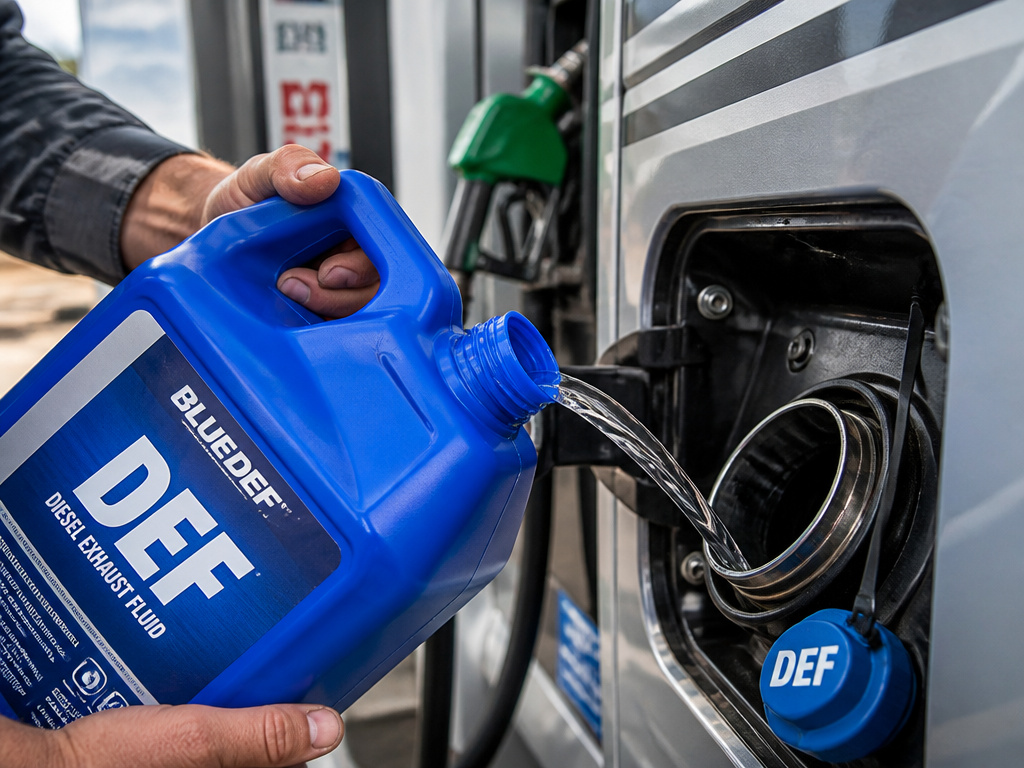
If you’re looking at a diesel from 2011 or newer, you have a second fluid to manage: Diesel Exhaust Fluid (DEF).
- What it is: A solution of 32% urea and 68% deionized water (ISO 22241-1 spec).
- What it does: It’s injected into the exhaust stream to break harmful NOx emissions into nitrogen and water.
- Consumption: Expect to use 2-6 gallons of DEF for every 100 gallons of diesel. A typical 15-gallon DEF tank lasts 300-500 miles.
- Shelf Life: 18 months in a sealed container below 78°F. It freezes at 11°F but thaws without damage.
Where this goes sideways: Letting DEF run empty. The engine will derate and eventually not start. It’s not a “maybe.” It’s a guarantee. Keep a sealed, fresh gallon on board as a backup.
The emissions system also includes a Diesel Particulate Filter (DPF). If a “DPF” dash lamp lights, it means the filter is full of soot and needs a “regen” — a high-temperature burn-off cycle. This usually requires a sustained 30-40 minute highway drive. Fail to do this, and you’ll face a forced regen at a shop.
Cost Analysis: Purchase Price vs. Total Ownership
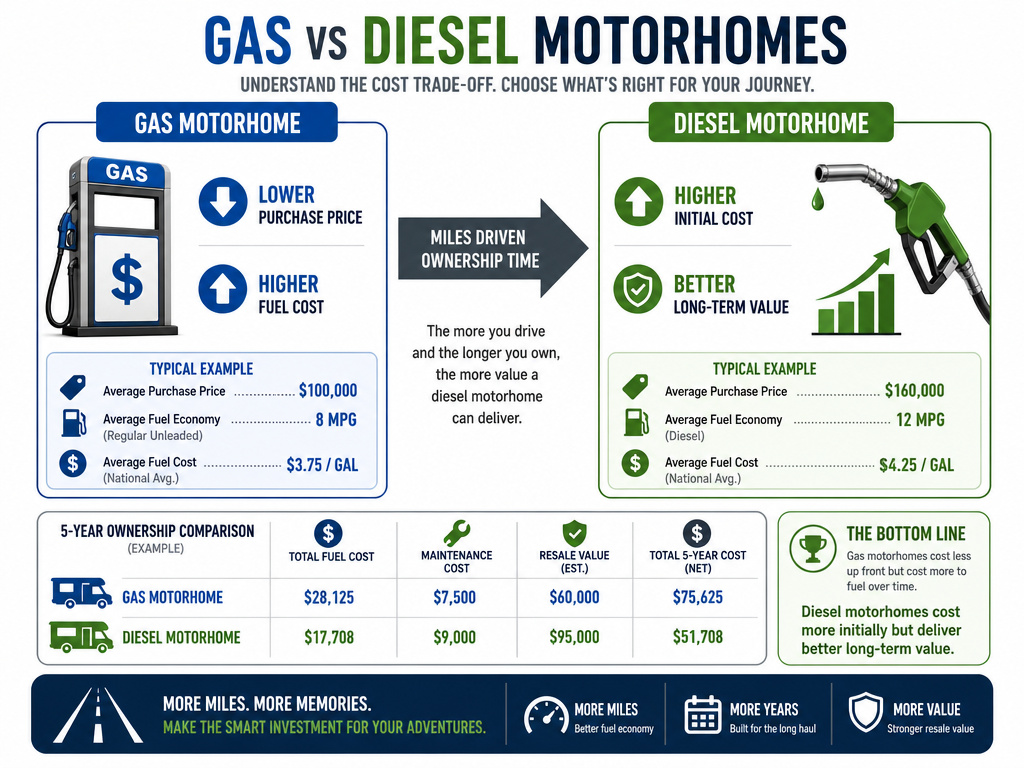
The upfront price difference is staggering and often the deciding factor. A Winnebego Forza diesel pusher starts tens of thousands higher than a Vista gas model.
But the math isn’t one-dimensional. You must project costs over your expected ownership period and mileage.
| Cost Factor | Gas Motorhome | Diesel Motorhome |
|---|---|---|
| Purchase Price | Lower ($120k – $250k typical) | Higher ($150k – $600k+) |
| Fuel Cost per Mile | Variable (6-10 mpg, cheaper fuel) | Variable (7-12 mpg, more expensive fuel + DEF) |
| Routine Service Cost | Lower ($200-$400 per oil change) | Higher ($800-$1,200 per oil change) |
| Major Engine Overhaul | Sooner (~150k-200k miles) | Much Later (~300k-500k+ miles) |
| Resale Value (% retained) | Lower depreciation | Higher depreciation |
The bottom line: If you drive less than 10,000 miles a year and stick to pavement, the gas coach’s lower upfront cost likely wins. The diesel’s premium is an investment that pays back over high mileage, tough terrain, and a longer ownership horizon. For a deeper dive on long-term value, see our analysis on whether diesel trucks are a good investment.
Who Actually Needs a Diesel Pusher?
This is the commitment question. The diesel’s advantages are concrete, but they only matter if your travel pattern demands them.
Choose a diesel pusher if:
- You are a full-time RVer logging 20,000+ miles annually.
- Your routes consistently include mountain passes (Rockies, Appalachians, Sierras).
- You plan to tow a vehicle (a “toad”) that weighs over 5,000 lbs.
- You prioritize a quieter, more stable ride and are willing to pay for it.
- You plan to own the coach for a decade or more.
Choose a gas Class A if:
- You are a weekend warrior or snowbird with sub-10,000 mile years.
- You primarily travel east of the Mississippi on flatter interstate highways.
- Your towing needs are light (a small utility trailer or no toad).
- Purchase price is the primary constraint, and you prefer lower periodic service costs.
- You’re comfortable with more DIY maintenance.
Understanding these motorhome classes is the first step, but the powertrain choice defines the experience within each class.
Frequently Asked Questions
Do I need a Commercial Driver’s License (CDL) for a diesel pusher?
In most states, no. A CDL is typically required for commercial vehicles over 26,001 lbs. While many diesel pushers exceed this GVWR, they are registered as recreational vehicles for personal use. State laws vary, so check your local DMV for non-commercial RV licensing rules for vehicles over 26,000 lbs.
How much more does diesel maintenance actually cost per year?
It’s less about “per year” and more about “per service.” An oil/filter change on a Cummins L9 can be 3-4 times the cost of one on a Ford V8. However, the diesel’s intervals can be longer (18,000 miles vs. 5,000-7,000 miles for gas). Over 100,000 miles, the total powertrain maintenance cost for the diesel can be competitive or even lower, as you’re avoiding major engine work.
Can a gas Class A comfortably tow 5,000 lbs?
On paper, many are rated for it. In practice, it’s a strain. The torque deficit means the engine will work hard (high RPMs) on grades, and the front-heavy weight distribution makes the rig feel less planted. It’s possible, but it’s not comfortable or efficient. A diesel of similar length would barely notice the load.
What happens if I put gasoline in a diesel motorhome?
Catastrophic engine failure. The fuel systems are incompatible. Gasoline acts as a solvent in a diesel’s high-pressure fuel pump and injectors, destroying lubrication and leading to metal-on-metal contact. The repair bill can exceed $20,000. The nozzle sizes are different to prevent this, but always double-check.
Is a diesel pusher harder to drive than a gas motorhome?
No, and often it’s easier. The air brakes are powerful and progressive. The rear-engine design and air suspension improve stability in crosswinds. The visibility is similar. The main difference is finding a service center familiar with Cummins engines and Freightliner chassis, which is why a diesel engine scanner is a valuable tool for owner diagnostics.
The Bottom Line
There is no universal “better.” There’s only “better for you.”
The diesel pusher is the undisputed technical champion for serious, long-distance RVing. Its torque, longevity, and ride quality justify its premium for those who need it. The gas Class A is the pragmatic workhorse for the majority of recreational campers, offering capable adventures at a far lower entry point.
Your decision shouldn’t be based on prestige or assumption. It should be a cold calculation of your mileage, your terrain, your towed weight, and your budget over five years, not just today. Match the machine to the mission, and you’ll have the right answer.
