
Are Diesel Trucks Worth It? How a Major Recall Alters Value
This post contains affiliate links. As an Amazon Associate, we earn from qualifying purchases.
Diesel trucks are worth it only if you tow over 10,000 pounds regularly, drive more than 25,000 miles a year, and plan to keep the truck for 150,000 miles or longer. For the average driver, the $8,000+ upfront premium, higher maintenance costs, and complex emissions systems erase the fuel economy advantage, making a gasoline truck the smarter financial choice.
That premium isn’t just a number on a sticker. It’s the entry fee for a mechanical ecosystem that demands specific knowledge and tolerates zero neglect. The 2024 NHTSA recall for 6.6L Duramax trucks, where the Engine Control Module couldn’t adjust injector flow, isn’t an anomaly. It’s a preview of the complexity you’re buying into.
What follows is a breakdown of the five real variables that decide this: acquisition cost, fuel and maintenance math, operational use, longevity myths, and the emissions systems that now define ownership. By the end, you’ll have a simple checklist to run your own situation against, and you’ll know exactly which side of the diesel divide you belong on.
Key Takeaways
- The diesel price premium has ballooned to $8,000 or more upfront, a sum that takes years of fuel savings to recoup.
- Oil consumption is officially part of the spec: GM’s NHTSA bulletin accepts up to 2.5 quarts burned per 100 gallons of fuel in newer Duramax engines.
- Two major studies conflict: a 2013 UMTRI report showed diesel savings for some trucks, while a 2012 Vincentric study found diesels cost $1,203 more over five years.
- Modern diesels are built for high-speed, long-distance runs; short trips and excessive idling clog the Diesel Particulate Filter (DPF) and lead to expensive repairs.
- The resale value advantage is real, but it matters most if you sell privately after 5-7 years; fleet managers who cycle trucks every 10 years see less benefit.
The Diesel vs Gas Cost Breakdown (in Numbers)
Forget broad statements. The decision lives in specific, verifiable numbers. Start with the price of entry. Where the diesel premium was once $2,000-$3,000, it now regularly exceeds $8,000 for a comparable heavy-duty pickup. That’s not an upgrade package; it’s the down payment on a second vehicle.
Fuel costs are a moving target. While diesel engines are typically 20-30% more efficient, the price per gallon often negates that edge. More importantly, you must factor in Diesel Exhaust Fluid (DEF). An empty DEF tank will put the truck into a reduced-power limp mode. The 3.0L Duramax LZ0 holds 5.4 gallons; you’ll add a box every 4,000-5,000 miles. It’s a small ongoing cost that gasoline doesn’t have.
Then there’s maintenance. A diesel oil change requires more quarts of a specialized oil, the LZ0 needs 7 quarts, and the intervals aren’t always longer. The fuel filter is a separate, critical service item that clogs faster if you use biodiesel or drive in dusty conditions. That filter replacement is a $200-$300 dealer visit every 30,000 miles.
Common mistake: Comparing only fuel economy. The 2024 NHTSA technical service bulletin on the 6.6L Duramax lists an accepted oil consumption rate of 2.5 quarts per 100 gallons of fuel burned. For someone towing heavy at 9 mpg, that’s nearly 3 quarts of oil gone every 1,000 miles, a cost and a check you never have with a gas engine.
| Cost Category | Diesel Truck | Gasoline Truck | Who Wins? |
|---|---|---|---|
| Acquisition Cost | $8,000+ Premium | Base Price | Gas |
| Fuel Cost (per mile) | Lower mpg cost, plus DEF | Higher mpg cost, no DEF | Toss-up (varies by region) |
| Routine Maintenance | More oil, fuel filters, DEF system checks | Standard oil changes, spark plugs | Gas |
| Major Repair Risk | Turbocharger, fuel injectors, DPF/SCR | Ignition system, transmission | Diesel (if maintained) |
| 5-Year Resale Value | 65-75% of original value | 55-65% of original value | Diesel |
The table shows a split decision. Diesel leads in long-term resale and theoretical durability. Gasoline wins on day-one pricing and predictable service costs. The tiebreaker is how you use the truck.
The Five Factors That Actually Decide
The marketing talks about power and prestige. Your bank account cares about application. Answer these five questions honestly.
1. What’s Your Real Towing Need?
A gasoline HD truck can tow 14,000 pounds comfortably. A diesel HD truck tows 20,000 pounds and does it with less strain, at lower RPMs, on a mountain grade. If your trailer scale ticket says over 10,000 pounds more than six times a year, diesel’s torque advantage becomes a safety and wear-and-tear benefit. For a 7,000-pound boat or a landscape trailer, it’s massive overkill.
2. What’s Your Annual Mileage?
The industry’s old breakpoint was 25,000 miles a year. The logic is simple: the higher fuel efficiency of diesel takes miles to pay back the upfront premium. If you drive 15,000 miles a year, you might own the truck for seven years before the fuel savings cover the $8,000. Most people trade trucks sooner. Use a diesel truck break-in guide to ensure longevity, but know that low mileage harms a modern diesel more than a gas engine. The DPF needs sustained highway heat to clean itself.
3. What’s Your Ownership Timeline?
Diesel’s financial case needs time. A 2012 Vincentric study found the average diesel cost $1,203 more than its gas counterpart over five years at 15,000 miles annually. At year six or seven, with 150,000 miles on the odometer, the math can flip. The diesel might still have life, while the gas engine is facing major wear. If you swap trucks every 4-5 years like many fleets, you pay the premium but never realize the payoff.
4. What’s Your Mechanical Tolerance?
A check engine light in a modern diesel isn’t always simple. It could be a $20,000 DEF dosing system or a clogged particulate filter. Diagnosing it requires OBD2 scanners for diesel that can talk to the emissions computer, not just a generic code reader. A gasoline truck’s fault is more likely to be a coil pack or an oxygen sensor, cheaper parts, more common knowledge. Your willingness to learn, or your relationship with a specialist mechanic, is a real cost.
Where this goes sideways: Using a diesel for short, cold trips. The engine never gets to operating temperature, soot accumulates in the DPF, and a forced regeneration cycles can’t complete. You’ll be staring at a warning light and a four-figure bill for DPF cleaning or replacement inside 50,000 miles.
5. What’s Your Climate?
Diesel fuel gels in extreme cold. You’ll need anti-gel additives, a block heater, and maybe a heated fuel filter. Summer heat is hard on turbochargers. The 3.0L Duramax’s maintenance schedule shortens if you drive in “severe” conditions, which includes hot, dusty climates. Winterizing a diesel truck is a mandatory seasonal ritual, not an option.
The Longevity Myth and the Resale Reality
“Diesel engines last longer.” It’s true for million-mile semi trucks. For a light-duty pickup? The evidence is thin. Between 2000 and 2015, manufacturers introduced and retired at least nine different diesel engine families due to emissions rules or mechanical flaws. Few have been on the road long enough in high numbers to prove the 300,000-mile claim.
Government fleets, which are coldly rational about costs, seldom keep Class 3-6 trucks beyond 10 years or 125,000 miles. Their lifecycle analysis shows no benefit to diesel longevity because they never use it. For them, the NHTSA urgent safety investigation into 2024 models is a data point about complexity, not durability.
Resale value is where diesel’s reputation pays. A five-year-old diesel pickup retains about 70% of its original value. A comparable gas truck holds maybe 60%. That’s a real $5,000-$7,000 difference. But this only puts money in your pocket if you sell privately. Trading it in to a dealer, the difference shrinks. And if the used market is flooded with diesels facing expensive emissions repairs, a real scenario as warranties expire, that premium can vanish.
The Emissions Elephant in the Room

Your new diesel truck is half engine, half chemical plant. The Diesel Particulate Filter (DPF) traps soot. The Selective Catalytic Reduction (SCR) system uses DEF to turn NOx into nitrogen and water. These systems work well under ideal conditions: long, hot highway runs.
They fail under urban, stop-and-go driving. A clogged DPF triggers forced regenerations, which burn extra fuel. If that fails, you’re replacing a $3,000 part. DEF quality matters; contaminated fluid can ruin the SCR catalyst. The 2024 recall for the Duramax L5P’s fuel injector programming is a sign of how finely tuned this ecosystem is. One software parameter off, and you get rough idle or spiking fuel consumption.
This complexity means your choice of oil for diesel engines and diesel oil filters is critical. Low-ash formulations are mandatory to avoid clogging the DPF. The wrong oil voids warranties and bricks the emissions system.
When Diesel is the Unambiguous Answer
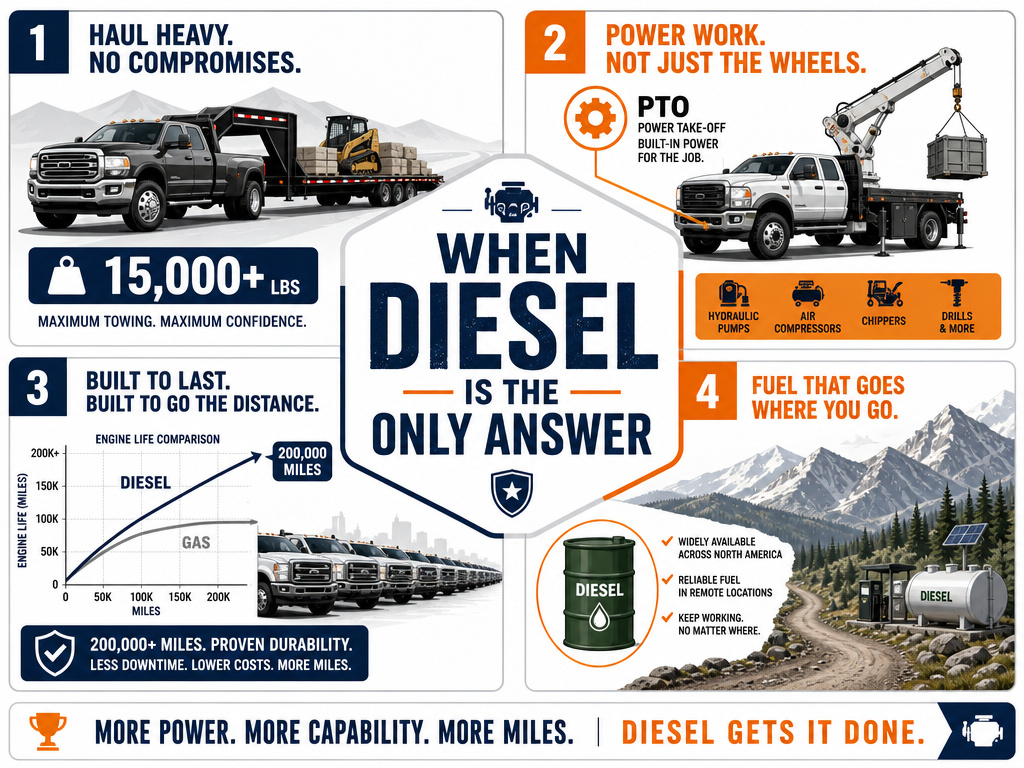
Despite the caveats, diesel is the only correct choice in specific scenarios.
- Constant Heavy Towing: If you pull a 15,000+ lb gooseneck trailer for hundreds of miles weekly, diesel’s torque, exhaust brake, and fuel economy under load are irreplaceable.
- High-Idle Applications: Running a PTO for a winch, pump, or crane for hours demands diesel’s low-RPM torque and fuel efficiency.
- Fleet with Long Lifecycles: A company that runs trucks to 200,000 miles over 8 years, with dedicated maintenance, can realize the TCO benefit.
- Remote Operations: Diesel’s energy density and stability make it safer to store and transport in the field than gasoline.
For these users, the upfront cost is a business investment, not a premium. They budget for synthetic diesel oil and diagnostic scanners. They stock antifreeze and batteries rated for high cold-cranking amps. They see the truck as a tool, not a vehicle.
Frequently Asked Questions
Are diesel trucks more expensive to maintain?
Yes, categorically. Routine services cost more due to higher oil capacity and additional items like fuel filter changes. Major repairs, injectors, turbochargers, emissions components, are exponentially more expensive than comparable gasoline engine repairs.
How long do modern diesel trucks last?
With rigorous, by-the-book maintenance, 250,000-300,000 miles is achievable. However, the long-term durability of emissions components (DPF, SCR) beyond 150,000 miles is unproven, and their replacement cost can exceed the value of an older truck.
Is diesel better for the environment?
Modern diesels produce far less particulate matter and NOx than older models, but they are complex and failure-prone. A malfunctioning emissions system can pollute more than a gasoline engine. Their higher fuel efficiency reduces CO2 emissions per mile, but the full lifecycle environmental cost of manufacturing and recycling the emissions systems is still debated.
Do I need to use a fuel additive?
For the 3.0L Duramax and similar engines, GM recommends using a fuel conditioner like ACDelco’s if TOP TIER Diesel fuel is unavailable. In cold climates, an anti-gel additive is mandatory to prevent fuel waxing. For older diesels without ultra-high-pressure injection systems, aftermarket additives can help with lubricity and cleaning.
Why do diesel trucks have such high resale value?
The perception of superior longevity and capability sustains demand in the used market. A 10-year-old diesel truck with 150,000 miles is still seen as having usable life, whereas a gas truck with the same mileage is considered worn out. This perception drives prices, even if the underlying mechanical reality is changing.
The Bottom Line
So, are diesel trucks worth it? For a specific user, the serious tower, the high-mileage driver, the fleet that keeps trucks for a decade, yes. The capability is real and the long-term math can work.
For the other 80% of truck buyers, the answer is a firm no. The $8,000 premium buys complexity, higher running costs, and a dependency on systems that don’t tolerate neglect. The 2024 NHTSA recall data shows this fragility isn’t theoretical. You’ll pay more to own it, more to run it, and need specialized tools like a battery charger or a jump starter just to keep it reliable.
Choose diesel because you need its specific strengths, not because you want its image. Choose gasoline because you value simplicity, predictable costs, and the freedom to use your truck without a mechanic on speed dial. Your wallet will know the difference.
