
The 80/20 Rule for a Good All Terrain Truck Tire | A Guide
This post contains affiliate links. As an Amazon Associate, we earn from qualifying purchases.
A good all-terrain truck tire balances two things: highway manners that don’t punish you on a daily commute, and genuine trail-ready traction for the dirt roads you actually drive. It needs a 3-Peak Mountain Snowflake rating for winter confidence, a treadwear warranty over 50,000 miles for value, and a noise level that doesn’t drone you out of the cab. The BFGoodrich KO3, Falken Wildpeak AT3W, and Toyo Open Country A/T III nail this formula; the common $400-per-tire mistake is buying tires built for terrain you’ll never see, and the Load Range E trap adds weight and a harsh ride for capacity you don’t use.
That gap between aggressive looks and balanced performance is where the tire’s whole job lives. Pick the wrong side and you’re stuck with a noisy, thirsty, unforgiving set that costs you fuel and comfort for 50,000 miles.
What follows: a breakdown of the 80/20 rule that applies to most truck owners, the three specs that decide real performance (and which two are fakes), and a head-to-head on the tires that bridge the gap without breaking your wallet or your back.
Key Takeaways
- Match the tire to your real 80/20 pavement-to-dirt ratio. An ultra-aggressive tread is a tax you pay every mile.
- Do not default to Load Range E (10-ply). Unless you tow heavy or haul max payload weekly, the extra stiffness and weight cost fuel and comfort.
- The 3-Peak Mountain Snowflake (3PMSF) rating is the benchmark for winter-capable all-terrains—it’s a certified test, not marketing.
- The best all-terrain tires now include features like full-depth sipes and specialized rubber compounds for wet traction, making older “looks tough” designs obsolete.
- For 95% of truck owners, the balanced performance of a Falken Wildpeak AT3W or Toyo Open Country A/T III beats the ruggedness of a more expensive, less refined tire.
The 80/20 Rule and the Load-Range Trap
Look at your odometer. For most truck owners, the honest mix is 80 percent highway, 20 percent dirt or gravel. Your tire choice should reflect that, not the fantasy of rock crawling every weekend.
Where this goes sideways: Choosing a hybrid all-terrain/mud-terrain tire for a truck that never sees deep mud. The stiff sidewalls and aggressive lugs add 2–3 decibels of constant drone by 15,000 miles, and wet pavement braking distances stretch by 10–15 feet.
The YouTube transcript from a 2026 tire review highlights this: a set of five hybrid tires can run $550 more than a well-rounded all-terrain. That cash buys nothing but noise if your trails are graded forest roads.
Load range is the second trap. The industry advice is clear: do not default to the heaviest load range “because it’s a truck.” A Load Range E (10-ply) tire is 15–25 percent heavier per tire than a C-range. That unsprung weight dulls acceleration, drops fuel economy by 1–2 MPG, and transmits every pavement seam into the cabin. Unless you’re regularly towing near your truck’s maximum or carrying construction payload, you don’t need E-range. The LT metric sizing for light truck tires already includes robust C- and D-range options that cover most half-ton and midsize pickups.
The Three Specs That Actually Matter (And Two That Don’t)
Ignore the marketing about “rock-crawling compound” or “desert-rated.” Three specifications tell you everything about how a tire will perform in the real world.
1. The 3-Peak Mountain Snowflake (3PMSF) Rating
This is a standardized, independent test for severe snow traction. A tire with this symbol has been verified to perform significantly better in packed snow and slush than a standard all-season tire. It’s not a replacement for a dedicated winter tire, but for most seasonal snow, it’s the difference between confidence and a white-knuckle drive. Nine of the eleven top all-terrain tires carry it.
2. Treadwear Warranty Mileage
This number is the manufacturer’s guarantee on tread life. A 50,000-mile warranty is standard; 60,000 or 65,000 indicates a harder, longer-lasting compound. This warranty is pro-rated, so it’s a direct indicator of value over time. The Toyo Open Country A/T III and Cooper Discoverer AT3 4S both offer 65,000-mile coverage.
3. UTQG Traction and Temperature Grades
The Uniform Tire Quality Grade system rates traction (AA, A, B) and temperature resistance (A, B, C). Most premium all-terrains score A for both. An A traction grade means shorter stopping distances on wet asphalt. Don’t settle for B.
The specs that don’t matter? “Studdable” (you’ll never add studs) and “flotation size” (unless you’re running a dedicated off-road rig). Focus on the three above.
| Specification | What It Means | Good Target | What Happens If You Ignore It |
|---|---|---|---|
| 3PMSF Rating | Certified severe snow traction. | Must-have for any winter driving. | Poor snow performance; tire slides in packed snow where others grip. |
| Treadwear Warranty | Manufacturer’s mileage guarantee. | 50,000+ miles. | Significantly shorter life; you replace tires 20,000 miles sooner. |
| UTQG Traction Grade | Wet pavement braking ability. | Grade “A”. | Longer stopping distances in rain, increasing accident risk. |
| Load Range | Tire’s weight capacity and ply strength. | Match to your actual payload (often C or D). | Harsher ride, worse fuel economy, no benefit if you’re not maxed out. |
Head-to-Head: The Contenders That Get the Balance Right
This isn’t about naming every tire. It’s about the three that define the current standard for balanced all-terrain performance, and one hybrid that shows where the compromise starts.
The Falken Wildpeak AT3W’s proprietary high-silica compound doesn’t harden in cold weather. The sipes stay flexible, which is why it stops 13 feet shorter than the BFG KO3 on wet asphalt in Tire Rack testing.
BFGoodrich All-Terrain T/A KO3
The benchmark. It replaced the KO2 with a new rubber compound focused on wet traction—the old tire’s weak spot. The KO3’s sidewall toughness is legendary, and its snow performance is top-tier. The trade-off is price and a slight on-road noise penalty compared to newer designs. It’s the tire you buy if off-road performance is non-negotiable and you accept the highway compromises.
Falken Wildpeak AT3W
The value and performance leader. It matches or beats the KO3 in most objective tests (wet braking, snow traction) for meaningfully less money. Falken’s 55,000-mile warranty and deep tread depth make it a long-term value play. For the owner whose truck is a daily driving tool that sees weekend trails, this is the default pick.
Toyo Open Country A/T III
The efficiency play. Toyo engineered this tire with a low-rolling-resistance compound. Owners report regaining 1–2 MPG over other all-terrains. It carries a 65,000-mile warranty and a 3PMSF rating. If fuel costs matter and your off-roading is light to moderate, this tire pays for itself.
Nitto Ridge Grappler
The hybrid warning. This tire blends all-terrain and mud-terrain patterns. It’s quieter than a true mud tire but lacks any treadwear warranty. Its ice performance is consistently flagged as weak. It’s only the right choice if your terrain demands more bite than an all-terrain can provide but you still must drive significant highway miles.
| Tire Model | Best For | 3PMSF Rated | Treadwear Warranty | Key Trade-off |
|---|---|---|---|---|
| BFGoodrich KO3 | Maximum off-road capability & snow. | Yes | 50,000 miles | Premium price; firmer on-road ride. |
| Falken Wildpeak AT3W | Balanced daily-driver with trail ability. | Yes | 55,000 miles | Slightly less sidewall toughness than KO3. |
| Toyo Open Country A/T III | Fuel-conscious owners with mixed use. | Yes | 65,000 miles | Less aggressive look; off-road limit is moderate terrain. |
| Nitto Ridge Grappler | Highway-driven trucks that see serious mud. | Yes | None | No mileage warranty; poor ice performance. |
What Breaks First: The All-Terrain Failure Modes
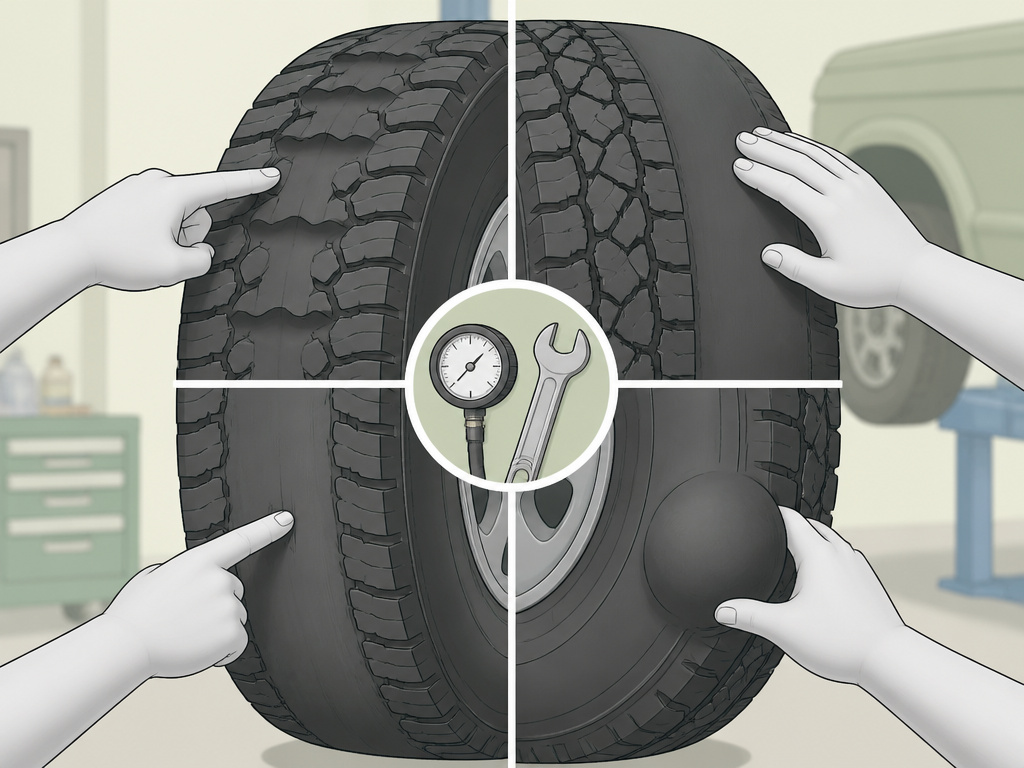 All-terrain tires don’t wear out evenly. They fail in predictable ways based on their design and your use.
Cupping and Irregular Wear
This is the number one killer of tread life. It shows up as scalloped dips around the tire’s circumference, causing a rhythmic thumping sound. The cause is almost always infrequent rotation or suspension issues. All-terrain tread blocks are larger and stiffer than all-season blocks; if they don’t contact the road uniformly, they wear in spots. Rotate every 5,000–6,000 miles without fail.
Shoulder Wear
The outer edges of the tread wear faster than the center. This points to chronic underinflation. An all-terrain tire run even 5 PSI low will over-flex, overheating the shoulder compound and eating through it 30 percent faster. Check pressures monthly, when the tires are cold.
Center Wear
The opposite problem. The middle of the tread is bald while shoulders look new. This is chronic overinflation. The tire crowns, reducing the contact patch and concentrating all wear on the center ribs. You lose traction, especially in wet conditions.
Sidewall Bruising and Cuts
The badge of honor for off-roaders. A sharp rock can slice a sidewall, but more common is bruising—internal ply damage from high-speed impact with a pothole or ledge. There’s no fix. Prevention is proper air-down pressure for the terrain. For rocky trails, dropping 5–8 PSI lets the tire conform and absorb impacts.
I ran a set of aggressive all-terrains at street pressure on a fast forest road. One hidden granite edge caught a sidewall just right. The bulge appeared two days later, a hernia the size of a golf ball. The tire was done at 8,000 miles. Now I carry a gauge and drop pressure before any real trail.
Highway Performance vs. Trail Grip: You Can’t Max Both
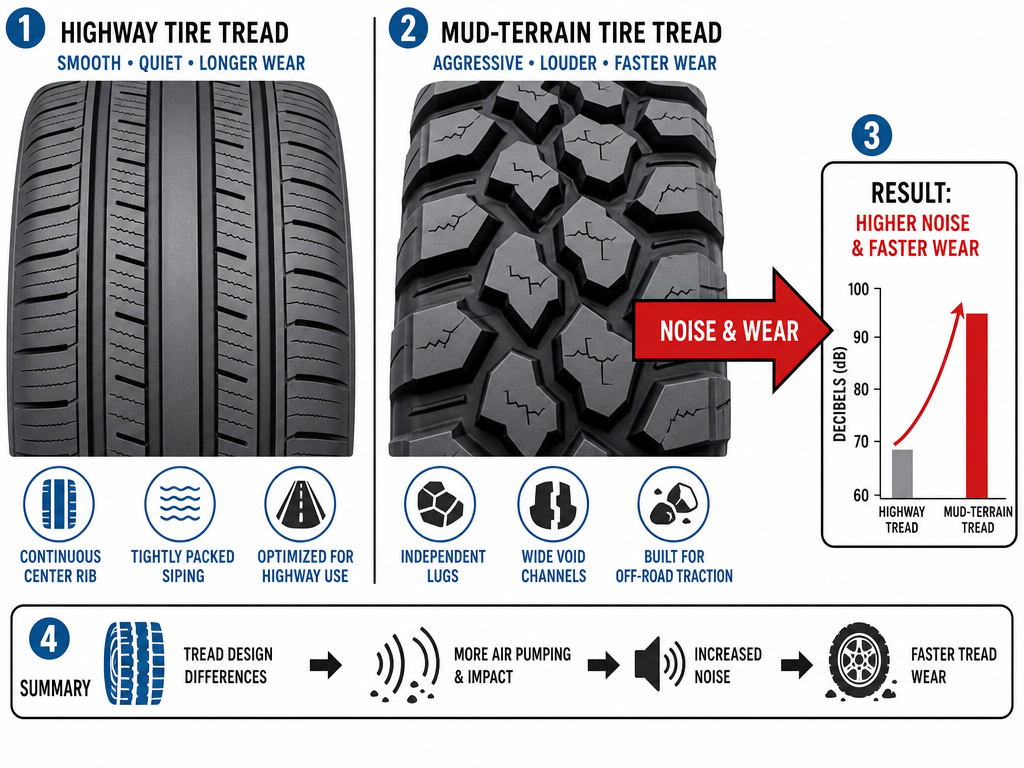 The laws of physics apply here. A tire optimized for silent highway driving uses closely spaced tread blocks and a continuous center rib. A tire optimized for mud uses wide, deep channels and independent lugs. You cannot have both in one tire.
The noise progression data from a 15,000-mile test is telling. A quality all-terrain tire’s noise level increased by only 1–2 dB over the test. A hybrid or mud-terrain tire increased by 5–6 dB, becoming “genuinely fatiguing on long highway runs.” That’s the direct result of lug squirm and irregular wear patterns.
Wet performance is another divider. The independent tread blocks of aggressive tires reduce the continuous rubber contact with wet pavement. Tests show stopping distances can vary by over 20 feet between a street-focused all-terrain and a hybrid. If your driving includes heavy rain, this isn’t a minor detail.
So, where should you land? Match the tire to your actual highway-to-trail ratio. If it’s 90/10, look at the best all-season tires for trucks. If it’s 60/40 and the trails are rough, the BFG KO3 or a dedicated LT all-terrain tire makes sense. For the 80/20 majority, the balanced all-terrains win.
The Snow Question: 3PMSF vs. Dedicated Winters
A 3-Peak Mountain Snowflake rating means the tire meets a specific performance standard in snow. It does not mean it equals a dedicated winter tire.
Dedicated winter tires use a softer rubber compound that stays pliable below 45°F. They have thousands of tiny sipes for ice grip. An all-terrain, even a 3PMSF-rated one, uses a harder, more durable compound. It will outperform an all-season in snow, but it will be noticeably less effective on glare ice and in sustained sub-freezing temperatures than a true winter tire.
The practical rule: if you live where winter means plowed roads with occasional snow, a 3PMSF all-terrain is sufficient. If you face months of ice, unplowed roads, and temperatures consistently below 20°F, a second set of winter tires on cheap steel wheels is the only safe choice. The best all-terrain tires for snow bridge the gap, but they don’t close it.
The Bottom Line
Stop shopping for the meanest-looking tread. Start with your 80/20 reality check, then demand the three real specs: 3PMSF rating, a 50,000+ mile warranty, and a UTQG traction grade of A.
For most daily-driven trucks that see moderate trails, the Falken Wildpeak AT3W is the smart money—proven performance, a lower price, and no glaring weaknesses. If fuel economy weighs on you, the Toyo Open Country A/T III pays back its cost. Only if your weekends are spent in rock gardens or deep ruts does the BFGoodrich KO3’s premium justify itself.
Ignore the Load Range E trap. Ignore the hybrid hype unless your terrain demands it. And never forget that the quiet, confident, long-wearing tire you actually enjoy for 50,000 miles beats the aggressive, noisy, short-lived legend every single time.
Frequently Asked Questions
Are all-terrain tires bad for gas mileage?
Yes, compared to highway all-season tires. The aggressive tread pattern increases rolling resistance. Expect a 1–3 MPG decrease, depending on tire size and truck. Models like the Toyo Open Country A/T III are engineered to minimize this loss.
How often should I rotate my all-terrain tires?
Every 5,000–6,000 miles. Their stiff, asymmetric tread blocks are prone to irregular wear (cupping). Regular rotation is the single biggest factor in reaching the tire’s advertised tread life.
Can I use all-terrain tires in the winter?
Yes, if they carry the Three-Peak Mountain Snowflake (3PMSF) symbol. They provide much better snow traction than standard all-seasons. They are not, however, as effective as dedicated winter tires on sheer ice.
Why are some all-terrain tires so loud?
Tire noise comes from tread pattern. Large, independent lugs hitting the pavement create a rhythmic hum. More aggressive, hybrid-style tires are louder and get louder as they wear. Modern all-terrains like the Continental Terrain Contact A/T are designed specifically to reduce noise.
What’s the difference between LT and P-metric all-terrain tires?
LT (Light Truck) tires have heavier construction, higher load capacity, and often thicker sidewalls. They are designed for trucks that carry payload or tow. P-metric (Passenger) tires are lighter and give a softer ride but have lower weight limits. For most half-ton pickups, an LT-rated tire in the correct load range (C or D) is the robust choice.
