
The Rule for Putting Regular Tires on Low Profile Rims
This post contains affiliate links. As an Amazon Associate, we earn from qualifying purchases.
You can put regular tires on low profile rims only if three specs match: the new tire’s load capacity equals or exceeds the original’s, the rim width stays within the tire manufacturer’s approved range, and the overall tire diameter changes by less than 3%. Miss any of these and the car’s handling degrades, the tire overheats, or stability control systems read false data.
The real question isn’t about looks or ride comfort. It’s about a federal regulation on rim width and load capacity. The 49 CFR § 571.110 standard says rims must be built to dimensions the tire maker lists as suitable. That’s the line between a safe swap and a violation.
This guide walks the swap from a garage standpoint. We’ll unpack that federal rule, translate the OEM and tire industry specs, and give you a checklist that catches every failure point before you pay for mounting.
Key Takeaways
- The load index molded on your new tire’s sidewall must be the same or higher than the original low-profile tire’s index. Going lower violates federal load rules and overloads the tire within 500 miles.
- Match the rim width to the tire’s approved range from the ETRTO (European Tyre and Rim Technical Organisation) standards. A 7.5-inch wide rim fits a 215mm to 255mm wide tire.
- Keep the overall diameter change under 3%. A change larger than that forces reprogramming of the speedometer and can disable anti-lock brake feedback loops.
- Never drop tire pressure below the factory door-jamb placard’s recommendation, even if the new tire has a higher load rating. Underinflation kills sidewalls in the first heat cycle.
- The speed rating can be equal or higher, but going lower caps your vehicle’s maximum speed. A V-rated tire on a Z-rated car is fine until you drive it like the car was designed.
The Three Unbreakable Rules
Forget the internet forums arguing about stretch and look. The swap passes or fails on three numbers printed on the tire and the door jamb. Get these right, and the physical fit is the easy part.
According to the Continental Tire Plus Sizing guideline, replacement tire load capacity must be equal to or greater than the Original Equipment fitment. Never select a tire with a lower load carrying capacity.
Load capacity is non-negotiable. Find the original tire’s load index on the door placard or owner’s manual. It’s a two- or three-digit number like 91 or 95. Your new regular tire must have that same number or a larger one. Why? The car’s weight hasn’t changed. A tire with a lower index is carrying more weight per square inch than it was designed for. It heats up, the belts separate, and you get a blowout on the highway. Not maybe. Will.
Rim width compatibility is next. A “low-profile rim” is usually just a wider wheel. You need to check the new tire’s approved rim width range. The ETRTO standards say a 7.5-inch rim (about 190mm) suits tires with a section width between 215mm and 255mm. Put a 205mm tire on that 7.5-inch rim, and the bead might not seat correctly. The tire stretches, the sidewall runs hotter, and you lose the ride comfort you were chasing. Check the tire manufacturer’s spec sheet online before you buy.
Overall diameter change must stay within 3%. The industry rule of thumb from Continental’s engineers is this: a rolling circumference change beyond plus or minus 3 percent affects the speedometer, anti-lock brakes, and stability control. Your car’s computer assumes a certain wheel speed for each road speed. Throw that off by 5%, and the traction control might engage at 55 mph on dry pavement. The ABS module gets confused during hard braking. You can have a dealer reprogram the computer for a new tire size, but that’s an extra cost most people forget to budget.
Where Swaps Go Wrong: The Physical Check
Even if the numbers line up, your car has metal and plastic in the way. A taller sidewall moves.
The strut and spring perch is the first impact point. Jack up the car and remove the current wheel and tire. Turn the steering lock to lock. Now hold your new, taller tire next to the strut. You need at least a finger’s width of clearance, about 15mm, at full compression and full turn. Less than that and the tire rubs the strut on the first pothole. The sound is a rhythmic grinding that stops when you straighten the wheel.
Fender and liner clearance comes second. Look at the space between the top of the current tire and the fender’s inner lip. A regular tire with a taller sidewall expands upward. Under hard cornering or with passengers in the back, the suspension compresses. The tire can catch the fender lip and rip the liner. You’ll hear a plastic crunch on speed bumps.
Sway bar end-links can get hit. This one surprises people. A taller tire has a larger radius. On some front-wheel-drive cars with a short wheelbase, that extra radius swings closer to the sway bar link at full lock. The link is a small metal rod. Contact sounds like a loud clunk when parking.
Where this goes sideways: Skipping the full-suspension travel test. A tire that clears at rest will rub when the suspension compresses over a dip at 40 mph. That rub wears a groove in the sidewall, and the tire fails within two months.
Step-by-Step Fitment Checklist
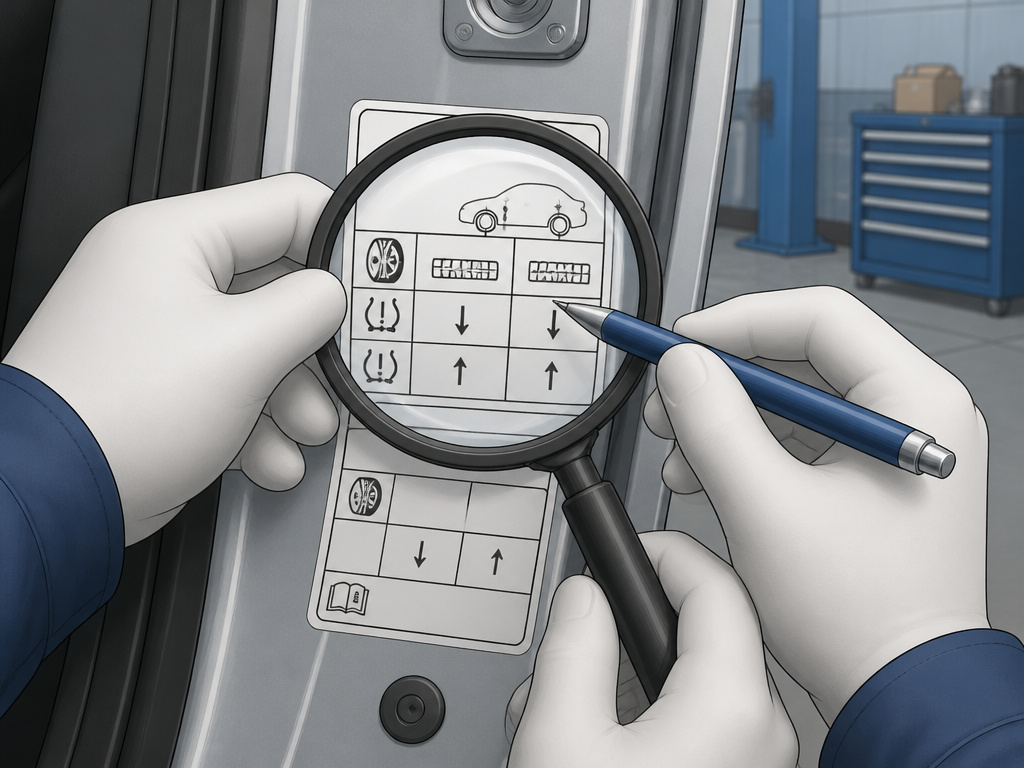 Do this before you order tires or pay for mounting. Each line is a stop sign.
- Pull the door-jamb placard data. Write down the original tire size (e.g., P225/45R18), the recommended cold pressure (front and rear), and the vehicle capacity weight. This is your legal baseline for tire and rim compatibility.
- Decode the new tire’s sidewall. Find the load index (e.g., 95), speed rating (e.g., V), and section width (e.g., 215mm). Cross-check the load index against the placard’s original size using a load index chart. The new index must be ≥ the old one.
- Verify rim width against ETRTO. Measure your rim width in inches. Compare it to the new tire’s approved width range from its manufacturer spec sheet. A 7-inch rim needs a tire approved for 7-inch rims. This step prevents the unsafe practice of installing wider tires on a rim that’s too narrow.
- Calculate the overall diameter difference. Use an online tire size calculator. Input the old size (225/45R18) and the new size (215/55R17). Read the percentage difference in diameter. If the calculator shows +2.8%, you’re green. If it shows -4.5%, you need a different size or you must plan on a speedometer recalibration. This math is crucial for any tire size change.
- Perform the static clearance test. With the car on a jack stand, hold the new tire and wheel assembly in place. Turn the steering wheel. Check for strut, fender, and sway bar clearance. This is the final proof before you spend money.
| Checkpoint | Pass Condition | Fail Consequence |
|---|---|---|
| Load Index | New ≥ Old | Overload failure within 500 miles |
| Rim Width | Within tire maker’s approved range | Bead leaks, uneven wear center to edge |
| Diameter Change | ≤ ±3% | ABS/ESP false activation, speedometer error |
| Speed Rating | New ≥ Old | Limits vehicle top speed; potential warranty void |
| Cold Pressure | Set to placard spec | Rapid shoulder wear, heat buildup |
Regular vs. Low-Profile: The Ride Trade-Off You Actually Feel
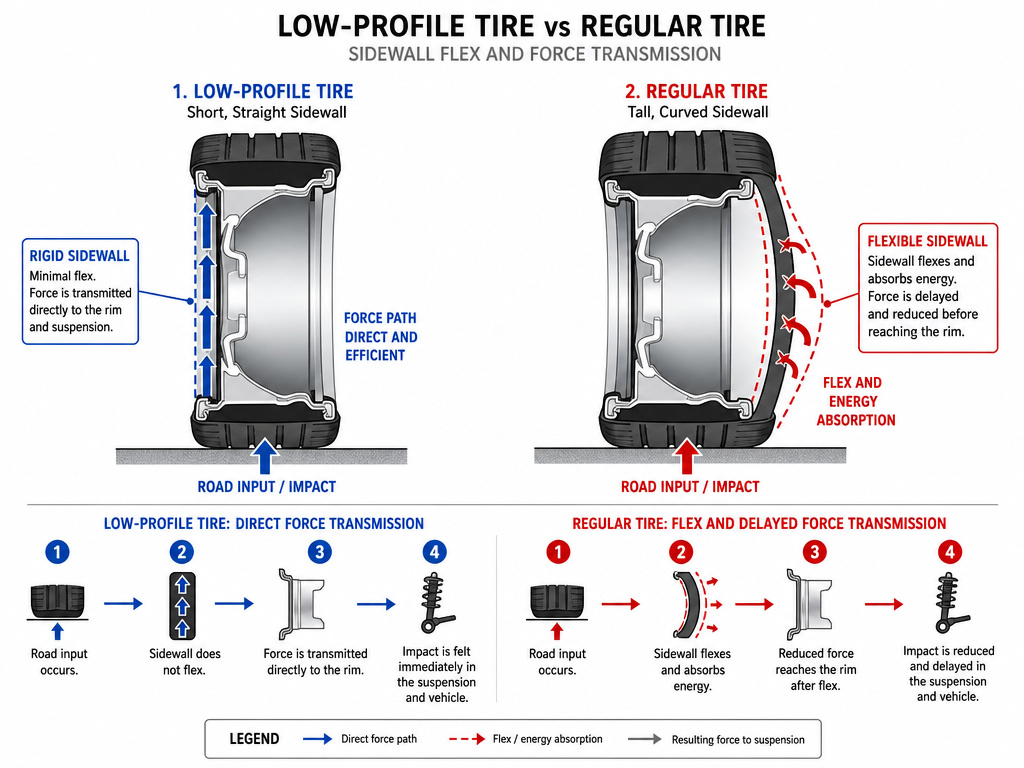 Swapping changes more than the spec sheet. You trade response for isolation.
A low-profile tire has a short, stiff sidewall. It transmits road texture directly to the steering wheel. You feel every tar strip and pebble. The benefit is immediate turn-in response. The car feels tight. The cost is a harsh ride and a higher risk of wheel damage from potholes.
A regular tire with a taller sidewall acts like a cushion. It absorbs small bumps. The steering feels slower, slightly numb. You lose that razor’s-edge feedback. You gain comfort and better protection for your wheels. The sidewall flexes more during hard cornering, so the car rolls a bit more before it grips.
Which one wins? For a daily driver on rough city streets, the regular tire. The comfort gain is real, and you’ll replace fewer bent rims. For a weekend sports car you take on smooth back roads, keep the low-profile setup. The handling precision is part of the car’s character. Mixing them—regulars on the front, low-profiles on the rear—unbalances the car’s dynamics and is a firm “don’t.”
The Law and Your Liability
This isn’t just garage talk. The Federal tire and rim selection standard (49 CFR § 571.110) sets the rules. It says rims must be constructed to dimensions the tire manufacturer lists as suitable. It also says the load on the tire must not exceed 94% of its rated capacity at the recommended pressure.
What does that mean for you? If your new regular tire has a lower load index than the original, you’ve broken that rule. If the rim width is outside the tire maker’s approved range, you’ve broken it. In an accident, an insurance adjuster or a plaintiff’s lawyer can point to that violation. Your coverage could be denied.
Ford’s owner manual language is typical: using unapproved wheel and tire sizes “could damage your vehicle.” That “could” turns into “did” in a legal finding. Stick to the three rules, and you stay on the right side of both engineering and the law. This due diligence is similar to researching theme park bag policies before a trip—knowing the rules prevents a costly rejection at the gate.
Frequently Asked Questions
Does putting regular tires on low-profile rims affect fuel economy?
It can, slightly. A taller, heavier tire increases rolling resistance and rotational mass. The effect is maybe 1-2% in real-world driving. You’re more likely to notice the change in acceleration feel than a dip at the gas pump.
Can I just change the tire size and not the wheels?
Yes, if the new tire fits your existing wheel’s width. This is a “plus-zero” or “minus-one” swap—changing the aspect ratio to get a taller sidewall on the same diameter wheel. You must still pass the load index and diameter change checks. It’s a common path for fitting wider tires on current rims.
Will my speedometer be wrong?
If the overall tire diameter changes by more than 3%, yes. A larger diameter tire rotates fewer times per mile, so the speedometer reads slower than you’re actually going. A 5% increase means your speedo shows 60 mph while you’re doing 63 mph. You can get it recalibrated at a dealer or with a specialty scan tool.
Is it bad to mix tire types on the same car?
Never mix types (all-season vs. Summer) or sizes (front vs. Rear on a non-staggered setup) unless the car came that way from the factory. Mismatched tires confuse stability control and anti-lock brake systems, leading to unpredictable handling. Stick to the same size, brand, and model on all four corners after any swap.
Do I need an alignment after changing tire sizes?
If you’re only swapping tires onto the same wheels, no. But if you change the tire’s width or diameter significantly, it can affect the scrub radius and camber curve. A fresh alignment checks that your new setup isn’t causing hidden toe wear. It’s cheap insurance.
The Bottom Line
You can mount regular tires on low-profile rims, but the window is narrow. The load index must hold, the rim width must match the tire’s book, and the diameter shift must stay under three percent. Get those three things right, and you gain ride comfort without breaking the law or your car’s electronics.
Get one wrong, and you’re driving a liability. The tire fails early, the car handles strangely, or the insurance claim gets messy. Use the checklist, do the math, and test the fit before the installer mounts a single tire. That’s the difference between a smart upgrade and an expensive mistake.
