
The 5-Step Vetting Process for Putting Bigger Tires on a Car
This post contains affiliate links. As an Amazon Associate, we earn from qualifying purchases.
You can install bigger tires on a car, but only if the new tire’s load capacity meets or exceeds the original specification, fits within the wheel well and chassis at full suspension travel, maintains the correct speed rating, is mounted on a compatible wheel, and won’t disrupt the ABS, stability control, or speedometer calibration beyond acceptable limits.
The load capacity clause is where most weekend projects fail. It’s not just about the number printed on the sidewall. For light trucks and SUVs, federal safety standards require a 10% derating of a passenger car tire’s load rating before you even start the math. That one line in the FMVSS 110 document kills a lot of popular “plus-size” combos before they leave the parts counter.
What follows is the five-point vetting process pulled directly from manufacturer technical bulletins and federal code. We’ll walk through load index derating, the precise 3% rolling circumference tolerance, chassis interference checks, and why your vehicle’s computer might throw a fit even when everything looks right.
Key Takeaways
- Federal safety standard 49 CFR § 571.110 mandates that the sum of a vehicle’s tire load ratings must meet or exceed its Gross Axle Weight Rating (GAWR).
- When passenger car tires are fitted to light trucks, their load rating must be divided by 1.10 before checking against the GAWR, a rule many aftermarket shops miss.
- Manufacturer guidelines, like Continental’s PSIB 06-03, state that a change in rolling circumference beyond +/- 3% can require speedometer and computer recalibration.
- Simply checking for rubbing at rest isn’t enough; you must verify clearance at full suspension compression and full steering lock.
- The vehicle’s placard inflation pressure is a minimum for the original tire; a larger or Extra Load (XL) tire may require higher pressure to carry the same weight.
The 5-Step Vetting Process for Upsizing
Forget generic “will it fit” advice. Installing larger tires is an engineering substitution governed by federal law and manufacturer specs. Each of these five points is a pass/fail gate.
Step 1: Verify Load Capacity – It’s Not Just the Sidewall Number
The load index on a new tire’s sidewall is meaningless until you cross-reference it with your vehicle’s Gross Axle Weight Rating (GAWR). The federal NHTSA tire selection standard is clear: the combined maximum load ratings of the tires on an axle must meet or exceed that axle’s GAWR.
The trap is in the fine print. If you’re putting passenger car tires on a light truck, SUV, or van, the standard derates those tires by 10%. You must divide the tire’s load rating by 1.10 before checking the math. A tire rated for 2,000 pounds per corner effectively becomes a 1,818-pound tire in the eyes of the law. This single step disqualifies countless casual “upgrade” plans.
Common mistake: Picking a tire based solely on a higher load index. An equal or greater index does not guarantee equal or greater load capacity at your vehicle’s placard pressure, especially when swapping between P-metric and Euro-metric standards. You need the load and inflation tables for the specific tire.
How to check: Find your GAWR on the driver’s door jamb sticker. For each axle, ensure (Tire Load Rating ÷ 1.10 if applicable) × Number of Tires on Axle ≥ GAWR.
Step 2: Confirm Physical Clearance Under All Conditions
A tire that clears the fender liner while parked will rip out wiring harnesses at full bump. The check happens in three dimensions: vertical travel, steering arc, and rear axle articulation.
Manufacturers like Continental specify you must ensure clearance “under all service conditions.” That means you need to check at full suspension compression, full droop, and full left and right steering lock. Account for tire growth—a tire can expand in diameter by half an inch at highway speed. Also, a wider tire can contact the spring perch or strut tube long before it touches the fender.
| Clearance Zone | How to Test | Risk If Skipped |
|---|---|---|
| Fender & Liner | Full suspension compression (jack up lower control arm). | Ripped fender liner, shredded tire sidewall. |
| Strut/Spring | Turn wheel to full lock, observe gap to strut tube. | Constant rubbing wear on tire shoulder. |
| Suspension Links | Cycle suspension through full travel with wheel turned. | Damaged tie rod, ABS sensor wire. |
| Chassis Rails | Check at full bump and full articulation. | Grooved tire tread, chassis damage. |
The test isn’t a glance. It’s a full suspension cycle with the new wheel and tire mocked up. Use a wheel spacer for clearance? Now you’ve changed the scrub radius and load on the wheel bearings. That’s another set of calculations.
Step 3: Match or Exceed Speed Rating & Rolling Circumference
Your new tires must have a speed rating equal to or greater than the originals. This isn’t about top speed; it’s about the tire’s construction to handle heat and stress at sustained highway velocities. A lower-rated tire can overheat and fail during normal driving.
More critically, you must maintain the original rolling circumference. Continental’s technical bulletin states that a change within plus or minus 3% typically doesn’t require adjustments to the speedometer or stability systems. Cross that threshold, and your ABS pulse calculations are off, your traction control intervention points are wrong, and your odometer is lying to you.
A 3% increase on a 25-inch tire is 0.75 inches. That’s enough to make a 60-mph speedometer read 58.2 mph. Your automatic transmission shift points will also be early, hurting performance and economy.
How to calculate: (New Tire Diameter – Original Tire Diameter) ÷ Original Tire Diameter × 100. Keep the result between -3% and +3% for minimal system impact.
Step 4: Use a Wheel with Approved Rim Width
A tire’s sidewall lists an approved rim width range. Stray outside it, and you alter the tire profile, potentially weakening the sidewall or causing uneven wear. Industry standards like those from TRA, ETRTO, or JATMA define these matches; a reputable tire shop won’t mount a tire on a rim outside its specified range.
Wheel offset is the other half of the equation. A wider wheel with the wrong offset pushes the tire out, directly impacting the clearance you checked in Step 2. It also changes steering effort and bearing load. Stick as close as possible to the factory offset when selecting new wheels.
Step 5: Plan for Computer Recalibration (It’s Not Optional)
Modern vehicles rely on wheel speed sensors for everything. A change in tire diameter directly affects the signals for: – Speedometer & Odometer – Anti-lock Braking System (ABS) – Electronic Stability Control (ESC/Traction Control) – All-Wheel Drive system torque distribution – Automatic Transmission shift points
Where this goes sideways: Assuming the computer will “adapt.” It won’t. The pulse count per mile is now wrong. Some vehicles allow recalibration through a dealer scan tool or aftermarket programmer. Others, particularly late-model cars with integrated safety systems, may not have a simple solution, making the upsizing project a non-starter.
Your final check: consult a service manual or forum specific to your vehicle’s make and model to see if wheel speed sensor recalibration is possible. If it’s not, the project ends here.
How Upsizing Affects Your Vehicle’s Computers
The relationship between tire size and your car’s electronic brain isn’t advisory. It’s foundational. The vehicle’s computer assumes a fixed number of pulses from the wheel speed sensor for every mile traveled. Change the tire’s rolling circumference, and you change the distance per pulse.
This throws a cascade of errors. The stability control system might interpret the mismatched wheel speeds as a skid and cut power unexpectedly. The all-wheel drive system could send torque to the wrong axle, inducing binding or wear. Most visibly, the speedometer and odometer will be inaccurate, which has legal implications.
The fix isn’t universal. Some trucks and older vehicles allow for a simple tire size change via the dashboard menu or a scan tool. Many newer cars require proprietary software only available to dealer technicians. Before committing to a tire size, you must have a confirmed path to recalibration. This is the single most overlooked cost in a tire upgrade.
The .080” vs .105” Trade-Off That Burns Out Electric Motors
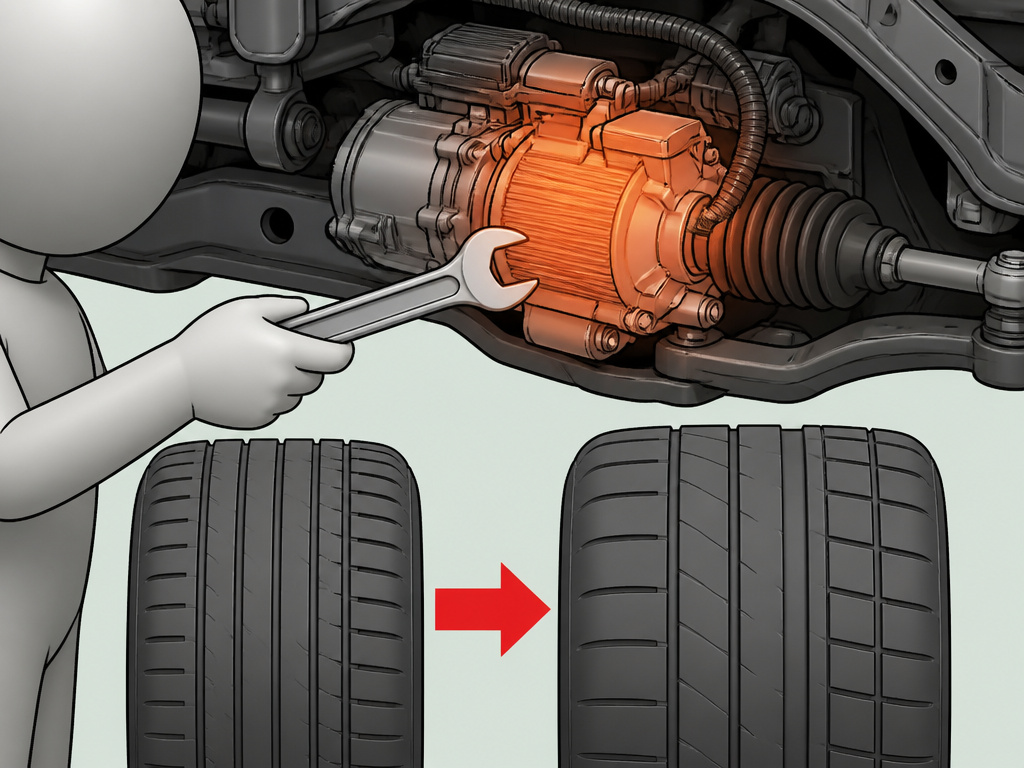
The conversation often jumps to diameter, but width is a critical variable, especially for electric vehicles and hybrids. A wider tire (e.g., moving from a 225mm to a 255mm section width) increases rolling resistance significantly.
For an electric vehicle, that translates directly into reduced range. For a vehicle with a modestly powered electric power steering pump or a belt-driven accessory, the extra effort required to turn the wider tires can strain the motor, leading to premature failure. This is a documented failure mode in some early hybrids that owners upsized without considering the parasitic draw.
The extra strain isn’t dramatic on the first drive. It’s the cumulative effect over thousands of steering cycles that overheats the motor windings. You’ll notice the steering feel go heavy on a hot day before the pump finally quits.
So, the trade-off: wider tires may improve dry cornering grip, but they exact a toll on efficiency, wear components, and sometimes, ancillary systems not designed for the load.
Bigger Tires vs Wider Tires: The Stakes for Your Suspension
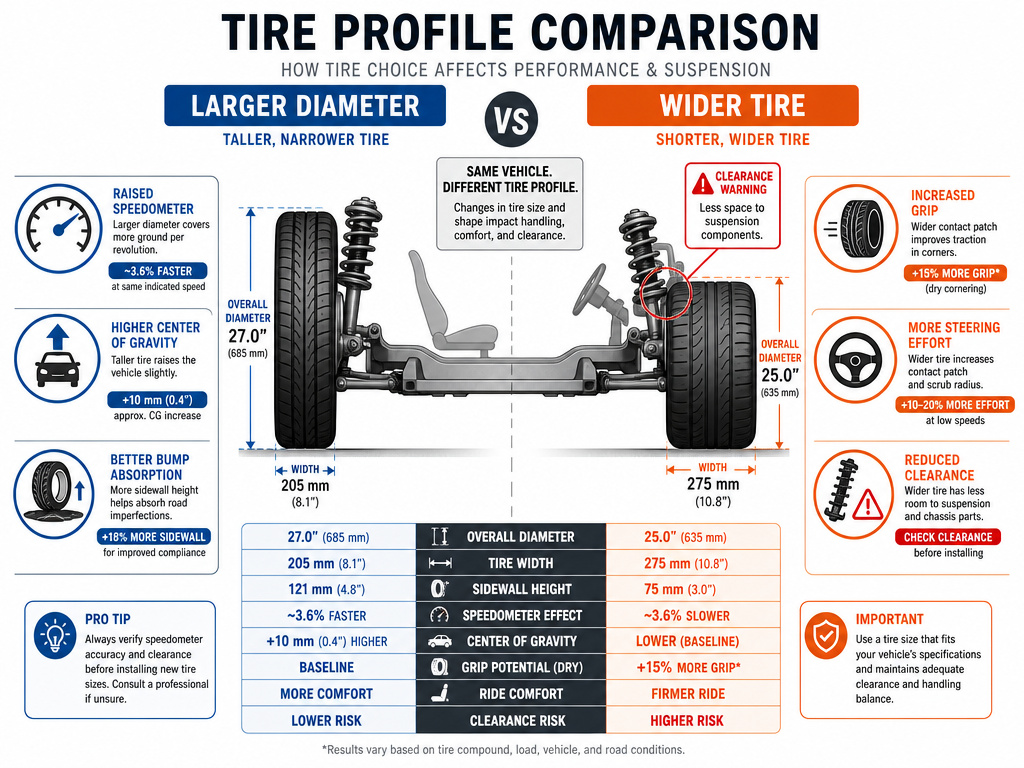
People often conflate “bigger” (taller diameter) with “wider” (greater section width). The impacts on your car are distinct.
Larger Diameter Tires:
- Raise the vehicle’s final drive ratio, potentially making it feel slower.
- Can raise the vehicle’s center of gravity, affecting handling.
- Primarily impact speedometer accuracy and computer systems.
- May provide a smoother ride over bumps due to more sidewall flex.
Wider Tires:
- Increase grip and potentially reduce braking distances on dry pavement.
- Often worsen wet-weather hydroplaning resistance.
- Increase steering effort and rolling resistance.
- Are more susceptible to tramlining (following road grooves).
- Directly challenge the clearance you have between the tire and suspension components.
Choosing between the two depends on your goal. Seeking a more aggressive look and slightly better ground clearance? Look at diameter. Want to improve lap times on a track day? Look at width. Most benefits of bigger tires are subjective or specific to off-road use, while the drawbacks are often mechanical and quantifiable.
Factory Recommendations vs. The Aftermarket Path
Your vehicle’s manufacturer issued a specific tire size for a reason. It represents a tested compromise between ride comfort, handling, noise, efficiency, and cost. Deviating from it introduces variables their engineers accounted for.
The aftermarket path isn’t wrong, but it’s a path of validation, not assumption. Resources like the Continental Tire Plus Sizing bulletin and the Bridgestone Replacement Tire Manual exist because professionals need a formal process. They are your blueprint.
This is why simply bolting on a set of larger tires from a junkyard is a gamble. It might work. It might also slowly overheat your wheel bearings, confuse your ABS into disabling itself, and leave you legally liable if the incorrect speedometer reading contributes to an accident.
Frequently Asked Questions
What is the biggest tire I can put on my car without a lift?
There is no universal answer. The limiting factor is available clearance at full suspension compression and steering lock. Even without a lift, you might fit a slightly taller tire if you also use a wheel with less offset to tuck it in, or a narrower tire to avoid strut contact. The only way to know is to mock up the proposed wheel and tire and physically test the clearance through the suspension’s full range of motion.
Do I need to reprogram my speedometer for bigger tires?
If the change in rolling circumference exceeds approximately 3%, yes. A reprogramming corrects the speedometer and ensures systems like ABS and stability control receive accurate wheel speed data. For many modern vehicles, this requires a dealer or specialized technician with the proper software.
Can bigger tires damage my transmission?
They can increase strain. A significantly larger tire acts like a higher gear ratio, forcing the engine to operate at lower RPMs for a given road speed. This can cause the transmission to “lug” or hunt between gears more frequently, increasing heat and wear. In severe cases, it can overwhelm a transmission cooler not designed for the extra load.
Are wider tires always better for performance?
No. Wider tires provide more grip on smooth, dry surfaces. However, on wet roads, a narrower tire can cut through water more effectively to maintain contact with the pavement. Wider tires also increase steering effort, rolling resistance (hurting fuel economy), and are more prone to following road grooves. The ideal width is specific to the vehicle’s weight, power, and intended use.
Is it illegal to put bigger tires on my car?
It can be if the modification violates federal motor vehicle safety standards. If the tires reduce the vehicle’s load capacity below its rated GAWR, impair the function of lighting or braking systems, or cause the vehicle to exceed maximum height laws, it may be illegal. State regulations also vary regarding how far tires can protrude beyond the fenders. Always check local laws.
The Bottom Line
You can put bigger tires on your car, but “can” and “should” are separated by a stack of technical manuals. The process isn’t about aesthetics; it’s about verifying load math, measuring clearances in motion, understanding computer dependencies, and accepting trade-offs in ride and efficiency. Skip the validation and you’re not customizing—you’re compromising the vehicle’s engineered safety margins.
For the majority of daily drivers, the smart move is a high-quality tire in the factory-specified size, like a Michelin Pilot Sport All-Season or a Continental ExtremeContact DWS06+. If you need a different look or capability, start with your vehicle’s factory optional tire sizes—they’re the only upgrades the manufacturer tested and certified. Everything beyond that is engineering, not guesswork.
