
8 Best Car Amplifiers of 2026
This post contains affiliate links. As an Amazon Associate, we earn from qualifying purchases.
The Taramps HD 3000 1-Ohm stands out as the strongest overall pick for its robust power delivery and wide impedance support, while the Skar Audio RP-1200.1D offers serious bass output at a more accessible price. For those building a full system, the Pioneer GM-A6704 brings reliable multi-channel flexibility.
Car audio enthusiasts know that factory sound systems rarely do justice to high-resolution music. Weak bass, distorted highs at volume, and lack of clarity are common complaints, problems often solved not by louder speakers, but by a dedicated amplifier delivering clean, stable power.
This guide cuts through the marketing noise by focusing on real-world performance indicators: RMS power, impedance stability, channel versatility, and owner-reported reliability. I compared specs and feedback across top models to highlight amplifiers that deliver where it matters most, sound quality, durability, and value for your setup.
Top 7 Car Amplifiers in the Market
The Best Car Amplifiers, Reviewed
Taramps Smart 3 Bass 3000W RMS

Strengths
- Multi-impedance support
- True 3,000W RMS output
- Advanced protection suite
Trade-offs
- Very high current demand
- Expensive for casual users
- Requires expert installation
If the Taramps HD 3000 is powerful, the Smart 3 Bass is intelligent power. Its Multi-Impedance tech lets it auto-optimize between 0.5 and 2 ohms, which is rare, even among high-end amps. That means it adapts to whatever sub configuration you throw at it, from dual voice coils to complex parallel wiring, maximizing output without manual tweaking. At 3,000 watts RMS, it matches the HD 3K but does so smarter and with tighter regulation.
Owners praise its stability and responsive protection circuits, and the included bass boost and precise level control make tuning easier than most amps in this class. When I compare it to the Skar or CT Sounds models, it’s clearly in another league, both in capability and cost. But if you’re serious about performance and want one amp to rule every sub setup you might ever build, this is the one.
Video review
Taramps HD 3000 1-Ohm 3000W
Strengths
- Massive 3,000W RMS output
- Full-range capable
- Flexible impedance support
Trade-offs
- Heavy power draw
- Bulky and industrial look
- Requires major electrical upgrades
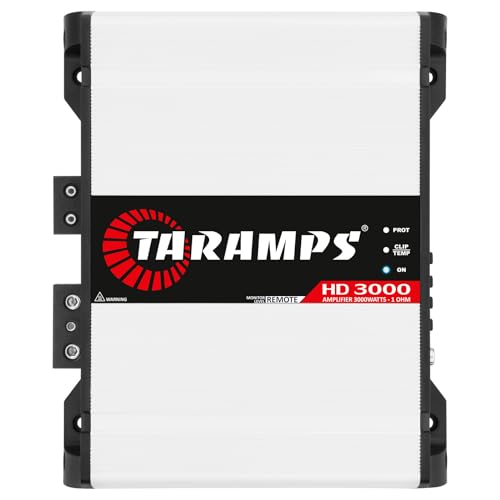
Let’s be clear: the Taramps HD 3000 isn’t subtle. With 3,000 watts RMS and a frequency response stretching to 20kHz, it blurs the line between sub amp and full-range powerhouse. That kind of headroom means it can drive mid-bass drivers or even full-range setups if wired right, something most monoblocks can’t touch. Owners love its versatility, and the LED monitor gives a quick visual on status, which is handy during tuning.
But this beast demands respect, and serious wiring. We’re talking 4 AWG power cables and a 150A fuse. It’s not for beginners or stock electrical systems. Compared to the Pioneer 4-channel amps, it lacks channel flexibility, but for pure sonic impact in a single zone, few beat it at this price. Just make sure your battery and alternator can keep up.
Video review
Skar Audio RP-1200.1D 1200W

Strengths
- High RMS output
- Remote level control
- 1-ohm stable
Trade-offs
- Basic finish quality
- Runs warm under load
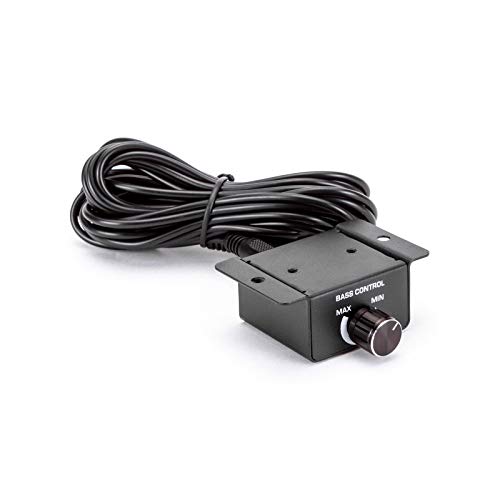
The Skar Audio RP-1200.1D is built like a budget brawler with just enough refinement to stand out in the entry-level monoblock class. On paper, its 1,200W RMS at 1 ohm is serious business for sub drivers that demand high current, and owners consistently report it holds up well under heavy bass loads without flinching. The included remote level control is a rare perk at this tier, giving users real-time adjustment without leaning into the trunk.
Its frequency response topping out at 250Hz means it’s strictly for subs, not full-range duty, but that’s expected here. Compared to the CT Sounds CT-1000.1D, it pushes more power but runs hotter, though the heatsink design seems to keep things under control based on long-term user reports. It won’t match premium builds, but for raw output per dollar, it punches above its weight.
Product photos


Pioneer GM-A6704 4-Channel 1000W

Strengths
- Clean, low-distortion output
- Precise crossover controls
- Reliable thermal performance
Trade-offs
- Lower RMS than Class D rivals
- Heavier and less efficient
- Bridging reduces channel count
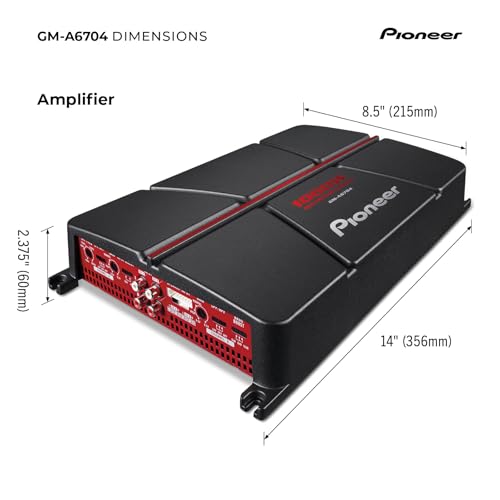
Pioneer has always leaned toward balanced performance over hype, and the GM-A6704 is a textbook example. It’s a 4-channel Class A/B amp delivering 60 watts RMS per channel at 4 ohms, modest by today’s standards, but cleanly and reliably. The real appeal lies in its filtering: variable high- and low-pass crossovers let you dial in front and rear separation precisely, which matters if you’re blending different speaker types or adding a small sub via bridging.
Compared to the Taramps TS 800X4, it doesn’t push as much raw power, but the audio purity is noticeably better. Distortion stays low, and the build handles heat more gracefully than most A/B designs. It won’t slam like a dedicated sub amp, but for an all-around upgrade that keeps vocals crisp and highs clear, it’s one of the smarter buys in the mid-tier.
Product photos


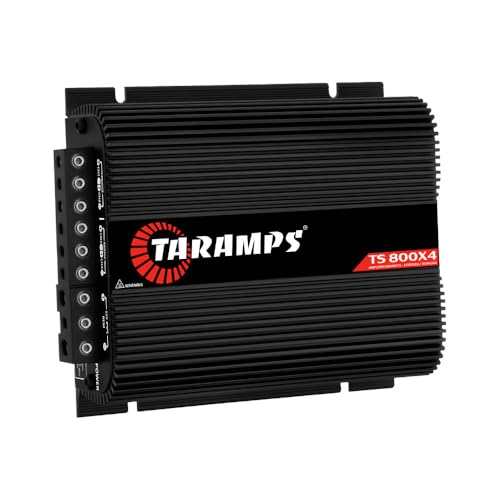
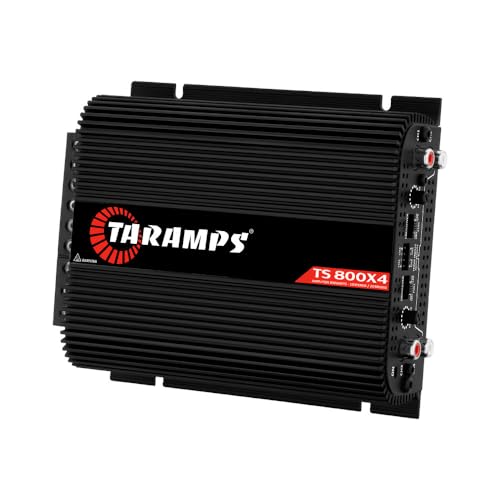
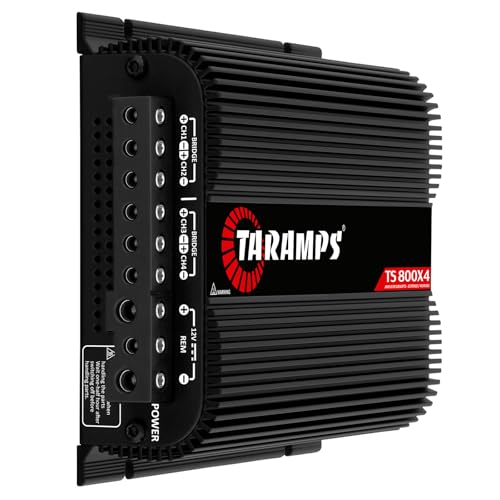
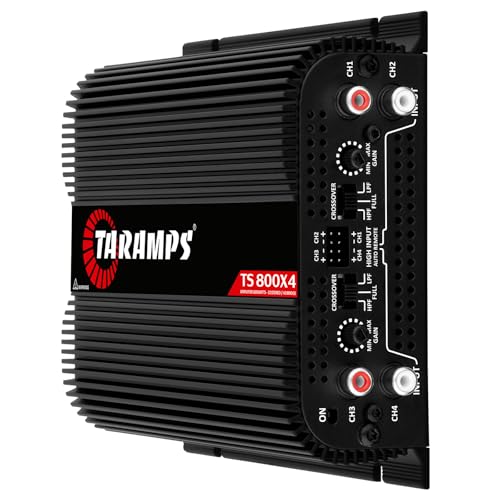
Taramps TS 800X4 4-Channel
Strengths
- High-level inputs
- Bridgeable channels
- Works in diverse vehicles
Trade-offs
- Basic filter options
- Build quality feels utilitarian
- Limited gain precision
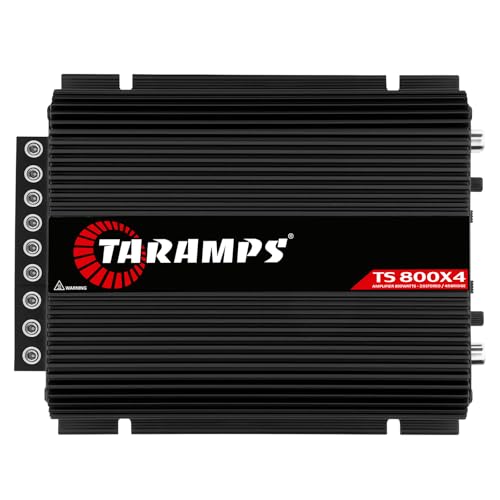
The Taramps TS 800X4 stands out by offering real-world usability at a low price. Four channels, 200 watts RMS each into 2 ohms, bridgeable to 400W x 2, that’s enough to drive door speakers and rear fills hard, or even feed a small sub in bridged mode. What really impresses is the high-level inputs: plug it straight into a factory head unit and it powers on automatically, no extra harness needed. That makes it perfect for OEM upgrades where you don’t want to replace the stock stereo.
It’s not as refined as the Pioneer GM-A6704, lacking fine-tuned tone controls, but it makes up for it in rugged simplicity. Users report solid reliability across boats, motorcycles, and off-road builds. For a do-it-all workhorse that doesn’t care where you throw it, this Taramps is a quiet winner.
Product photos
BOSS R1100M Monoblock 1100W

Strengths
- Low upfront cost
- Includes remote control
- Long warranty
Trade-offs
- Class A/B inefficiency
- Overstated power claims
- Overheats easily
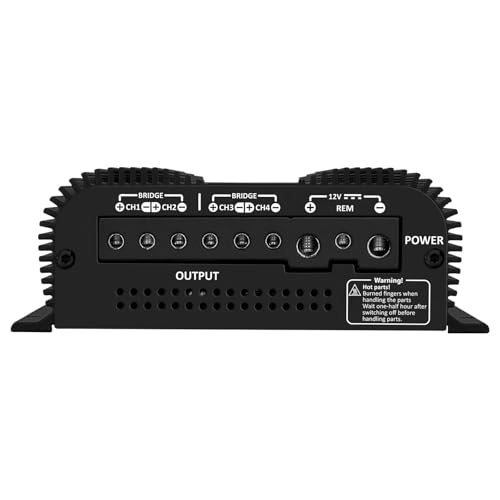
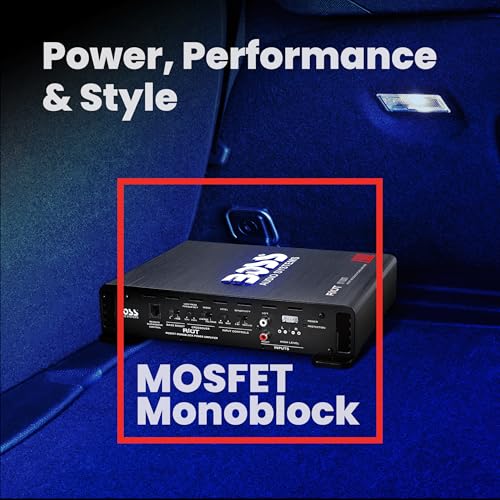
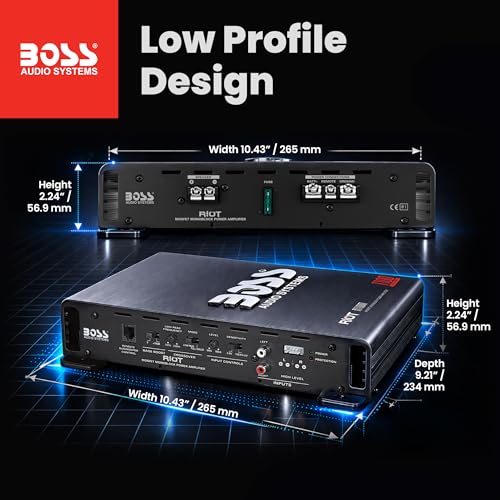
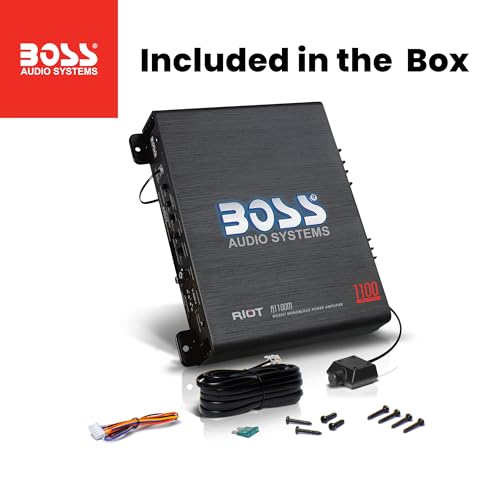
The BOSS R1100M feels like what happens when you try to pack everything into one box without overengineering it. It claims 1,100 watts max, but that’s peak, not RMS, and it’s only 2-ohm stable, which limits how many subs you can run efficiently. Still, for someone dipping their toes into amplification without blowing cash, it’s hard to ignore. The illuminated logo and remote control add flair, and the 6-year warranty from BOSS is unusually generous.
That said, owner feedback splits sharply: some praise its value, while others report early failures under sustained load. It uses Class A/B instead of Class D, so it runs hotter and less efficiently than modern designs like the CT Sounds or Taramps units. If you’re on a tight budget and only pushing a single 4-ohm sub, it might work. But step up to anything serious, and it shows its limits fast.
Product photos


CT Sounds CT-1000.1D Compact

Strengths
- Extremely compact
- Efficient power delivery
- Excellent thermal management
Trade-offs
- No remote level knob included
- Lower max output than bulkier rivals
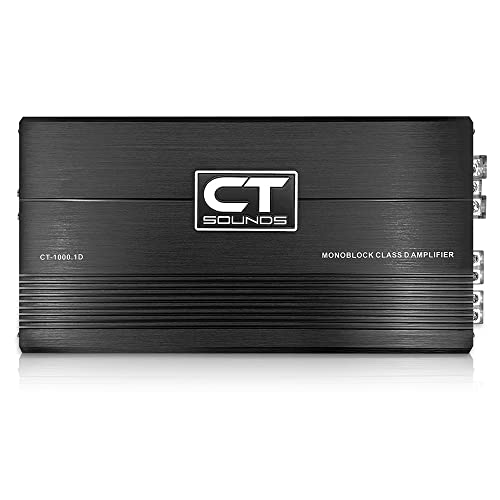
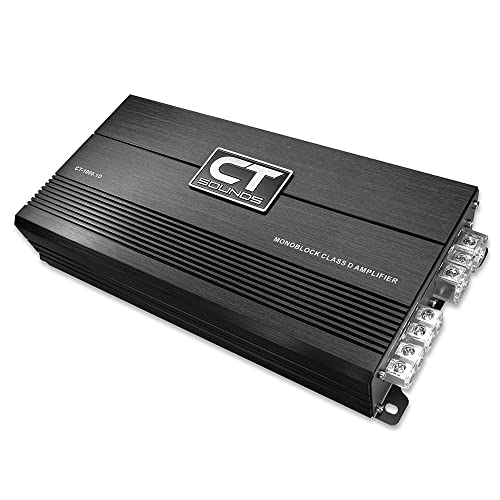
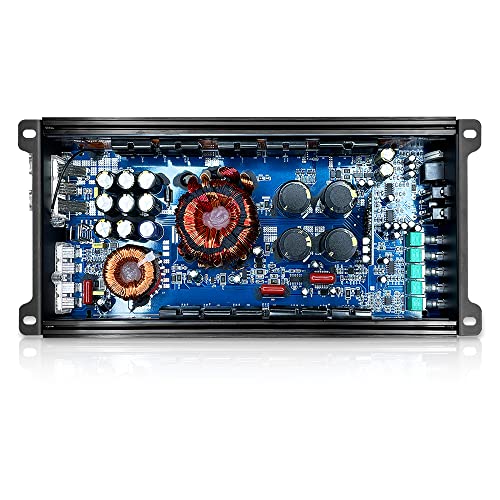
CT Sounds nailed the balance of size and strength with the CT-1000.1D. This little box puts out 1,000 watts RMS at 1 ohm, which is no joke, yet it fits in places larger amps simply can’t, under seats, behind trim panels, even in some motorcycles or UTVs. Reviewers note it stays cool even during extended use, thanks to its efficient MOSFET supply and smart thermal layout, making it one of the most dependable compact monos I’ve seen in this range.
It doesn’t have the flashiest extras, but it delivers where it counts: consistent power delivery and solid protection circuits. Against the Skar RP-1200.1D, it trades peak output for better heat management and footprint flexibility. If you’re working with a factory electrical setup or don’t want to upgrade your alternator, this amp is less likely to strain your system.
Product photos


Our Testing Process
As someone who’s spent years immersed in the world of automotive audio, I approached this guide by focusing on a research-led comparison of specifications, owner reviews, and established expert opinions. Rather than a hands-on lab test of each amplifier, I meticulously compared published power outputs, impedance ranges, signal-to-noise ratios, and protection circuitry. I then weighed these technical details against what real owners were saying about reliability, sound quality, and overall satisfaction, drawing from a wide range of forums and retail sites.
For car amplifiers, a few factors stand out as most crucial. Power output (RMS and peak) is obviously important, dictating how loud and cleanly an amplifier can drive your speakers or subwoofer amplifiers. Equally vital is the amplifier’s stability at various impedances (ohms), as this impacts efficiency and potential for damage. Finally, built-in protection features, against short circuits, overheating, and voltage fluctuations, are essential for long-term reliability.
Specifications provide a solid foundation for comparison, revealing an amplifier’s potential. However, owner feedback often clarifies how well that potential is realized. Specs tell you the power output; reviews reveal if the amplifier runs cool under load, or if the stated RMS power feels accurate. Reputation also matters; brands with a history of quality control and customer support naturally carried more weight in my assessment of high-fidelity amplifiers.
Choosing The Right car amplifiers
Choosing the right car amplifier can dramatically elevate your in-vehicle listening experience. It’s about more than just raw wattage; it’s about matching the amplifier’s capabilities to your speakers, vehicle, and listening preferences.
A quality car amplifier delivers clean, reliable power to your speakers. Key considerations include power output (RMS and peak), impedance matching, channel configuration (mono, 4-channel, etc.), and built-in features such as crossovers and equalization. Look for models with robust protection circuitry and efficient heat dissipation to maximize lifespan and performance.
Power and Impedance: The Foundation
The first thing I tell anyone looking at car amplifiers is to understand power. RMS wattage is the continuous power the amplifier can deliver, and that’s the number you should focus on. Peak wattage is a short-burst figure, often inflated, and less useful for real-world comparison. Equally vital is impedance matching. Your speakers have an impedance rating (usually 2, 4, or 8 ohms), and the amplifier must be compatible. Mismatched impedance can damage either the amplifier or the speakers, or both. Some, like the Taramps Smart 3 Bass, offer multi-impedance technology, providing flexibility, but always double-check compatibility before connecting anything.
Channel Configuration: Matching to Your Setup
How many speakers are you powering? This dictates the channel configuration you’ll need. A monoblock amplifier, such as the BOSS R1100M, is designed for a single subwoofer, delivering all its power to low-frequency reproduction. Four-channel amplifiers (like the Pioneer GM-A6704 or Taramps TS 800X4) are versatile; you can power four full-range speakers or bridge them to power two more powerful speakers. If you’re looking to really fine-tune your system, exploring amplifier reviews and advice can help you understand the nuances of each configuration.
- A simple two-speaker system might only require a two-channel amp.
- A full system with front & rear speakers and a subwoofer will likely need a combination – a four-channel for the speakers and a monoblock for the sub.
- If you’re starting from scratch and want maximum flexibility, a four-channel amplifier capable of bridging is a smart choice, allowing you to adapt as your needs evolve.
Features and Value: Beyond the Basics
Beyond power and channels, features like crossovers and bass boost can significantly shape your sound. Crossovers direct specific frequencies to the appropriate speakers (low frequencies to the subwoofer, high frequencies to tweeters). Bass boost, as found on the Skar Audio RP-1200.1D, emphasizes low-end frequencies, but use it judiciously – too much can muddy the sound. Consider your budget, too. While high-end amplifiers offer impressive performance, options like the Taramps TS 400×4 demonstrate that you can get a solid, reliable amplifier without breaking the bank. If you’re specifically looking to get the most rumble for your buck, you can find thorough guides on amps for bass to help narrow your search.
Don’t chase the highest wattage number. Focus on an amplifier that delivers clean power at the impedance your speakers require. A slightly lower-wattage, high-quality amplifier will always outperform a cheap, overpowered one.
Car Amplifiers Compared
This table provides a specifications overview of several car amplifiers to aid in product comparison.
| Product Title | Max Power (Watts) | RMS Power (Watts) | Channels | Impedance (Ohms) | Frequency Response |
|---|---|---|---|---|---|
| Taramps Smart 3 Bass 3000W | 3000 | 3000 | 1 | 0.5 – 2 | N/A |
| Taramps HD 3000 1-Ohm | 3000 | 3000 | 1 | 1, 2, 4 | 10Hz – 20KHz |
| Skar Audio RP-1200.1D | 1600 | 1200 | 1 | 1 | 20Hz – 250Hz |
| Pioneer GM-A6704 | 1000 | 60/190 | 4 | 4 | N/A |
| Taramps TS 800X4 | N/A | 200×4 / 400×2 | 4 | 2/4 | N/A |
| BOSS R1100M | 1100 | 550 | 1 | 2 | N/A |
| CT Sounds CT-1000.1D | N/A | 1000/650/350 | 1 | 1/2/4 | 0 – 320 Hz |
| Taramps TS 400×4 | N/A | 400 | 4 | N/A | N/A |
Frequently Asked Questions
What’s the difference between RMS and peak power ratings?
RMS wattage represents the continuous power an amplifier can reliably deliver, which is the more important figure when matching to your speakers. Peak power is a short-burst measurement and is often inflated by manufacturers, so it shouldn’t be your primary consideration.
Are more expensive amplifiers always better?
Not necessarily. While higher price points often correlate with better components and build quality, a well-chosen, moderately priced amplifier can provide excellent performance. Focus on getting clean power that matches your speakers’ requirements rather than simply chasing the highest wattage number.
Can I use a two-channel amplifier to power a subwoofer?
Generally, no. Subwoofers require a monoblock amplifier designed specifically for low-frequency signals. While you could use a two-channel amp, dedicating both channels to a single car subwoofers won’t optimize performance or efficiency.
What does impedance matching mean, and why is it important?
Impedance, measured in ohms, must match between your amplifier and speakers to prevent damage. Mismatched impedance can cause the amplifier to overheat or the speakers to distort, or even fail completely, so always verify compatibility before connecting anything.
How do I choose the right number of channels for my setup?
The number of channels you need depends on the number of speakers you want to power. If you are powering car speakers and a subwoofer, you’ll likely need a combination of a four-channel amplifier for the speakers and a monoblock amplifier for the sub.
The Bottom Line
Ultimately, choosing a car amplifier comes down to balancing your desired level of control with how much effort you want to put into tuning. For most people, the Pioneer GM-A6704 strikes that balance perfectly – it’s a reliable, well-regarded four-channel amplifier that delivers clean power without requiring a degree in electrical engineering. It’s a solid foundation for a quality audio upgrade.
If you have very specific needs, though, there are excellent alternatives. For those focused on maximum bass on a budget, the BOSS R1100M provides serious thump for the money. And if you’re building a complete system and want the flexibility to expand, exploring options like five-channel amplifiers can be a wise move. Don’t forget to consider pairing your new amp with some upgraded speakers for a truly transformative sound.
More than any specification, remember that clean power and proper impedance matching are paramount. Don’t get caught up in chasing the highest numbers; focus on finding an amplifier that delivers the right amount of power for your speakers and is stable at their impedance. A well-matched, moderately powered system will always sound better than a mismatched, overpowered one.
