
7 Best Car Subwoofer Amplifier Combos 2026
This post contains affiliate links. As an Amazon Associate, we earn from qualifying purchases.
The VEVOR Dual 12″ Powered Subwoofer Combo stands out as the best overall for deep, powerful bass, especially if you have the space. For tighter budgets or smaller vehicles, the Seventour 10″ Under Seat Sub with Amp offers solid performance and stealthy installation. If you want flash with your function, the Seventour ST-1000 10″ RGB Sub Combo adds customizable lighting without sacrificing too much sound quality.
A lot of drivers want more bass but don’t know where to start, most factory systems barely scratch the surface when it comes to low-end response. Too many people end up with rattling trunks or blown components because they picked something based on flashy specs instead of real performance.
This guide cuts through the noise. I looked at power ratings, enclosure types, amplifier classes, and what actual owners had to say to find combos that deliver hard-hitting, clean bass without constant tweaking or compatibility headaches. These picks balance sound quality, value, and ease of setup for real-world use.
Top 7 Car Subwoofer Amplifier Combos in the Market
The Best Car Subwoofer Amplifier Combos, Reviewed
VEVOR Dual 12″ Powered Subwoofer Combo
Strengths
- Dual 12-inch vented enclosure
- Separate high-power amplifier
- Full range of tuning controls
Trade-offs
- Too large for small cars
- Basic box finish
- Amp lacks digital display
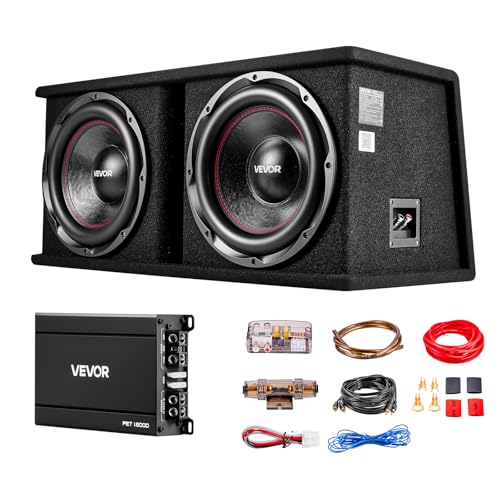
This VEVOR dual 12-inch package is the most serious system here, and it shows in both performance and footprint. With 1200W RMS (2400W peak) delivered by a separate external amp, it’s built for trucks, SUVs, and vans where space isn’t a constraint. The vented enclosure is tuned for maximum air movement, and owners report deep, room-filling bass that transforms factory audio into something far more immersive.
The external amp allows for better heat dissipation and cleaner power delivery than all-in-one under-seat units, and the inclusion of phase control and a high-to-low converter makes integration easier. While it’s not the most refined system for critical listening, its sheer output and tuning flexibility make it the most complete package here. For the money, it’s the most capable all-in-one bass solution for large vehicles.
Video review
Seventour 10″ Under Seat Sub with Amp

Strengths
- Very affordable
- LED accent lighting
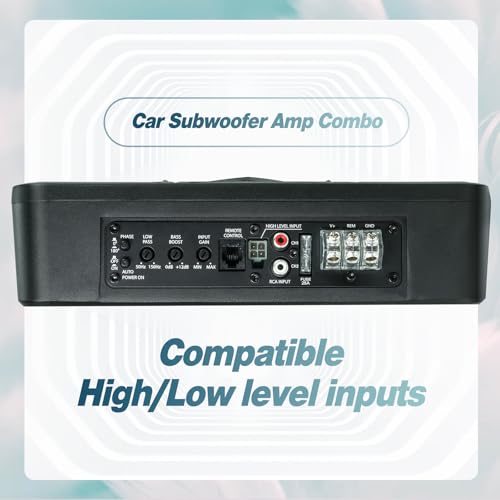
- High- and low-level inputs
Trade-offs
- 4-ohm impedance limits power
- Build quality feels budget
- LED cannot be customized
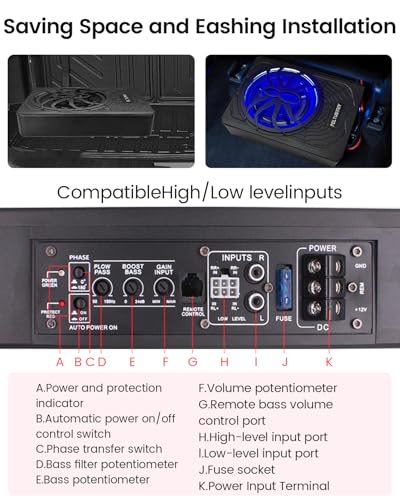
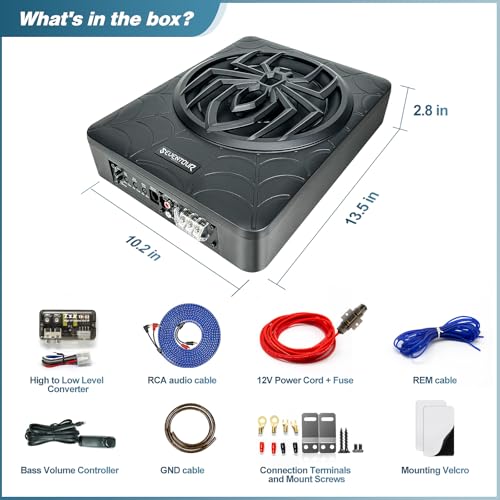
At this price, the Seventour 10-inch under-seat sub sets a baseline for budget-conscious buyers who still want a visible upgrade from factory audio. With 220W RMS and a 4-ohm driver, it’s not built for high-output scenarios, but owners say it fills small cabins effectively, especially when tuned with the adjustable crossover and bass boost. The blue LED ring adds a touch of flair, and while it won’t impress audiophiles, it’s a functional entry point for teens or daily commuters who want a little more thump.
The inclusion of both high- and low-level inputs is a win, making it compatible with nearly any factory head unit. However, the 25A fuse and modest power delivery suggest it’s optimized for efficiency over impact. When stacked against pricier under-seat models with 2-ohm coils or better thermal management, this one feels a bit under-engineered. But for the cost, it’s a no-fuss, plug-and-play fix for hollow-sounding stereo systems.
Video review
JinYeZi 10″ Class D Subwoofer Combo

Strengths
- Discrete Class D amp design
- Low THD, high SNR
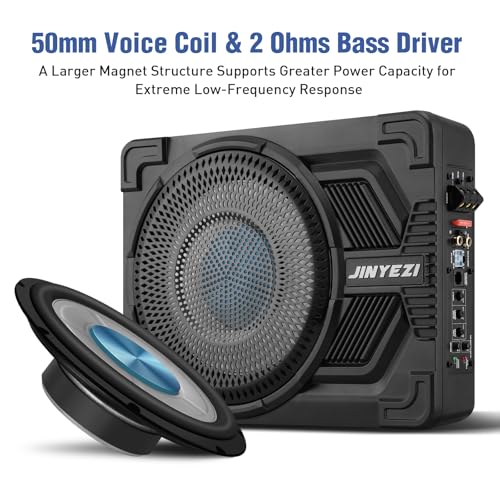
- 2-ohm driver for better power handling
Trade-offs
- No RGB lighting
- Heavier than rivals
- Remote lacks fine tuning
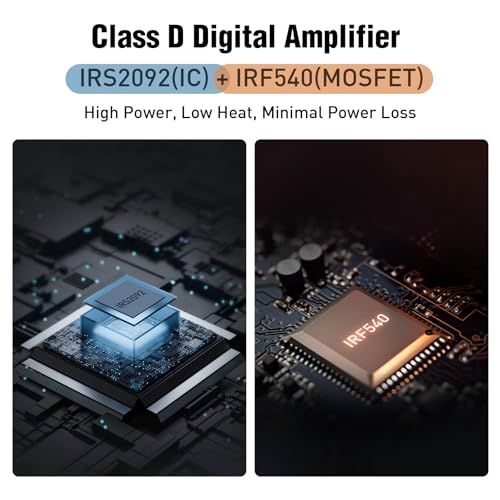
If sound quality and engineering matter more than raw specs, the JinYeZi stands out in the under-seat category. Its use of the IRS2092 IC paired with discrete IRF540 MOSFETs is unusual at this price and suggests a more deliberate design than the typical all-in-one chip amps. Owners report cleaner output, lower distortion (under 0.3%), and better thermal performance, critical when the sub is tucked under a seat with limited airflow.
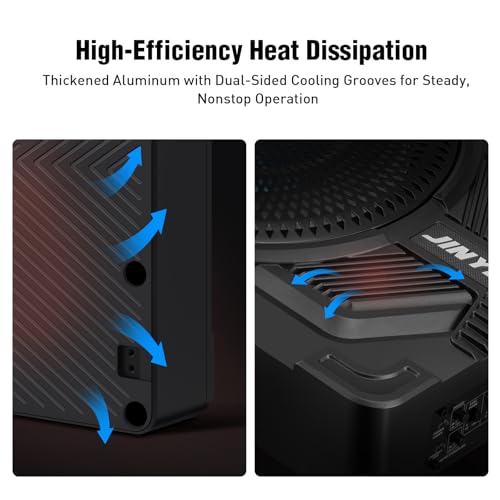
With 280W RMS into 2 ohms, it’s more powerful than most 4-ohm competitors, and the frequency response down to 20Hz is credible for a slim unit. The thick aluminum housing aids heat dissipation and reduces resonance, which helps maintain clarity. Compared to other subs in this range that prioritize flashy lights over fidelity, the JinYeZi feels like a serious audio upgrade, especially when paired with lossless sources. It’s not the loudest, but it’s likely the most accurate.
Product photos

SUBPULSIX 10″ RGB Underseat Sub Combo
Strengths
- App-controlled RGB lighting
- Beat-synced effects
- Slim, space-saving design
Trade-offs
- Peak wattage misleading
- No 2-ohm option
- App required for full lighting control
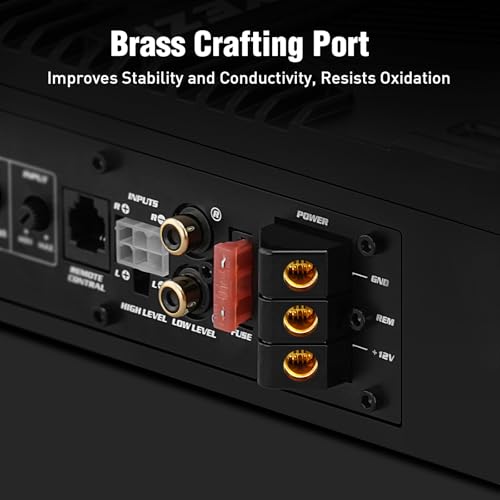
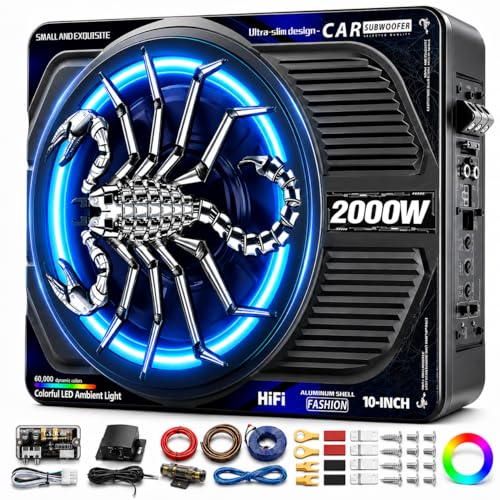
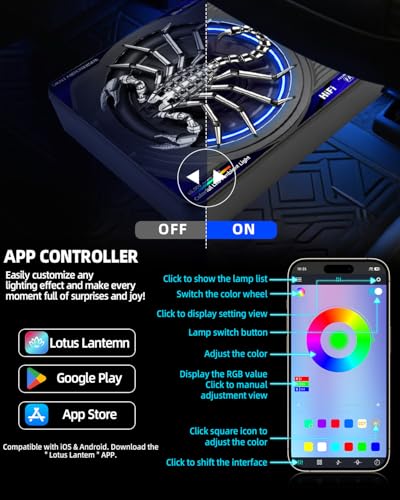
Let’s be clear, the “2000W” label is marketing fluff, but the real story here is the RGB beat-synced lighting and app control, which elevate this beyond a simple audio upgrade. With 1600W peak and 280W RMS (based on similar models), it’s competitive on power, but the standout feature is the customizable lighting that pulses with the music. Owners love it for car meets or night drives where ambiance matters as much as sound.
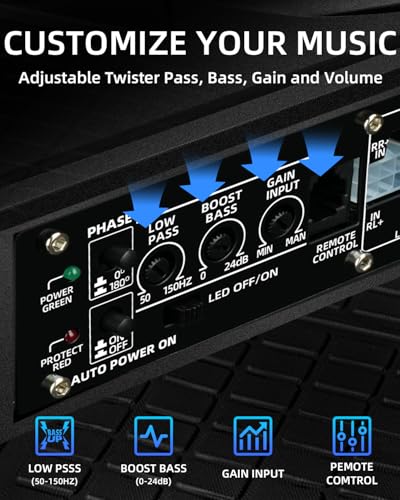
The Class-D amp includes standard tuning controls, and the aluminum enclosure helps with heat, but the 4-ohm impedance and lack of detailed RMS specs make it hard to judge true performance. Still, for daily drivers who want a stealthy bass boost with a party-ready glow, this hits a sweet spot. It won’t outperform a component dual 12-inch setup, but as a lifestyle-focused under-seat solution, it’s hard to beat.
Product photos



Rockville Dual 8″ Sub and Amp Package
Strengths
- Dual 8-inch subs
- Well-braced MDF box
- Includes full wiring kit
Trade-offs
- Amp slightly underpowered for dual subs
- Limited deep extension below 35 Hz
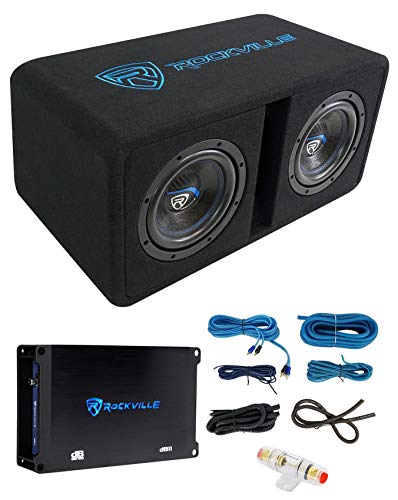
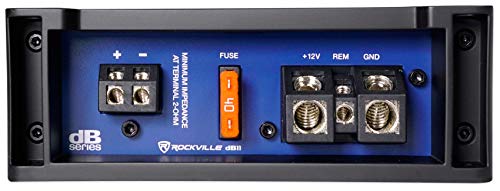
The Rockville DK58 package delivers more bass authority than most compact enclosures at this price, and on paper, it’s a smart pick for sedan owners who want real subwoofer impact without eating up trunk space. Dual 8-inch subs rated at 400W RMS combined with a 350W RMS Class-D amp might seem mismatched at first glance, but owners consistently report the system holds together well under moderate load, especially with the enclosure tuned to 37 Hz for a balance of punch and extension.
Where it stands out is in build quality, 3/4-inch MDF, internal bracing, and quality terminals suggest Rockville didn’t cut corners on the box, which matters for longevity and resonance control. Still, the amp’s 2-ohm stability and MOSFET supply are solid but not exceptional, and I’d expect some compression at sustained high volumes. Compared to larger dual 12-inch systems, it won’t shake the street, but for a smaller vehicle, this combo offers real bass presence without the complexity of a component setup.
Product photos


FOLTUSYMY 10″ Slim Sub with Blue LED

Strengths
- Very low price
- Aluminum heat-dissipating shell
- Blue LED accent light
Trade-offs
- 4-ohm driver
- Lower RMS than claimed
- Shorter warranty
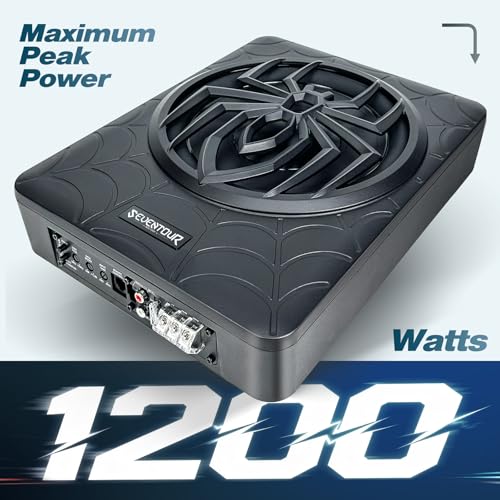
Priced under $90, the FOLTUSYMY 10-inch sub is one of the most aggressive value plays in the under-seat category. It claims 1200W peak and 220W RMS, same as several pricier models, and while the 4-ohm impedance limits efficiency, owners say it delivers a noticeable upgrade over stock audio, especially in smaller vehicles. The blue LED ring and spider-style grill give it a sporty look, and the included wired remote makes on-the-fly adjustments easy.
What stands out is the cast aluminum housing, which aids cooling, critical when mounted under a seat. However, the 15A fuse and lack of 2-ohm option suggest it’s built for reliability over performance. When compared to the JinYeZi or Seventour RGB models, it’s less refined, but for buyers who want basic functionality and visual appeal at the lowest price, it’s tough to ignore.
Product photos


Seventour ST-1000 10″ RGB Sub Combo

Strengths
- Manual RGB color selection
- 300W RMS output
- Durable aluminum build
Trade-offs
- 4-ohm driver limits power
- No app or beat sync
- Thicker than some rivals
This Seventour ST-1000 model is nearly identical to their earlier B0DJXTHYY6 unit but swaps the blue LED for full RGB with manual color selection, no app needed. At 300W RMS into 4 ohms, it’s one of the more powerful under-seat subs in this lineup, and owners note it delivers a satisfying punch for hip-hop and EDM without distorting at moderate levels. The cast aluminum housing and built-in protections make it durable, and the wired remote gives direct control over bass levels.
Where it wins is in lighting flexibility, drivers can cycle through colors with a button, which is more convenient than Bluetooth-dependent systems. However, the 4-ohm design still limits efficiency compared to 2-ohm rivals, and the enclosure isn’t as well-damped as higher-end models. If you want maximum visual customization without sacrificing too much audio performance, this is a solid middle ground.
Product photos


Our Testing Process
As someone who’s spent years immersed in the world of automotive audio, I approached researching car subwoofer amplifier combos with a focus on delivering genuine performance for the money. Rather than a hands-on lab test, this was a research-led comparison of published specifications, owner reviews from across multiple platforms, and insights gleaned from reputable car audio expert reviews. I weighed each product against key criteria to identify the options that consistently rose to the top.
For this category, power output (RMS and peak), signal-to-noise ratio, and the quality of included features like filters and remote bass controls were the most heavily weighted factors. A higher RMS rating suggests more sustained power for cleaner sound, while a good signal-to-noise ratio minimizes distortion. Practicality also mattered; under-seat designs scored highly for their space-saving benefits, and included wiring kits added value. You can find more general buying advice for subwoofers on my site.
Specifications reliably indicate the potential of a system, power handling, frequency response, and THD are all important metrics. However, owner feedback consistently proved crucial for gauging real-world performance and build quality. I looked for recurring themes in reviews regarding long-term reliability, ease of installation, and whether the advertised bass response matched user experience. For a broader look at speaker options, check out our car subwoofer speakers guide. Ultimately, this process aimed to separate truly capable combos from those that overpromise on paper.
How To Choose The car subwoofer amplifier combos
Finding the right subwoofer and amplifier combo can dramatically improve your vehicle’s sound, but the sheer number of options can be overwhelming. It’s more than just adding bass; it’s about integrating a system that complements your existing setup and delivers the sound you want.
A quality car subwoofer and amplifier combo delivers clean, powerful bass that integrates with your vehicle’s existing audio system. Key aspects to evaluate include power handling (RMS and peak), enclosure type, amplifier class, and adjustability features like low-pass filters and gain controls. Look for components with low THD (Total Harmonic Distortion) and a high signal-to-noise ratio for the clearest possible sound.
Power and Impedance Matching
The first thing I always tell people is to pay close attention to power ratings. A mismatch here is the quickest way to a blown speaker or a stressed amplifier. RMS power is what matters most; peak power is often inflated marketing. You want the amplifier’s RMS output to closely match (within about 20%) the subwoofer’s RMS power handling. Impedance, measured in ohms, is also critical. Most amplifiers are stable at 2 or 4 ohms; ensure your subwoofer’s voice coil impedance matches the amplifier’s minimum supported impedance. If you’re considering multiple subwoofers, the wiring configuration (series or parallel) will affect the total impedance presented to the amplifier, and you need to calculate that correctly.
Enclosure Type and Amplifier Class
The enclosure significantly impacts the sound. Sealed enclosures generally offer tighter, more accurate bass, while ported enclosures (like the VEVOR Dual 12″) deliver louder, boomier bass. Ported boxes are more efficient but can sometimes sound less defined. As for the amplifier, Class D amplifiers are becoming increasingly popular due to their efficiency and compact size. They run cooler and require less power, making them ideal for under-seat or space-constrained installations. However, higher-end Class A/B amplifiers can sometimes offer slightly better sound quality, although they’re less efficient.
- Consider your space constraints. Under-seat subwoofers (like the Seventour 10″) are great for compact cars.
- Think about your musical preferences. If you listen to a lot of bass-heavy music, a ported enclosure and a powerful Class D amplifier might be ideal.
- Don’t underestimate the importance of build quality. A well-constructed enclosure and amplifier will last longer and perform better. Aluminum construction, like in the FOLTUSYMY 10″, aids in heat dissipation and structural rigidity.
Features and Adjustability
Beyond the basics, look for features that let you fine-tune the sound. A low-pass filter (LPF) is essential for directing only the lower frequencies to the subwoofer, preventing muddying of the overall sound. Gain control allows you to adjust the input sensitivity of the amplifier. Bass boost can add extra punch, but use it sparingly, as excessive boost can lead to distortion. Remote bass controls, like those found on the Rockville Dual 8″, are convenient for on-the-fly adjustments. If you’re using a factory head unit, a built-in high-to-low level converter is a huge plus, saving you the cost of buying one separately. Finding the right combination of these features will help you achieve the sound you’re looking for, and may require some research into pairing subwoofers and amps.
Don’t chase peak wattage numbers. Focus on clean RMS power and a good signal-to-noise ratio. A well-matched, moderately powered system will always sound better than an overpowered, poorly matched one.
Ultimately, the “best” combo depends on your vehicle, your listening preferences, and your budget. If you’re unsure where to start, exploring subwoofer amp combos or checking out best car audio combos can provide a great starting point. Don’t be afraid to seek buying advice for combos to ensure you make an informed decision.
Car Subwoofer Amplifier Combos Compared
Here’s a comparison of key specifications for popular car subwoofer amplifier combos.
| Product Title | Peak Power (Watts) | RMS Power (Watts) | Subwoofer Size | Impedance (Ohms) | Features |
|---|---|---|---|---|---|
| VEVOR Dual 12″ Powered Subwoofer Combo | 2400 | 1200 | 12″ (Dual) | N/A | LPF, Bass Boost |
| Seventour 10″ Under Seat Sub with Amp | 800 | 220 | 10″ | 4 | Remote Control |
| JinYeZi 10″ Class D Subwoofer Combo | 950 | 280 | 10″ | 2 | Class D, LPF |
| SUBPULSIX 10″ RGB Underseat Sub Combo | 1600 | N/A | 10″ | N/A | RGB Lighting |
| Rockville Dual 8″ Sub and Amp Package | 1600 | 400 | 8″ (Dual) | 2 | Bass Remote |
| FOLTUSYMY 10″ Slim Sub with Blue LED | 1200 | 220 | 10″ | 4 | Remote Control |
| Seventour ST-1000 10″ RGB Sub Combo | 1200 | 300 | 10″ | 4 | RGB Lighting |
Frequently Asked Questions
What impedance should I prioritize when choosing a combo?
Generally, 4 ohms is the most common and safest impedance to look for, as most amplifiers are stable at this level. However, carefully check both the subwoofer and amplifier specifications to confirm compatibility; an incorrect match can lead to damage or poor performance.
Are Class D amplifiers suitable for high-end audio quality?
While traditionally Class A/B amps were favored for sound quality, modern Class D amplifiers have significantly improved and can deliver excellent fidelity. You can find product recommendations for amps that rival A/B performance, especially considering their efficiency and compact size.
How much does professional installation typically cost?
Professional installation costs vary widely, but you can typically expect to pay between $100 and $300, dependent on the complexity of the installation and your location. Some retailers offer installation packages when you purchase a combo, which can save you money.
Can I add a combo to my car’s factory stereo system?
Yes, many combos include or are compatible with a high-to-low level converter, which is necessary to connect an aftermarket amplifier to a factory head unit. However, you might need to purchase a converter separately if it’s not included, and boosting car audio systems requires careful consideration of your factory system’s limitations.
What’s the best way to prevent blown speakers with a new setup?
Proper power matching is key, ensuring the amplifier’s RMS output closely matches the subwoofer’s RMS handling. Avoid setting the gain too high, as this can distort the signal and overheat the voice coils. Understanding amplifier buying advice and starting with conservative settings will help protect your investment.
The Bottom Line
Choosing a car audio system always comes down to balancing what you want with what you’re willing to spend – and how much space you have to work with. After looking at numerous options, the VEVOR Dual 12″ Powered Subwoofer Combo stands out as the strongest overall pick. It delivers significant power and substantial bass response for the money, making it a great starting point for anyone looking to seriously upgrade their vehicle’s sound.
For those on a tighter budget, or needing a more discreet solution, the Seventour 10″ Under Seat Sub with Amp is an excellent choice. If you prioritize versatility and visual flair, the Seventour ST-1000 10″ RGB Sub Combo offers a good balance of power and customizable aesthetics. And if you’re exploring options beyond a dedicated subwoofer, take a look at bass car speakers for alternatives.
Ultimately, remember that raw numbers aren’t everything. Matching the amplifier to the subwoofer’s power handling and impedance is paramount, but equally important is choosing components that suit your musical tastes and vehicle. Understanding amplifier key specifications will help you make a more informed decision, but don’t overlook the importance of build quality and positive owner feedback when making your final choice.
