
8 Best Air Gauges for Tires 2026
This post contains affiliate links. As an Amazon Associate, we earn from qualifying purchases.
The AstroAI Digital Tire Pressure Gauge stands out as the best overall choice for its accuracy, ease of use, and added inflate/deflate functions. For a budget-friendly, no-frills option, the UNCO Pencil Tire Pressure Gauge 2-Pack gets the job done. If you need reach for dual wheels on trucks or RVs, the LUMITECO 12″ Dual Head Tire Gauge is the clear winner.
As someone who’s spent years around vehicles, I know how often tire pressure gets overlooked, until a warning light flashes or a tire fails. A bad gauge gives false confidence, leading to unsafe driving and wasted fuel. Overinflated or underinflated tires wear unevenly and can compromise handling.
This guide cuts through the noise by focusing on what matters: accuracy, build quality, and real-world usability. I compared specs, analyzed owner feedback, and weighed the strengths of digital versus mechanical designs to find the most reliable tools for keeping your tires in check.
Top 8 Air Gauges For Tires in the Market
The Best Air Gauges For Tires, Reviewed
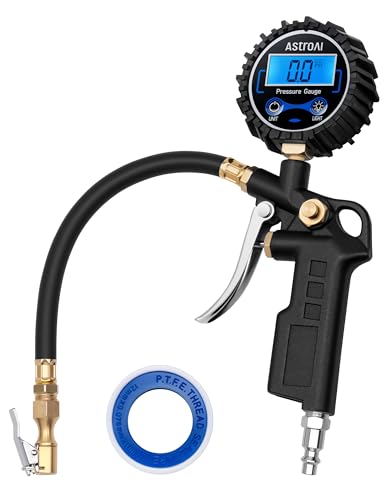
AstroAI Digital Tire Pressure Gauge
Strengths
- High accuracy
- Ergonomic design
- Built-in LED light
Trade-offs
- Battery-dependent
- Slightly heavier than others
- No carrying case included
If I had to pick one gauge to recommend as the best overall, it’d be this one. It’s calibrated to ±0.5% full scale, which beats most digital competitors, and the 0.1 PSI resolution gives you confidence in every reading. The 3-in-1 function, inflate, deflate, check, is smooth and intuitive, and the 360° swivel chuck with brass fittings eliminates leaks and wrist strain.
Owners love the ergonomic grip and built-in LED light, which is surprisingly bright. The auto-on/off feature works well, and the 19.7″ hose gives real flexibility. It’s also backed by strong customer support, which matters when you’re relying on it for roadside use. For the price, it’s hard to find a more complete package.
Video review
DigitPro Digital Tire Pressure Gauge

Strengths
- Affordable price
- Wide pressure range
- Durable materials
Trade-offs
- Dim backlight
- Stiff trigger
- No swivel chuck
This one punches above its weight. At under $17, it offers 3–250 PSI range, 0.1 PSI resolution, and a backlit LCD with light mode, making it a strong contender for best value with an inflator. The stainless steel and brass construction feels solid, and the gear-type dial suggests long-term durability.
It’s not quite as refined as the AstroAI, some owners report the backlight isn’t as bright, and the trigger mechanism can feel a bit stiff. But for the price, it delivers 90% of the performance with 100% of the functionality. If you’re pairing it with a home compressor, it’s a smart, cost-effective upgrade over basic models.
Video review
Spurtar 10-120 PSI Tire Gauge

Strengths
- Dual head chuck
- Heavy-duty build
- No batteries needed
Trade-offs
- Limited to 120 PSI
- 2% accuracy tolerance
- No backlight
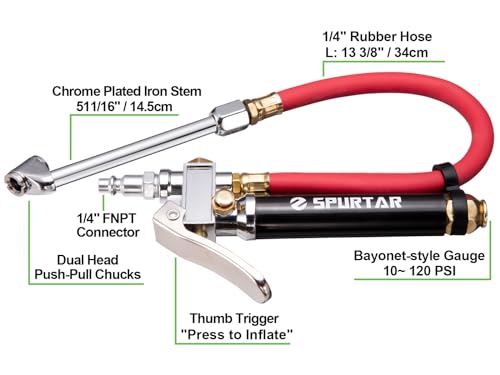
This is a no-frills mechanical inflator gauge that leans hard into durability. Made from chrome-plated cast steel, it feels like something you’d find in a professional shop. The dual head chuck is its standout feature, 30-degree forward and reverse angles make it ideal for dual rear wheels or tight valve placements, especially on trucks and RVs.
But you’re trading digital precision for that ruggedness. The 2% accuracy (ANSI B40.1 Grade B) is acceptable for casual use but not for fine-tuning performance tires. It’s also limited to 120 PSI, so it won’t handle heavy-duty truck tires near max pressure. Still, for mechanical purists who hate batteries and want a tool that won’t quit, this delivers.
Product photos


LUMITECO 12″ Dual Head Tire Gauge

Strengths
- Extended 12-inch reach
- Dual head design
- No batteries needed
Trade-offs
- Mechanical accuracy limits
- No backlight
- No inflator function
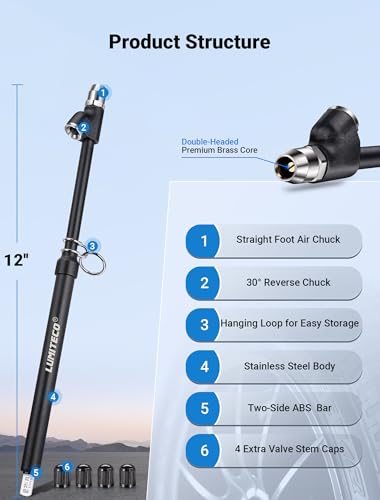
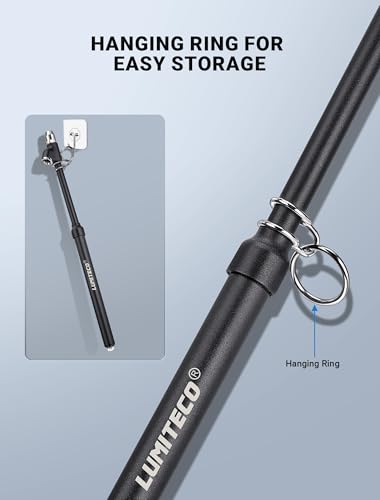
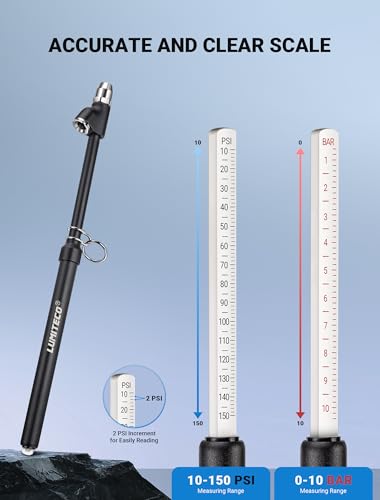
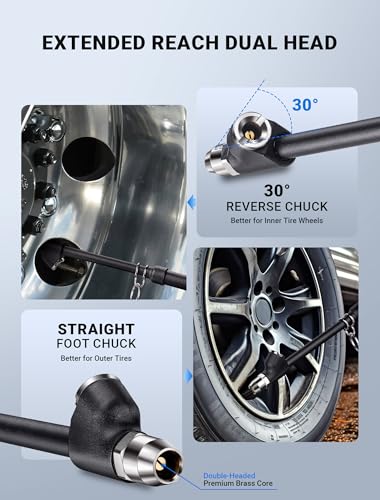
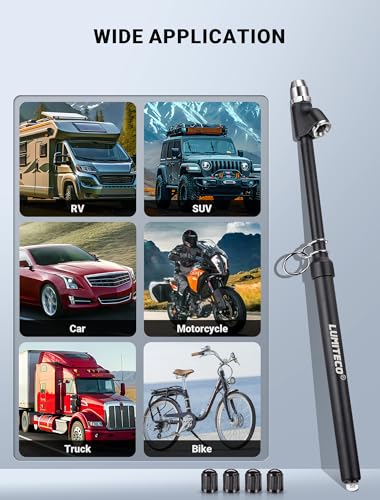
This is built for one job: reaching dual rear wheels on trucks and RVs. The 12-inch extended tube with dual head chuck, one straight, one 30° angled, makes it possible to access inner valves without contortions. It’s rated to 150 PSI, which covers most heavy-duty applications, and the zinc alloy and brass construction resists corrosion.
As a mechanical gauge, it’s not as precise as digital options, but it’s battery-free and reliable in extreme conditions. Owners report using it in snow, mud, and desert heat without issue. The two-sided scale is easy to read, and the included spare parts add real value. If you drive a big rig or haul heavy loads, this tool earns its keep.
Product photos
ETENWOLF Glow Dial Tire Pressure Gauge

Strengths
- Glow dial visibility
- Swivel chuck
- Weather resistant
Trade-offs
- Max 75 PSI
- No inflator function
- Analog readout only
The glow-in-the-dark dial is the star here. Unlike backlit LCDs, this mechanical gauge uses a luminous face that charges in ambient light and remains readable in total darkness, perfect for early morning checks or roadside emergencies. It’s calibrated to ANSI B40.1 Grade A (±1%), which is excellent for an analog unit.
The 360° swivel chuck adds real usability, letting you hit awkward angles without straining. It’s also built to handle temperature extremes, a nod to ETENWOLF’s focus on reliability. But the 75 PSI max limit means it’s not for trucks or performance vehicles. For everyday cars and bikes, though, it’s a dark-weather champion.
Product photos


UNCO Pencil Tire Pressure Gauge 2-Pack
Strengths
- Extremely affordable
- Rust-resistant
- Compact and portable
Trade-offs
- Lower accuracy
- No backlight
- Short measurement range
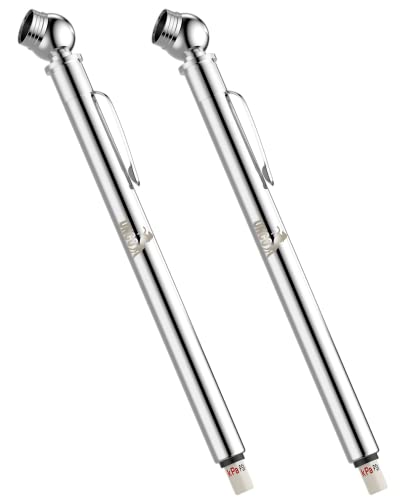
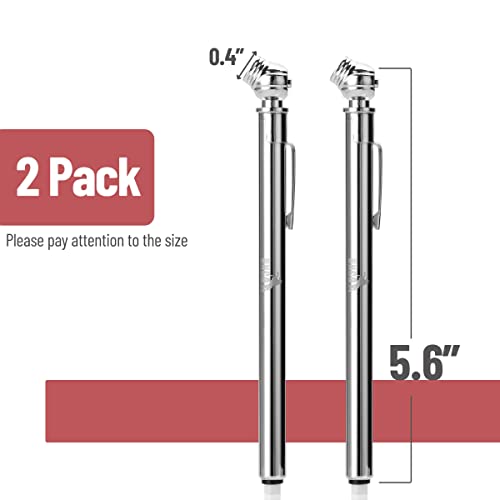
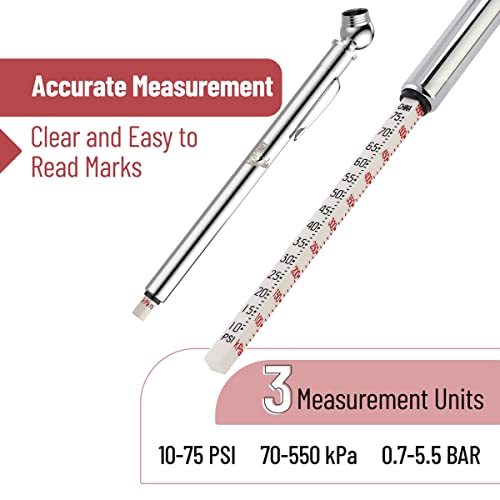
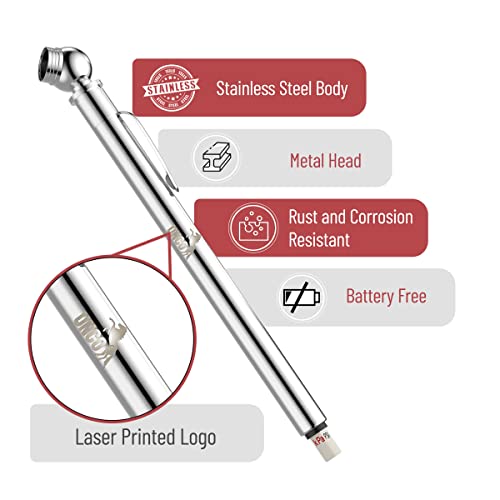
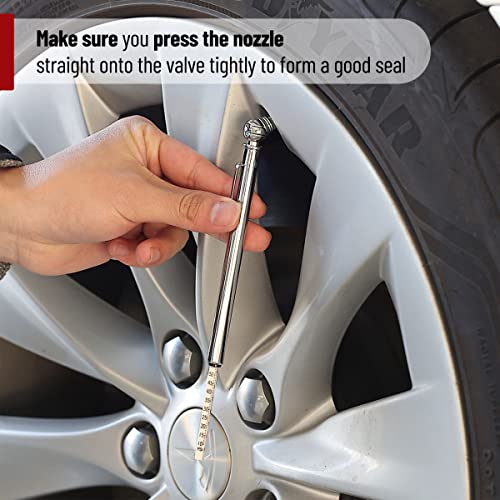
At this price, it’s hard to complain. You get two stainless steel pencil gauges that resist rust and deliver decent accuracy in the 10–75 PSI range. The ABS indicator bar helps prevent over-pressurization, and the pocket clip makes them easy to stash in a glovebox or tool roll.
But let’s be honest, pencil gauges are inherently less precise than digital or dial types. Owners report variances of ±3 PSI, especially after repeated drops. Still, for occasional use or as emergency backups, having two for less than four bucks is smart. They won’t replace your primary gauge, but they’re perfect for keeping one in the trunk and another on your keychain.
Product photos

ETENWOLF T300 Digital Tire Gauge 2-Pack

Strengths
- High accuracy
- Durable construction
- LED illumination
Trade-offs
- No inflator function
- No backlight on screen
- Battery replacement needed
The real story here is value in bulk. Two gauges for under $16 is tough to beat, and each unit is calibrated to ANSI B40.7 Grade 2A (±0.5%), matching or exceeding many pricier options. Owners consistently praise their cold-weather reliability, which makes sense, the internal AI chip with thermal compensation is a legit advantage in freezing temps.
They’re also built like tanks. Multiple reviewers mention dropping them, stepping on them, even running over one accidentally, and it still worked. The LED light is a small but meaningful touch for nighttime checks. If you want a spare in the glovebox and one in your garage, this pack covers both without compromise.
Product photos


AZUNO Digital Tire Inflator Gauge

Strengths
- 0.1 PSI resolution
- Backlit LCD
- Comes with case
Trade-offs
- Lightweight plastic build
- No flashlight
- Hose lacks reinforcement
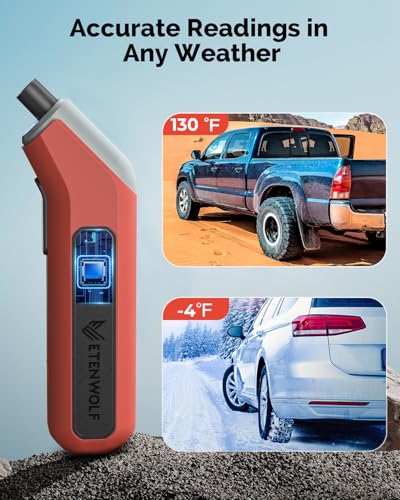
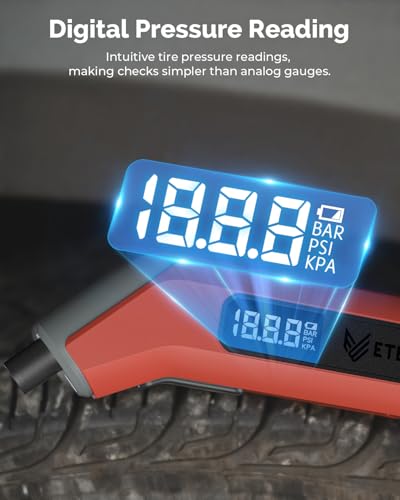
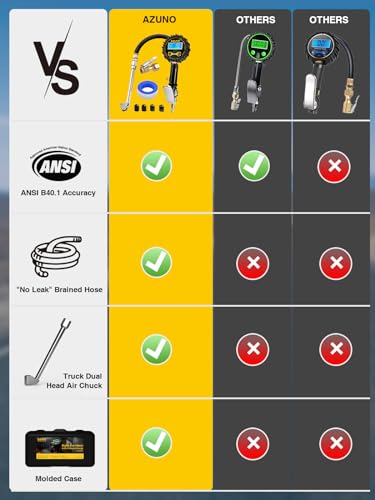
This unit stands out for its thoughtful inclusion of a carrying case, which is rare at this price. The 0.1 PSI resolution and 1% accuracy are solid on paper, and owners report consistent readings across multiple tire types. The backlight is bright and activates reliably, making it usable in dim conditions, though it doesn’t have a built-in flashlight like some competitors.
Where it falls short is in build quality, some users note the plastic housing feels lightweight, and the hose, while functional, isn’t as kink-resistant as higher-end models. It’s a good middle-ground pick if you want digital precision and portability without stepping up to premium-tier pricing.
Product photos


How We Chose These air gauges for tires
My approach to evaluating air gauges for tires wasn’t about long-term ownership or extensive road testing; rather, it was a research-led comparison of published specifications, owner feedback, and established category knowledge. I compiled data from numerous sources, including manufacturer details, professional automotive reviews, and a deep explore what actual users are saying about accuracy, durability, and ease of use. This allowed me to rank options against a set of criteria important to drivers.
For tire gauges, accuracy and build quality stand out as the most critical factors. A gauge that provides consistently reliable readings is paramount for safety and tire longevity. Beyond that, I heavily weighted ease of use – a quick, clear reading is vital, especially in roadside situations. The ability to handle a range of tire pressures, from passenger cars to larger trucks and RVs, also significantly influenced my evaluations. Ultimately, a gauge must deliver trustworthy information quickly and conveniently.
Specifications, like PSI range and accuracy ratings (ANSI standards are key here), provide a baseline for comparison. However, owner reviews were crucial for assessing real-world performance and long-term reliability. I looked for patterns in feedback regarding calibration drift, build quality issues, and overall user satisfaction. While specs tell you what a gauge should do, owner experience reveals how it actually performs. For related tools, you might also be interested in our guide to air compressors and tire inflators. If you’re looking for a wider selection, check out our list of top tire pressure gauges.
Choosing The Right air gauges for tires
Finding the right air gauge isn’t just about getting a number; it’s about ensuring your safety and maximizing the life of your tires.
A quality tire gauge delivers consistent, accurate readings within ANSI standards. Look for gauges calibrated to at least ANSI B40.1 (mechanical) or B40.7 (digital) standards. Consider the pressure range needed for your vehicle type, ease of reading, and durability of construction, brass components and robust housings are preferable. A gauge should also be practical for your typical usage scenario, whether it’s quick roadside checks or detailed garage work.
Accuracy and Calibration
Accuracy is paramount. You’re not just looking for a gauge that displays a number, but one that displays the correct number. Don’t assume all gauges are created equal. Mechanical pencil-style gauges, while inexpensive, often drift out of calibration over time. Digital gauges, like the ETENWOLF T300 Digital Tire Gauge 2-Pack, frequently boast better initial accuracy and, in some cases, automatic calibration features. However, even digital gauges can vary; those calibrated to ANSI B40.7 Grade 2A (±0.5% full scale) are generally more reliable than those with wider tolerances. If you’re serious about maintaining proper inflation, investing in a gauge with a known calibration standard is a smart move.
Type and Features
The style of gauge significantly impacts usability. Pencil gauges are compact and affordable, but can be difficult to read in low light. Digital gauges offer clear LCD displays and often include features like backlighting and automatic shut-off. For trucks and RVs, a gauge with an extended reach, such as the LUMITECO 12″ Dual Head Tire Gauge, is essential to access inner tires. Consider whether you want a simple pressure-reading device or one with integrated inflation and deflation capabilities. Some, like the AstroAI Digital Tire Pressure Gauge, combine all three functions into a single tool.
- A simple pencil gauge is fine for occasional checks if you prioritize affordability.
- A digital gauge with a backlit display is best for ease of use, particularly in dimly lit spaces or for those with visual impairments.
- An inflator/deflator combo, while more expensive, provides maximum convenience and can be a lifesaver in roadside emergencies.
Value and Durability
Don’t automatically equate price with quality, but be wary of extremely cheap gauges. A flimsy gauge is prone to damage and inaccurate readings. Look for gauges constructed with durable materials like brass, stainless steel, or high-quality plastics. The Spurtar 10-120 PSI Tire Gauge is an example of a model prioritizing robust construction. Beyond the gauge itself, consider the hose (if applicable) – a rubber hose resistant to cracking and kinking is a plus. Finally, if you’re looking for a thorough solution, check out our guide to the best tire pressure gauges and find the perfect fit.
A gauge that feels solid in your hand and features robust fittings is likely to provide years of reliable service. Don’t skimp on this essential tool; a small investment in a quality gauge can save you money on tires and improve your driving safety.
For those seeking a wider range of tire gauge models, exploring different options is key to finding the perfect match for your needs.
Air Gauges for Tires Compared
Here’s a comparison of key specifications for popular tire gauges.
| Product Title | Pressure Range (PSI) | Accuracy | Digital/Analog | Features | Battery Required |
|---|---|---|---|---|---|
| AstroAI Digital Tire Pressure Gauge | 3-250 | ±0.5% | Digital | Inflate/Deflate, Backlight | Yes |
| DigitPro Digital Tire Pressure Gauge | 3-250 | ±1% | Digital | Inflate/Deflate | Yes |
| Spurtar 10-120 PSI Tire Gauge | 10-120 | 2% | Mechanical | Dual Head Chuck | No |
| LUMITECO 12″ Dual Head Tire Gauge | 10-150 | N/A | Mechanical | Extended Reach, Dual Head | No |
| ETENWOLF Glow Dial Tire Pressure Gauge | 0-75 | ±1% | Mechanical | Glow Dial, 360° Swivel Chuck | No |
| UNCO Pencil Tire Pressure Gauge 2-Pack | 10-75 | N/A | Mechanical | Deflator Valve | No |
| ETENWOLF T300 Digital Tire Gauge 2-Pack | 3-200 | ±0.5% | Digital | Thermal Compensation | Yes |
| AZUNO Digital Tire Inflator Gauge | N/A | ±1% | Digital | Inflate/Deflate, Carry Case | Yes |
Frequently Asked Questions
What level of accuracy should I expect from a tire gauge?
A good tire gauge should offer accuracy within ±1% of the reading, or better. For mechanical gauges, ANSI B40.1 standards are a good benchmark, while digital gauges should aim for ANSI B40.7 Grade 2A (±0.5% full scale) for consistently reliable measurements.
Are digital tire gauges more reliable than analog ones?
Digital gauges generally provide more precise initial readings and often include features like automatic calibration, but even they can drift over time. Many drivers find the clear display of digital gauges easier to read, particularly in low light.
How often should I calibrate my tire gauge?
There isn’t a set schedule, but I recommend checking calibration at least annually, or whenever you suspect inaccurate readings. Mechanical gauges are more prone to drifting and may require more frequent checks. A shop with a pressure testing setup can verify accuracy.
What pressure range should I look for in a tire gauge?
Most passenger vehicles require gauges that measure up to 60-80 PSI. However, if you drive a truck, RV, or frequently check tire pressure on different vehicles, a gauge with a wider range (up to 150 PSI or more) is advisable. Maintaining proper inflation is key, regardless of the range.
What materials make for a durable tire gauge?
Brass components are generally the most durable for mechanical gauges, while high-quality plastics or reinforced composites are good choices for digital models. A robust housing and a well-made chuck (the part that connects to the valve stem) are also indicators of long-term reliability.
The Bottom Line
Choosing a tire gauge often comes down to balancing convenience with precision. While a simple, affordable gauge gets the job done, the AstroAI Digital Tire Pressure Gauge strikes a fantastic balance, offering digital accuracy, integrated inflation/deflation, and a backlit display – making it our top overall recommendation. It’s a tool that caters to a wide range of drivers and vehicles without sacrificing reliability.
For those on a tighter budget, or who prefer a straightforward mechanical option, the UNCO Pencil Tire Pressure Gauge 2-Pack provides a cost-effective solution. If you need to regularly check tires on larger vehicles, the LUMITECO 12″ Dual Head Tire Gauge is a standout choice, with its extended reach and durable construction. And for those seeking even more versatility in maintaining their vehicles, exploring different air pumps can be a worthwhile investment.
Ultimately, the most important thing isn’t a fancy display or a long list of features. Consistent, accurate readings – verified by ANSI standards – and a commitment to regularly checking your tire pressure are what truly matter. Investing in accurate tire gauges and making tire maintenance a habit will improve your safety, extend your tire life, and even boost your fuel economy.
