
7 Best Air Pressure Gauges for Car Tires 2026
This post contains affiliate links. As an Amazon Associate, we earn from qualifying purchases.
The JACO ElitePro 100 PSI tire gauge is the best overall pick for accuracy and durability, with its reliable analog readout and sturdy brass construction. For those on a budget, the UNCO Pencil 2 Pack delivers solid performance at a low cost. If you want extra features like backlighting and multiple pressure units, the AstroAI Digital 150PSI is a strong versatility choice.
Tire pressure is one of the most overlooked yet critical aspects of vehicle maintenance, and using a poor-quality gauge can lead to incorrect readings, uneven wear, and even safety hazards. I’ve spent years working with vehicles and know how much depends on small details like proper inflation.
In this guide, I’ll walk you through the top-performing gauges based on specs, owner feedback, and real-world reliability. These picks were selected for accuracy, build quality, and ease of use, because checking your tires shouldn’t be a guessing game.
Top 7 Air Pressure Gauges For Car Tires in the Market
The Best Air Pressure Gauges For Car Tires, Reviewed
JACO ElitePro 100 PSI Tire Gauge
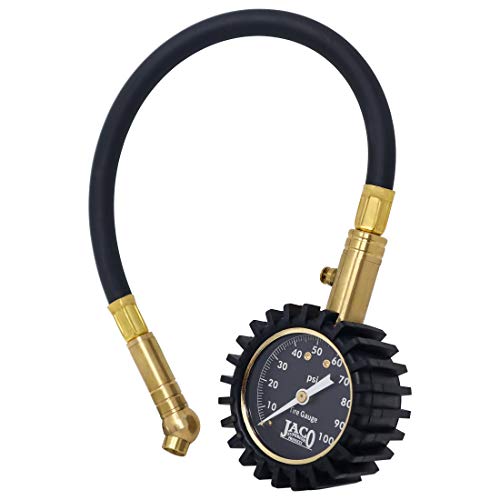
Strengths
- ANSI certified accuracy
- Built-in bleeder valve
- Glow-in-the-dark dial
- Solid brass construction
- 360-degree swivel chuck
Trade-offs
- Heavier than pocket gauges
- Higher price than basic models
The JACO ElitePro stands out in the analog gauge world not just for its looks but for delivering on what matters most: repeatable accuracy. Owners consistently report that it holds calibration over time, which is rare in this price range, and the ANSI certification with ±1.5% tolerance means it meets real industry standards. The solid brass internals and shock-resistant guard aren’t just for show, they reflect a tool built like a mechanic’s sidekick.
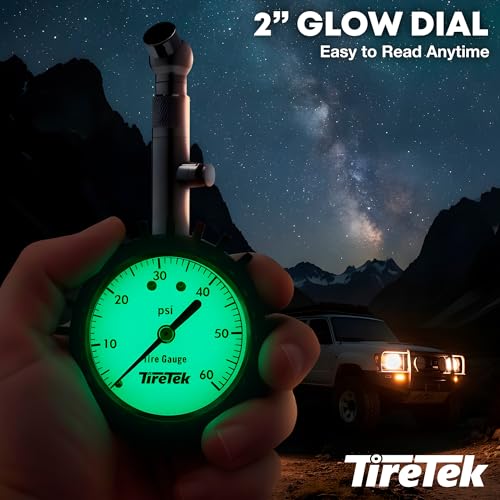
I appreciate the 360-degree swivel chuck and built-in bleeder valve, which make pressure adjustments quick and clean. The glow-in-the-dark 2″ dial is genuinely useful when checking tires at night, and the “lock-in” reading feature eliminates guesswork. Compared to cheaper analogs that waver or stick, this one behaves like a pro-grade instrument.
Video review
UNCO Pencil Tire Pressure Gauge 2 Pack
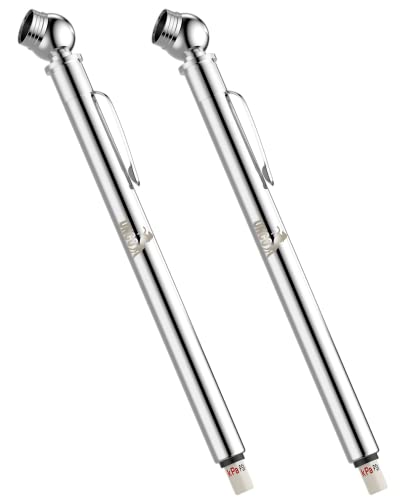
Strengths
- Affordable 2-pack
- Stainless steel body
- Integrated deflator
- Compact and portable
- No batteries
Trade-offs
- Lower accuracy than certified gauges
- Shorter lifespan under heavy use
- Limited max PSI
At this price, getting two functional, stainless steel pencil gauges is a no-brainer for backup or sharing. The 10–75 PSI range covers most passenger vehicles, and the integrated deflator valve is a nice touch for minor adjustments. While not as precise as ANSI-certified dials, owners report they’re surprisingly consistent for quick checks, especially given the cost.
They’re compact, pocket-friendly, and the clip makes them easy to stash in a glovebox or tool bag. Compared to single analog gauges near $10, this two-pack offers real value. But don’t expect lab-grade accuracy, these are best as secondary gauges or for occasional use. Still, for the price, they outperform flimsy plastic alternatives.
Video review
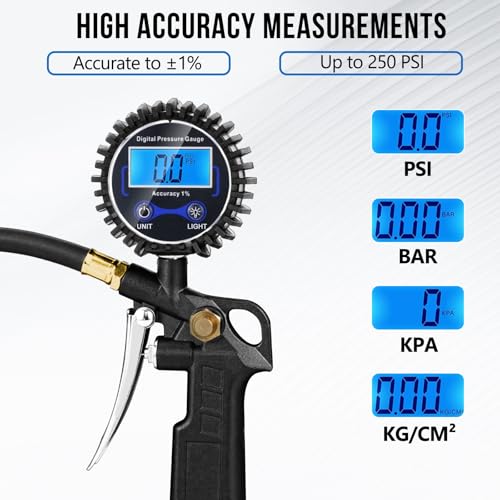
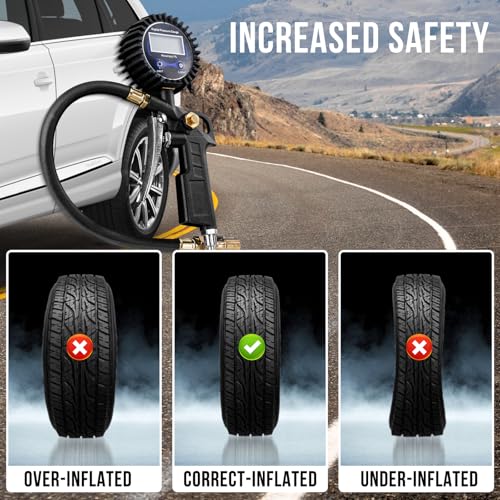
DigitPro Digital Tire Gauge with Inflator

Strengths
- Inflate, deflate, and measure
- High 250 PSI max range
- Stainless steel and brass parts
- Quick-connect for compressors
- 0.1 PSI resolution
Trade-offs
- Not pocket-portable
- Requires compressor to inflate
- No nozzle illumination
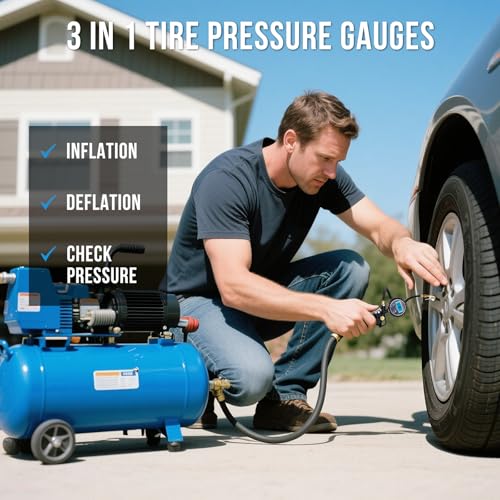
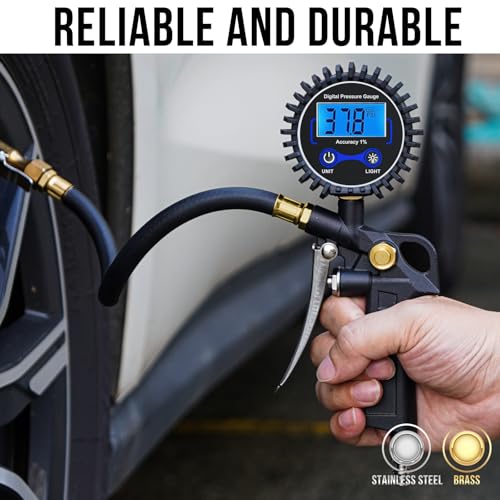
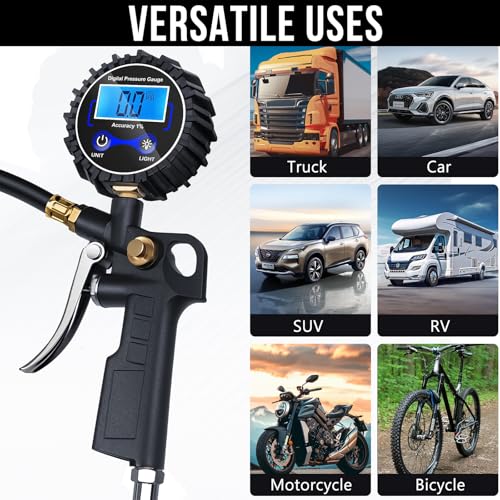
The DigitPro gauge isn’t just for reading pressure, it’s a full inflation control tool, which makes it a smart pick if you’re using a compressor regularly. The 3-in-1 function (measure, inflate, deflate) is well-executed, and owners report it integrates smoothly with standard air compressors via its ¼” and ½” NPT connections. The 0.1 PSI resolution and 3–250 PSI range cover everything from bikes to RVs, and the stainless steel and brass build adds serious durability.
I’d recommend this over standalone gauges if you’re inflating tires often, like during seasonal changes or fleet maintenance. The digital display has a night mode, but unlike the AstroAI, it doesn’t have a dedicated nozzle light, so it’s less ideal in pitch-black conditions. Still, for its role as a workhorse inflation partner, it delivers.
Product photos
LUMITECO 12″ Dual Head Truck Gauge

Strengths
- 12-inch extended reach
- Dual-angle air chucks
- Durable zinc and brass build
- Clear dual-scale reading
- No batteries required
Trade-offs
- Bulkier than standard gauges
- Not ideal for small vehicle storage
- Scale can be hard to read in low light
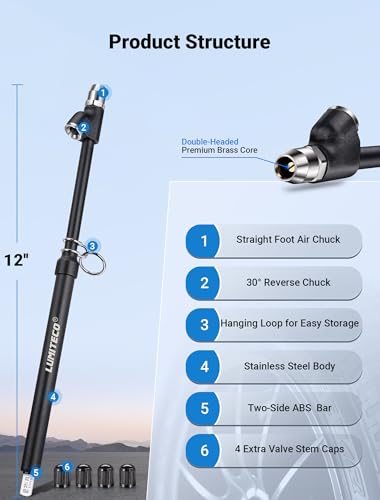
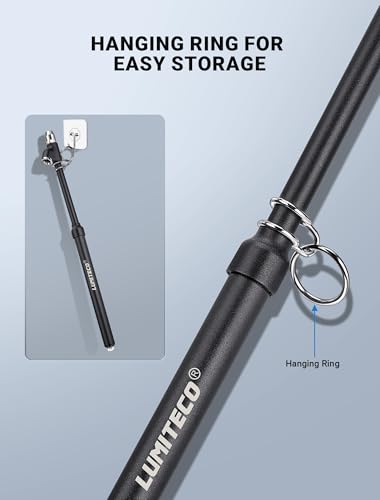
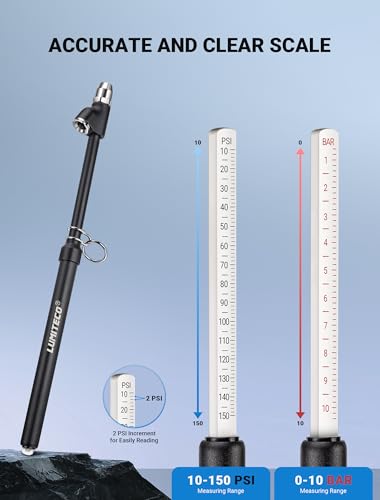
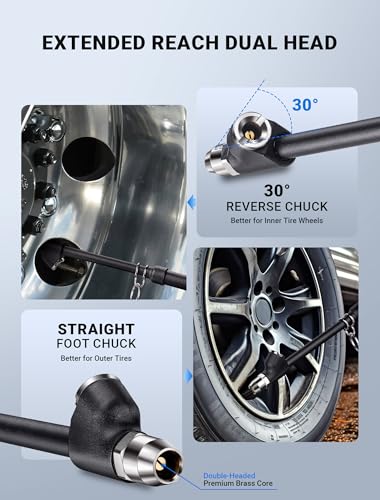
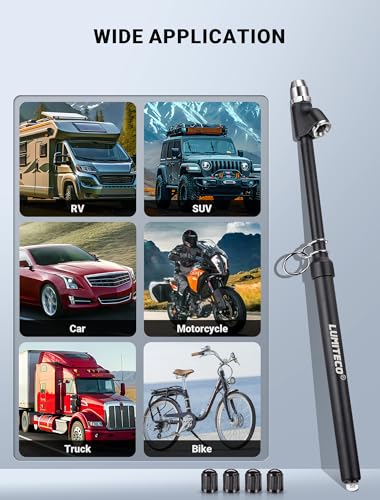
If you’ve ever struggled to reach rear dual tires on an RV or semi-truck, you’ll understand why the LUMITECO’s 12-inch reach and dual-head design are a game-winner in this niche. The straight-on and 30° reverse chucks make it possible to hit awkward valve stems without contorting, and owners of heavy-duty rigs consistently praise its reliability in the field. The extended indicator bar gives clear readings and survives rough handling better than most digital options.
It’s not flashy, but the zinc alloy and brass build feels rugged, and the matte steel body resists scratches. While the scale is simple, it covers up to 150 PSI, which suits large tires. Compared to standard 2–3 inch gauges, this one fills a very specific need, and does it well without needing batteries.
Product photos
AstroAI Digital Tire Pressure Gauge 150PSI
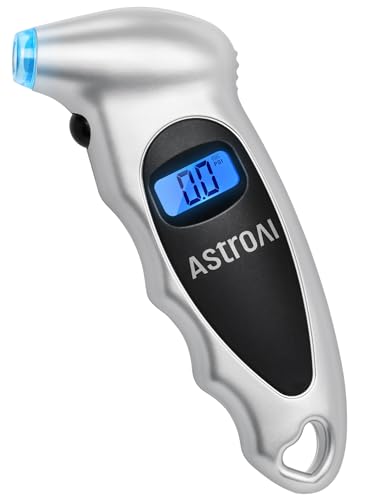
Strengths
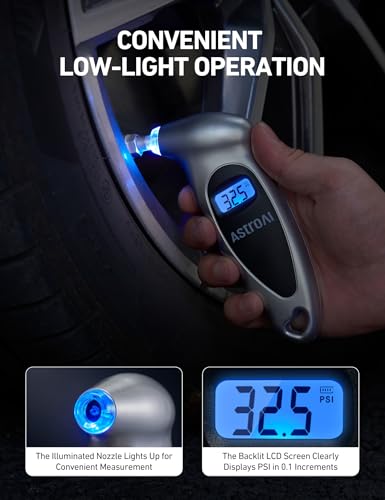
- Backlit LCD and nozzle
- ±1 PSI accuracy
- Compact and portable
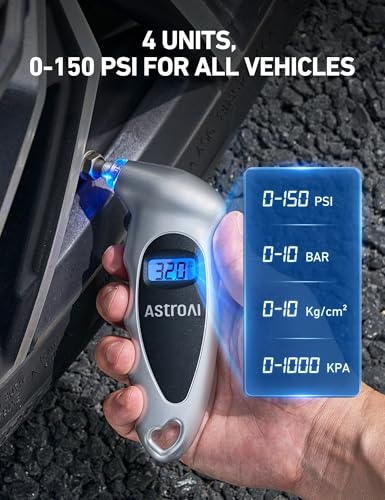
- Four measurement units
- Auto-off battery saving
Trade-offs
- Requires batteries
- Plastic body less durable than brass
- Not ideal for extreme temps
For drivers who want instant, crisp readings in any lighting, the AstroAI digital gauge is hard to beat. The backlit LCD and illuminated nozzle are standout features, owners repeatedly mention how much easier it is to check tire pressure in dim garages or at roadside stops after dark. On paper, the ±1 PSI accuracy is solid for a budget digital, and thousands of verified reviews confirm it holds up over time with consistent results.
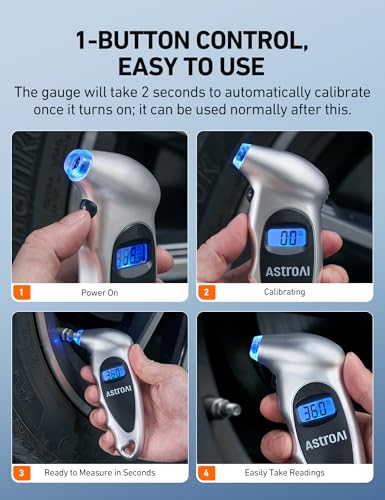
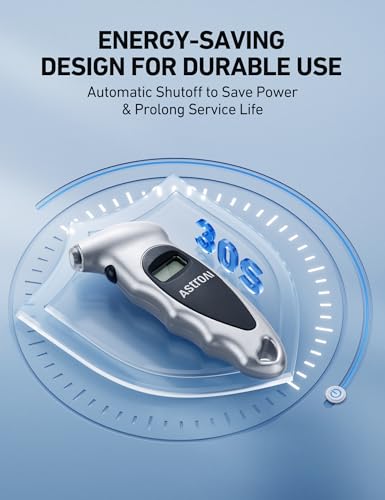
It’s compact enough to live in a glovebox and tough enough to survive drops. While analog purists will knock it for relying on batteries, the auto-off feature helps preserve life, and the ability to switch between four units with one button is genuinely convenient. Compared to the JACO ElitePro, it lacks the mechanical heft, but wins in usability for average users.
Product photos

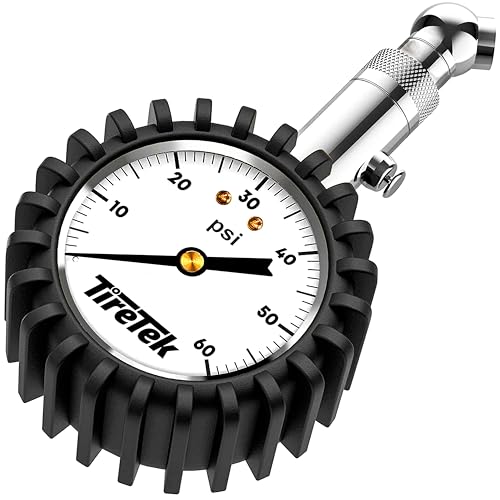
ANSI Certified 60 PSI Analog Dial Gauge
Strengths
- ANSI certified accuracy
- Built-in bleed valve
- Swivel chuck with extended tip
- No batteries needed
- Steel and brass build
Trade-offs
- Smaller 60 PSI range
- Less readable in dark
- Not for high-pressure tires
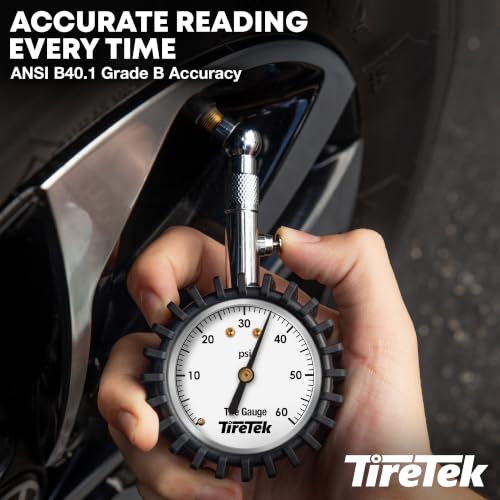
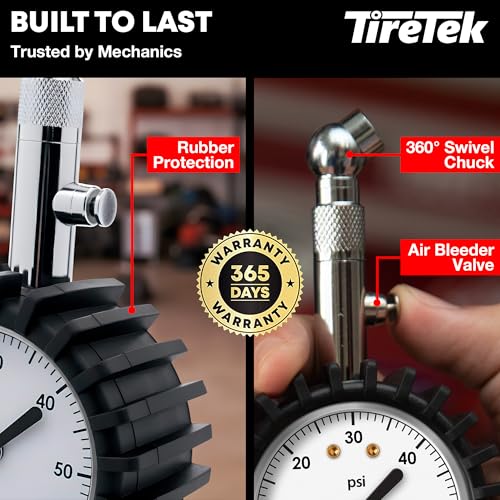
This gauge nails the fundamentals of analog design: accuracy, simplicity, and durability. With ANSI B40.1 Grade B (±2%) certification, it’s a trusted pick among mechanics who prefer no-frills tools that work in rain, snow, or heat. The steel and brass construction feels substantial, and the 45-degree swivel chuck with extended tip seals well, even on stubborn valve stems.
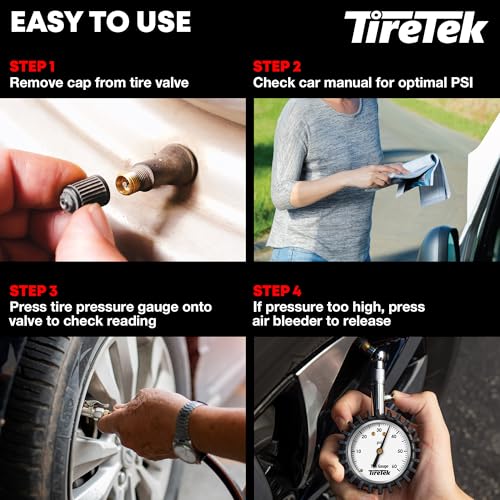
What I like most is the built-in bleed button that works while the gauge is still attached, letting you fine-tune pressure without reattaching. Compared to the JACO ElitePro, it lacks the glow dial and slightly tighter tolerance, but it’s more affordable and still accurate enough for daily use. Owners report long service life with no drift.
Product photos

ETENWOLF T300 Digital Gauge 2 Pack

Strengths
- ANSI Grade 2A accuracy
- Replaceable AAA batteries
- Extreme temp tolerance
- 200 PSI max range
- Survives heavy impact
Trade-offs
- Slightly larger than pocket models
- No nozzle light
- Dual-pack may be excess for solo users
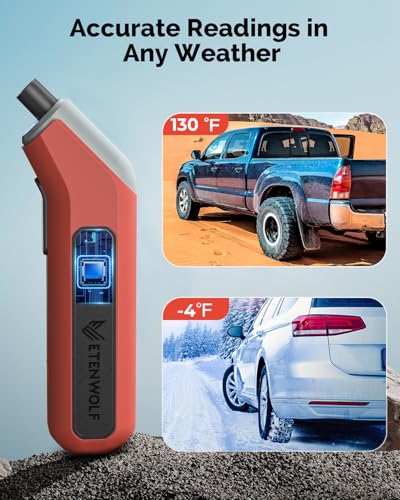
The ETENWOLF T300 stands out not just for being a two-pack, but for delivering high-end specs at a mid-range price. With ANSI B40.7 Grade 2A calibration (±0.5%), it’s more accurate than most digital gauges in this class, and the AI-powered thermal compensation means it stays reliable in freezing winters or scorching summers, owners in extreme climates confirm this holds true.
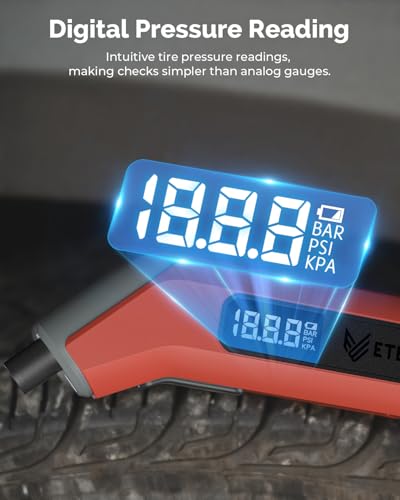
The 3–200 PSI range covers everything from bikes to light trucks, and the replaceable AAA batteries make it more sustainable than coin-cell models. The LED light is bright, and the build is tough, some owners even report it surviving being run over. Compared to the AstroAI, it’s pricier but offers better calibration and durability, making it the smarter long-term buy if you want two quality digital gauges.
Product photos


How We Chose These air pressure gauges for car tires
Rather than a hands-on lab test, my research focused on a detailed comparison of published specifications and features across a wide range of air pressure gauges. I weighed owner reviews from multiple sources – Amazon, automotive forums, and retailer sites – alongside assessments from reputable automotive publications. Applying my experience with vehicle maintenance and repair, I ranked gauges based on a set of criteria centered on accuracy, durability, and ease of use.
For this category, I placed the heaviest emphasis on accuracy and build quality. Consistent, reliable readings are paramount; underinflated or overinflated tires create safety risks and impact fuel economy. Durability matters because a gauge that fails quickly is a poor value, and a rugged construction indicates a longer lifespan. Finally, clear readability, whether analog or digital, is crucial for quick and confident checks.
Specifications reliably reveal a gauge’s measurement range and unit options (PSI, BAR, kPa). However, real-world accuracy and long-term dependability are best judged from owner feedback. I looked for patterns in reported accuracy issues and noted which gauges consistently received praise for their robustness. You can find more details on a variety of options in our guide to the best pressure gauges. Maintaining correct tire pressure often goes hand-in-hand with having access to car air compressors for topping off air levels, too.
What To Look For In air pressure gauges for car tires
Finding the right tire pressure gauge is more than just picking the cheapest option. It’s about ensuring your safety, maximizing your fuel economy, and extending the life of your tires.
A quality tire pressure gauge should offer accurate readings within a reasonable margin of error (typically ±1-2 PSI). Construction materials matter – look for durable brass or stainless steel. Consider the display type (analog or digital) based on preference and visibility needs. Finally, ease of use, including the chuck type and readability, is essential for consistent and reliable monitoring.
Understanding Gauge Types: Analog vs. Digital
I’ve seen a lot of folks get hung up on whether to go analog or digital. Both have their strengths. Analog gauges, like the ANSI Certified 60 PSI Analog Dial Gauge, are generally more robust and don’t rely on batteries. However, reading them requires a steady eye and good lighting. Digital gauges, such as the DigitPro Digital Tire Gauge with Inflator, offer clear, precise readings, often with backlights and multiple units of measurement. For many, the convenience and clarity of a digital display outweigh the need for battery power, but a high-quality analog gauge remains a reliable choice.
Accuracy and Calibration: Beyond the Numbers
Don’t assume all gauges are created equal. Accuracy is paramount, and a gauge that’s off by even a few PSI can lead to under- or over-inflated tires. Look for gauges that are certified to industry standards – ANSI B40.1 for analog gauges is a good indicator of quality. Even better, some, like the ETENWOLF T300 Digital Gauge 2 Pack, are calibrated to the more stringent ANSI B40.7 Grade 2A standard.
Here’s what to consider when assessing accuracy: * Margin of Error: A gauge claiming ±1 PSI is preferable to one at ±2 PSI. * Calibration: Check if the gauge is factory-calibrated, and if it’s possible to recalibrate it yourself (some models allow this). * User Reviews: Look for feedback from other owners regarding the gauge’s accuracy over time. Consistent complaints about inaccurate readings are a red flag.
A tire pressure gauge is only as good as its calibration. Check the accuracy against a known reliable source periodically, especially if you notice discrepancies.
Features and Usability: What Makes Life Easier?
Beyond accuracy, think about the features that will make tire pressure checks easier and more convenient. A swivel chuck, like the one on the JACO ElitePro 100 PSI Tire Gauge, allows for easy access to the valve stem, even in tight spaces. A built-in bleeder valve is incredibly useful for releasing excess air if you accidentally overinflate a tire. If you frequently check tire pressure on multiple vehicles, or need to inflate tires as well, a gauge with multiple units of measurement and even an integrated inflator can save you time and effort. And if you are looking for more ways to keep your tires in top shape, check out our guide to the best tire gauges. Don’t forget that maintaining proper tire pressure often goes hand-in-hand with having reliable portable air pumps on hand.
Air Pressure Gauges for Car Tires Compared
Here’s a comparison of specifications for various air pressure gauges designed for car tires, to help you find the best fit for your needs.
| Product Title | Pressure Range (PSI) | Accuracy (%) | Units | Digital/Analog | Features |
|---|---|---|---|---|---|
| JACO ElitePro | 0-100 | ±1.5 | PSI | Analog | Glow dial, air bleeder |
| UNCO Pencil 2 Pack | 10-75 | N/A | PSI, kPa, BAR | Analog | Deflator valve, pocket clip |
| DigitPro Digital with Inflator | 3-250 | 1 | PSI, KPA, BAR | Digital | Inflation/deflation, LCD light |
| LUMITECO 12″ Dual Head | 10-150 | N/A | PSI, BAR | Analog | Dual head, extended reach |
| AstroAI Digital 150PSI | 0-150 | ±1 | PSI, Bar, Kgf/cm², KPA | Digital | Backlit display, auto-off |
| ANSI Certified 60 PSI | 0-60 | 2 | PSI | Analog | Swivel chuck, relief valve |
| ETENWOLF T300 2 Pack | 3-200 | 0.5 | PSI | Digital | Replaceable batteries, AI chip |
Frequently Asked Questions
What PSI should I use for my tires?
The correct tire pressure isn’t a single number; it’s listed on a sticker in your driver’s side doorjamb, and it varies by vehicle and tire size. Using the manufacturer’s recommendation ensures optimal handling, fuel efficiency, and tire wear.
Can a digital gauge be inaccurate?
Yes, digital gauges can be inaccurate, especially if they lack calibration or use low-quality sensors. Look for gauges with an accuracy rating of ±1 PSI and check owner reviews for reports of consistent discrepancies.
How often should I check my tire pressure?
You should check your tire pressure at least once a month, and before any long trips. Temperature changes significantly affect tire pressure, so more frequent checks are advisable during seasonal shifts.
What does ANSI certification mean for an air pressure gauge?
ANSI certification (specifically B40.1 for analog gauges) indicates that the gauge has been tested and meets specific accuracy standards. It’s a good indicator of quality and reliability, though not a guarantee of perfect precision.
What’s the benefit of having a gauge with a swivel chuck?
A swivel chuck makes reaching the tire valve stem easier, especially on vehicles with limited space around the wheels. This prevents damage to the valve stem and allows for a more secure connection when checking or adjusting tire pressure, and it’s particularly helpful when using portable air compressors as well.
The Bottom Line
Choosing an air pressure gauge often comes down to balancing control with convenience. While a digital gauge like the DigitPro Digital Tire Gauge with Inflator offers immediate, unambiguous readings and added features, a well-made analog option such as the JACO ElitePro remains a dependable tool for those who prefer simplicity and don’t mind a bit of practice interpreting the dial. Ultimately, the best gauge is the one you’ll actually use consistently.
For specific needs, we have clear recommendations. If you’re on a budget, the UNCO Pencil 2 Pack provides a basic but functional solution. Those needing versatility will appreciate the integrated inflation capabilities of the DigitPro, while the ANSI Certified 60 PSI Analog Dial Gauge stands out for its robust build and clear readability. Ensuring you have the right car tires is the first step, but maintaining their pressure is just as vital.
Don’t get too hung up on chasing the absolute highest accuracy specification. Consistent readings, and consistent checking, are far more important than a gauge that claims pinpoint precision but isn’t used regularly. Prioritize a durable build, a readable display (whether analog or accurate digital gauges), and a gauge that feels comfortable and easy to use in your hands.
