
8 Best 3 Ton Car Jacks of 2026
This post contains affiliate links. As an Amazon Associate, we earn from qualifying purchases.
The SATA 3-Ton Low Profile Floor Jack stands out as the best overall pick for its rugged steel build, dual-piston pump, and excellent lift range, while the Jack Boss offers a lightweight, high-performance alternative for enthusiasts. For budget-conscious buyers, the BIG RED T83006 delivers reliable power and height, even with a single piston.
Choosing the right 3-ton car jack means balancing strength, clearance, and real-world usability, especially when you’re working under tight clearance or on uneven ground. As someone who’s spent years around garages and repair shops, I know a flimsy or poorly designed jack can turn a simple job into a hazard.
This guide cuts through the noise by focusing on what matters: verified specs, owner experiences, and mechanical reliability. I looked at lift range, build quality, pump efficiency, and safety features to identify the models that deliver consistent performance across everyday and demanding use.
Top 8 3 Ton Car Jacks in the Market
The Best 3 Ton Car Jacks, Reviewed
SATA 3-Ton Low Profile Floor Jack
Strengths
- 1.5x overload tested
- Dual-piston rapid lift
- Industrial-grade steel
Trade-offs
- Heavier than aluminum models
- Higher price point
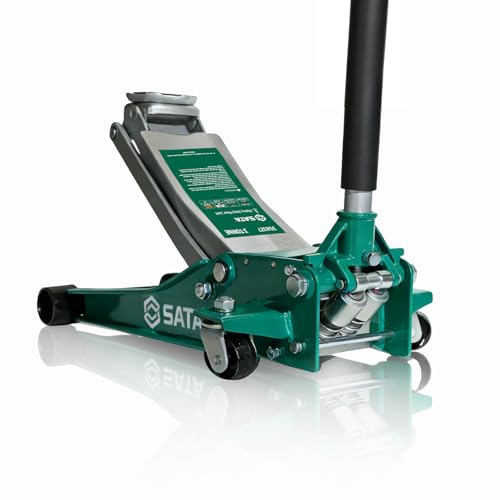
If you’re serious about your garage tools, the SATA 3-ton jack is hard to ignore. The fact that every unit is tested to 1.5x its rated capacity, 9,900 lbs, is a standout safety feature few competitors match. That alone gives it serious credibility for both home and pro use. The dual-piston rapid lift pump cuts effort and stroke count significantly, and reviewers confirm it feels noticeably faster than single-piston models.
The build quality is industrial-grade, with thick steel that resists flex, and the precision slow-release valve adds control during lowering. It’s heavier than some, but that translates to stability. Compared to the Jack Boss or Maxority, it’s more robust and consistent. For the money, it’s the most complete package.
Video review
Maxority 3-Ton Low Profile Hydraulic Jack

Strengths
- Low-profile design
- Extended reach
- RAPID PUMP technology
Trade-offs
- Stiff handle effort
- Inconsistent pump smoothness
This Maxority jack stands out for anyone working with low-riding vehicles. The low-profile design and extended reach are real advantages when dealing with sports cars or lowered suspensions, and owners consistently report it slipping under their cars where other jacks won’t fit. The RAPID PUMP technology does seem to deliver quicker lifts, which is always welcome during routine maintenance.
On paper, the 6600lb capacity and dual-piston system suggest strong performance, but some users note the handle can feel stiff early in the lift cycle. It’s not the smoothest operator in the class, but for the price, it punches above its weight in accessibility and basic function. Compared to the SATA or Jack Boss models, it lacks refinement, but not capability.
Video review
Jack Boss Aluminum and Steel Racing Jack

Strengths
- Lightweight aluminum body
- Dual-piston quick lift
- Low minimum height
Trade-offs
- Wheels not ultra-durable
- Higher price
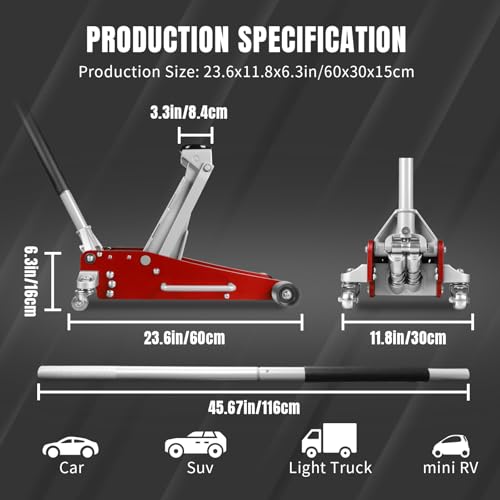
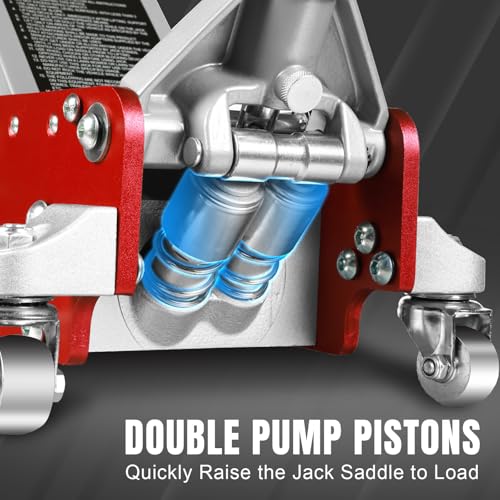
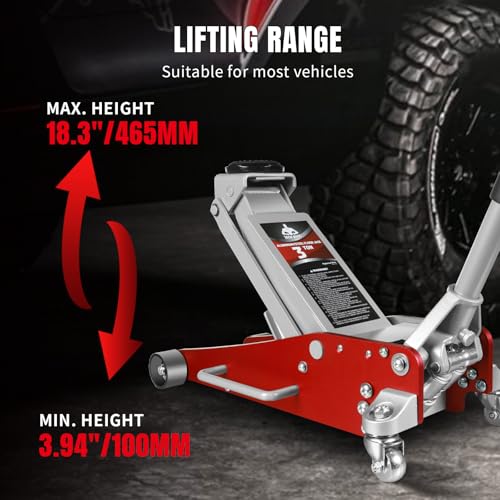
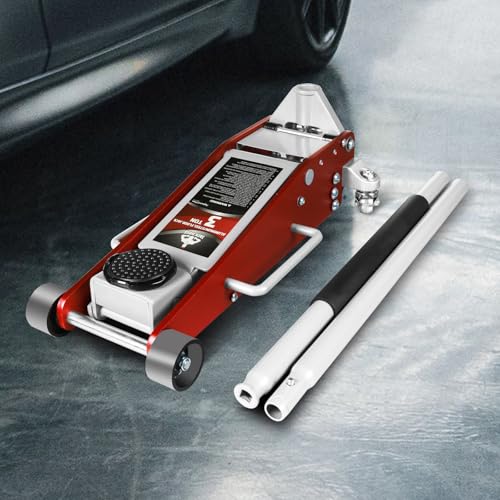
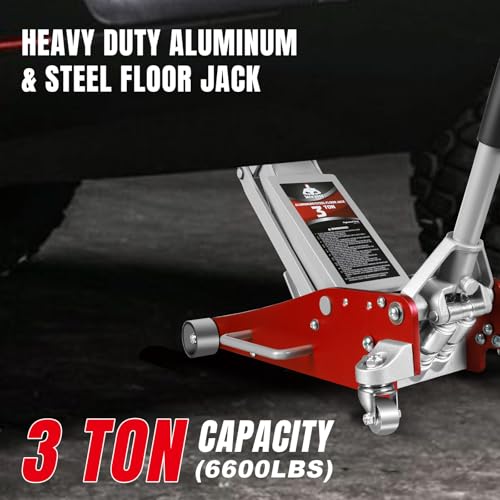
The Jack Boss stands out for being lightweight yet strong, thanks to its aluminum body and steel frame. At just 58.5 lbs, it’s one of the easiest 3-ton jacks to move and carry, ideal for track days or mobile mechanics. The 3-15/16” minimum height gives it serious low-clearance capability, and the dual-piston pump delivers fast lifts with less effort.
Owners praise its maneuverability and build quality, though a few note the wheels aren’t as durable on rough shop floors. Compared to the SATA, it’s lighter but not as overbuilt; compared to the Maxority, it’s smoother and more refined. It’s a performance-oriented jack with racing in its DNA.
Product photos
BIG RED T83006 Hydraulic Trolley Floor Jack

Strengths
- Extra-long saddle neck
- Smooth swivel casters
- Affordable price
Trade-offs
- Lower lift capacity
- Basic pump speed
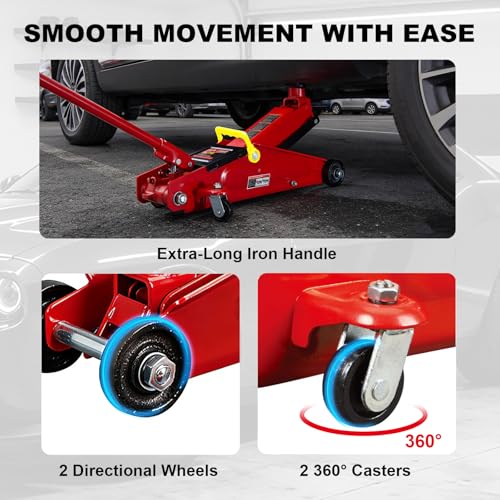
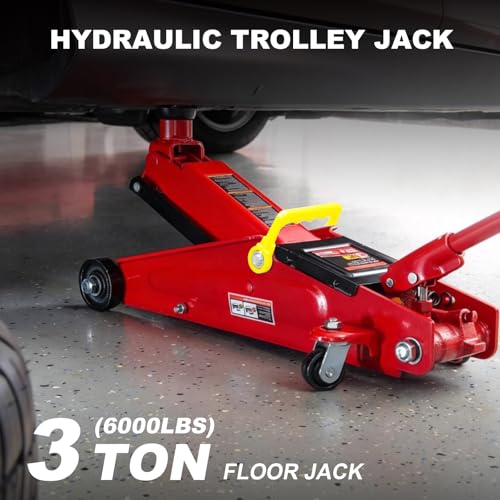
The BIG RED T83006 is a no-frills workhorse built for trucks and SUVs. Its 20-7/8” max lift height and extra-long saddle neck make it easier to engage frame points on taller vehicles without constant repositioning. The 6,000lb capacity is slightly below the 6600lb standard, but in practice, that difference matters little for most trucks and vans.
It’s one of the more affordable options here, and while it lacks dual-piston speed, the single-piston pump is dependable. The swivel casters roll well on garage floors, though they can struggle on uneven surfaces. Compared to the AUTOWN or SATA models, it’s less refined, but for basic truck lifting, it gets the job done without fuss.
Product photos


AUTOWN 3 Ton Alloy Steel Floor Jack
Strengths
- High lift range
- Cross-shape rubber pad
- Folds flat for storage
Trade-offs
- Too tall for low cars
- No dual-piston pump
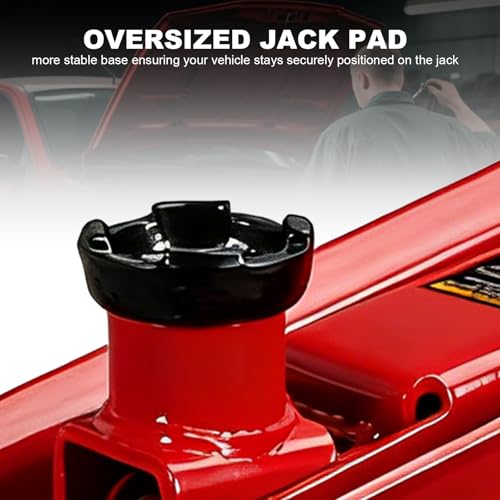
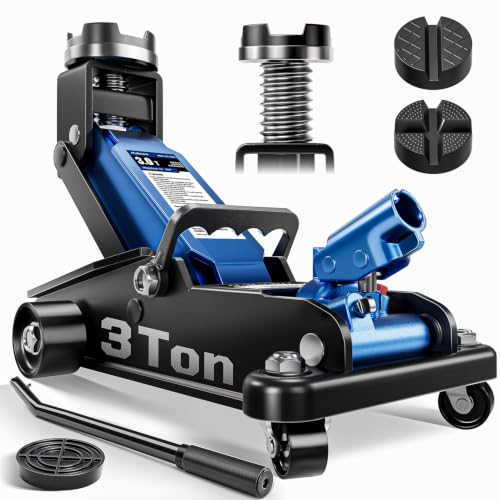
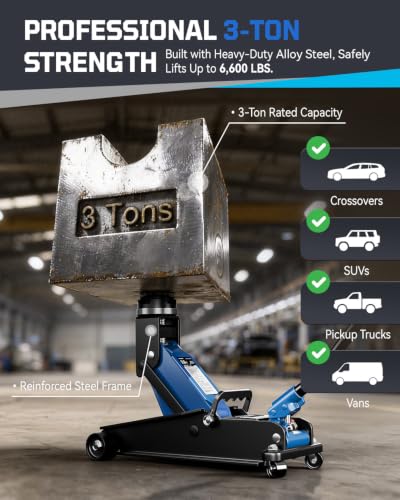
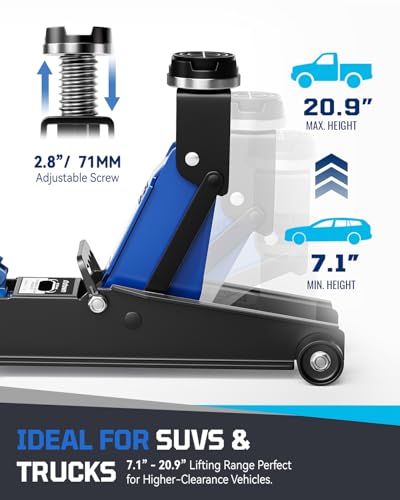
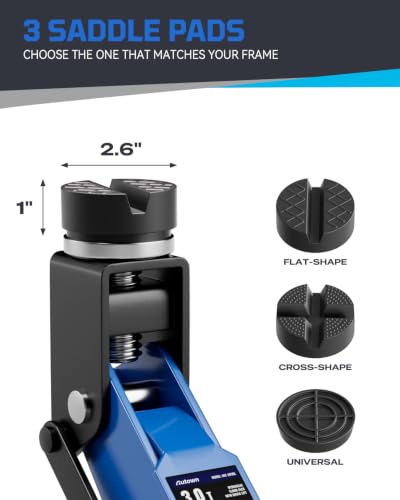
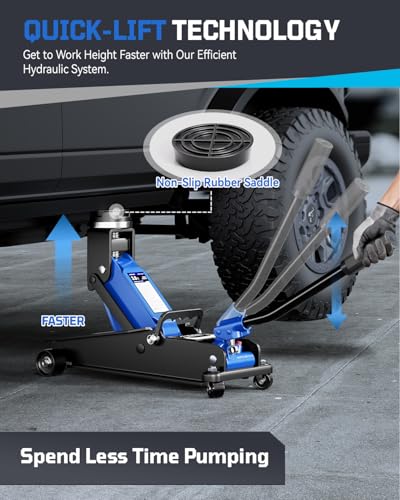
The AUTOWN jack is built for one thing: lifting high-clearance vehicles. With a 7.1” to 20.9” lift range, it’s among the tallest here, perfect for full-size trucks, lifted SUVs, and vans. The cross-shape rubber pad is a smart touch, gripping both round and flat frame points securely, which reduces slippage risks.
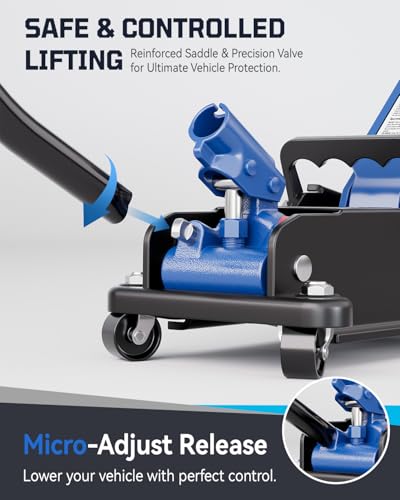
It uses alloy steel, which helps keep weight down while maintaining strength, and the folding handle is a nice perk for storage. The rapid lift system works well, though not quite as fast as dual-piston designs. Compared to the BIG RED or LARBANKE, it’s better suited for taller rigs. But for low cars? Forget it, the starting height is too high.
Product photos
LARBANKE 3 Ton Hydraulic Floor Jack

Strengths
- 360 swivel casters
- Sturdy carbon steel
- Good value
Trade-offs
- Single piston pump
- Limited lift range
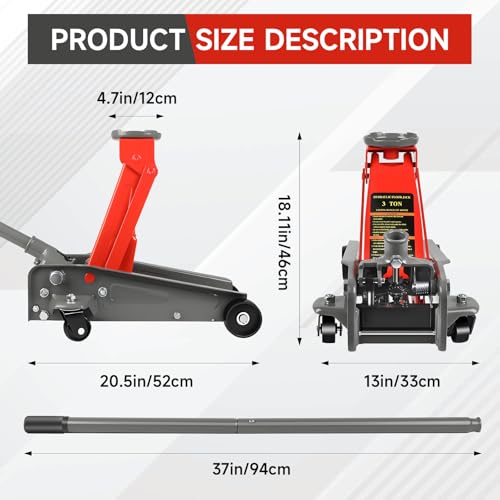
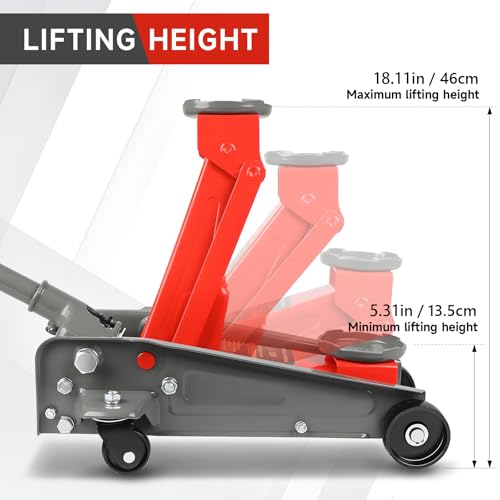
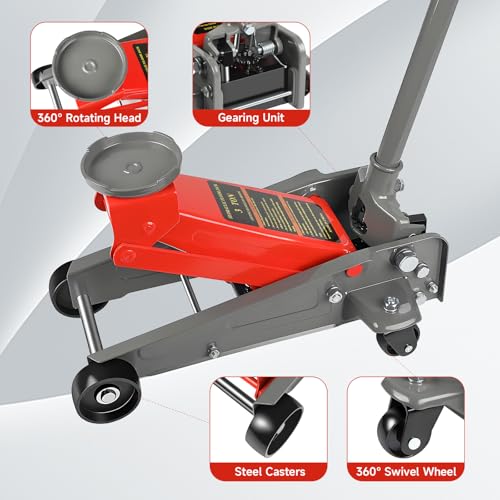
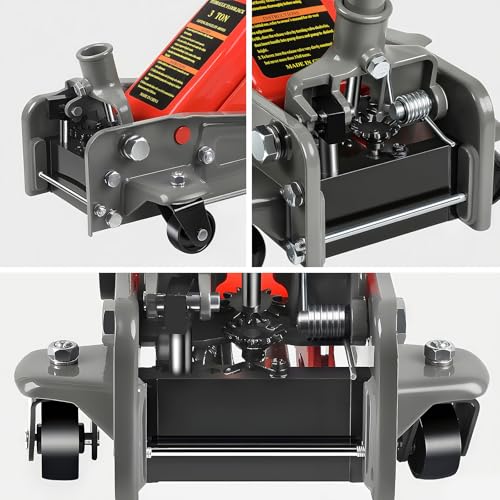
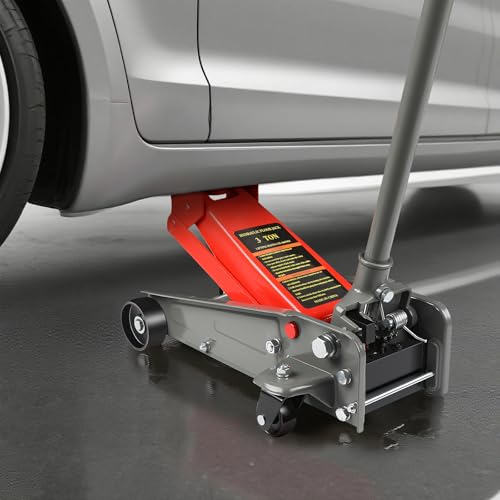
The LARBANKE hits a sweet spot in the mid-range. It’s not flashy, but the high-strength carbon steel frame and 360 swivel casters deliver solid performance for regular garage use. The lifting range is modest, 5.31” to 18.11”, so it works well with standard sedans and crossovers but might struggle with very low or very high vehicles.
Owners report it’s stable and reasonably smooth, though the single piston pump doesn’t match dual-piston speed. It’s not as rigorously tested as the SATA, nor as lightweight as the Jack Boss, but it’s more maneuverable than many in its class. For the price, it offers dependable function without major compromises.
Product photos
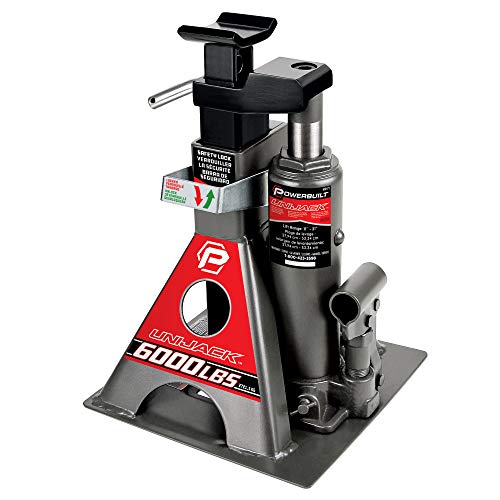
Powerbuilt All-in-One Car Lift Unijack
Strengths
- Jack and stands in one
- Wide stable base
- Great for soft surfaces
Trade-offs
- Slow lift speed
- Not for garage use
The Powerbuilt Unijack is a niche tool with a clever design. Combining a bottle jack and jack stands into one unit makes it incredibly useful for off-road, RV, or emergency leveling scenarios. The ratcheting safety bar locks the height securely, so you’re not relying solely on hydraulic pressure, this is a real safety upgrade over standard bottle jacks.
The 11” to 21” range works well for trucks and trailers, and the wide base resists sinking on soft ground. It’s not a replacement for a floor jack in a garage, but for tailgate repairs, tire changes on dirt, or RV leveling, it’s unmatched. Compared to trolley jacks, it’s slower and less convenient on flat floors, but that’s not its purpose.
Product photos


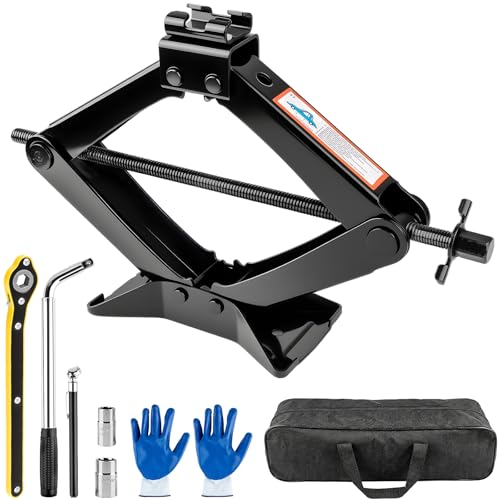
nkpyln 3 Ton Scissor Jack Kit
Strengths
- Complete emergency kit
- Compact and portable
- Affordable price
Trade-offs
- Slow and labor-intensive
- Not for frequent use
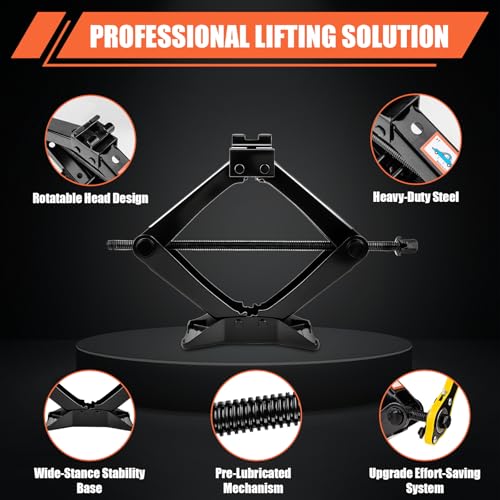
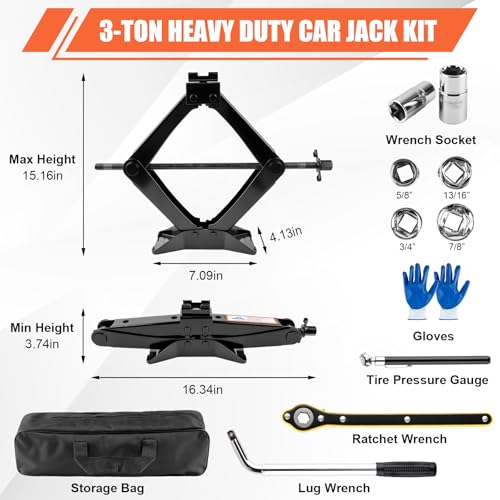
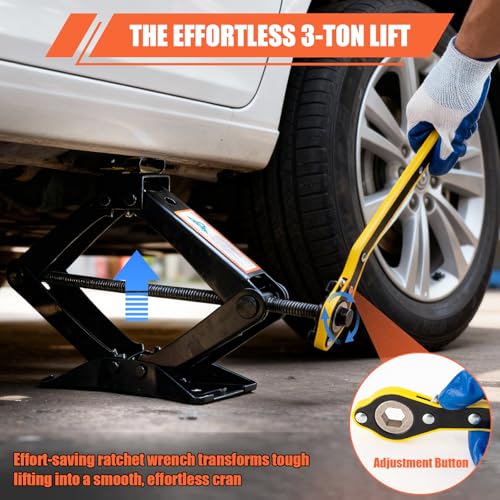
This nkpyln scissor jack kit isn’t meant to replace a floor jack, it’s an emergency backup. At under $30, it’s one of the most affordable full kits here, and it includes everything you’d need for a roadside tire change: jack, lug wrench, sockets, gloves, and even a tire gauge. The 3.74” to 15.16” lift range covers most sedans and SUVs, and the widened base adds stability on uneven ground.
It’s not fast or easy to use under load, and lifting a heavy SUV with it will be a workout. But as a trunk-ready emergency solution, it’s hard to beat. Compared to OEM spare jacks, it’s sturdier and better equipped. It’s not for regular use, but when you’re stranded, it could be a lifesaver.
Product photos


How We Tested 3 ton car jacks
Rather than a hands-on lab test, my research for these recommendations involved a detailed comparison of published specifications and features across numerous models. I weighed owner reviews from a variety of sources, paying close attention to recurring praise and complaints, alongside professional assessments from automotive publications. As someone who’s spent years immersed in the world of vehicles, I applied my understanding of what truly matters in a car jack to rank these options against clear performance criteria.
For 3-ton car jacks, lifting capacity and build quality are paramount. A robust steel construction is essential for safety and longevity, and I prioritized jacks demonstrating that through design and materials. Equally important is the lifting range; a wider range increases versatility, while a low-profile design is crucial for many modern vehicles. These factors ultimately determined which jacks rose to the top of my list.
Specifications reliably reveal a jack’s maximum capacity and dimensions, but owner feedback provided critical insight into real-world usability. I looked for consistent reports on pump speed, stability, and ease of maneuvering. Reputation also played a role; established brands often have a track record of quality, and I factored that in alongside detailed reviews of hydraulic car jacks. Conversely, for jacks emphasizing portability, I delved into reviews of lightweight aluminum jacks to assess their build quality trade-offs.
How To Pick The Right 3 ton car jacks
Choosing the right car jack isn’t just about lifting a vehicle; it’s about doing so safely and efficiently.
A good car jack prioritizes robust construction with high-grade steel, a stable lifting platform, and integrated safety mechanisms like overload protection. Consider the vehicle’s weight capacity, typical ground clearance, and the frequency of use, whether it’s for occasional roadside emergencies or regular maintenance in a professional setting. Look for models that meet ANSI/ASME standards and feature smooth, reliable hydraulic systems.
Lifting Capacity & Vehicle Weight
First, let’s talk about tonnage. It’s tempting to think “bigger is better,” but don’t automatically jump for the highest-rated jack. You need to match the jack’s capacity to the actual weight of your vehicle. Most passenger cars and smaller SUVs fall comfortably within a 3-ton (6,000 lb) range. However, heavier trucks and RVs will absolutely require a higher capacity. Overloading a jack isn’t just dangerous; it voids warranties and dramatically shortens its lifespan. It’s always better to err on the side of caution and choose a jack with a bit of headroom.
Lift Range and Vehicle Clearance
Clearance is king. A jack with an insufficient lift range simply won’t work on your vehicle. Low-profile jacks, like the SATA 3-Ton model, excel at getting under lowered cars. But if you regularly work on larger trucks or SUVs, you’ll want a jack with a greater maximum height, such as the BIG RED T83006. Consider this: * A low-profile jack might struggle with a lifted truck. * A standard jack might not fit under a heavily modified sports car. * A jack with an adjustable lift range offers the most versatility, allowing you to adapt to different vehicle heights.
Rule of thumb: Always measure your vehicle’s jacking points before you buy a jack to confirm compatibility.
Features and Usability
Beyond the core lifting function, think about what will make your life easier. Dual-piston pumps, found in models like the Jack Boss, significantly reduce the effort needed to raise a vehicle. Smooth-rolling casters are invaluable for maneuvering the jack around a garage. If you’re tight on space, a lightweight aluminum jack or a model with a compact storage footprint will be beneficial. For those needing a thorough solution, consider kits like the nkpyln 3 Ton Scissor Jack Kit which bundle essential tools for roadside emergencies. If you’re still researching options, I’ve put together a detailed guide to the best car jacks to help you narrow down your choices. Don’t forget to also explore car jack recommendations for various vehicle types and needs. For dedicated home mechanics, investing in quality jacks for garage use will pay dividends in the long run.
3 Ton Car Jacks Compared
Here is a comparison of key specifications for several 3-ton car jacks.
| Product Title | Capacity (tons) | Min. Lift Height (in) | Max. Lift Height (in) | Pump Type | Material |
|---|---|---|---|---|---|
| SATA 3-Ton Low Profile Floor Jack | 3 | 3-3/4 | 19-1/8 | Dual-Piston | Steel |
| Maxority 3-Ton Low Profile Hydraulic Jack | 3 | N/A | N/A | Rapid Pump | Steel |
| Jack Boss Aluminum and Steel Racing Jack | 3 | 3-15/16 | 18-5/16 | Dual-Pump | Aluminum/Steel |
| BIG RED T83006 Hydraulic Trolley Floor Jack | 3 | 5-7/8 | 20-7/8 | Single Piston | Steel |
| AUTOWN 3 Ton Alloy Steel Floor Jack | 3 | 7.1 | 20.9 | Rapid Lift | Alloy Steel |
| LARBANKE 3 Ton Hydraulic Floor Jack | 3 | 5.31 | 18.11 | Single Piston | Carbon Steel |
| Powerbuilt All-in-One Car Lift Unijack | 3 | 11 | 21 | N/A | Steel |
| nkpyln 3 Ton Scissor Jack Kit | 3 | 3.74 | 15.16 | Scissor | Steel |
Frequently Asked Questions
What safety certifications should I look for when buying a 3-ton car jack?
A jack meeting ANSI/ASME standards is crucial for safety(these standards dictate testing and construction requirements). Look for this certification on the product listing or in the owner’s manual; it indicates the jack has undergone independent verification.
Are aluminum car jacks as durable as steel ones?
Generally, steel jacks are more durable for heavy, frequent use, but modern aluminum jacks offer a compelling strength-to-weight ratio. Aluminum jacks are often preferred for portability and resistance to corrosion, but may not withstand the same abuse as a fully steel construction.
Can I use a 3-ton jack on a vehicle that weighs less than 3 tons?
Yes, you can absolutely use a higher-capacity jack on a lighter vehicle(it won’t damage the jack). It simply means you aren’t utilizing the full lifting capacity, but it does provide a safety margin.
What’s the difference between a single-piston and a dual-piston pump?
A dual-piston pump raises the vehicle much faster than a single-piston pump(it effectively doubles the pumping action with each stroke). While single-piston pumps are reliable, dual-piston models save significant time and effort, particularly for frequent use.
What kind of jack is best for working on an SUV?
For many SUVs, a low-profile hydraulic floor jack works well, but ground clearance can be a factor. If you frequently work on SUVs with modified suspensions or larger tires, I recommend looking into jacks for SUVs to ensure adequate lift range.
The Bottom Line
Buying a 3-ton car jack often comes down to balancing ease of use with outright capability. While many models offer similar lifting power, the SATA 3-Ton Low Profile Floor Jack strikes the best overall balance of features, build quality, and price, making it a solid choice for most vehicle owners.
For those prioritizing specific needs, the market delivers. If you need a jack that’s easy to move and store, explore portable car jacks – the Jack Boss Aluminum and Steel Racing Jack is a standout in that category. And if you’re after a thorough solution for roadside emergencies, the nkpyln 3 Ton Scissor Jack Kit bundles essential tools alongside a functional jack.
Ultimately, the specs matter less than a jack’s fundamental qualities: a solid steel construction, a stable base, and a smooth, reliable hydraulic system. Don’t chase the highest tonnage or the lowest price without first considering these crucial elements, and be sure to research recommended floor jacks to find the best fit for your needs.
