
Safety Compared: Are Side by Sides Safer Than ATVs? Data
This post contains affiliate links. As an Amazon Associate, we earn from qualifying purchases.
Side-by-side vehicles (SxS/UTVs) are not categorically safer than all-terrain vehicles (ATVs). The perception of safety comes from automotive-like features, roll cages, seatbelts, steering wheels, but the injury data, particularly for children, shows higher rates of severe upper-extremity fractures and a greater likelihood of being pinned in rollovers compared to ATVs. Safety hinges entirely on using the seatbelt to stay within the roll cage’s zone of protection, a rule most riders ignore.
That gap between perceived and actual safety is where the real danger lives. A roll cage does nothing if you are thrown from it, and a 1,500-pound machine tumbling over is a physics problem, not a feature checklist.
What follows: the specific pediatric injury data that flips the script, the engineering reasons SxS vehicles tip so easily, and the three safety behaviors that separate a close call from a life-altering injury. By the end, you’ll read a spec sheet not as a list of features, but as a list of conditions that must be met for those features to work.
Key Takeaways
- Seatbelts are the entire system. A roll-over protective structure (ROPS) only works if the seatbelt keeps you inside it. In documented crashes, two-thirds of injured occupants were ejected.
- Children face disproportionate risk. Nearly half of those injured in SxS crashes are under 16, and pediatric upper-extremity fractures from SxS accidents are more likely to be open and require surgery than those from ATVs.
- Rollovers happen on flat ground. Directional instability can cause a tip at lateral accelerations as low as 0.25 g, often during a turn, not just on extreme slopes.
- Public roadways multiply severity. Over 60% of crashes occur on paved roads, where ejection leads to worse head trauma and longer ICU stays compared to off-road incidents.
- The vehicle’s design is a starting point. Modifications like larger tires or added cargo shift the center of gravity and can nullify the factory’s stability calculations.
The Core Safety Paradox: Perception vs. Data
You see a steering wheel, bucket seats, and a steel frame. It looks like a small car. The natural assumption is that it must be safer than straddling an ATV. This perception is the primary driver behind SxS sales now doubling those of ATVs. The reality documented by trauma surgeons and engineers is a mismatch.
A 2024 study focusing on pediatric upper extremity fractures found that injuries from SxS accidents were more likely to be open wounds and require surgery compared to ATV injuries. The study noted that SxS drivers tended to sustain left-side injuries, while passengers got hurt on the right side, a direct map of where limbs are positioned when gripping the interior during a roll.
Where this goes sideways: Assuming the roll cage makes the vehicle inherently safe. In a multi-state analysis of crash reports, two-thirds of victims were ejected from the SxS. A roll cage only protects occupants who stay within it.
The Consumer Product Safety Commission (CPSC) data groups fatalities, and while raw numbers show more ATV deaths, the rate and severity of injuries in SxS crashes tell a different story. The injuries are different. An ATV rider might be thrown clear. A SxS occupant who unbuckles can be caught, crushed, or pinned by the very structure meant to protect them. This is why understanding ATV safety for kids involves different risk calculations than for side-by-sides.
| Safety Feature | Perceived Benefit | Actual Risk If Misused |
|---|---|---|
| Roll Cage (ROPS) | Contains occupants in a rollover. | Becomes a crushing weight if occupant is ejected and pinned. |
| 3-Point Seatbelt | Keeps occupant in protective zone. | Worn by less than a third of injured riders; without it, all other features are irrelevant. |
| Automotive Controls | Feels familiar and stable. | Can encourage overconfidence and operation on paved roads, where most crashes occur. |
| Side-by-Side Seating | Allows passenger conversation. | Passenger limbs are exposed to the vehicle’s interior during a roll, leading to patterned fractures. |
How Side-by-Sides Actually Fail
The failure modes are predictable outcomes of vehicle physics and human behavior. A standard SxS configuration is directionally unstable.Engineering tests have recorded a transition to severe oversteer at lateral accelerations as low as 0.25 to 0.3 g’s. That’s not a high-speed maneuver; it’s a moderate turn taken with a bit too much throttle.
The Static Stability Factor (SSF), a ratio of half the track width to the center of gravity height, is a key metric. A lower SSF means a lower threshold for tipping. Consumer modifications are a major problem here. Adding a lift kit, larger tires, or a roof-mounted cargo box directly raises the center of gravity. That changes the SSF, moving the vehicle closer to its rollover threshold without any warning to the driver. This is a critical consideration when choosing ATVs for farming or utility work, where stability under load is non-negotiable.
Rollovers are the dominant crash mechanism, accounting for 50-70% of incidents in studies. And they are not just for steep hills. CPSC data indicates a significant portion occur on flat terrain during turning. The vehicle’s high center of gravity and relatively narrow track width create the potential. The driver’s input, speed, steering angle, throttle, triggers it.
A 2010 SAE International technical paper on rollover resistance explicitly notes that rider interactions and modifications critically affect the stability engineers designed for.
The second major failure is occupant ejection. The CDC SxS crash characteristics report from an analysis of newspaper narratives found ejection rates around 66%. When the vehicle rolls, an unbelted body becomes a projectile inside a tumbling metal cage. After ejection, the next event is often being struck or pinned by the vehicle, which weighs over half a ton. This sequence, roll, eject, pin, is responsible for the most severe crush injuries and fatalities.
The Pediatric Injury Picture: A Specific Warning
The data on young riders is stark and should reset any family’s risk assessment. In the Iowa off-road vehicle surveillance study, 39% of injured SxS occupants were 17 or younger. Nearly half of those were under 16, the manufacturer’s stated minimum operator age. Of these injured children, almost half were operating the vehicle at the time of the crash.
This isn’t just about broken bones. The pediatric upper extremity study highlighted a grim distinction: SxS-related fractures in children had a 42% open fracture rate, compared to 7% for ATVs. Open fractures mean the bone has broken through the skin, bringing a high risk of infection and complex surgery. Furthermore, 70% of these SxS fractures required surgical intervention.
Common mistake: Letting a child ride as a passenger without proper restraint. The passenger seat is the most dangerous place in a rollover for a child. Their smaller size means factory seatbelts don’t fit correctly, and their limbs are more likely to be trapped.
The dynamics differ from adults. Children have a higher center of gravity relative to their size when seated, and they lack the muscle mass to brace themselves effectively. They are also more likely to be passengers, and passengers in the Iowa study were injured in non-collision events like rollovers 90% of the time. This underscores why dedicated youth ATVs with speed limiters and appropriate sizing exist, they are engineered for a different set of physical and cognitive capabilities.
Seatbelts, Roll Cages, and the 30 MPH Rule
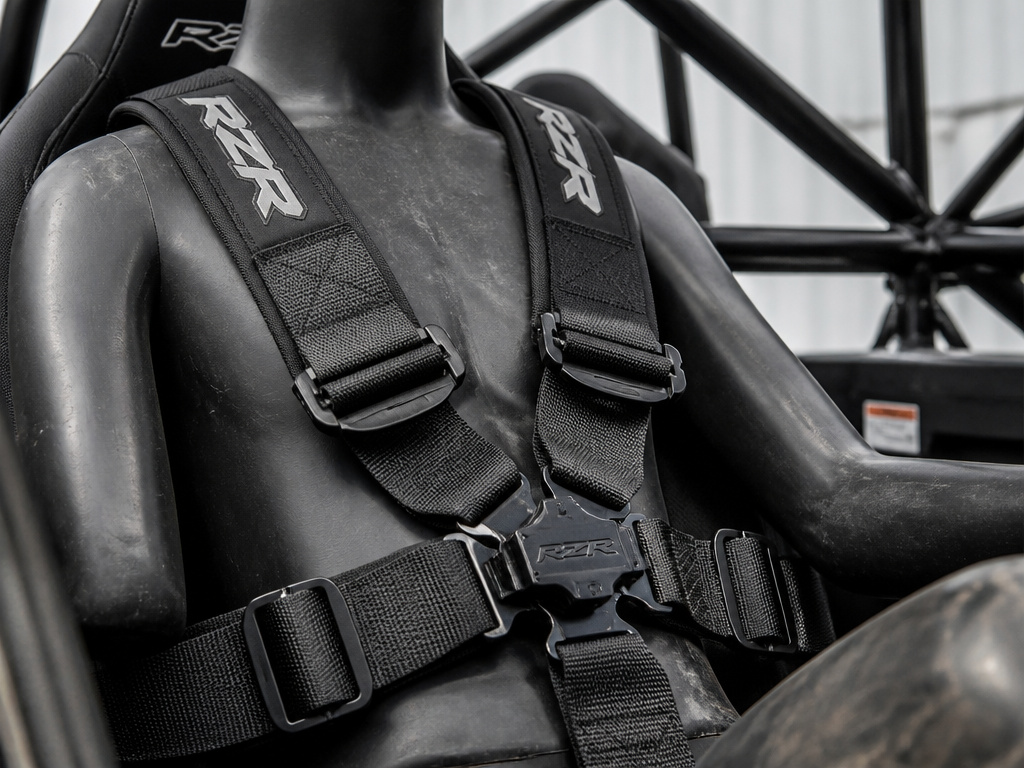
This is the mechanical heart of the safety question. The roll cage is formally called a Roll-Over Protective Structure (ROPS). Its job is to maintain a survival space around the occupants if the vehicle ends up on its roof or side. For it to work, you must be inside that space.
The seatbelt’s sole purpose is to keep you within the ROPS’s zone of protection. This is the mechanical link that makes the entire passive safety system function. Data from the Iowa study is unequivocal: only 32% of injured occupants were wearing a seatbelt.The other 68% negated their primary defense.
There’s a regulatory threshold that highlights this link. In the United States, all UTVs capable of speeds of 30 mph or more are required to have a ROPS and seatbelts or harnesses at each seating position. This federal rule recognizes that beyond a certain speed, the energy in a crash or rollover is too great for a rider to stay in place by strength alone. The vehicle itself must provide the containment. This rule shapes the design of every modern electric side-by-sides and traditional models.
The “or harnesses” part is key for off-road use. A five-point harness, properly worn, prevents “submarining” (sliding under the lap belt) and keeps the torso firmly against the seat during violent maneuvers. For serious trail riding or racing, harnesses are a worthwhile upgrade from standard three-point belts.
The part nobody mentions: The seatbelt anchor points and the ROPS are engineered as a single system. Adding aftermarket seats or harnesses without verifying their compatibility with the factory mounting points can compromise the system’s strength in a crash.
Side-by-Side vs. ATV: A Direct Comparison
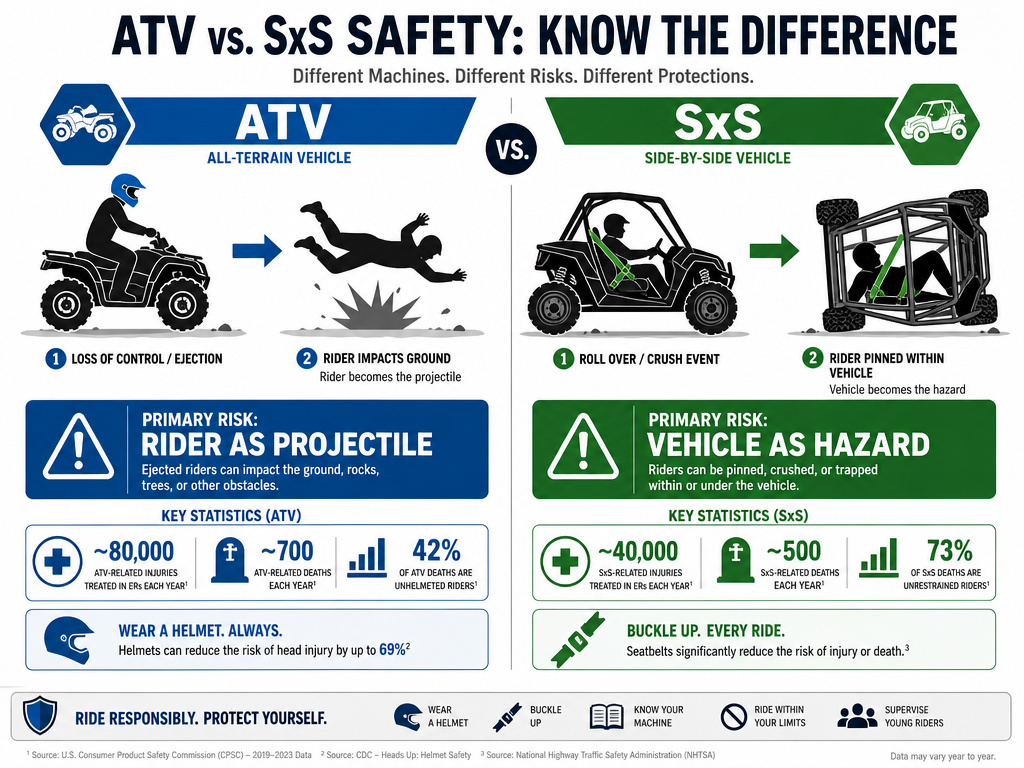
The choice between an ATV and a SxS isn’t just about safety; it’s about matching the machine to the task and the terrain. Each has a distinct risk profile that changes with how and where it’s used.
An ATV’s main risk is a rider being separated from the vehicle, thrown off in a rollover or collision. The injury is often a blunt trauma from hitting the ground or an object. The rider is the projectile. This is why helmet use is the non-negotiable rule for ATV safety, and why understanding ATV trail regulations is so important for managing speed.
A SxS’s main risk is the occupant being trapped with the vehicle. The injury is often a crush or complex fracture from being pinned against the interior or under the structure. The vehicle itself is the hazard. This makes the seatbelt the non-negotiable rule.
| Aspect | Side-by-Side (SxS/UTV) | All-Terrain Vehicle (ATV) |
|---|---|---|
| Primary Crash Mechanism | Rollover (often on flat ground during a turn) | Rollover or collision (often on uneven terrain) |
| Key Protective Gear | Seatbelt/Harness (to stay in ROPS) | Helmet (to protect head on impact) |
| Typical Severe Injury | Crush injury, open extremity fracture, pinning | Head trauma, spinal injury, blunt force trauma |
| Common Risk Factor | Unbelted operation, paved road use, modifications | Unhelmeted operation, carrying passengers, excessive speed |
| Best Use Case | Hauling cargo/tools, multi-passenger transport, slow-speed work | Maneuvering tight trails, solo recreation, navigating uneven ground |
For utility work, a 4×4 ATV might be more nimble for checking fences, while a SxS is better for hauling feed or tools with a helper. For snow, both can be fitted with plows, but the enclosed cab of a SxS is a clear comfort advantage, though stability on icy snowy conditions remains a concern for both.
The Public Roadway Problem
Manufacturer manuals are clear: these are off-highway vehicles. Their tires, suspension, and high center of gravity are not designed for paved surfaces. Yet, the Iowa data found over 60% of SxS crashes occurred on public roadways. Of those, most were single-vehicle, non-collision events, meaning a rollover without another car hitting them.
The physics are simple. Knobby, low-pressure off-road tires have a small, inconsistent contact patch on asphalt. They are designed to dig into dirt, not grip smooth pavement. This reduces lateral stability precisely when higher speeds are tempting. A turn that would be fine on a trail can cause the tires to slip and the vehicle to trip over its own geometry on pavement.
The consequences are worse. Victims injured on roadways had higher rates of abnormal Glasgow Coma Scale scores (indicating head trauma) and were more likely to require intensive care. The harder surface and potential for secondary impacts with road signs or curbs increase severity. This illegal and dangerous practice is a major contributor to the injury statistics that fuel the safety debate.
Safety Rules That Aren’t Optional
If you operate or ride in a SxS, these are the conditions under which the vehicle’s safety features can function.
- Wear the Seatbelt. Every Time. This is the first and last rule. It applies to every occupant, on every ride, regardless of distance or speed. A rollover can happen in your driveway.
- No Riders Under 12. Manufacturers state passengers should be at least 12 years old and large enough to sit with their back against the seat and feet flat on the floor. Factory seatbelts are not designed for small children. If they can’t meet this fit test, they shouldn’t be in the vehicle.
- Operators 16 and Older Only. The cognitive and physical demands of handling a multi-thousand-pound machine are real. This is a manufacturer specification, not an arbitrary number.
- Stay Off Public Roads. Unless your local jurisdiction has specifically legalized it for direct agricultural access, keep it off the pavement. The vehicle isn’t built for it, and it’s often illegal.
- Avoid Modifications That Affect Stability. If you add something, tires, lift, cargo rack, understand it changes the center of gravity. Drive accordingly, with reduced speed and more caution in turns.
- Drive for Conditions, Not for Thrills. Most rollovers occur at speeds under 20 mph. Smooth inputs on the throttle and steering are more important than horsepower, especially when considering electric ATVs with their instant torque.
For transporting your machine safely to the trail, using a proper side-by-side trailers is part of the safety chain, avoiding risky road miles.
Frequently Asked Questions
Do side-by-sides roll over more easily than ATVs?
They roll over differently. ATVs tip from rider weight shift and high-center-of-gravity on slopes. SxS vehicles can exhibit directional instability, where a turn at speed can cause the inside wheels to lift even on flat ground due to their suspension and weight distribution. Studies like the IRC rollover crashworthiness testing show both are vulnerable, but the mechanisms differ.
Are seatbelts really that important in a side-by-side?
They are the single most important item. The roll cage is useless if you’re thrown out of it. Data from the government OHV death and injury statistics and state trauma registries consistently show low seatbelt use among seriously injured riders, and a high correlation between ejection and severe head trauma or crush injuries.
Can my child ride in a side-by-side with me?
It depends entirely on their size. If they are under 12, or cannot sit all the way back with feet flat on the floor while properly secured by the factory seatbelt, the answer is no. The belt won’t fit correctly, and in a crash, they can slide out or be injured by the belt itself. For younger kids, a properly sized youth ATV is the safer alternative for off-road fun.
Why are so many side-by-side crashes on the road?
Combination of convenience, legality loopholes in some rural areas, and a mistaken belief that the vehicle’s car-like appearance makes it road-worthy. The tires and suspension are not designed for pavement, leading to reduced control and a higher rollover risk during maneuvers that would be fine on dirt.
What’s the safest side-by-side?
The safest one is the one operated by a trained, disciplined driver who follows all the rules: seatbelts on, appropriate-age passengers, off-road only, and no stability-compromising modifications. Specific models with a lower center of gravity and a wider track will have a better Static Stability Factor, but no design can overcome unsafe operation.
The Bottom Line
The question “are side-by-sides safer than ATVs?” is the wrong one. It implies a simple ranking. The right question is “what are the specific risks of each, and how do I manage them?”
A side-by-side presents a particular hazard: it can make you feel safe while systematically removing the cues that keep you alert. The roof, the doors, the steering wheel, they create a false sense of security that directly leads to unbelted riding and road use. The data shows the roll cage is a conditional safety device that requires a seatbelt to activate.
The evidence from trauma centers is clear. The severe, pattern-based injuries in children, the ejection rates, and the rollovers on flat paved roads are predictable outcomes of physics meeting perception. Your safest ride is defined by the rules you choose to follow before you turn the key, not by the features listed on the window sticker.
