
Are ATVs Good for Snow? The Plowing Truth & 450cc Engine Need
This post contains affiliate links. As an Amazon Associate, we earn from qualifying purchases.
An ATV is good for snow if it has at least 450cc of engine displacement, four-wheel drive, and a proper plow or track setup. For plowing, a 300cc machine struggles with anything beyond a light dusting, while a 450-600cc ATV can handle 6-12 inches of fresh snow per pass. The machine is only half the equation, tire chains or tracks are often mandatory, and a single high-speed ram into a snowbank can bend the frame and void your warranty.
That displacement number is the torque floor needed to keep the transmission and V-belt from slipping under load in wet, heavy snow. Go under it, and you’re not just moving snow slowly; you’re cooking the drive system.
What follows: the hard specs that separate a toy from a tool, the accessory that manuals never mention but every plow owner uses, and the exact line where “use” becomes “abuse” in the eyes of your warranty. By the end, you’ll know whether your garage holds a winter workhorse or a fair-weather friend.
Key Takeaways
- Engine size is non-negotiable. For serious snow work, target 450cc or more. A 300cc ATV can manage a light driveway coating but lacks the torque for deep or wet snow, risking premature drivetrain failure.
- Tire chains work, but manuals are silent. Owner’s manuals from major brands don’t mention chains, yet they provide the critical traction for plowing in 2WD and prevent digging in. Never use them at high speed, a broken chain becomes a projectile.
- Shift to low range before you plow. The Arctic Cat manual states failure to do this causes “premature V-belt failure.” This isn’t a tip; it’s a documented failure mode with a timeline measured in hours, not seasons.
- Your warranty covers use, not abuse. Installing a plow doesn’t void it. However, ramming a snowbank at speed and bending the frame is classified as abuse, and that claim will be denied.
- Tracks beat chains in extreme depth. For snow over four feet deep, chains can’t reach a solid base. A track system for snow is the only effective ATV-based option, turning it into a mini snowcat.
The 450cc Rule and Why It’s Not a Suggestion
The first question is about the number stamped on your ATV’s engine. Displacement is the single biggest predictor of snow-plowing viability.
A 300cc engine can move light, fluffy snow about 3-5 inches deep. A 400cc machine starts to sweat with heavy, wet snowfall. For consistent winter work, 450cc is the practical minimum because it delivers the sustained, low-RPM torque needed to push a loaded plow without bogging down.
Going below this threshold doesn’t mean failure. It means expensive strain. An underpowered ATV forces you to use more throttle to maintain momentum, which spins the tires, overheats the clutch or V-belt, and stresses every joint in the drivetrain. You might get the job done, but you’ll be replacing components long before the manual’s service interval.
This is where the OEM specs become your bible. The Arctic Cat Alterra 450 carries a 450cc engine with an oil capacity of 2.8 liters. The Arctic Cat Alterra 600 bumps that to a 597cc engine. That extra 147cc provides pushing force. It creates the difference between churning through a mid-drift and stalling in it.
| Engine Size (cc) | Snow Type & Depth | Primary Risk |
|---|---|---|
| 200-300 | Light, dry snow (< 3 inches) | Overheating, belt slip, inability to clear a packed base |
| 400-450 | Moderate dry/wet snow (6-8 inches) | Struggles with heavy, wet loads; drivetrain wear accelerated |
| 450-600+ | Heavy wet snow, deep drifts (6-12 inches/pass) | Capable for most residential tasks; proper maintenance is key |
The right machine is a foundation. For a detailed breakdown of models built for this, our guide on ATVs for plowing separates the contenders from the pretenders.
Tire Chains vs. Manufacturer Silence
Here’s the disconnect every new plow owner hits. You buy a major-brand ATV, read the manual cover to cover, and find zero guidance on tire chains. Then you try to plow on bare tires and get stuck in your own driveway.
Where this goes sideways: Assuming your ATV’s aggressive tread is enough for packed snow or ice. The tread digs for dirt, not ice. On a slippery base, all four wheels spin with equal helplessness.
The community fix is tire chains. They work. Side-by-side videos show an ATV with chains climbing an icy incline where the same machine without them digs itself a grave. Chains bite into the hard surface below the snow, allowing you to operate in two-wheel drive and reducing wheel spin by over half.
But why the silence from Honda, Polaris, and Yamaha? Liability and misuse. A chain thrown at 25 MPH can crack a plastic fender, dent metal, or worse. The manuals can’t recommend something that fails catastrophically if used wrong. So they say nothing, leaving you to discover the solution on forums and videos.
If you go this route, keep speeds low and inspect links regularly for wear. For deep powder over four feet, chains lose effectiveness because they can’t reach a solid base. That’s when you look beyond tires altogether to a track system for snow.
The Two Upgrades That Change Everything: Plows and Tracks
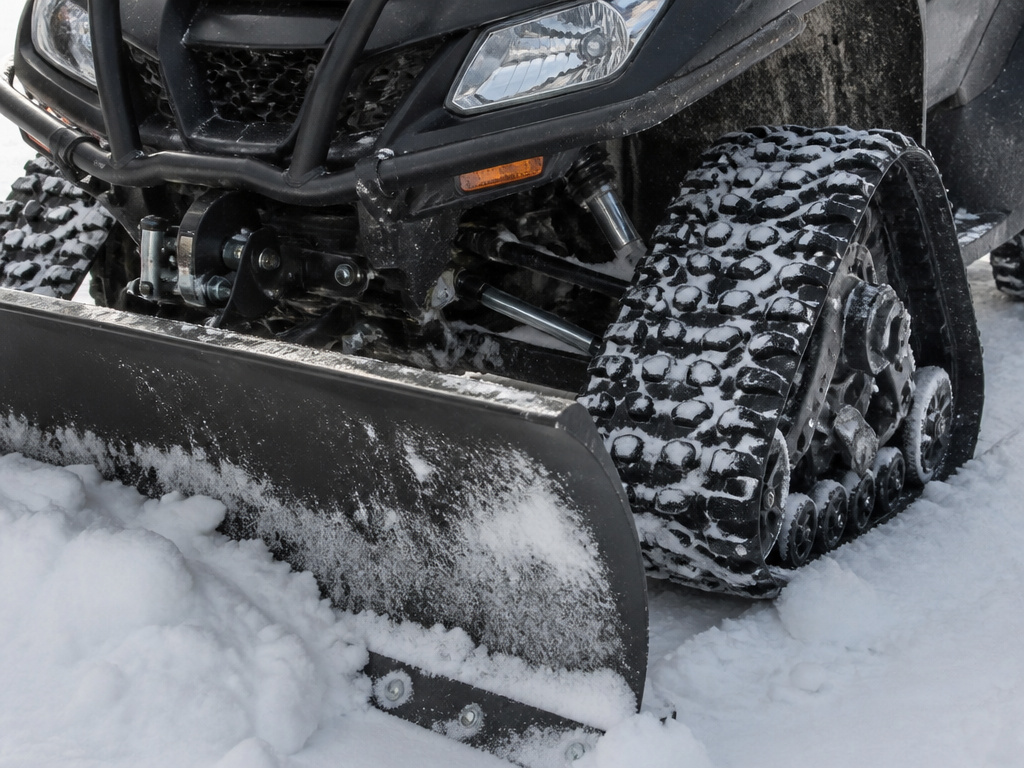
An ATV without attachments is just a ride. For snow, you need to convert its energy into pushing or floating force.
The Snow Plow Attachment
A front-mounted plow is the standard. The blade angles left or right to cast snow off the path. The real choice is between a manual lift (you get off and move a pin) and a powered hydraulic or electric lift controlled from the handlebars. For a driveway over 50 feet, the powered lift is worth every penny.
The ATV-mounted plow turns pushing force into clearing action. But it also changes the machine’s balance and stresses the front suspension and frame mounts in ways the factory didn’t fully anticipate for continuous duty.
The Track Conversion System
This is the ultimate winter modification. It replaces all four wheels with rubber-tracked units, dramatically increasing surface area. An ATV on tracks floats over deep snow where even chained tires would sink. It transforms the machine into a completely different vehicle, capable of traversing powder that would stop a snowmobile.
The trade-off is cost, speed reduction, and added complexity. It’s a serious investment for serious snow country. When evaluating ATV track kits, consider the intended snow depth and whether you need true off-trail capability or just a better-plowed driveway.
The Hidden Drivetrain Killer and How to Avoid It
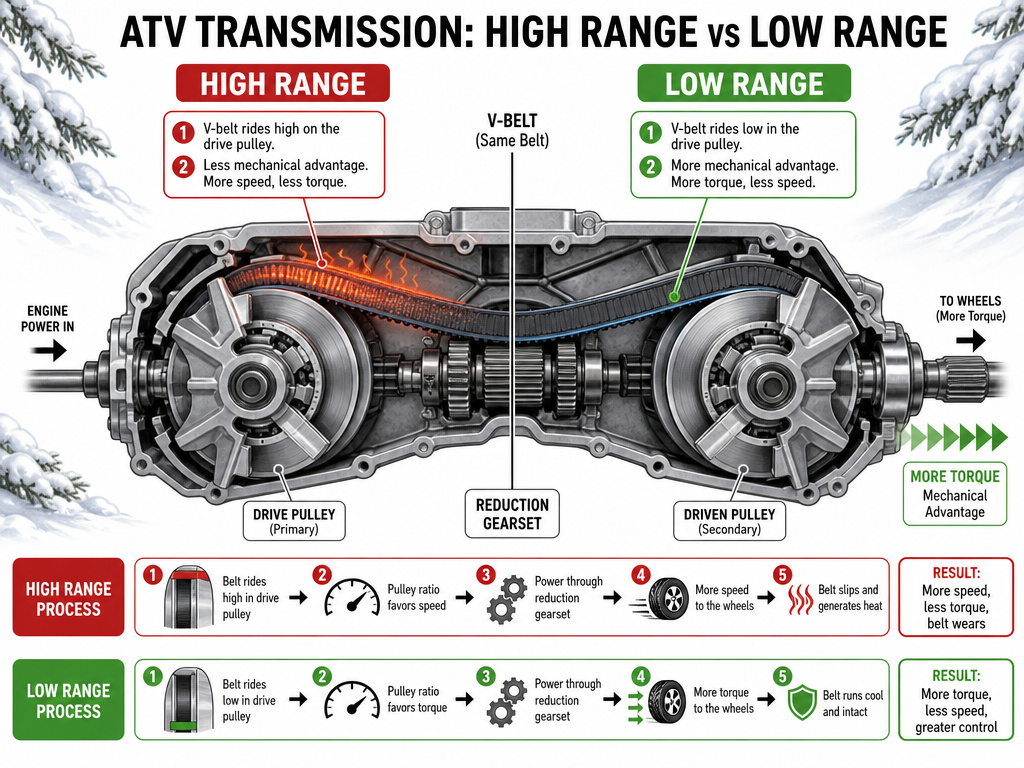
You have the cc’s. You have the chains or tracks. You’re ready to push snow. Now, the most common mechanical mistake happens inside the transmission.
Common mistake: Plowing in high range. The transmission runs hotter, the V-belt slips, and the clutch engages harshly. The manual is explicit about this for a reason.
The Arctic Cat Alterra 600 operator’s manual states: “Always shift into low range when operating on wet or uneven terrain, when towing or pushing heavy loads, and when using a plow. Failure to follow this caution may result in premature V-belt failure or in damage to related drive system components.”
This is a sourced, numeric warning. “Premature” means a belt that should last 400 hours might shred in 40. Low range provides mechanical advantage, reducing slip and heat. It feels slower, but it’s the sustainable gear for high-torque work. Ignoring this is the fastest way to a $300 repair bill and a half-cleared driveway.
The same principle applies to basic maintenance. Cold weather thickens fluids. The manual for the Alterra 300 specifies SAE-Approved 80W-90 Hypoid gear oil for the rear drive. Using a thinner fluid in winter increases wear; using a thicker one in summer causes overheating. Stick to the OEM-specified grades.
What Your Warranty Actually Covers (And What It Doesn’t)
Let’s be blunt about money. Adding a plow to a new ATV does not automatically void the factory warranty. Manufacturers expect this. Damage caused by the plow installation itself might not be covered, but general powertrain failures are.
The line is abuse. The warranty booklet uses that word. What does it mean in winter?
- Covered (typically): A differential seal that starts leaking during normal plowing use. A faulty ignition coil on a machine used in snow.
- Not Covered (abuse): A bent front frame crossmember from ramming a frozen snowbank at speed. A shattered rear differential case from repeatedly spinning the tires on ice with the transmission in high range.
The distinction hinges on whether the failure resulted from a defect or from operation outside reasonable parameters. Hitting an unseen curb under the snow is an accident. Using your ATV as a battering ram is abuse. The dealer’s service manager will know the difference in ten seconds.
This is why understanding your machine’s limits, like the 450cc rule and the low-range mandate, is a financial decision, not just a practical one. For those considering more affordable options, it’s worth researching the general reliability of Chinese ATVs as their warranties and support networks can differ significantly.
Safety in the Cold: It’s More Than a Helmet
Winter adds layers of risk. Reduced visibility, frozen surfaces, and the machine’s own cold-weather behavior change the game. A 2023 survey of ATV dealers and track owners in Kansas, published in a PMC peer-reviewed safety study, found that only about half offered formal safety materials. The onus is on you.
Your gear needs an upgrade. A DOT-certified helmet is the bare legal minimum in many states; a Snell-certified helmet offers a higher impact standard. Gloves must balance warmth and grip. Boots need insulation but also a rigid sole for operating foot controls.
The machine itself needs a pre-flight check. 1. Lights: The Alterra 300 uses a 12V, 35W/35W headlight. Ensure it’s clean and functional. Days are short. 2. Battery: Cold saps capacity. A weak battery might not crank a cold engine. 3. Throttle and Brakes: Check for ice buildup in the cables or around the calipers. A frozen brake pad is a runaway vehicle.
Finally, never plow alone, and always tell someone your plan. A rolled ATV in a snowdrift is a silent, deadly trap. The machine’s weight and the insulating snow can pin you quickly. This is the predictable outcome of a single unseen ditch.
Frequently Asked Questions
What size ATV do I need to plow my driveway?
For a typical 3-car residential driveway, a 450cc to 600cc ATV is the sweet spot. This size provides enough torque to push wet snow without constantly straining the engine. A 300cc model will work for very light, infrequent snowfalls but will struggle and wear quickly with anything substantial.
Can I use my ATV in snow without a plow?
Yes, for riding and trail use. However, for effective travel in more than a foot of snow, you will need tire chains or a track system. The standard knobby tires are designed for dirt; they pack with snow and become slicks on ice. For utility work like hauling firewood, a snow plow attachment for ATV is what converts motion into useful work.
Do I need 4-wheel drive to plow snow?
Absolutely. Plowing is a high-resistance activity. Two-wheel drive, even with chains, will often result in one driven axle spinning while the other does nothing. Four-wheel drive distributes the load and provides the necessary push. All serious utility ATVs for snow are 4×4.
How deep of snow can an ATV plow?
Properly equipped ATV can handle 6 to 12 inches of light, fresh snow per pass. For deeper accumulations, you make multiple passes, taking a few inches off the top each time. Heavy, wet “heart-attack” snow drastically reduces this capacity. If the snow is deeper than the ATV’s ground clearance, you must use a plow to avoid high-centering.
Are UTVs better than ATVs for snow plowing?
Often, yes. A UTV (Side-by-Side) offers a heavier, more stable platform, a protected cab, and often a higher-capacity hydraulic system for the plow. It’s a more dedicated tool for large properties. For comparing the best options, our review of ATVs and UTVs for plowing breaks down the use cases.
The Bottom Line
An ATV is a capable snow machine, but it’s not a magic wand. Its effectiveness is a checklist: 450cc minimum, four-wheel drive, a quality plow, and either tire chains or tracks. Skip any one, and you’re buying a season of frustration.
The hidden cost is knowledge. Shift into low range. Respect the warranty line between use and abuse. And gear up like the conditions are trying to hurt you, because they are. For most homeowners, a mid-size ATV like a 500cc model with a powered plow and chains is the perfect balance of power and practicality. If your winters are measured in feet, not inches, start looking at track systems or step up to a dedicated UTV.
Choose based on your actual winter, not the one you hope to have.
