
Are Fat Tire Bikes Harder to Ride? A Performance Analysis
This post contains affiliate links. As an Amazon Associate, we earn from qualifying purchases.
Fat tire bikes are harder to pedal on paved roads and smooth trails due to increased rolling resistance and weight, but they become easier, and sometimes the only viable option, on soft, unstable surfaces like deep snow, sand, and mud. The difference isn’t minor; a University of California, Davis study noted these bikes can be up to 30% more resistant to rolling than traditional mountain bikes. On pavement, you fight physics. Off pavement, physics works for you.
That 30% number is the starting point, but it doesn’t tell the whole story. The riding experience splits completely based on what’s under your wheels. On hardpack, you’re managing sluggish steering and a workout. On soft stuff, you’re floating over obstacles that would stop a regular bike dead. This guide walks through the specs that create that divide, tire width, pressure, geometry, and names the specific situations where a fat bike is either a burden or a revelation.
What follows: a breakdown of the two main forces working against you (rolling resistance and weight), the one adjustment that changes everything (tire pressure), and a direct comparison of where fat bikes win versus where they feel like a chore. By the end, you’ll know exactly what you’re signing up for.
Key Takeaways
- On pavement, the wider contact patch of a fat tire creates significantly more rolling resistance, making each pedal stroke harder.
- Tire pressure is your primary control. Running 5-10 PSI on sand lets the tire float; running that low on pavement causes tire squirm and dramatically increases effort.
- Fat bikes introduce a wider Q-factor (the stance between your pedals), which can strain knees and hips on long rides if you’re not used to it.
- For deep snow, sand, or boggy mud, a fat bike isn’t just easier, it’s often the only bike that will move forward without sinking.
- Annual maintenance costs run $100-$200 more for a fat tire bike, driven by faster brake pad wear and more expensive tire replacements.
The Real Culprit: Rolling Resistance & Weight
Pedaling effort boils down to two physical forces: rolling resistance and rotating mass. Fat bikes amplify both.
Rolling resistance is the energy lost as your tire deforms against the ground. A fat tire’s contact patch, the area of rubber actually touching the earth, is vast. Where a mountain bike tire might press a strip the size of a credit card, a 4-inch fat tire lays down something closer to a dinner plate. More rubber on the ground means more friction to overcome with every revolution of the crank.
A 2020 laboratory test of four mountain-bike tire sizes found the 26×4-inch fat tire had nearly twice the cornering stiffness and the highest twisting torque compared to a 29×2.3-inch baseline. The researchers linked this torque to the “auto-steer” sensation riders report, the tire wants to hold its line, making quick, tight maneuvers feel heavier.
This isn’t just a feeling. It’s measurable drag. On smooth asphalt, that drag translates directly into slower acceleration and a constant feeling that you’re riding through thick syrup. You compensate by shifting into a lower gear, spinning faster to maintain speed. It’s a workout.
Weight is the second factor, and it’s mostly in the wheels. A single fat bike tire can contain as much rubber as two standard 29er tires. Add a tube, and you’re looking at a rotational mass that takes more energy to get spinning and more energy to keep spinning. This “rotational weight penalty” is most noticeable when starting from a stop or climbing a hill. The bike feels anchored.
Where this goes sideways: Pumping your fat tires to 25 PSI because that’s what your mountain bike runs. At high pressure on a hard surface, the large, stiff casing doesn’t deform enough to absorb bumps, it just transmits every vibration to your hands and seat. But it also doesn’t roll efficiently. You get the worst of both worlds: a harsh, noisy ride that still feels slow. The sweet spot for pavement is higher than for sand, but it’s never as high as a skinny tire.
Where Fat Bikes Actually Get Easier
The equation flips when the ground gets soft. This is where the fat bike’s design stops being a handicap and becomes a superpower.
On surfaces like deep snow, dry sand, or thick mud, a standard tire fails through penetration. Its narrow profile acts like a blade, slicing down into the loose material until it loses traction and spins out. You sink, you stall, you walk.
A fat tire spreads the bike’s and rider’s weight over a much larger area. This principle, called floatation, prevents the tire from sinking past its tread. Instead of digging a trench, it rolls on top. On a well-inflated fat bike, you can ride across a snow-covered field or a sandy beach where a regular mountain bike would be unrideable after ten feet.
The part nobody mentions: It’s not just about not sinking. That floatation provides a stable, predictable platform. On a loose, steep sand dune, a mountain bike’s rear tire will claw for purchase, fishtailing and eventually stalling. A fat tire’s broad footprint lays down consistent traction, letting you power up inclines that look impossible. In these specific conditions, the fat bike isn’t just easier, it’s dramatically more capable.
Easy to miss: The correct PSI for sand or snow is often between 3 and 8. At that pressure, the tire conforms to the surface’s contours, maximizing its footprint and float. Running 15 PSI on the same beach will have you plowing through the sand like a shovel.
This capability opens up terrain. You’re no longer limited by season or trail condition. A fat bike is a key to winter singletrack, beach cruising, or muddy spring trail networks that would be destroyed by narrower, knobbier tires.
Gearing, Geometry, and the “Q-Factor”
 Beyond the tires, the bike’s frame and components are tuned for its mission. This tuning creates a distinct riding feel that goes beyond simple effort.
Most modern fat bikes use a 1x drivetrain from brands like SRAM. This single chainring up front eliminates a front derailleur, which is a liability in the mud and snow a fat bike is built for. The trade-off is a narrower range of gears. While a 2x mountain bike setup might have a very low “granny gear” for steep climbs and a high gear for descents, a fat bike’s gearing is typically biased toward the low end. This helps you turn the cranks against high resistance, but it means you’ll spin out quickly on downhills or flat pavement. You have torque, not top speed.
Geometry is about stability over agility. Models like the Canyon Dude CF have longer chainstays and a slacker head angle compared to cross-country mountain bikes. This stretches the wheelbase, making the bike less twitchy and more planted at the expense of quick, technical handling. It’s a benefit when you’re barreling down a snow-covered fire road but a drawback on a twisty, rooted singletrack where you need the bike to change direction now.
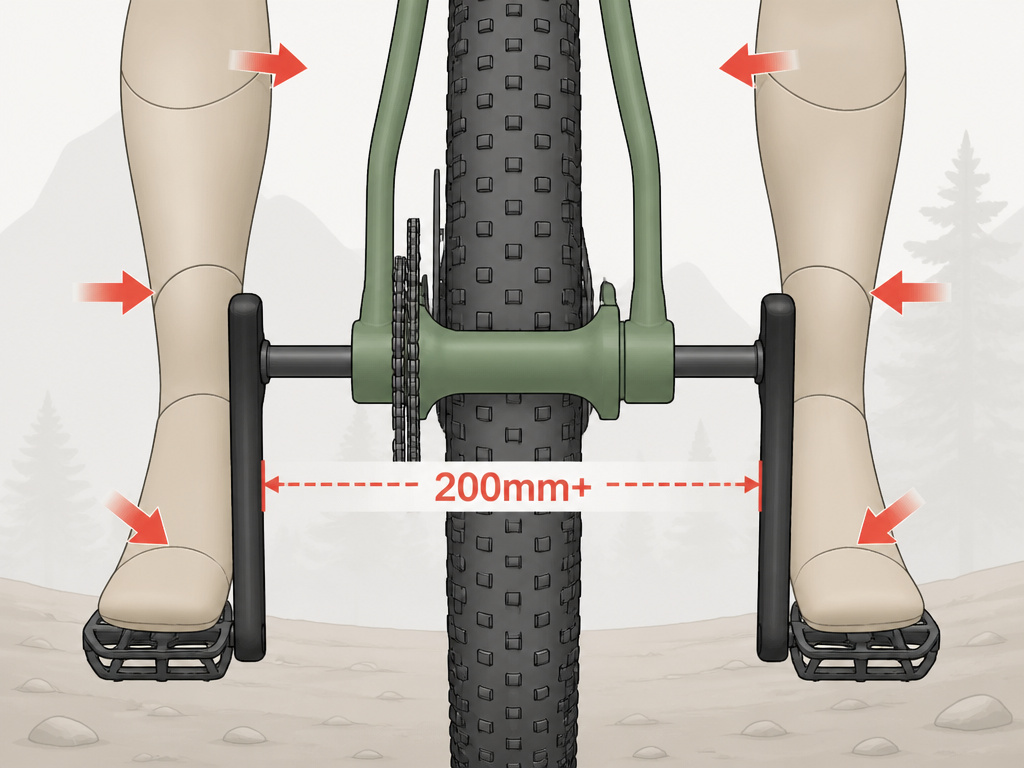
Then there’s the Q-factor. This is the distance between the outer faces of the crank arms. Fat bikes need a wide Q-factor, sometimes 200mm or more, to clear those massive tires with your heels. Your feet are placed farther apart on the pedals than on any other type of bike.
A wide Q-factor can strain your hips, knees, and ankles on long rides if your body isn’t accustomed to the stance. It’s a primary reason new fat bikers feel muscle fatigue in unfamiliar places after their first few outings.
This isn’t a deal-breaker. Your body adapts. But it’s a tangible difference that contributes to the “fat bikes are harder” sensation, separate from rolling resistance. It’s a mechanical fit issue, not a terrain one.
Fat Bike vs. Mountain Bike: Which Wins Where?
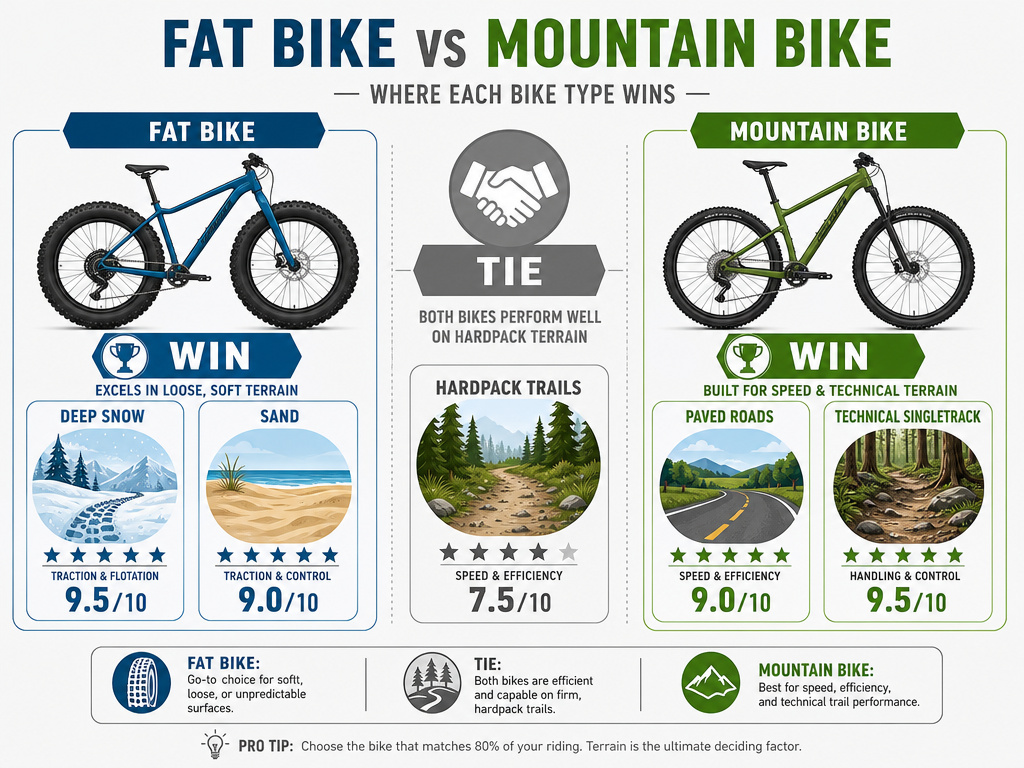 The choice isn’t about good and bad. It’s about matching the tool to the job. This table breaks down the contest by terrain.
| Terrain / Condition | Fat Bike Verdict | Mountain Bike Verdict | Why It Matters |
|---|---|---|---|
| Paved Roads / Bike Paths | Loss | Win | High rolling resistance and weight make the fat bike slow and laborious. The mountain bike is efficient and fast. |
| Hardpack Dirt Trails | Tie/Loss | Win/Tie | If the trail is smooth, the mountain bike is quicker. If it’s chunky, the fat bike’s cushion can be more comfortable, but slower. |
| Deep Snow (>6 inches) | Win | Loss | The fat bike floats. The mountain bike sinks and becomes unrideable. |
| Sand (Beach, Dunes) | Win | Loss | Same as snow—floatation vs. Penetration. A fat tire beach cruiser is built for this. |
| Mud & Wet Roots | Conditional Win | Conditional Loss | Fat tire footprint can offer better surface grip. However, neither tire guarantees safety on slick, contaminated surfaces. |
| Technical Singletrack | Loss | Win | The fat bike’s weight, auto-steer, and slower handling are disadvantages on tight, technical trails requiring agility. |
| Long-Distance Comfort | Conditional Win | Conditional Win | On rough roads, the fat bike’s low-pressure tires can be more comfortable. On smooth roads, the mountain bike’s efficiency wins. |
For the rider whose local trails are rooty, rocky, and best tackled with precision, a traditional mountain bike like a trail or enduro model is the better tool. Its suspension, lighter weight, and responsive geometry are designed for that dance.
For the rider who sees snow-covered forests, sandy coastlines, or expansive muddy flats as the ultimate playground, a fat bike is the only tool. Its entire design, from the 80mm-plus rims to the frame clearance, serves that purpose. Looking at our selection of fat tire bikes shows models purpose-built for these exact conditions.
The Maintenance & Cost Reality
Owning a fat bike is a commitment beyond the initial price tag. The forces that make it hard to pedal also wear components faster.
Tires are the biggest recurring cost. A quality 20×4 fat tire or 26×4 fat tire costs between $40 and $90, compared to $15-$45 for a standard mountain bike tire. You’ll go through them quicker, too. The large, soft rubber compound wears faster on pavement, and the low pressures you run off-road can lead to more pinch flats if you hit a rock wrong.
Brake pads wear faster because there’s more mass to slow down. Expect to replace pads every 500-1,000 miles on a fat tire e-bike, versus 800-1,500 miles on a lighter regular-tire model. Rotating that heavier wheel requires more braking force every time you squeeze the lever.
Bottom line: Budget roughly $100–$200 more per year for a fat tire ebike versus a regular tire ebike, driven mostly by tire and brake pad costs. It’s a gap that’s easy to justify if you’re regularly riding sand, snow, or gravel, and harder to justify if you’re mostly on pavement.
Then there’s storage and transport. A fat bike doesn’t always fit on a standard bike rack designed for 2-inch tires. You need a rack with wider clamps or a tray system. In a crowded garage or apartment, its wider profile takes up more space.
For riders on a budget, these ongoing costs are a real factor. The premium isn’t just at the checkout counter.
Finding Your Pressure Sweet Spot
You have one powerful dial to adjust your fat bike’s personality: the air pressure in your tires. Mastering this is the difference between a miserable ride and a magical one.
For paved roads and hardpack trails, you need enough pressure to support the tire’s sidewalls and minimize deformation. Start around 15-20 PSI. This reduces rolling resistance and prevents the tire from feeling vague or squirmy in corners. It’ll be a firmer ride, but a more efficient one.
For sand or powder snow, drop the pressure dramatically. The goal is maximum footprint. For 4.5-inch tires, start at 5-8 PSI. The tire should bulge noticeably but not so much that the rim feels vulnerable. You’re looking for that “float” sensation.
For packed snow or rough, rocky trails, a middle ground of 8-12 PSI often works best. It provides some cushioning over bumps while maintaining enough casing tension for reasonable rolling.
Common mistake: Guessing pressure by feel. A high-quality floor pump with a low-pressure gauge is non-negotiable. A 2 PSI difference can transform the bike’s handling on soft terrain.
The process is iterative. Start at a recommended pressure, ride a test loop, and let go. Did the tire feel like it was digging? Drop 1 PSI. Did it feel bouncy and slow? Add 1 PSI. Your perfect setting will change with the season, the weather, and the specific trail.
The Motorized Equalizer: Fat Tire E-Bikes
Everything discussed so far assumes human power alone. Adding an electric motor changes the calculus completely.
A mid-drive motor on a fat tire e-bike directly offsets the two main penalties: weight and rolling resistance. The motor provides the torque to get that heavy rotating mass up to speed and then the assist to maintain it. On pavement, with the assist on, the question of whether a fat bike is harder to pedal becomes almost irrelevant. The motor does the heavy lifting.
The trade-off is range. The motor has to work harder to push those fat tires, so battery drain is faster. Riders commonly report 10–20% less range on fat tires versus regular tires with comparable batteries. Manufacturers know this, so many fat tire e-bikes are equipped with larger battery packs from the start.
For heavier riders or those looking to explore without exhausting themselves, a fat tire e-bike is a compelling solution. It delivers the fat bike’s all-terrain capability without the brutal pedaling effort on the way to the trailhead. It turns a specialized tool into a versatile daily driver.
Before You Go
So, are fat tire bikes harder to ride? On smooth, hard surfaces, the answer is an unambiguous yes. The physics of rolling resistance and weight are not kind to them. But that’s the wrong question for a fat bike. The right question is: what do you want to ride?
If your goal is speed on pavement or agility on technical singletrack, a fat bike is the wrong choice. Get a road bike or a nimble mountain bike.
If your goal is to ride when others can’t, through winter snows, across summer beaches, or over thawing spring mud, then a fat bike isn’t harder. It’s enabling. The effort is the price of admission to a world most cyclists never see. For that rider, the slight inefficiency on the hardpack is a trade worth making every time. Start your search with a solid list of recommended fat tire bicycles to find a model built for your specific adventures.
Frequently Asked Questions
Are fat bikes harder to pedal on flat pavement?
Yes, significantly. The combination of increased rolling resistance from the wide contact patch and the additional rotating weight of the tires and wheels requires more effort per pedal stroke compared to a standard mountain bike or road bike.
Can I use a fat bike as my only bike?
You can, but it’s a compromise. A fat bike will handle daily commuting and trail riding, but it will feel slower and less efficient on roads than a bike designed for that purpose. It’s a fantastic option if you live where seasons dramatically change the terrain, or if comfort over rough surfaces is your top priority.
Do fat bikes need special maintenance?
They need the same basic maintenance as any bike, but certain components wear faster. Brake pads and tires are the big ones. You’ll also need to check and adjust tire pressure more frequently, as small changes have a big impact on performance.
What’s the best tire pressure for a fat bike?
There is no single “best” pressure. It depends entirely on terrain, tire size, and rider weight. A good starting point is 15-20 PSI for pavement, 8-12 PSI for hardpack or rocky trails, and 3-8 PSI for sand or deep snow. Always use a low-pressure gauge.
Are fat bikes good for beginners?
They can be. Their inherent stability and forgiving nature on uneven ground can build confidence. However, the unique fit (wider Q-factor) and the increased effort required on pavement can be discouraging for some. A beginner should test-ride one on their typical terrain before deciding.
How much heavier is a fat bike than a regular mountain bike?
Typical aluminum fat bike frame with 4-inch tires weighs 32-38 pounds. A comparable hardtail mountain bike might weigh 28-31 pounds. The difference of 4-7 pounds is mostly in the wheels and tires, which is rotating weight, the kind you feel most when pedaling.
