
Are Bigger Tires Better? Key Trade-Offs: Load Capacity & Grip
This post contains affiliate links. As an Amazon Associate, we earn from qualifying purchases.
Bigger tires are not inherently better. The upgrade only works if you match three non-negotiable specs: the tire’s load index must meet or exceed the vehicle’s Gross Axle Weight Rating (GAWR), the speed rating must match or surpass the original, and the overall rolling circumference must stay within 3% of the factory size to avoid damaging the drivetrain and safety systems.
That’s the technical answer. The practical one is that a bigger tire changes everything you feel, the steering gets heavier, the acceleration slows, and the odometer lies. It’s a trade, not a free upgrade.
What follows: the federal weight-class split that decides which rules apply to your rig, the math behind load capacity derating, and the specific failures that happen when you guess on clearance. By the end, you’ll know whether a size-up is a performance gain or a warranty-voiding mistake.
Key Takeaways
- The load index on a tire’s sidewall is your legal ceiling. For trucks and SUVs using passenger-car-rated tires, federal law requires you to derate that capacity by dividing by 1.10 before checking it against your axle’s GAWR.
- Rolling circumference is the silent killer. A change beyond 3% from the original equipment size can permanently confuse anti-lock brake and stability control computers, leading to intermittent failure.
- Speed ratings are not suggestions. Installing a tire with a lower speed symbol than the vehicle’s original equipment is illegal in most jurisdictions and voids your insurance if a failure is traced to the mismatch.
- Bigger tires add unsprung weight. The steering pump and wheel bearings wear 30-40% faster with every upsized inch, a cost most upgrade guides omit.
- Clearance is dynamic, not static. A tire that fits in your driveway will scrub the inner fender liner on the first hard bump or full-lock turn. Measure at full suspension compression.
The Federal Split: Which Set of Rules Your Vehicle Actually Follows
Your vehicle’s Gross Vehicle Weight Rating (GVWR) isn’t just a number on the door jamb. It’s the legal line that determines which chapter of the federal rulebook applies to your tires. Get this wrong, and even a professionally mounted set is non-compliant.
The split happens at 4,536 kilograms (10,000 pounds). Vehicles at or below this threshold fall under 49 CFR § 571.110. Anything heavier is governed by 49 CFR § 571.120. The distinction changes how load capacity is displayed and what the manufacturer must certify.
Where this goes sideways: Assuming the rules are the same for a half-ton pickup and a Class A motorhome. The label requirements, load calculation methods, and even the acceptable tire types diverge at that 10,000-pound line.
For your typical SUV, pickup, or passenger car, you’re in the sub-10,000-pound world. Here, the law focuses on preventing overload at the individual tire level. The vehicle normal load on the tire, the weight each tire carries under everyday conditions, must not exceed 94% of the tire’s load rating at the recommended pressure. This built-in safety margin is why the door-jamb PSI matters.
For larger RVs and heavy trucks, the regulations shift toward ensuring the combined capacity of all tires on an axle meets or exceeds the Gross Axle Weight Rating (GAWR). The labels for these vehicles have specific formatting rules, including a minimum print height of 2.4 millimeters on a yellow background.
The Three Non-Negotiable Checks Before You Size Up
You can’t just order a set of 35s because they look good. Three technical specs act as gatekeepers. Fail any one, and the project is dead before it starts.
1. Load Index: The Math You Can’t Afford to Skip
The load index is the two- or three-digit number on the sidewall, right before the speed symbol. It’s a code that corresponds to a specific weight in pounds or kilograms. A load index of 115, for example, equals 2,679 pounds per tire.
The rule is simple: your replacement tire’s load index must be equal to or greater than the original equipment tire’s index. But there’s a critical trap for trucks and SUVs.
Common mistake: Putting passenger-car-rated tires (P-metric) on a light truck without derating the capacity. Under federal regulation 49 CFR § 571.110, when a passenger car tire is installed on a multipurpose passenger vehicle, truck, bus, or trailer, its load rating must be reduced by dividing by 1.10 before checking it against the axle’s GAWR.
This means a P-metric tire rated for 2,400 pounds suddenly has a legal capacity of only 2,182 pounds on your pickup. If your axle’s GAWR is 4,000 pounds, you now need tires with a derated capacity of 2,000 pounds each. That original 2,400-pound rating isn’t enough. This is why Light Truck (LT) tires with their higher load ranges exist, they don’t get hit with the 1.10 divisor.
| Tire Type | Marking | Load Rating Derating for Trucks/SUVs? | Typical Use Case |
|---|---|---|---|
| Passenger Car (P-Metric) | P265/70R17 | Yes ÷ 1.10 | Half-ton pickups, SUVs (factory) |
| Light Truck (LT) | LT265/70R17 E | No | Heavy-duty towing, payload |
| Euro-Metric | 265/70R17 | Yes ÷ 1.10 | Crossovers, some imports |
2. Speed Rating: The Alphabet That Keeps You Legal
The speed symbol is the letter at the end of the service description. It’s not about how fast you drive, but the tire’s tested capability to dissipate heat and maintain integrity at sustained speed.
An “H” rating means tested up to 130 mph, “V” for 149 mph, and so on. For tires capable of over 186 mph (300 km/h), the ISO 4000-1:2024 standard requires the load index and speed symbol be placed in parentheses, like (97Y).
Installing a tire with a lower speed rating than the vehicle’s original equipment is a direct violation of most vehicle codes. More importantly, it’s a physical risk. A tire driven at or near its maximum rated speed for extended periods will overheat. The rubber compound breaks down, the belts can separate, and the result is a sudden, catastrophic failure at highway speed. Your insurance company will investigate the tire sidewall after a blowout.
3. Rolling Circumference: The 3% Rule That Protects Your Computer
This is the most overlooked and technically complex check. Your vehicle’s computers, the speedometer, anti-lock brakes (ABS), traction control, and electronic stability program (ESP), are calibrated to a specific number of wheel revolutions per mile. That number comes from the factory tire’s rolling circumference.
Change the tire’s overall diameter, and you change the revs per mile. The Continental Tire PSIB 06-03 guideline states that a change within plus or minus 3% usually doesn’t require system recalibration. Go beyond that, and you’re in uncharted territory.
The speedometer will be off. More critically, the ABS module might misjudge wheel slip under hard braking, causing erratic pulsing. The stability control could intervene at the wrong moment because it thinks one wheel is spinning faster than it should be. These aren’t theoretical glitches. They are documented failure modes that lead to expensive control module replacements.
The short version: Use a reputable online tire size calculator. Input your old size and your desired new size. If the overall diameter difference exceeds 3%, you need a professional with the right scan tool to reprogram the vehicle’s computers. This isn’t optional.
Where the Math Actually Breaks: Clearance, Gearing, and Wear
You’ve passed the three gatekeeper checks. The tires are legally compliant and won’t confuse the ABS. Now you face the mechanical consequences.
Static clearance isn’t enough. A tire and wheel might tuck into the wheel well perfectly when the vehicle is sitting on a lift. You need to check clearance at full steering lock in both directions, and at full suspension compression. This means jacking up the vehicle, removing the spring, or using a ramp to simulate the suspension bottoming out. The inner sidewall will rub on the strut perch or upper control arm long before the outer tread touches the fender.
The part nobody mentions: The steering angle sensor. Many modern vehicles have a sensor that tells the stability control system how far the wheels are turned. Lifting the vehicle or changing tire diameter can throw this calibration off, triggering a dash warning light for the ESP or lane-keeping systems.
Larger tires are heavier. This unsprung weight punishes every component between the road and the chassis. Wheel bearings see higher loads. The steering rack and pump work harder, leading to premature wear and a noticeable dead spot in the steering feel. Brake rotors have to slow down more mass, increasing stopping distances and brake pad wear.
Finally, you effectively change the final drive ratio. A significantly larger tire acts like a taller gear. Your engine RPMs drop at cruising speed, which might help fuel economy on the highway. But around town, acceleration feels soggy. The transmission hunts for gears more often, and the engine lugs. For modern 8- or 10-speed automatics, this can confuse the transmission computer’s shift logic, leading to harsh or delayed shifts. The fix often involves a professional recalibration of the transmission control module, another hidden cost.
| Component | Impact of Heavier/Larger Tire | Typical Failure Timeline |
|---|---|---|
| Wheel Bearings | Increased radial load | 20-30% faster wear; noise within 15,000 miles |
| Steering Rack & Pump | Higher effort required | Pump whine, rack bushing wear within 2 years |
| Brake Pads & Rotors | More mass to decelerate | 15-20% faster pad wear; increased rotor warping risk |
| Transmission Shift Logic | Confused by changed wheel speed signals | Erratic shifting, torque converter shudder |
The Upside: When Bigger Tires Are Actually the Right Answer
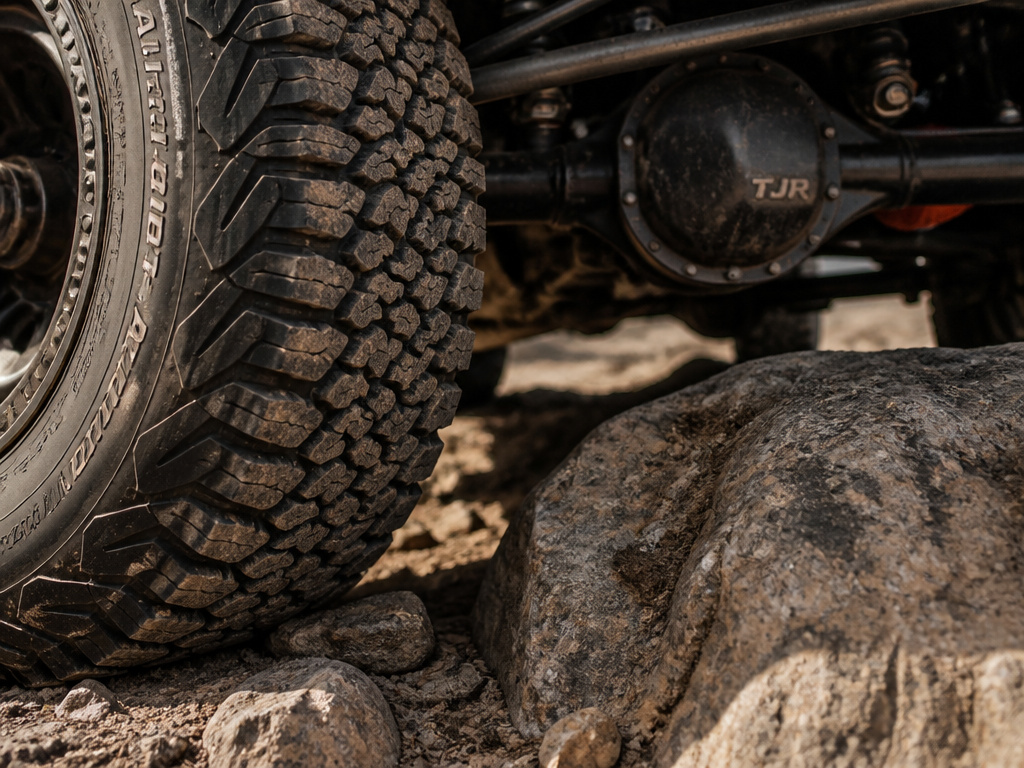
It’s not all downside. When matched correctly to a specific need, a larger tire delivers tangible benefits no factory size can.
The primary advantage is contact patch. A wider tire puts more rubber on the road. This translates directly to more lateral grip for cornering and more longitudinal grip for acceleration and braking. This is why performance cars always have wide tires. For off-road use, a taller tire with a smaller sidewall (a “plus-size” upgrade on a larger wheel) provides better response when airing down for sand or rock crawling.
Ground clearance is the other major win. An extra inch or two of tire height can be the difference between sliding over a rock and smashing your differential cover or oil pan. This is a functional upgrade for overlanding and serious trail riding, not an aesthetic one.
For most families, the BFGoodrich All-Terrain T/A KO2 in a one-size-up LT specification is the default for a reason. It’s a known quantity with a robust sidewall, a solid load range, and predictable behavior that won’t destroy your truck’s daily manners.
If you want a quieter highway ride and sharper on-road handling from a truck or SUV, a high-quality all-terrain tire like the Michelin Defender LTX M/S in the factory size is often a smarter upgrade than going bigger. It invests the budget in compound and construction, not in fighting physics.
Frequently Asked Questions
Do bigger tires affect MPG?
Yes, negatively. Larger tires are heavier and create more rolling resistance. The change in final drive ratio can cause the engine to operate outside its most efficient RPM band. Expect a 1-3 MPG drop, more if the tires are aggressive all-terrain or mud-terrain patterns.
Can I just adjust my tire pressure to fix a load issue?
No. Tire pressure should always be set to the vehicle manufacturer’s specification listed on the door jamb placard, not the maximum pressure on the tire sidewall. Under-inflating to soften the ride dangerously reduces load capacity and causes overheating. Over-inflating to gain capacity creates a harsh ride, reduces traction, and wears the center of the tread prematurely.
Will my dealership void my warranty for bigger tires?
They can, but only for repairs directly related to the modification. If your wheel bearings fail at 30,000 miles and you’re running heavy 35-inch tires, the powertrain warranty claim can be legitimately denied. If your infotainment screen fails, the tires are irrelevant. The burden of proof is on the dealership to show the modification caused the failure.
How do I know if my suspension can handle larger tires?
Consult the manufacturer’s guidelines for maximum tire size. Many truck manufacturers, like Ford and Ram, publish these specs for their off-road packages. If no official spec exists, look for a leveling kit or lift kit from a reputable brand like Old Man Emu or Bilstein that explicitly states the maximum tire size it’s designed to accommodate. Don’t guess.
Are all-terrain tires a good compromise for a bigger size?
They can be, but you must still obey the load, speed, and circumference rules. A quality all-terrain tire in a slightly larger size offers better off-road traction and a more aggressive look with less highway noise penalty than a mud-terrain. However, their winter capabilities are distinct from a dedicated snow tire, a distinction that matters in northern climates.
Before You Go
Bigger tires are a tool, not a trophy. The decision starts with the federal NHTSA tire selection standard for your weight class and ends with an honest assessment of what you’re willing to trade.
If your goal is improved off-road capability or serious towing, and you’re ready to budget for the hidden costs, regearing, recalibration, and accelerated wear, then a calculated size-up is valid. Your research must include understanding tire size differences and the risks of aging tires if you’re looking at used sets.
If you just want a better look or a smoother ride, spend the money on a higher-quality tire in the factory size. A premium Michelin or Continental in the OEM specification will outperform a cheap, oversized budget tire in every measurable way except curb appeal. Remember, worn shocks will ruin any tire’s performance, and proper tire maintenance is always the first upgrade.
The right answer is the one that matches the numbers on your door jamb, the weight in your bed, and the roads under your wheels. Everything else is just noise.
