
Are 295 Tires the Same As 35? A Clear Guide to Tire Sizing
This post contains affiliate links. As an Amazon Associate, we earn from qualifying purchases.
No, a 295 tire is not the same as a 35 tire. They measure two completely different things. The number 295 is the tire’s section width in millimeters. The number 35 is the aspect ratio, a percentage that tells you the sidewall height is 35% of that width. You need both numbers, plus the rim diameter, to define a complete tire size like 295/35R20.
Comparing them directly is like asking if 10 pounds is the same as 10 inches. The confusion usually starts when someone sees “295” and “35” next to each other on a sidewall and wonders which one matters more. They both matter, but for different reasons that change your speedometer, your ride quality, and what fits under your fender.
What follows: a breakdown of the ETRTO formula that defines every tire, the real-world difference a 35-series sidewall makes, and the three rules for swapping sizes without breaking your truck’s electronics or scraping its suspension. By the end, you’ll read a sidewall in ten seconds and know exactly what you’re buying.
Key Takeaways
- 295 is width, 35 is profile. 295 millimeters is the tire’s cross-section width. The 35 means the sidewall height is 35% of that width (about 103 mm).
- Overall diameter is king for fitment. The critical number for clearance and speedometer accuracy comes from a set formula:
(Rim Diameter in inches × 25.4) + (2 × (Width × Aspect Ratio / 100)). - Stay within ±3%. When considering alternative sizes, the new tire’s overall diameter must be within 3% of the original to keep your speedometer and safety systems working correctly.
- The “R” isn’t optional. The “R” stands for radial construction, which is on every modern passenger tire. A “P” prefix (P295/35R20) denotes a P-Metric tire, which may have different load specs.
- Not all combos are OEM. Sizes like 295/35R17 or 295/35R24 are valid under ISO standards but are often aftermarket plus-size choices, not factory specifications.
What Does 295/35R20 Actually Mean?
You see a string like 295/35R20 on your tire’s sidewall. It’s not a model name. It’s a coordinate system that tells the tire builder exactly how to construct it, following international standards like ETRTO 2024 and ISO 4000-1:2021.
Here’s the translation, piece by piece.
295: This is the section width. It’s the measurement of the tire’s cross-section from the outermost point of one sidewall to the other, expressed in millimeters. For a 295/35R20, that’s 295 mm, or about 11.6 inches. It’s a wide tire, common on performance cars and SUVs where a large contact patch aids grip.
35: This is the aspect ratio. It’s not a measurement in millimeters or inches. It’s a percentage. It tells you that the sidewall’s height, from the rim’s bead seat to the top of the tread, is 35% of the section width. So for our 295 mm wide tire, the sidewall height is 295 × 0.35 = 103.25 mm (about 4.06 inches). A lower number like 35 means a shorter, stiffer sidewall.
R: This indicates radial construction. The internal cords of the tire run perpendicularly from bead to bead. This is universal for modern passenger and light truck tires because it offers a more stable contact patch, better fuel economy, and improved high-speed stability than the older bias-ply construction.
20: This is the rim diameter in inches. The tire is designed to mount on a 20-inch wheel. This is the one part of the size that is never in metric.
The European Tyre and Rim Technical Organisation (ETRTO) defines the formula for overall tire diameter as:
overall_diameter_mm = rim_inches × 25.4 + 2 × (width_mm × aspect_percent / 100). For a 295/35R20, that’s (20 × 25.4) + 2 × (295 × 35 / 100) = 508 + 206.5 = 714.5 mm.
That final number, 714.5 mm, or about 28.13 inches, is the tire’s overall diameter. This is the single most important figure when considering wider tires or bigger tires. It determines fitment, gear ratio effect, and speedometer accuracy.
The 295 vs. 35 Comparison Table
You can’t compare 295 and 35. One is an absolute width, the other is a relative height. This table shows how they work together across different rim sizes to create vastly different tires, all starting with “295/35”.
| Full Tire Size | Section Width (mm) | Sidewall Height (mm) | Overall Diameter (mm/in) | Primary Vehicle Fitment |
|---|---|---|---|---|
| 295/35R18 | 295 mm | 103.3 mm | 663.7 mm / 26.13 in | Performance Sports (Ferrari 512TR) |
| 295/35R20 | 295 mm | 103.3 mm | 714.5 mm / 28.13 in | Luxury Sport (Porsche, Aston Martin) |
| 295/35R22 | 295 mm | 103.3 mm | 765.3 mm / 30.13 in | High-Performance SUV (Jaguar F-Pace) |
| 295/35R24 | 295 mm | 103.3 mm | 816.1 mm / 32.13 in | Aftermarket Plus-Size / Custom |
Notice the sidewall height stays constant at roughly 103 mm because it’s always 35% of 295 mm. The overall diameter balloons because the rim gets larger. A 295/35R24 is a full 6 inches taller than a 295/35R18. They share a width and profile number, but they are utterly different tires for different vehicles.
Where this goes sideways: Assuming all “295/35” tires are interchangeable. Swapping a 295/35R20 for a 295/35R22 changes the overall diameter by over 50 mm (2 inches). Your speedometer will read roughly 7% slow, and the tire will likely contact the fender liner or suspension on compression.
How a 35-Series Sidewall Changes Everything
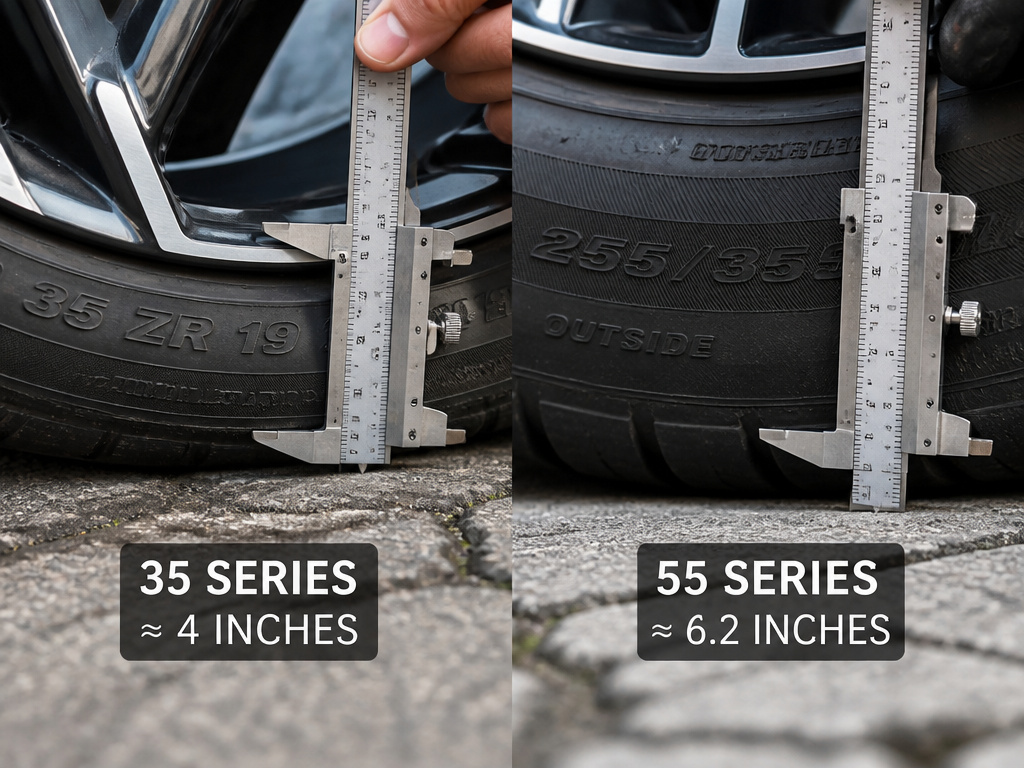
The aspect ratio is the personality dial of your tire. A 35-series tire is considered an ultra-low profile. This isn’t just an aesthetic choice. It fundamentally alters how the car communicates with the road.
The sidewall is your primary suspension cushion before the actual springs and shocks engage. A shorter sidewall has less rubber and air volume to flex.
The trade-off is immediate. You gain razor-sharp steering response and reduced sidewall squirm during hard cornering. The tire feels more precise, more connected. You lose ride comfort and pothole protection. Every crack in the pavement transmits directly through the wheel into the chassis, and into your spine.
There’s also a durability cost. With only about 4 inches of sidewall, there’s minimal buffer between the rim and a curb or pothole. A sharp impact that a 55-series tire would absorb can bend a $1,000 wheel on a 35-series tire. This is a critical consideration if your roads are less than perfect.
I prefer a 35-series sidewall for a dedicated summer performance car on smooth pavement. The feedback is worth the harshness. For a daily driver or an SUV that might see gravel, I’d step up to a 40- or 45-series tire every time. The minor loss in turn-in crispness is a fair price for not replacing a wheel every other year.
This stiffness also affects tire noise. Less rubber to dampen vibrations can mean more road hum, though tread pattern is a bigger factor.
The Three Rules for Swapping Tire Sizes

You’re not stuck with the original size. Maybe you want a meatier look, a smoother ride, or a specific 295/70R18 all-terrain for your truck. The rules for safe substitution are about geometry, not guesswork.
Rule 1: Overall Diameter Must Stay Within ±3%.
This is the non-negotiable rule sourced from industry guidelines. Use the ETRTO formula to calculate your original tire’s diameter. Any new size must be within 3% of that number. Why? – Speedometer Accuracy: Governed by SAE J1349, your speedometer is calibrated for a specific revolutions-per-mile count. A 3% change means your speedo reads about 2 mph off at 65 mph. Beyond that, it’s illegal in some jurisdictions and confusing at best. – ABS & Stability Control: These systems use wheel speed sensors. Large diameter variances can confuse them, causing intermittent activation or system failure. – Gearing: Effectively changes your final drive ratio. A larger diameter acts like a taller gear, potentially making the vehicle feel sluggish.
Rule 2: Load Index and Speed Rating Must Match or Exceed the Placard.
The door jamb sticker lists the minimum load capacity (index) and speed rating (letter like H, V, W) your vehicle requires. A 295/35R20 102Y is different from a 295/35R20 98W. The “102” and “Y” are not part of the size, but they are critical for safety. Never downgrade these numbers.
Rule 3: The New Tire Must Physically Fit.
A wider tire needs wheel width. A 295mm tire generally requires a wheel between 10 and 11.5 inches wide. Putting it on a 9-inch rim pinches the tread, while an overly wide rim exposes the sidewall to curb damage. Check your factory wheels for width markings (e.g., “20×9.5J”).
P-Metric, OEM Fitments, and Other Critical Details
The basics covered, a few nuances separate an informed choice from an expensive mistake.
P-Metric vs. Metric: You might see P295/35R20. The “P” stands for P-Metric, a slightly different sizing standard primarily for North American passenger vehicles. It may have different load inflation tables than an identical-looking metric 295/35R20. Always match the designation type (P-metric or not) of your original tires when possible.
OEM vs. Aftermarket Fitment: Just because a size is valid per ISO standards doesn’t mean it came on a car. 295/35R17 and 295/35R24 are perfect examples, they exist in the ETRTO book but aren’t listed as original equipment on any vehicle in major catalogs. These are custom plus-size choices. They can work brilliantly but require meticulous verification of Rules 1-3.
The DOT Date Code: On the sidewall, look for a small oval stamp ending in a 4-digit number like “4724”. This is the DOT date code: the 47th week of 2024. Rubber degrades with age. Most manufacturers recommend replacing tires at 6-10 years old, regardless of tread depth. A cheap, old “295/35” tire is a worse buy than a fresher mid-range model.
Easy to miss: The “ZR” in some older sizes like 295/35ZR20. The “Z” is a legacy speed rating (over 149 mph). Modern tires drop the “Z” and put the speed rating (Y, W, etc.) after the load index. A 295/35ZR20 is functionally the same as a 295/35R20 102Y.
Frequently Asked Questions
Can I replace a 295/30R20 with a 295/35R20?
Yes, but calculate the diameter change. A 295/30R20 has a shorter sidewall (30% of 295mm = 88.5mm). The 295/35R20 will be about 29.6 mm taller overall. This is often beyond the 3% rule, making your speedometer read slow and potentially causing fitment issues. It’s not a direct swap.
Are 295 tires good for snow?
Tire width is one factor in snow traction. A very wide tire like a 295 can “float” on top of deep snow, which can be bad. For packed snow and ice, a narrower tire often cuts down to the pavement better. The rubber compound and tread pattern (look for the Three-Peak Mountain Snowflake symbol) are far more important than the width number alone.
Is a 295/35R20 considered a low-profile tire?
Yes. An aspect ratio of 35 is definitively in the ultra-low-profile category. It offers performance handling benefits at the expense of ride comfort and wheel protection from road hazards.
Do all-terrain tires come in 295/35 sizes?
Extremely rarely. A 295/35 size is a performance street dimension. All-terrain tires are built for off-road durability and have much taller sidewalls (e.g., 295/70R18, 295/65R20). If you need an all-terrain, you’re looking at a completely different size spectrum.
What’s the difference between a 295 tire and a 35-inch tire?
295 tire” refers to a width (295mm). A “35-inch tire” refers to an overall diameter (35 inches). They are different measurement systems. A 295/75R17 off-road tire might be close to 35 inches tall, but a 295/35R20 street tire is only about 28 inches tall. Always compare complete sizes.
Before You Go
The question “Are 295 tires the same as 35?” misses the point. They are partners in a single specification. The 295 gives you the width for grip and stability. The 35 gives you the sidewall profile that decides ride and response. Ignoring one for the other gets you a tire that doesn’t fit, doesn’t work, or doesn’t last.
Your next step is simple. Go read your current tire’s sidewall. Write down the full sequence: width, aspect ratio, construction, rim diameter, load index, and speed rating. That’s your baseline. Any change, whether to a 295/65R20 for off-road or a different street size, starts with plugging those numbers into the ETRTO formula and respecting the ±3% diameter rule.
Choose the complete size that matches your vehicle’s needs, not just one number that sounds impressive. Your suspension, your speedometer, and your wallet will thank you.
