
Why Some Choose Not to Wear a Bike Helmet: The Reasons
This post contains affiliate links. As an Amazon Associate, we earn from qualifying purchases.
Reasons not to wear a bike helmet rest on documented science: risk compensation alters rider behavior, helmet standards protect only against low-speed impacts, and laws can reduce overall cycling participation, which erodes public safety.
That gap between lab-tested protection and real-world collisions is the core of the argument. The engineering specs for a typical bicycle helmet are built for a head falling from a standing bike, not for a collision with a two-ton vehicle. When the physics says a device works within one set of limits, using it outside those limits is a personal risk calculation, not a moral failing.
What follows is the data that reshapes the simple “always wear one” rule: the peer-reviewed studies on risk-taking, the exact speed and force thresholds in the standards, the real variation between helmet models, and the public health math that changes when laws shrink the cycling population.
Key Takeaways
- Bicycle helmet standards (like EN 1078) are designed for impacts around 20 km/h. A crash with a car at 40 km/h generates forces ten times higher, exceeding the helmet’s protective capacity.
- Studies show wearing a helmet can lead to risk compensation, where riders feel safer and adopt riskier behaviors, and may lower cognitive control, making risk-indifferent choices.
- A 2024 study of 30 popular helmets found protection levels varied wildly; the worst-performing helmet carried 2.25 times the overall injury risk of the best, with price being no guarantee of performance.
- Mandatory helmet laws can suppress cycling rates, weakening the “safety-in-numbers” effect and leading to a long-term net negative public health outcome that outweighs the benefits of individual head protection.
- Proper fit is critical and rare; a loose or tilted helmet offers drastically reduced protection, and motorists have been observed giving helmeted cyclists less passing room.
The Psychology of Perceived Safety
The most counterintuitive argument against universal helmet use concerns the brain under the helmet. Risk compensation is a documented psychological phenomenon where people adjust their behavior in response to perceived safety levels.
Where this goes sideways: Assuming a helmet makes you invulnerable. Studies indicate it can trigger subconscious riskier behavior, negating some of its protective benefit.
A controlled experiment using an eye-tracker head mount found adults wearing a helmet showed increased risk-taking and sensation-seeking compared to those wearing a baseball cap, even for tasks unrelated to cycling. Another study measured brain activity and found helmet use was associated with lower frontal midline theta power—a marker of cognitive control—and led to riskier choices in about half of decision trials. The mechanism isn’t conscious recklessness; it’s a subtle, often subconscious, recalibration of risk tolerance.
This interacts poorly with another finding: motorists tend to overtake cyclists wearing helmets more closely than those without. When the rider feels subtly safer and the driver grants less space, the margin for error evaporates. The argument here is that helmets change the behavioral ecosystem of the ride in ways that aren’t fully protective.
The Helmet Design Ceiling
Bicycle helmets are energy-absorption devices engineered to a specific standard, such as EN 1078 in Europe, which defines their limits.The critical number is impact speed.
Helmets are designed to protect against linear impacts at approximately 20 km/h. This isn’t arbitrary; it models the kinetic energy of a cyclist’s head falling from roughly saddle height during a slow-speed tip-over. The Head Injury Criterion (HIC), a key metric in biomechanics, shows that conventional bicycle helmets cannot protect against serious injury in impacts exceeding 30 km/h.
Now consider real-world physics. A collision with a car traveling at 40 km/h generates an impact force approximately ten times greater than the 20 km/h threshold. The helmet’s expanded polystyrene (EPS) liner is engineered to crush and dissipate a certain amount of energy. At double the design speed, that energy absorption is overwhelmed instantly. The helmet may still crack and deform, but the head inside experiences forces far beyond the protection threshold.
A helmet standard test uses a rigid metal headform dropped onto an anvil. The human head is neither rigid nor metal; it deforms elastically. A senior engineer from Bell Helmets noted that in real-world impacts, even on damaged infant helmets, he rarely saw the “bottomed out” liner compression the tests are designed to produce.
The takeaway is mechanical, not emotional. You wouldn’t rely on a car’s bumper to stop a semi-truck. Relying on a helmet designed for a 20 km/h impact to stop a 40 km/h collision is a similar mismatch. This is why the importance of bicycle helmets is always framed within the context of low-speed accidents.
The Metrics Tell a Range, Not a Guarantee
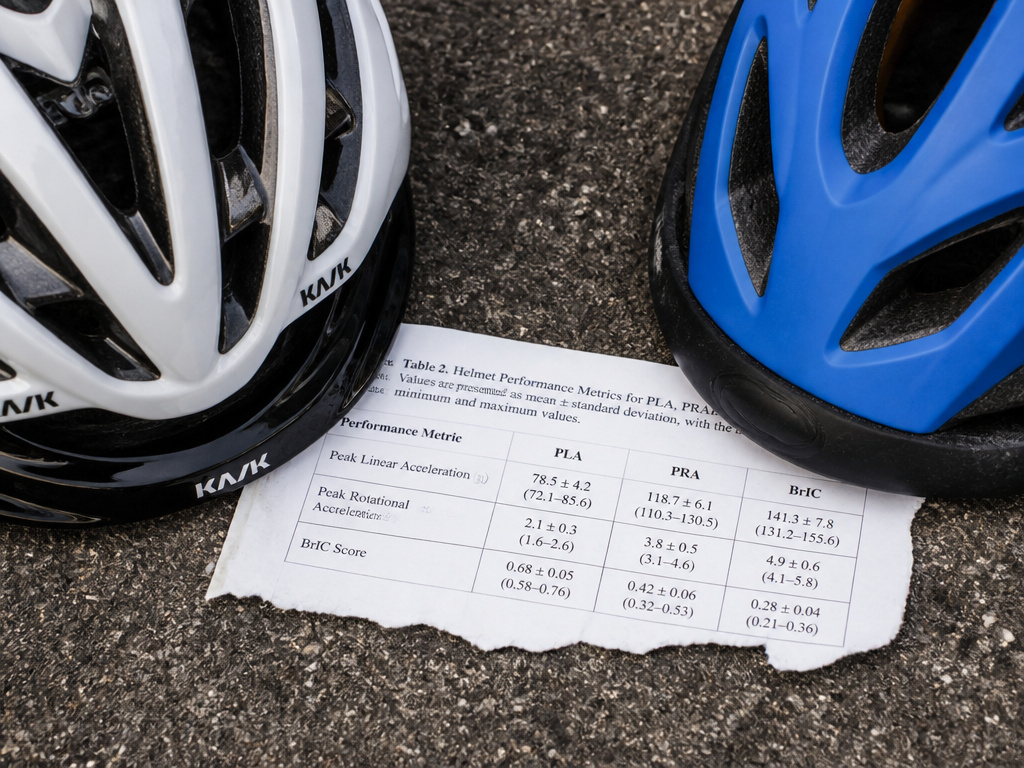
If you accept the design limits, the next question is: how well do helmets work within those limits? A 2024 study published in the Annals of Biomedical Engineering provides a stark answer: it depends wildly on which helmet you buy.
Researchers tested 30 popular helmets for pavement and trails, all certified to EN 1078. They measured key injury metrics across different impact locations.
| Performance Metric | Range Across 30 Helmets | What It Means |
|---|---|---|
| Peak Linear Acceleration (PLA) | 80 – 213 g | Lower is better. Measures force causing skull fractures, linear brain injury. |
| Peak Rotational Acceleration (PRA) | 1.6 – 9.7 krad/s² | Lower is better. Measures twisting force linked to diffuse axonal injury, concussion. |
| Brain Injury Criterion (BrIC) | 0.17 – 0.65 | Lower is better. Combined metric for serious brain trauma risk. |
| Overall Injury Risk Ratio | 1 : 2.25 | The worst helmet presented 2.25 times the risk of the best helmet. |
The study found no correlation between price and protection. A £9.99 helmet could outperform one costing £135.00. MIPS (Multi-directional Impact Protection System) technology, designed to reduce rotational forces, was present in nine of the best performers, but not all MIPS helmets scored well. Its effect was clear on rotational kinematics but did not improve linear impact protection.
This peer-reviewed helmet biomechanics research reveals that the “helmet” category is not uniform. Picking any certified model gives you a selection of top-rated bicycle helmets with a possible 125% variance in real-world protection. Your safety depends as much on your specific model choice as on the decision to wear one.
This variability matters when considering a best bike helmet for a commuter versus a best mountain bike helmet for trail riding. The intended use and impact types differ.
When Laws Do More Harm Than Good
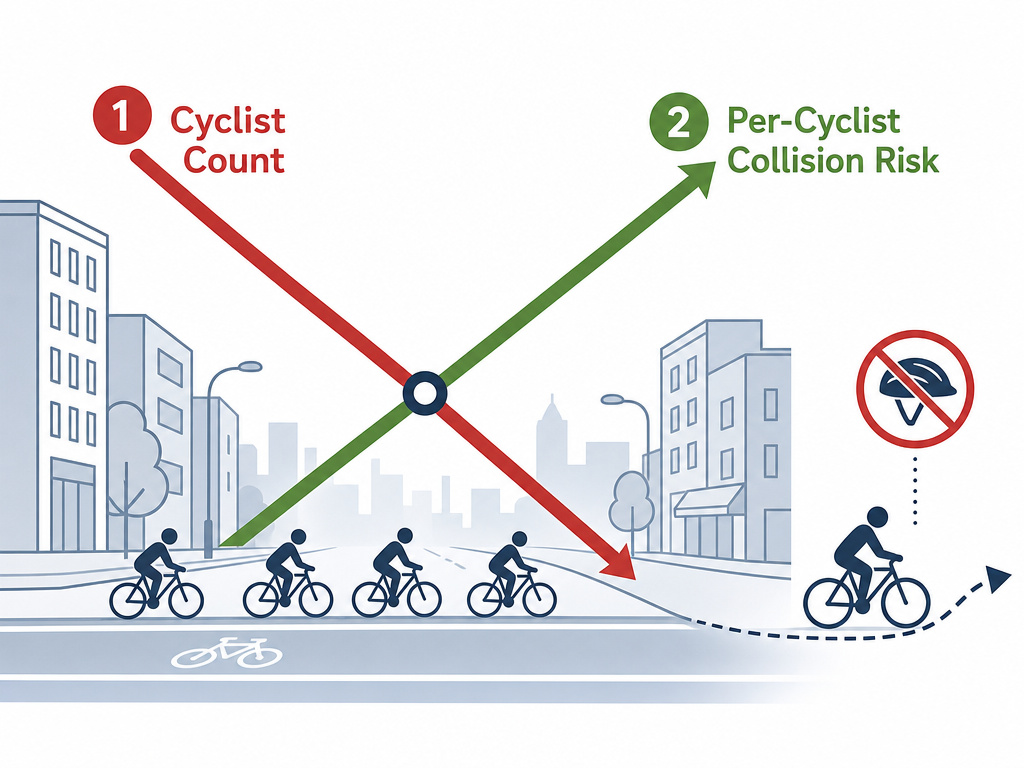
The debate shifts from the individual to the population with mandatory helmet legislation. The argument hinges on a well-established epidemiological principle: the safety-in-numbers effect. As cycling participation increases, the per-cyclist rate of collisions with motor vehicles decreases. Drivers become more aware, infrastructure improves, and the culture shifts.
Helmet laws, particularly for adults, can suppress cycling participation. A survey of 1504 bicycle owners in Norway suggested such laws disproportionately discourage safer, casual cyclists. When these riders leave the road, the total number of cyclists drops.
A system dynamics model published in 2024 concluded that the long-term public health cost:benefit ratio of helmet laws can exceed 100:1 due to unintended consequences. The life-years gained from helmet-protected cyclists are outweighed by the life-years lost from the overall decline in physical activity across a shrinking cycling population.
The logic is systemic. A law intended to make each cyclist safer can, by reducing the total cyclist count, make the remaining riders less safe and harm public health overall. This is a primary reason many cycling advocacy groups in Europe oppose adult helmet mandates, focusing instead on state-by-state overview of mandatory bicycle helmet laws as a cautionary study rather than a model.
The Problem of Fit and False Security
A helmet only works if it’s on your head correctly. Here, the gap between theory and practice is cavernous. Observation studies consistently show a majority of cyclists wear helmets incorrectly—too loose, tilted back, or with loose straps.
Helmet Fit is a Real Problem
A helmet that shifts on impact exposes the skull. The retention system must be tight enough that the helmet moves the scalp, not slides over it. The front edge should sit two finger-widths above the eyebrows, not perched on the back of the head like a bonnet. This isn’t nitpicking; it’s the difference between the helmet doing its job and being a plastic hat.
The false security is twofold. First, the rider feels “protected.” Second, as noted earlier, motorists may perceive them as more competent and afford them less caution. This creates a perfect storm: a rider in a poorly fitted helmet, behaving slightly more boldly, with drivers giving them less room. The essential factors for selecting a motorcycle helmet—like shell shape and retention design—apply equally to bicycle helmets but are often ignored in the cheaper, one-size-fits-most retail environment.
The Unspoken Cultural Counterargument
For some communities, particularly in cycling-centric cultures like the Netherlands or Denmark, the helmet debate is settled differently. The helmet is seen as a symptom of a dangerous cycling environment, not a solution to it. In places with dedicated, separated infrastructure where cyclists are physically protected from high-speed traffic, the risk profile changes dramatically.
The need for a helmet diminishes when the system is designed to prevent high-energy collisions in the first place. In this view, focusing on mandatory helmets distracts from the more effective, but more expensive, task of building safe streets. It places the burden of safety on the individual with gear rather than on society with design. This cultural perspective explains why you’ll see fewer helmets in Amsterdam than in American suburbs, despite similar or higher cycling rates.
Frequently Asked Questions
Does a bike helmet actually protect you?
Yes, but within strict limits. For low-speed falls (around 20 km/h), a properly fitted helmet can significantly reduce the risk of skull fracture and linear brain injury. It is not designed to protect against high-speed collisions with vehicles.
What is risk compensation in cycling?
Risk compensation is the theory that people adjust their behavior in response to perceived risk levels. Studies suggest some cyclists may ride more aggressively or accept riskier situations when wearing a helmet because they feel safer, potentially offsetting some of the helmet’s protective benefit.
Why do some European countries not wear bike helmets?
Many European countries with high cycling rates, like the Netherlands and Denmark, have invested heavily in separated cycling infrastructure. This physically protects cyclists from traffic, reducing high-impact collision risk. In these environments, the individual protective gear is seen as less critical than the systemic safe design.
Are more expensive bike helmets safer?
Not necessarily. A 2024 study of 30 popular helmets found no correlation between price and performance metrics like peak linear acceleration or rotational acceleration. A cheaper model can offer equal or better protection than a costly one. Fit and intended use are more important factors than price.
What is the safety-in-numbers effect for cyclists?
The safety-in-numbers effect is the observed phenomenon where as the number of cyclists on the road increases, the per-cyclist rate of collisions with motor vehicles decreases. Drivers become more accustomed to cyclists, and cities are more likely to invest in safer infrastructure. Policies that reduce cycling participation, like strict helmet laws, can weaken this effect.
The Bottom Line
The case against universal, mandatory bike helmet use is a more complex calculation of safety. It weighs individual gear against behavioral psychology, understands the hard engineering limits of polystyrene foam, and recognizes that public health policy must consider population-level effects, not just individual risk.
For a casual rider on quiet streets, a helmet is a sensible precaution for a low-speed fall. For a commuter mixing with dense traffic, its protection is limited to the lower end of the collision energy spectrum. The strongest “reason not to wear one” isn’t for the ride itself, but for the policy that makes it compulsory. Such laws can erode the very cycling culture that brings the greatest health and safety benefits to an entire city.
Your choice should be informed by your route, your riding style, and a clear-eyed view of what that piece of plastic on your head can and cannot do. For many, the best protection remains a combination of a well-fitted helmet, defensive riding awareness, and advocating for streets designed for safety, not just survival.
