
What States Have Bicycle Helmet Laws | The Adult Gap
This post contains affiliate links. As an Amazon Associate, we earn from qualifying purchases.
Twenty-one states and the District of Columbia have bicycle helmet laws, but they almost exclusively apply to minors, no state mandates them for all adults on traditional bikes. The age cutoff ranges from under 12 in Louisiana and Pennsylvania to under 18 in California and Delaware. In the 29 states without a statewide law, over 200 cities and counties enforce their own rules, some of which do cover riders of all ages.
That “adults are exempt” clause is where the real confusion starts. A state law might protect a 16-year-old, but a local ordinance from Seattle or Dallas can mandate a helmet for a 45-year-old commuter on a specific trail. Electric bikes introduce another layer, with states like Connecticut and California requiring helmets for all ages on the fastest class.
What follows is a breakdown of the 22 state-wide laws, a map of where local rules override state silence, and the three things that change the answer entirely: e-bikes, passenger rules, and the civil lawsuit risk that exists even where no cop can ticket you.
Key Takeaways
- No U.S. State requires all adults to wear a helmet on a traditional bicycle. Every statewide law targets minors, with age limits varying from 11 to 17.
- Local ordinances in over 200 cities and counties can impose stricter rules, including all-ages mandates. These are most common in states like Washington, which has no state law.
- Electric bicycle (e-bike) helmet laws are often stricter. Several states, including Alabama and Connecticut, require helmets for all riders on certain e-bike classes, regardless of age.
- Not wearing a helmet can significantly reduce a personal injury settlement after a crash, even in states with no helmet law, through the “helmet defense” in civil court.
- A helmet must have a CPSC compliance label (16 CFR 1203) to be considered legal under any state or local law. A cheap, certified helmet meets the legal requirement.
The State-by-State Helmet Law Map (and Where Adults Fit)
The legal landscape is a patchwork, not a blanket. Twenty-two jurisdictions have laws, but they share one glaring feature: they are built for kids.
All bicycle helmets sold in the U.S. Must meet the federal CPSC safety standard (16 CFR Part 1203). A compliant helmet has a permanent internal label stating “Complies with U.S. CPSC Safety Standard for Bicycle Helmets” along with the manufacturer’s details and production date. If that label is missing, the helmet doesn’t satisfy any state law.
The table below captures the core state laws as of 2026. Notice the age spread. A family moving from Pennsylvania (under 12) to California (under 18) faces a six-year shift in legal responsibility for the same child.
| State | Age Requirement | Governing Statute |
|---|---|---|
| Alabama | Under 16 | Code 32-5A-283 |
| California | Under 18 | Vehicle Code 21212 |
| Connecticut | Under 16 | C.G.S. 14-286d |
| Delaware | Under 18 | Title 21, 4198K |
| District of Columbia | Under 16 | § 50-1605/1606 |
| Florida | Under 16 | Statute 316.2065 |
| Georgia | Under 16 | O.C.G.A. 40-6-296 |
| Hawaii | Under 16 | HRS 291C-150 |
| Louisiana | Under 12 | RS 32:199 |
| Maine | Under 16 | Title 29-A, 2323 |
| Maryland | Under 16 | Trans. 21-1207.1 |
| Massachusetts | Under 17 | Ch. 85, Sec 11B |
| New Hampshire | Under 16 | RSA 265:144 |
| New Jersey | Under 17 | 39:4-10.1 |
| New York | Under 14 | VTL 1238 |
| North Carolina | Under 16 | G.S. 20-171.9 |
| Oregon | Under 16 | ORS 814.485 |
| Pennsylvania | Under 12 | Title 75, 3510 |
| Rhode Island | Under 16 | § 31-19-2.1 |
| Tennessee | Under 16 | TCA 55-8-175 |
| Virginia | 14 or younger | § 46.2-906.1 |
| West Virginia | Under 15 | 17C-11A-3 |
The map has two clear holes. First, the 29 states with no law at all, including populous ones like Texas, Ohio, and Colorado. Second, the universal exclusion of adults. This is where local power fills the gap.
Where local ordinances change everything
Washington State has no helmet law. But dozens of its cities, including Seattle, do. An adult riding a trail within city limits can be ticketed. The same dynamic plays out in Missouri, New York, and North Carolina. The Bicycle Helmet Safety Institute tracks over 200 of these local ordinances, with roughly 49 applying to all ages. You must check your city code, not just your state’s vehicle laws.
Common mistake: Assuming “no state law” means “no law at all.” In states like Texas, cities like Dallas and Austin have their own theme park bag policies, style rules for specific trail systems that apply to everyone.
For a high-level view of which states have laws and how they compare, the IIHS bicycle helmet laws table is the definitive resource. It’s where you’ll find the cleanest legislative snapshot.
Electric Bikes, Scooters, and Passengers: The Law’s Fine Print
The law sees a 20mph electric bike differently from a 10mph beach cruiser. It also sees a child in a trailer as a passenger, not a rider. These distinctions rewrite the rules.
E-bikes get their own rulebook
Most states use a three-class system for e-bikes. Class 1 and 2 (pedal-assist and throttle up to 20mph) often follow the traditional bicycle helmet laws for minors. Class 3 (pedal-assist up to 28mph) triggers stricter rules. * Alabama and Massachusetts require helmets for all riders on any class of e-bike. * California, Connecticut, Georgia, Louisiana, Ohio, Tennessee, and Virginia require helmets for all riders on Class 3 e-bikes only. * Arkansas and Colorado set the bar at under 21 for Class 3 riders, higher than their traditional bike age cutoffs.
Connecticut’s 2018 law was the first of its kind. It means an adult on a Class 3 e-bike there needs a helmet, while the same adult on a traditional bike does not. This split is becoming more common as e-bike legislation catches up with technology. The Wikipedia bicycle helmet laws entry provides a useful global context, showing how the U.S. Approach differs from countries with blanket adult mandates.
Passengers and the parent’s ticket
If a state law says “under 16 must wear a helmet,” that includes a 4-year-old in a bike seat or a trailer. The responsibility usually falls on the parent or guardian riding the bike. In many states, like New Jersey, the fine for a violation goes to the parent, not the child. This shifts enforcement from a warning to a mailed citation.
Choosing the right gear for a young passenger means more than legality. The benefits of helmets are well-documented, but fitting a small child correctly is its own skill. A loose helmet is as good as none.
Enforcement, Fines, and the Real-World “Helmet Defense”
A cop pulls over a 13-year-old riding without a helmet in a state with a law. What actually happens? The answer is less about jail time and more about insurance forms.
On the street: warnings, fines, and who pays
Helmet violations are almost always traffic infractions, not criminal charges. No jail time, no record. Typical outcomes: * First offense: Often a verbal warning, especially for a younger child. * Subsequent offenses: A fine, usually between $10 and $50. Some states, like Florida, allow courts to waive the fine if the child completes a bicycle safety course. * The liable party: Many statutes make the parent or guardian financially responsible. The ticket arrives in the mail.
The enforcement priority is low. Police rarely conduct helmet stops alone; it’s usually an add-on during a stop for another violation, like riding against traffic. But the real financial risk isn’t the fine. It’s the civil case after a crash.
In court: The “helmet defense” that cuts your settlement
This is the part no traffic ticket shows. In a personal injury lawsuit after a bicycle crash, the defense will raise the “helmet defense” if you weren’t wearing one. The argument isn’t that you caused the accident. It’s that your head injuries, and the associated medical costs, would have been less severe with a helmet.
In states with comparative negligence rules, a jury can assign a percentage of fault to your decision not to wear a helmet. If they decide the driver was 80% at fault but your lack of a helmet made your injuries 20% worse, your total compensation drops by 20%. In some states, if that assigned fault crosses 50% or 51%, you recover nothing at all. This risk exists everywhere, even in states with no helmet law.
Where this goes sideways: Thinking a helmet law only matters for a ticket. The civil liability exposure is where the real financial damage happens, often amounting to tens of thousands of dollars in a reduced settlement.
For a deeper look at the other side of this debate, some cycling advocates point to arguments against wearing helmets that focus on personal freedom and potential deterrents to riding. It’s a perspective worth understanding, even if the legal and medical consensus leans heavily toward use.
The 3-Second Check for Your Helmet’s Legality
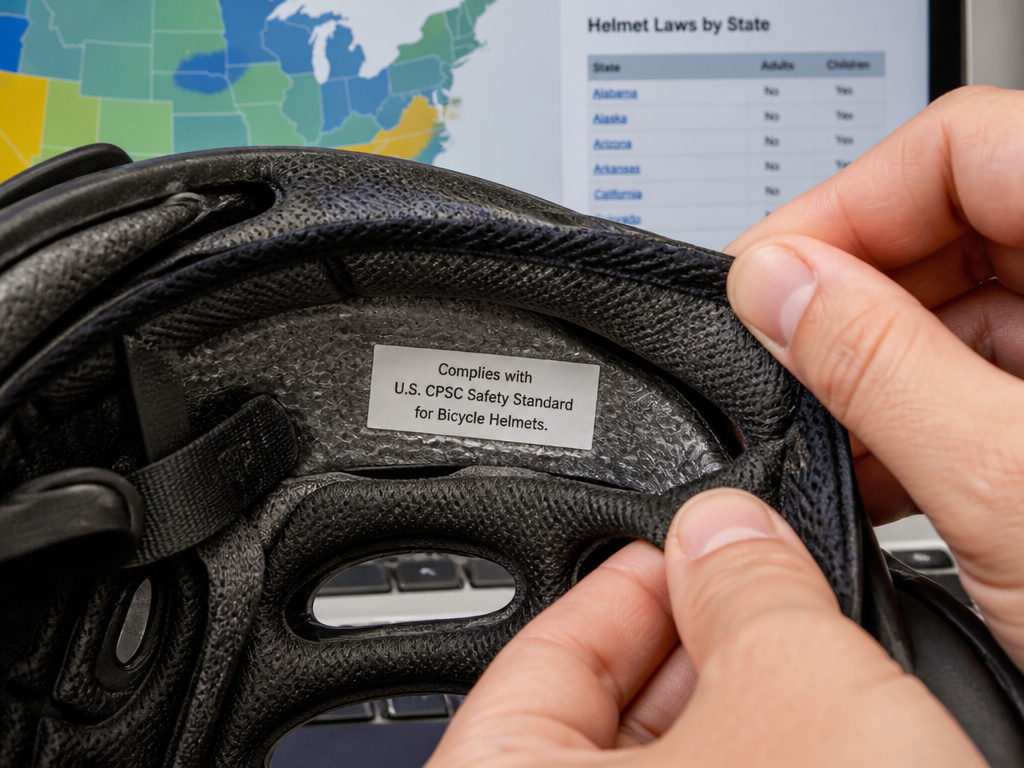 A helmet must be legal in two ways: it must comply with the safety standard, and it must be worn by a person who falls under the law. Here’s how to verify both.
- Find the CPSC label. Lift the comfort padding inside the helmet. Look for a permanent, printed label that says “Complies with U.S. CPSC Safety Standard for Bicycle Helmets.” It will list the manufacturer, model, and production date. No label, no legal compliance. This requirement is federal, from the Consumer Product Safety Commission, the same rule that covers toys and furniture.
- Know your local age cutoff. Check the state table above. Then search “[Your City] bicycle helmet ordinance.” Local parks and recreation department websites often list trail rules that include helmet mandates for all ages.
- Classify your e-bike. If you ride an e-bike, know its class (usually on the motor or in the manual). A Class 3 bike changes the helmet requirement in at least seven states, regardless of your age.
You don’t need a premium model to be legal. Any CPSC-certified helmet from a brand like Giro, Bell, or Specialized meets the standard. The difference between a $30 and a $300 model is weight, ventilation, and aerodynamics, not the legal threshold for impact protection. For a vetted selection, our guide to the best adult helmets focuses on certified models that balance protection, comfort, and value.
Why No Nationwide Law? The Politics of Helmets
 The U.S. Has federal standards for helmet construction but not for helmet use. The political arguments have stalled a national mandate for decades.
* Personal Freedom: The dominant argument against laws, especially for adults, centers on individual liberty and parental rights.
* Ridership Concerns: Some cycling advocates, including the League of American Bicyclists, argue that mandatory laws can discourage cycling without creating safer infrastructure. Their 2018 bicycle helmet laws document outlines this position, favoring encouragement over compulsion.
* Enforcement Equity: Concerns exist that helmet laws, like other traffic infractions, could be enforced disproportionately against certain communities.
The result is the patchwork we have. Public health agencies like the CDC promote the benefits of helmets and track the effectiveness of state laws, but the legislative push remains fragmented and local. For the latest public health analysis on this intervention, the CDC transportation safety guide is a primary source, though its data often feeds into state-level discussions rather than federal ones.
Frequently Asked Questions
Does my state have a bicycle helmet law?
Twenty-one states and D.C. Have statewide bicycle helmet laws. They all apply only to minors, with age cutoffs ranging from under 12 to under 18. You can check the table in this article for your state’s specific statute and age limit.
Do any states require adults to wear bike helmets?
No state requires all adults to wear a helmet on a traditional bicycle. However, over 200 cities and counties have local ordinances that do apply to all ages. These are common in states like Washington and Missouri. Additionally, many states require helmets for all adults riding certain classes of electric bikes (e-bikes).
What happens if a child is caught riding without a helmet?
Typically, the child receives a warning for a first offense. Subsequent violations can result in a small fine (usually $10-$50). In many states, the parent or guardian is legally and financially responsible for the fine, not the child.
Do helmet laws apply to electric scooters?
Sometimes, but it’s less consistent. About ten states have helmet laws for e-scooter riders, most focusing on minors. E-scooter regulations are newer and changing fast, so you must check your current local and state codes.
Is my old helmet still legal?
Helmet is only legally compliant if it has an intact CPSC safety standard label inside. Beyond legality, you should replace any helmet that has been in a crash, shows visible damage, or is more than about five years old (the foam degrades over time). For affordable, up-to-date options, see our picks for helmets under $100.
Before You Go
The answer to “what states have bicycle helmet laws” is a list of 22, but the real answer is messier. State laws protect kids within varying age brackets. Local ordinances can cover everyone. E-bike laws are stricter and evolving. And the civil court “helmet defense” is a financial risk that exists in all 50 states, ticket or no ticket.
Your three-step move: know your state’s age cutoff, check your city’s park and trail codes, and classify your e-bike if you have one. Then, regardless of the law, the data from sources like the Insurance Institute helmet law data is unambiguous on one point, a certified helmet slashes the odds of a serious head injury. The law might not make you wear it, but physics doesn’t care about jurisdiction.
