
What is Target Fixation on a Motorcycle? A Rider’s Guide.
This post contains affiliate links. As an Amazon Associate, we earn from qualifying purchases.
Target fixation on a motorcycle is a psychological and visual phenomenon where a rider’s focus narrows so intensely on a hazard, a pothole, a guardrail, an oncoming car, that they inadvertently steer directly into it, often causing a crash. It originates from WWII fighter pilots flying into targets during strafing runs, and it is responsible for a majority of single-vehicle motorcycle fatalities, like the 15 out of 21 recorded in Alberta in 2020.
That 15-out-of-21 statistic isn’t just a number; it’s a pattern. When a rider crashes alone, the enemy is the rider’s own eyes locking onto the one thing they’re trying to avoid, rather than a car turning left or gravel in a corner. Their brain stops processing escape routes, and their hands follow their gaze straight into the impact.
What follows is the full anatomy of target fixation: the exact 3-degree window of vision where it happens, the stress response that freezes your ability to act, and the military-grade scanning drill that turns panic into procedure. By the last section, you’ll know why the old advice “look where you want to go” is incomplete, and what to replace it with.
Key Takeaways
- Your brain assembles a visual scene from a central 3-degree “thumbnail at arm’s length” cone; staring at a hazard fills that cone with the threat, blotting out escape paths.
- The limbic system’s “freeze” response under fear can override conscious control; you’ll know it’s happening when your gaze sticks and your hands feel locked.
- The Motorcycle Safety Foundation’s SEE method (Search, Evaluate, Execute) is the documented countermeasure; it works by making scanning a rhythmic, mechanical habit, not a conscious choice.
- Practicing emergency swerves and threshold braking in a parking lot installs the “Execute” step as muscle memory, so it’s available when your conscious mind is swamped by fear.
- The majority of single-vehicle motorcycle crashes are linked to this phenomenon, making it a rider’s primary solo enemy.
The 3-Degree Window: How Your Vision Actually Works
You don’t see a wide-angle movie. Your brain stitches together a scene from rapid snapshots collected by a tiny, high-detail sensor in the center of your eye. The Motorcycle Safety Foundation specifies this central vision is a 3-degree cone, about the width of your thumbnail held at arm’s length. Everything outside that cone is peripheral, good for detecting movement but not detail.
When your central vision fixes on a hazard, a deep pothole at 60 mph, that thumbnail-sized window fills with the pothole’s edges. Your peripheral vision still registers the clear pavement to the left or right, but your detail-processing brain is now consumed by the texture of the asphalt in the hole. Escape routes exist in your field of view but not in your processed reality.
This is why a rider can look directly at an obstacle and still hit it. The eyes aren’t steering the bike; the mind is directing the hands based on the most salient detail it has. If that detail is the hazard, your trained motor patterns will steer toward it. It’s not a mystical force. It’s a biological bottleneck.
Why “Look Where You Want to Go” Is Only Half the Answer
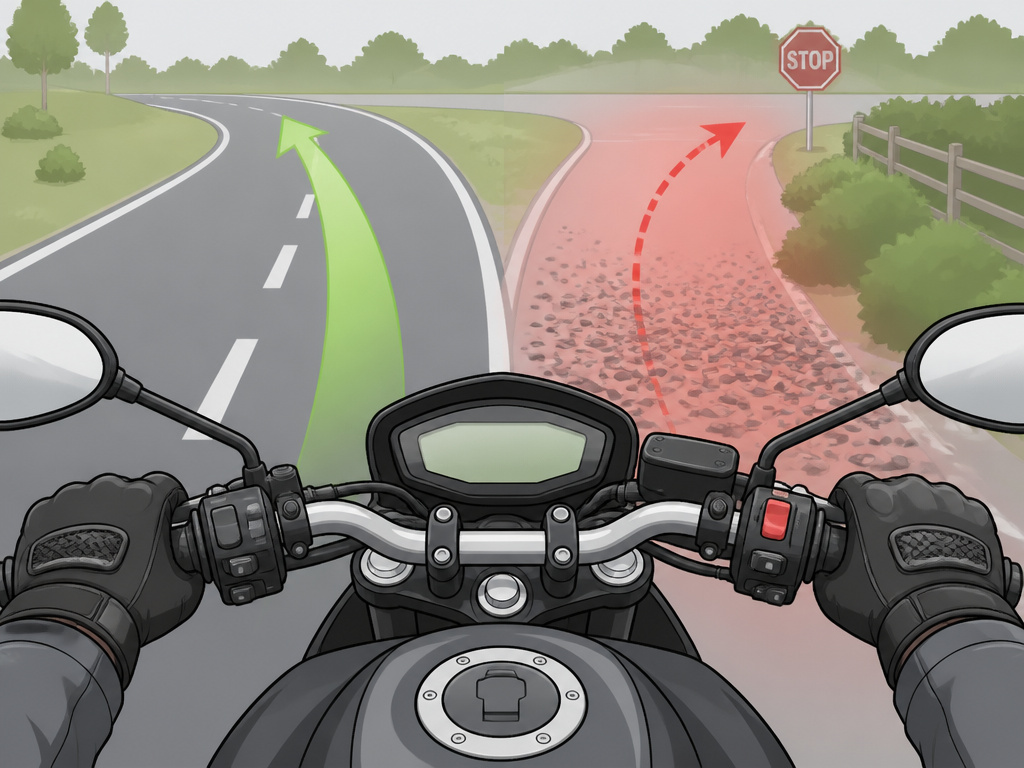
The common mantra is correct in principle but misses the mechanism. Your hands naturally follow your central focus because that’s where your brain is spending its processing budget. The trick isn’t just to look away, but to search aggressively for your new target first.
A useful parallel is the discipline needed for wet weather riding, where your scan must constantly refresh to find dry traction patches. Target fixation is the opposite: a scan that has stalled on a single point. Reactivating that scan is a conscious drill, not a hopeful glance.
From Fighter Pilots to Fatal Crashes: The Evidence Isn’t Theoretical
The term was coined in WWII to describe pilots diving into ships or ground targets during attack runs. The modern equivalent is the single-vehicle motorcycle crash. The Alberta Motorcycle Safety Society guide reported that in 2020, 15 of the year’s 21 motorcycle fatalities in the province were solo crashes, with target fixation as a likely culprit.
| Scenario | Fixation Target | Common Outcome |
|---|---|---|
| Corner entry with gravel | The patch of gravel | Running wide into oncoming lane or ditch |
| Avoiding an animal | The animal crossing the road | Swerving directly into its path |
| Correcting a front-wheel wobble | The shaking handlebars | Stiffening arms, worsening the oscillation |
| Sudden obstacle in lane | The obstacle (car, debris) | Steering into it instead of available gap |
These events are the predictable result of a visual system under stress defaulting to its most basic setting: stare at the threat. Your essential motorcycle gear, helmet, jacket, boots, is your last line of defense after this chain reaction starts.Prevention happens earlier, in the eyes and the mind.
The Limbic System Lock: When Fear Overrides Skill
Your conscious mind plans and analyzes. Your limbic system reacts to threat with fight, flight, or freeze. On a bike, freeze looks like this: your eyes lock, your breath stops, your grip tightens, and your body prepares for impact. All your practiced swerves and braking sequences sit in your motor cortex, inaccessible.
Where this goes sideways: Believing you’ll simply “react” when scared. Untrained, the freeze response wins. Your gaze sticks to the hazard for two full seconds, at highway speed, that’s over 170 feet traveled without a single corrective input.
The solution is to install a procedure so ingrained it runs beneath the panic. This is where professional rider training diverges from internet advice.They don’t teach you to be brave; they teach you to scan, evaluate, and execute on a loop so mechanical that fear can’t interrupt it.
The SEE Method: Search, Evaluate, Execute
The Motorcycle Safety Foundation’s SEE method is the formalized countermeasure. It turns passive looking into active threat management.
- Search: Move your central vision in a deliberate pattern, far ahead (12-second horizon), mid-range (4-6 seconds), near-path (2 seconds), mirrors. This is a systematic refresh that populates your brain with options, not just threats. Evaluate: Assign a threat level and a priority.That pothole is a high-level threat, but the clean lane to its left is the priority escape. This step fails if you skip Search; with only one hazard in view, evaluation has nothing to compare.
- Execute: Perform the avoidance maneuver. This step fails if you haven’t practiced it. A swerve is a coordinated counter-steer and lean, not a tense jerk. You can’t invent it in the moment.
This method directly addresses the necessity of motorcycle jackets and other armor. Gear mitigates the crash. SEE prevents it from happening in the first place.
Training Your Eyes and Hands: The Practical Drills
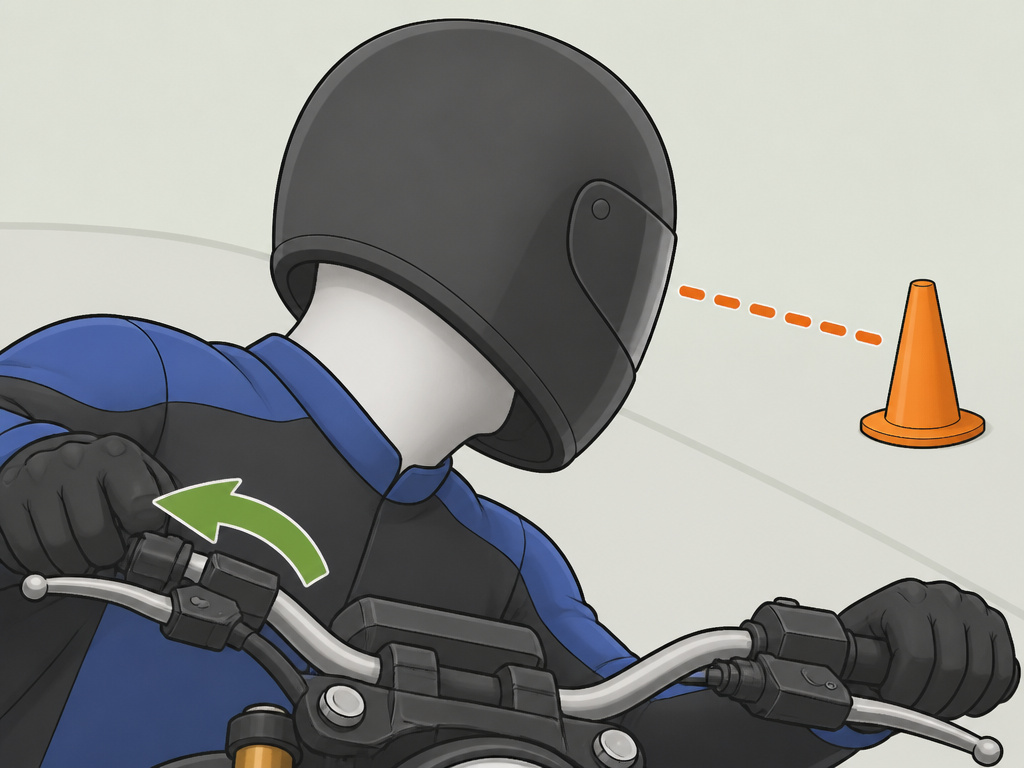 Knowledge doesn’t change behavior; drills do. These are the non-negotiable practice routines.
The Scanning Drill: On a straight, empty road, consciously move your focus every three seconds: horizon, left shoulder, speedometer, right shoulder, rearview mirror, repeat. The goal isn’t to see everything each time, but to break the habit of a fixed stare. This is the foundational skill for all risk management, as critical as choosing the right helmet.
The Swerve Drill: In a clean parking lot, set up two cones 12 feet apart. Approach at 20 mph in a straight line. As you pass a marked point, look sharply at a cone placed 45 degrees to your side, and counter-steer to swerve around your practice “obstacle.” The key is moving your head first, then letting the bike follow. Do this until the head-turn initiates the swerve without thought.
The Threshold Braking Drill: Practice squeezing the front brake to the point just before the tire chirps or the fork dives radically. Knowing your bike’s maximum braking feel means you won’t grab a handful in panic, which can lock the front and guarantee a fall. Pair this with looking up at the horizon, not down at the fleeing pavement.
These drills build the neural pathways that survive the limbic hijack. They make the correct response the path of least resistance.
Ride Like an Astronaut: The Mindset That Prevents Fixation
 Astronaut Chris Hadfield, in his book An Astronaut’s Guide to Life on Earth, described the focus of a fighter pilot flying at 400 knots just 150 feet off the deck: you must concentrate solely on what’s directly in front of you, asking, “What’s the next thing that could kill me?” He then told the author of the AMSS article he’d never ridden a motorcycle. The mindset, however, is identical.
This is about proactive, granular attention. It means scanning not for ‘dangers,’ but for the next specific threat: the sun glare hiding a stop sign, the gravel truck ahead with unsecured load, the side road with a car idling.This continuous, specific search leaves no mental room for fixation to take root.
Adopting this mindset also influences your gear choices. You select protective eyewear that manages glare without obscuring detail, because contrast sensitivity matters in threat detection. You wear motorcycle boots that give you precise feel at the controls for those Execute-step maneuvers. Every piece supports the mission of seeing and avoiding.
The Bottom Line
Target fixation is a documented psychological phenomenon with a body count, rooted in the hard biology of your 3-degree central vision and your fear-driven limbic system, not merely a rider’s myth or a lack of skill.Beating it requires more than good intentions; it demands the mechanical practice of the SEE method and the physical drills that make swerving and braking reflexive.
The majority of solo crashes stem from this chain reaction. Your helmet, your airbag jacket, your spine protector, they’re all designed for the moment after this chain has run its course. Your eyes and your training are the only things that can break the chain before it starts. Look further ahead, search without rest, and practice until the right move happens even when you’re scared.
Frequently Asked Questions
Can target fixation happen to car drivers too?
Absolutely. The same visual and psychological mechanisms apply to anyone operating a vehicle at speed. Drivers fixate on a stalled car or an animal and steer into it. The higher stakes and exposure on a motorcycle simply make the consequences more severe and the phenomenon more frequently studied in rider safety.
How do I know if I’m experiencing target fixation while riding?
You’ll feel it. Your gaze will feel “stuck” on an object. Your peripheral vision will seem to tunnel. You might stop breathing or feel a tightness in your chest and hands. The moment you notice this, force a head turn, literally snap your chin toward your intended escape path. The bike will follow.
Is there a certain type of rider more prone to target fixation?
Inexperienced riders are more susceptible because they haven’t automated their control inputs or scanning habits. However, even experienced riders can fall victim under high stress, fatigue, or surprise. This is why continuous training, not just miles logged, is critical. Complacency is a risk factor.
Does wearing a full-face helmet contribute to tunnel vision?
Well-designed full-face helmet should not significantly reduce your peripheral field of view. The potential for tunnel vision comes from the rider’s internal focus, not the helmet’s physical aperture. In fact, a good helmet with a clear visor reduces wind fatigue and glare, helping you maintain an active scan longer. Choosing a proper motorcycle helmet is about maximizing your sensory input, not restricting it.
Are action cameras a distraction that could cause fixation?
They can be if you’re thinking about framing the shot instead of riding the road. A motorcycle camera mounted and set to record automatically is a passive tool. The hazard is when a rider starts “riding for the camera,” focusing on the scene they’re capturing instead of the environment they’re navigating. The camera should be a witness, not a director.
