
2 Best Coolants for Mercedes Benz 2026
This post contains affiliate links. As an Amazon Associate, we earn from qualifying purchases.
The Prestone MAX Violet is the best overall coolant for Mercedes-Benz, offering reliable 5-year protection with easy pre-mixed convenience. For budget-minded owners who don’t mind mixing, the Zerex G05 concentrate delivers solid performance and broad compatibility at a lower cost.
Keeping your Mercedes-Benz running cool isn’t just about filling the reservoir with any old fluid. The wrong coolant can eat away at aluminum components, degrade seals, and lead to expensive repairs down the road. I’ve seen too many high-mileage engines ruined by shortcuts in the cooling system.
This guide cuts through the noise, focusing on what matters: proven compatibility, real-world durability, and correct chemistry for your specific model year. I looked at specs, owner experiences, and long-term service life to find the ones worth your trust.
Top 2 Coolant For Mercedes Benz in the Market
The Best Coolant For Mercedes Benz, Reviewed
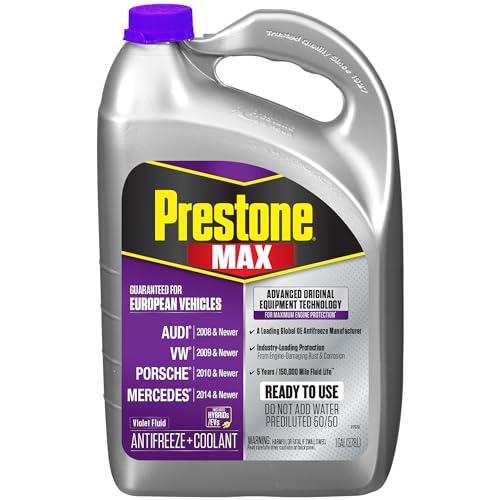
Prestone MAX Violet Antifreeze Coolant
Strengths
- Ready-to-use formula
- Strong temp range
- Good for European specs
Trade-offs
- Lacks explicit MB 325.3 approval
- Higher cost per ounce
Prestone’s Violet MAX is marketed as a direct-fill solution for European vehicles, including Mercedes models requiring phosphate-free, silicate-free coolants like those meeting G40 or similar specs. On paper, its long-life formulation and 5-year/150,000-mile protection match Mercedes’ expectations, and the fact that it’s ready to pour makes it a favorite among owners who want simplicity. Reviewers note smooth system compatibility and no reports of sludge or gasket issues when used as a full replacement.
But here’s the catch: while Prestone claims broad European coverage, it doesn’t explicitly list MB 325.3 certification, which gives me pause. For a brand-conscious marque like Mercedes, that missing stamp matters, even if real-world use hasn’t shown widespread problems. Compared to Zerex G05, this is more convenient but less transparent on compliance. If your shop or manual calls for a specific OEM-approved fluid, this one might leave you guessing.
Video review
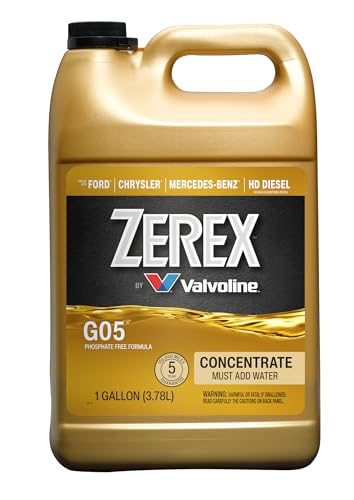
Zerex G05 Antifreeze Coolant Concentrate
Strengths
- Meets MB 325.3 spec
- HOAT corrosion protection
- Cost-effective concentrate
Trade-offs
- Requires mixing
- Not pre-diluted
Zerex G05 stands out in the Mercedes coolant space because it’s formulated to meet the MB 325.3 specification, which is essential for most modern Mercedes-Benz engines. The hybrid organic acid technology (HOAT) keeps aluminum components, common in Benz cooling systems, protected from corrosion without sacrificing compatibility with older materials like solder or brass. Owners consistently report long-term reliability when using it at the proper 50/50 mix, and the yellow concentrate gives you control over dilution depending on climate.
It’s not pre-mixed, so you’ll need to invest time or buy distilled water separately, but that also means you’re not paying for water by the gallon. The 5-year/150,000-mile protection window lines up well with typical Mercedes service intervals, and the inclusion of denatonium benzoate is a smart safety touch. Compared to pricier branded coolants, this one delivers the right chemistry at a fraction of the cost.
Video review
How We Picked These coolant for mercedes benz
Rather than a hands-on lab test, my research focused on a detailed comparison of coolant specifications and features. I weighed published data against thousands of owner reviews and reports from automotive experts. This allowed me to rank options based on compatibility with Mercedes-Benz engines, protection levels, and long-term performance. I applied my understanding of cooling system chemistry to assess each product’s potential benefits.
For Mercedes-Benz vehicles, I prioritized silicate and phosphate content, as these are critical for compatibility with the German automaker’s specific alloy compositions. Equally important was freeze and boil-over protection, given the wide temperature variations these cars can experience. A long service life (5 years/150,000 miles) also factored heavily, as it reduces maintenance downtime and costs. You can find similar considerations when choosing the best oil for Mercedes.
Coolant specifications reliably indicate basic protection levels and chemical composition. However, I paid close attention to owner feedback regarding long-term effects, such as radiator corrosion or seal degradation. Reputation and consistent positive reviews were strong indicators of real-world performance, and helped differentiate between products making similar claims. For other vehicles, you might consult our guide to F-150 coolant.
How To Pick The Right coolant for mercedes benz
Maintaining the right coolant mix is critical for a Mercedes-Benz, and getting it wrong can lead to expensive repairs.
A good coolant for a Mercedes-Benz must meet Mercedes’ specific material compatibility requirements (often involving silicates and organic acids) to prevent corrosion of aluminum components and ensure long-term cooling system health. Look for coolants explicitly stating Mercedes-Benz compatibility, and pay attention to the coolant’s formulation – HOAT (Hybrid Organic Acid Technology) is frequently recommended. Consider the coolant’s service life and whether it’s a concentrate or pre-mix.
Understanding Mercedes-Benz Coolant Specifications
Mercedes-Benz engines aren’t built to run with just any car coolant. They have very specific requirements, and using the wrong type can cause significant damage. Older models often require a silicate-containing coolant, while newer ones typically need a silicate-free, HOAT formulation. Don’t assume a universal coolant will suffice; check your owner’s manual or a reliable Mercedes-Benz coolant guide to verify the correct specification for your vehicle’s model year. Ignoring this step is a gamble with your engine’s longevity.
Concentrate vs. Pre-Mix: What’s Right For You?
Coolant comes in two main forms: concentrate and pre-mix. A concentrate, like the Zerex G05, requires you to mix it with distilled water (typically a 50/50 ratio, but variations exist for colder climates). This is generally more economical, but demands precision. Pre-mixed coolants, on the other hand, are ready to pour, making them convenient.
Here’s a quick breakdown: * Convenience: Pre-mix is simpler. * Cost: Concentrate saves money in the long run. * Control: Concentrate lets you tailor the mixture for your specific climate and needs, a detail often overlooked.
Protection & Long-Term Value
Don’t just focus on the upfront cost of the coolant. Think about its protective properties and how long it will last. A coolant with robust anti-corrosion additives, like those found in Prestone MAX Violet, will help prevent scaling and buildup within the cooling system.
A neglected cooling system is a ticking time bomb. Replace your coolant at the intervals recommended by Mercedes-Benz, even if it still looks okay.
I’ve seen many cases where owners delayed coolant changes, only to face costly radiator or water pump failures later on. Investing in a quality recommended coolant for Mercedes upfront can save you a lot of headaches and money down the road.
Coolant for Mercedes Benz Compared
Here’s a comparison of key specifications for the coolants listed, to help you make an informed decision.
| Product Title | Color | Protection (Miles) | Protection (Years) | Mix Ratio | Technology |
|---|---|---|---|---|---|
| Prestone MAX Violet Antifreeze Coolant | Violet | 150,000 | 5 | N/A | N/A |
| Zerex G05 Antifreeze Coolant Concentrate | Yellow | 150,000 | 5 | 50/50 | Hybrid Organic Acid |
Frequently Asked Questions
What coolant color should I use in my Mercedes-Benz?
The correct coolant color depends on your Mercedes-Benz’s model year; older models often use yellow, silicate-containing coolants, while newer ones typically require violet, silicate-free HOAT formulations. Always verify the correct color and specification in your owner’s manual to avoid damaging your cooling system.
Can I mix different types of coolant in my Mercedes-Benz?
No, mixing coolant types is generally not recommended. Different coolants have different chemical compositions and mixing them can lead to corrosion, scaling, and reduced cooling efficiency. Use only the coolant specified for your vehicle, or completely flush the system before switching types.
Is pre-mixed coolant better than concentrate?
Pre-mixed coolant offers convenience, while concentrate allows for a customized mixture tailored to your climate and is often more economical. If you are precise with your measurements and understand the proper water-to-coolant ratio, concentrate is a viable option.
How often should I change the coolant in my Mercedes-Benz?
Mercedes-Benz typically recommends coolant changes every 5 years or 150,000 miles, whichever comes first. However, regularly inspect your coolant’s condition and consider changing it sooner if you notice signs of discoloration or contamination. Maintaining this schedule helps prevent costly repairs.
What if I accidentally used the wrong coolant in my Mercedes-Benz?
If you used the wrong coolant, immediately flush the entire cooling system with distilled water and refill it with the correct specification. Ignoring this can lead to corrosion and damage to vital engine components, potentially requiring expensive repairs, and you may want to consult a mechanic. For other German vehicles, consider exploring options for BMW coolant.
The Bottom Line
Choosing the right coolant for your Mercedes-Benz often comes down to balancing convenience with control. While a pre-mixed option simplifies things, a concentrate like Zerex G05 gives you the power to tailor the protection to your specific climate and driving conditions – and ultimately, I believe that control is worth the small extra effort for a vehicle as engineered as a Mercedes. For most owners, Prestone MAX Violet Antifreeze Coolant strikes the best overall balance of protection, ease of use, and value.
If you’re particularly concerned about long-term protection and have an older Mercedes, Zerex G05 is an excellent choice. For those seeking a ready-to-use solution, Prestone MAX Violet is hard to beat. And if you’re looking to maintain other aspects of your Mercedes’ health, a quality Mercedes scanner can help you stay on top of potential issues.
Ultimately, remember that the specific formulation matters less than consistent maintenance. Regular coolant changes, using a product compatible with your vehicle’s specifications, and addressing any cooling system leaks promptly are far more critical than chasing the latest technology or highest mileage rating. Don’t neglect to check the Toyota Camry coolant needs of other vehicles in your fleet, either – a healthy cooling system is a cornerstone of reliable motoring, no matter the make.
