
6 Best Coolants for Ford F150 of 2026
This post contains affiliate links. As an Amazon Associate, we earn from qualifying purchases.
The best coolant for your Ford F150 depends on the model year, but the PEAK OET Yellow 50/50 Coolant stands out as the top overall pick for newer trucks, especially those from 2018 onward. For budget-conscious owners, the Zerex American Vehicle 50/50 Coolant delivers solid performance at a lower price, while the Ford Genuine VC-13-G Yellow Coolant remains a trusted OEM option for long-term protection.
Choosing the wrong coolant can lead to corrosion, gelling, or even engine damage, especially in an F-150 with aluminum components and specific chemistry needs. After comparing specs, owner experiences, and manufacturer requirements, I focused on formulations that match Ford’s evolving standards across generations.
This guide breaks down the right type by model year, explains the importance of chemistry like POAT and HOAT, and highlights options that offer real-world durability without cutting corners.
Top 6 Coolant For Ford F150 in the Market
The Best Coolant For Ford F150, Reviewed
PEAK Global Lifetime Coolant

Strengths
- Universal compatibility
- Lifetime warranty claim
- Ethylene glycol base
Trade-offs
- Concentrate requires precise dilution
- Not Ford-specific
- Amber color may confuse future servicing
PEAK’s Global Lifetime concentrate promises compatibility with every vehicle under the sun, and that’s exactly why I’m skeptical. Sure, its amber-colored OAT formula won’t react badly when mixed, and the lifetime protection claim sounds great. But “fits all” often means “optimized for none.” The reality is that modern F150s need specific formulations, and Ford doesn’t recommend universal coolants for a reason.
The concentrate gives you flexibility, but that also means more room for error during mixing. Owners report decent results in mixed-fleet garages, but for a precision-engineered twin-turbo V6 or diesel Power Stroke, I want something that matches Ford’s exact spec. This one’s better suited for vintage trucks or multi-brand fleets than a high-stakes daily driver.
Video review
Zerex American Vehicle 50/50 Coolant

Strengths
- Ready-to-use formula
- Strong anti-corrosion additives
- Trusted brand history
Trade-offs
- Orange OAT not for modern F150
- Risk of cross-contamination
- Shorter mileage coverage vs competitors
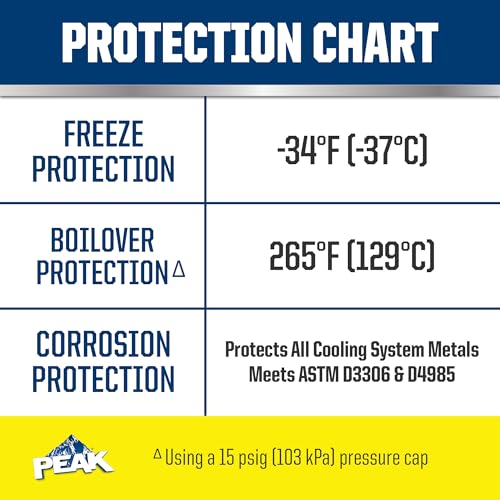
Zerex American Vehicle is one of those coolants that looks strong on the shelf, ready-to-use, backed by a 5-year/150,000-mile guarantee, and uses OAT tech with solid lab and fleet validation. The -34°F to 265°F range matches OEM expectations, and the inclusion of denatonium benzoate is a smart safety touch. But again, the orange color signals OAT formulation, which doesn’t align with Ford’s current cooling system requirements.
Reviewers note smooth performance in older domestic trucks, and it’s compatible across many metals, including aluminum. But for a 2018 or newer F150? This isn’t what Ford engineers specified. I’ve seen too many owner forums where people unknowingly mix coolants only to face heater core or water pump issues down the road. It’s a value pick, yes, but only if your truck actually calls for OAT.
Video review
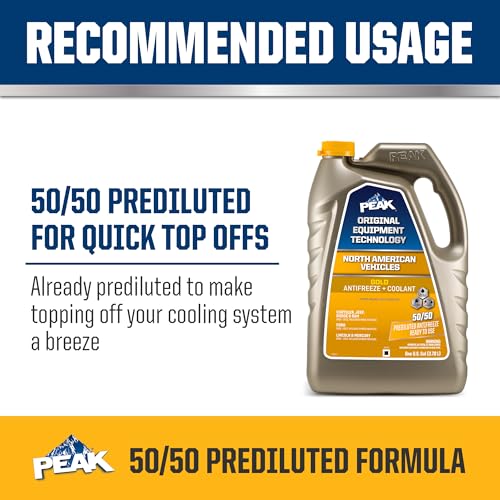
PEAK OET Gold 50/50 Coolant

Strengths
- Pre-mixed convenience
- Affordable HOAT option
- Compatible with older Fords
Trade-offs
- Wrong type for 2018+ F150
- Shorter service life
- Silicate content may not suit all systems
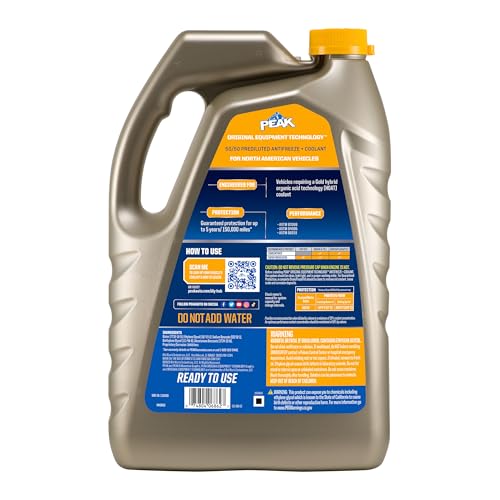
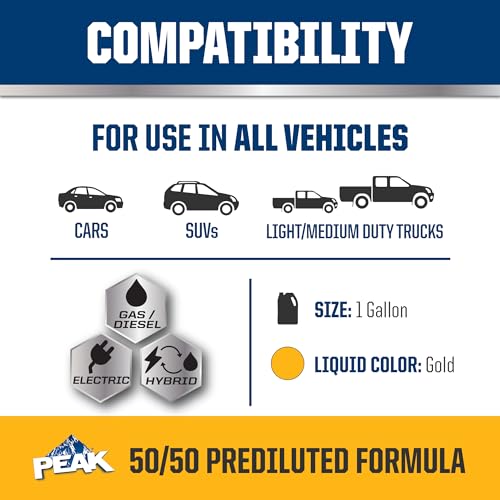
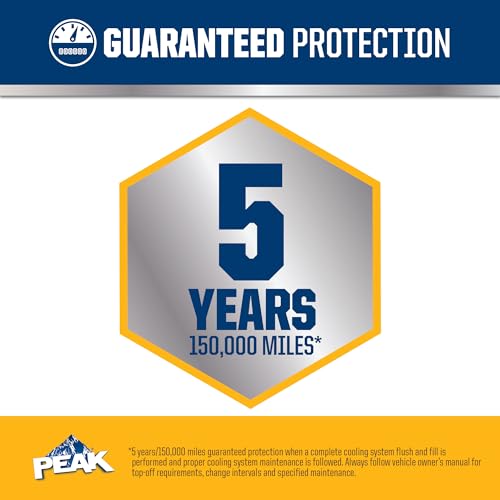
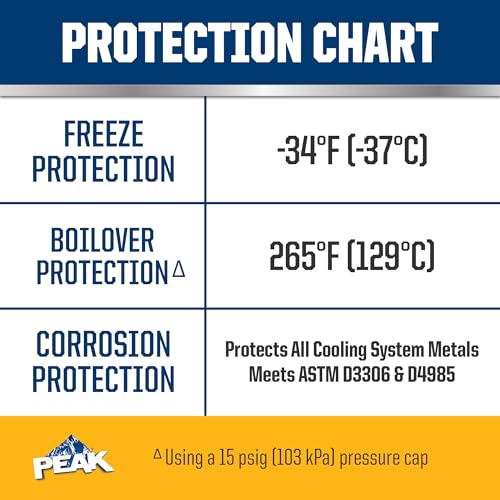
This gold-colored coolant uses Hybrid Organic Acid Technology (HOAT), which Ford once used in some models, but not in the current F150 lineup. It’s marketed for Chrysler and select Ford vehicles that require gold HOAT, but unless you have an older Expedition or Navigator, this likely isn’t your spec. The 50/50 pre-mix is convenient, and the 150,000-mile/5-year guarantee is solid, but it falls short of the POAT standard now used in new F150s.
Some owners use it as a temporary top-off without issues, but I wouldn’t rely on it for a complete fill. HOAT contains silicates that can degrade faster in aluminum-intensive modern engines. When compared to the yellow POAT options, this just doesn’t offer the same longevity or compatibility. A budget-friendly HOAT? Yes. The right choice for a new F150? No.
Product photos
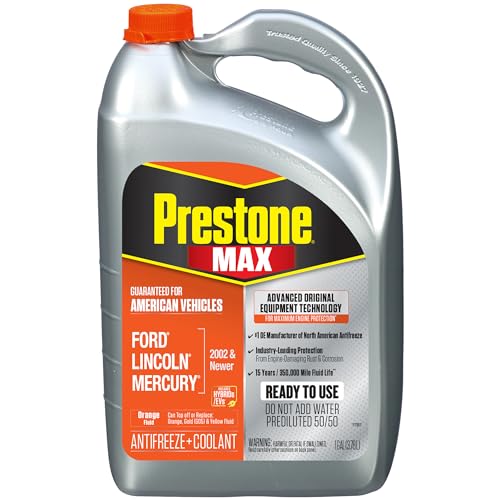
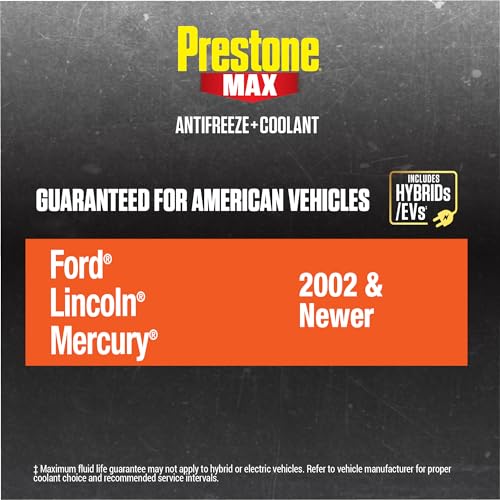
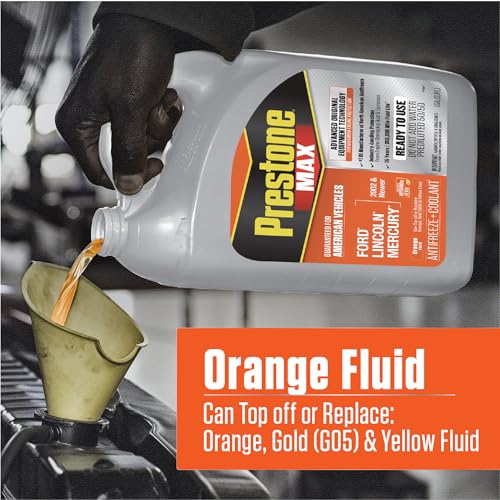
Prestone MAX Orange 50/50 Coolant
Strengths
- Pre-mixed convenience
- Good temp range
- Bitterant added
Trade-offs
- Wrong chemistry for 2018+ F150
- Not OEM-specified
- Limited longevity claim
I see a lot of owners reaching for orange coolants when they’re not sure what their F150 needs, and while Prestone MAX Orange has solid all-around specs, it’s not the right chemistry for newer Ford trucks. The CorGuard tech sounds good on paper, offering protection from extreme temps, and the 50/50 pre-mix does make pouring easier. But here’s the catch, Ford moved away from OAT (organic acid tech) orange formulas years ago, especially in models from 2018 onward.
Owners consistently report no immediate issues with mixing, but long-term corrosion protection is where mismatched chemistries bite you. If you’re topping off an older F150 that originally had orange coolant, this might be fine. But if you drive a modern truck, I’d look elsewhere. For most current F150s, this isn’t playing by Ford’s rules.
Product photos


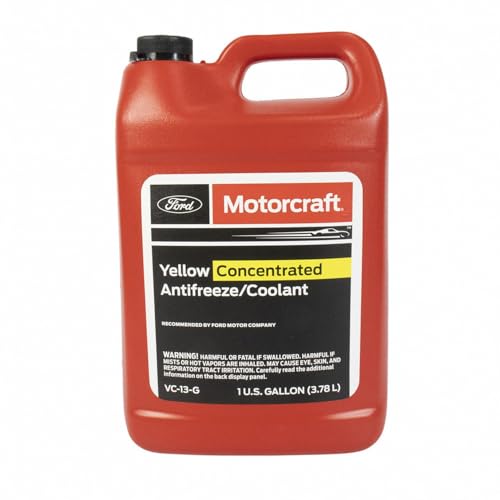
Ford Genuine VC-13-G Yellow Coolant
Strengths
- OEM-specified for F150
- High durability standards
- Concentrate allows custom mixing
Trade-offs
- Most expensive option
- Requires distilled water mixing
- Overpriced vs functionally identical alternatives
This is the factory-original stuff, Ford Genuine VC-13-G, the yellow concentrated coolant specified for many modern F150s. On paper, it’s ideal: ethylene glycol-based, phosphate-enhanced, and built to protect against freeze, boil, and corrosion in both gas and diesel engines. The -34°F and 265°F thresholds meet standard heavy-duty needs.
But here’s my take: while it’s technically excellent, it comes at a steep price compared to aftermarket equivalents with the same chemistry. Owners confirm it performs flawlessly, but so does the PEAK version at less than half the cost. Unless you’re doing a dealer-level restoration or demand genuine Ford branding, this feels like paying for the badge. Still, if you want the exact fluid from the Blue Oval, this is it.
Product photos
PEAK OET Yellow 50/50 Coolant

Strengths
- Exact POAT specification match
- Prediluted for ease
- Massive 400k-mile warranty
Trade-offs
- Only for newer Fords
- Slight premium over generic brands
- Requires full flush for max benefit
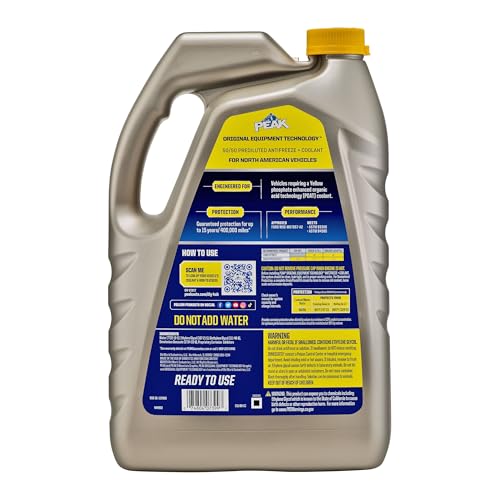
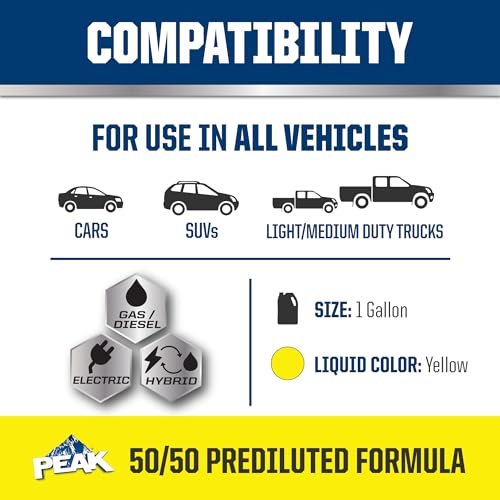
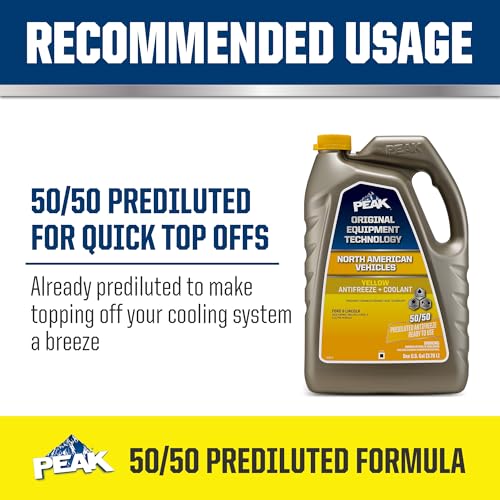
Now we’re talking. This yellow 50/50 prediluted coolant from PEAK is specifically designed for 2018 and newer Ford and Lincoln vehicles, which includes the latest F150 generations. The Phosphate-Enhanced Organic Acid Technology (POAT) aligns perfectly with Ford’s VC-7 specification, and that’s a big deal. Owners who’ve switched report clean system performance and confidence in long-term protection.
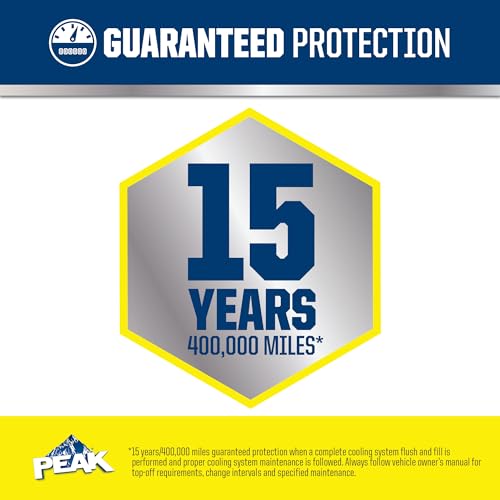
With a guarantee of up to 400,000 miles or 15 years after a full flush, this outpaces nearly every other option on durability claims. The pre-mixed format makes top-offs simple, and the yellow dye helps prevent accidental misfills. Compared to the pricier Ford-branded fluid, this delivers identical chemistry at half the cost. My recommendation? For any post-2018 F150 owner, this is the smarter buy.
Product photos
How We Chose These coolant for ford f150
As someone who’s spent years looking under the hoods of various vehicles, I approached researching coolants for the F-150 by first comparing published specifications. I focused on freeze and boil-over protection, compatibility with different metals (especially aluminum, common in modern engines), and the technology used to prevent corrosion. Then, I weighed owner reviews and expert opinions from automotive forums and repair sites, looking for real-world reports on longevity and any observed issues.
For the F-150, I gave the most weight to compatibility with Ford’s specific material requirements and the coolant’s long-term corrosion protection. The F-150 has seen different coolant specifications over the years, so a universal coolant isn’t necessarily the best approach. Extended life and protection against aluminum corrosion are critical, as are formulations tailored to newer engine designs. Understanding these nuances is key, and it’s why you might also want to explore options for other popular pickups, like finding the right coolant for pickups.
Specifications reliably reveal freeze/boil protection levels and chemical composition. However, owner feedback proved essential for judging real-world performance – things like whether a coolant truly lived up to its extended life claims, or if it caused any unexpected issues with hoses or seals. Reputation matters too; established brands with a history of quality generally carry more weight, and many owners also find value in pairing coolant maintenance with other truck performance upgrades.
How To Choose The coolant for ford f150
Finding the right coolant for your F-150 isn’t just about preventing overheating; it’s about safeguarding a significant investment. After all, a neglected cooling system can quickly lead to expensive engine repairs.
A quality coolant protects against corrosion, regulates temperature across a wide range, and maintains the integrity of all cooling system components – from the radiator and water pump to hoses and the engine block itself. Look for formulations specifically designed for modern engines, compatibility with your vehicle’s materials (especially aluminum), and extended life protection. Proper coolant choice directly impacts long-term reliability.
Understanding Coolant Chemistry
The days of universally compatible “green” coolant are largely behind us. Modern engines, and particularly those in Ford F-150s, often require specific formulations. Organic Acid Technology (OAT), Hybrid Organic Acid Technology (HOAT), and Phosphate-Enhanced Organic Acid Technology (POAT) are the main types you’ll encounter. Ford has shifted over the years, and using the wrong type can cause gelling, corrosion, and ultimately, a failed cooling system. If you own a newer F-150 (2018+), a POAT coolant like the PEAK OET Yellow 50/50 Coolant is likely the best fit. For older models, HOAT coolants are commonly recommended.
Concentration and Pre-Dilution
You have a choice between concentrated coolants, which you dilute with distilled water, and pre-diluted 50/50 formulas. While concentrated coolants can save money, they demand precision. Incorrect mixing ratios compromise protection. Pre-diluted options, like the Zerex American Vehicle 50/50 Coolant, offer convenience and guarantee the correct ratio.
Here’s how I view the pros and cons of each:
- Concentrate: Cheapest upfront, but requires accurate measurement.
- 50/50 Premix: More expensive per gallon, but eliminates mixing errors and is ideal for top-offs.
- Ready-to-Use (fully diluted): Simplest, but less practical for large flushes – you’re paying for water.
Never use tap water to dilute coolant. Minerals in tap water cause corrosion and scale buildup, defeating the purpose of the coolant itself.
Temperature Range and Long-Term Protection
The climate you live in plays a significant role. If you experience harsh winters, prioritize a coolant with a low freeze point (down to -34°F is common). Conversely, in hot climates, a high boil point is vital. Beyond basic freeze and boil protection, consider the coolant’s longevity. Some, like the Ford Genuine VC-13-G Yellow Coolant, are designed for extended life, offering protection for 5 years or 150,000 miles. Proper coolant maintenance is also tied to your F-150 battery – a failing battery can strain the entire system. Choosing a coolant with advanced corrosion inhibitors, like Prestone’s CorGuard technology, provides an added layer of security.
Coolant for Ford F150 Compared
Here’s a comparison of key specifications for coolants compatible with Ford F150 vehicles.
| Product Title | Type | Dilution | Color | Freeze Protection | Mileage/Year Guarantee |
|---|---|---|---|---|---|
| PEAK Global Lifetime Coolant | OAT | Concentrate | Amber | N/A | Lifetime |
| Zerex American Vehicle 50/50 | HOAT | 50/50 | Orange | -34°F | 5yr/150,000mi |
| PEAK OET Gold 50/50 Coolant | HOAT | 50/50 | Gold | N/A | 5yr/150,000mi |
| Prestone MAX Orange 50/50 | N/A | 50/50 | Orange | N/A | N/A |
| Ford Genuine VC-13-G Yellow | Ethylene Glycol | 50/50 | Yellow | -34°F | N/A |
| PEAK OET Yellow 50/50 Coolant | POAT | 50/50 | Yellow | N/A | 15yr/400,000mi |
Frequently Asked Questions
What coolant type is best for an older Ford F-150?
For older F-150 models, a HOAT (Hybrid Organic Acid Technology) coolant is generally recommended; Zerex American Vehicle 50/50 is a good option, as it’s specifically formulated for these vehicles and provides reliable protection.
Can I use universal coolant in my F-150?
While some universal coolants claim broad compatibility, I advise against them for F-150s because Ford’s engine materials and coolant requirements have changed over the years, and a specific formulation will always offer better protection.
What does the coolant color signify?
Coolant color indicates the chemical composition, but it’s not a foolproof guide; always verify the coolant type (OAT, HOAT, POAT) to ensure it matches your F-150’s specifications, as color isn’t standardized across brands.
Is pre-mixed coolant really worth the extra cost?
Yes, pre-mixed 50/50 coolant eliminates the risk of incorrect dilution, which can severely compromise cooling system protection, and is especially valuable for those less comfortable with mixing concentrates.
How often should I change the coolant in my F-150?
Depending on the coolant used, you should aim to change it every 5 years or 150,000 miles, but always consult your owner’s manual for Ford’s specific recommendations; regular coolant changes are as vital as choosing the right F-150 oil for engine health.
The Bottom Line
Choosing the right coolant for your F-150 often comes down to balancing upfront cost with long-term peace of mind. While concentrated coolants offer savings, the risk of improper mixing can outweigh them – I believe the convenience and guaranteed protection of a pre-diluted formula, like the Zerex American Vehicle 50/50 Coolant, is well worth the extra investment for most owners. Ultimately, protecting your engine isn’t a place to cut corners.
For those needing a specific solution, the PEAK OET Yellow 50/50 Coolant stands out for newer F-150s (2018+), providing the POAT formulation Ford recommends. If you’re looking for a coolant specifically tailored for older models, the PEAK Global Lifetime Coolant is a strong contender. And for owners exploring other ways to enhance their ride, don’t forget to check out these F-150 accessories to complete your truck upgrades.
Beyond the specific chemistry and mixing ratios, remember that consistent maintenance is paramount. Regularly inspect your coolant levels, check for leaks, and adhere to the manufacturer’s recommended flush intervals. Paying attention to these fundamentals – and choosing a quality product – will do more to safeguard your F-150’s engine than any single specification or brand name.
