
The 70-90% Rule: Can I Put Wider Tires on My Stock Rims?
This post contains affiliate links. As an Amazon Associate, we earn from qualifying purchases.
You can put wider tires on stock rims, but only within the tire manufacturer’s approved rim width range, typically 70–90% of the tire’s section width in inches, and only if you maintain the original load capacity, speed rating, and rolling circumference. Exceeding these limits risks bead unseating, abnormal wear, and can void your vehicle’s safety systems.
That “approved rim width range” is the specific, tire-by-tire spec sheet number most people never look up. They see a number like 235 and think it fits a 7-inch rim because the math works. It usually does. Until it doesn’t, and the sidewall flex lets the bead pop on a hard corner.
What follows: the three non-negotiable specs from the tire’s data sheet, the one clearance check you must do in the wheel well, and why your owner’s manual has a clause that makes this a warranty question, not just a fitment one.
Key Takeaways
- The tire manufacturer’s data sheet lists the exact approved rim width range; the common 70–90% rule is a rough estimate that fails for performance tires.
- Load Index and Speed Rating must match or exceed OEM specs; a wider tire with a lower load capacity is a direct safety violation.
- Rolling circumference changes must stay within ±3% to prevent ABS and stability control malfunctions.
- Physical clearance in the wheel well needs checking at full lock and full suspension compression, not just static.
- Continental Tire explicitly states it does not approve any tire-rim combo outside TRA, ETRTO, or JATMA standards, installing one may violate federal safety regulations.
The Three Specs That Matter More Than Width
Width gets the attention. It’s the visible change. But three other numbers on your tire’s sidewall dictate whether a swap is safe or a ticking failure. Ignoring them because the width fits the rim is how you pass a visual inspection but fail a mechanical one.
Load Index: The Weight Your Tire Can Actually Carry
The Load Index is a number, not a suggestion. It’s the maximum weight each tire can support at its maximum inflation pressure. A common mistake is assuming a wider tire automatically carries more weight. It doesn’t.
A tire’s load capacity is engineered around its internal construction, casing ply strength, bead design, rubber compound. A 255mm wide tire with a Load Index of 101 can carry less weight than a 245mm tire with an Index of 105. If your door jamb sticker calls for a 103 load index, you must match or exceed it. Going under stresses the sidewall beyond its design limits.
Common mistake: Choosing a wider tire with a lower Load Index because “it’s bigger.” The tire will overheat under load, the sidewall will fatigue, and a blowout becomes a question of miles, not months.
The consequence isn’t gradual. Under-inflated or overloaded tires fail from heat buildup. On a highway, that heat can spike in minutes.
Speed Rating: The Letter That Isn’t About Top Speed
The Speed Rating (T, H, V, W) isn’t just about how fast you drive. It certifies the tire’s ability to dissipate heat and maintain structural integrity at sustained high speeds. A ‘V’ rated tire is built with different materials and reinforcement than an ‘H’ rated one.
Switching to a wider tire with a lower speed rating might seem fine if you never hit 149 mph. The problem is the rating also correlates with handling precision and emergency maneuver performance at any speed. Your vehicle’s electronic stability control (ESP) is tuned expecting a certain level of tire responsiveness. A downgraded tire won’t provide it.
The Honda owner’s manual puts it bluntly: “Using tires of a different size or construction can cause the ABS to work inconsistently.” The system expects a certain wheel speed and deflection profile. Change the tire’s fundamental behavior, and the computer’s corrections arrive late or wrong.
Rolling Circumference: The Math Your Speedometer and ABS Rely On
Rolling circumference is the distance your tire travels in one revolution. Change it, and your speedometer and odometer become lies. More critically, your anti-lock brakes and traction control systems get confused.
These systems compare wheel speed sensor data across all four wheels. If your new tires have a different rolling circumference, one wheel will appear to be rotating faster or slower than the others. The system may interpret this as a skid or loss of traction and apply brakes or cut power unexpectedly.
| Change in Rolling Circumference | Effect on Vehicle Systems |
|---|---|
| Within ±1% | Negligible. Speedometer error under 1 mph. Systems operate normally. |
| ±1% to ±3% | Speedometer error noticeable. ABS/ESP may trigger slightly earlier or later but generally functions. |
| Beyond ±3% | High risk of system malfunction. ABS may pulse on dry pavement, ESP may cut power erratically. |
Continental’s plus-sizing guideline states a change within ±3% “does not require any adjustments.” That’s the ceiling. Go past it, and you’re asking for trouble no shop can calibrate out.
How Wide is Too Wide? The 70–90% Rule
Here is where the internet gives you a handy rule of thumb and stops. For most passenger tires, your rim width should be about 70 to 90 percent of the tire’s section width, once converted from millimeters to inches. A 235mm tire (9.25 inches) fits a rim between 6.5 and 8.3 inches wide. Your 7.5-inch stock rim sits comfortably in the middle.
For most passenger tires, rim width should be approximately 70–90% of the tire’s section width (measured in inches). The section width on the tire sidewall is in millimeters, divide by 25.4 to convert.
This rule works for all-season touring tires. It fails for high-performance summer tires or off-road all-terrains. Those tires have stiffer sidewalls and narrower approved ranges. A 255/35ZR20 performance tire might demand a 9-inch rim as its minimum, blowing the 70% rule out of the water.
That’s why the manufacturer’s data sheet is the only authoritative source. Brands like Michelin, Bridgestone, and Continental publish these for every tire model. The sheet lists the “approved rim width range” and the “recommended rim width.” The range is what’s safe to mount. The recommendation is where the tire performs as engineered.
The difference is everything. Mounting at the extreme end of the approved range is a compromise. The tire will work, but it won’t work well.
What “Ballooning” and “Stretching” Actually Do to Your Tire
When a rim is too narrow for the tire, the sidewall bulges outward, a “balloon” shape. The tread contact patch shrinks and concentrates in the center. Steering feels vague, and the sidewall can roll under in a hard turn, risking bead unseatment.
When a rim is too wide, the tire stretches. The tread flattens, putting more pressure on the outer edges. The sidewall sits at a sharper angle, exposing it to curb and pothole damage. The bead is under constant tension.
| Condition | Primary Risk | Observable Symptom |
|---|---|---|
| Rim Too Narrow | Bead unseating during hard cornering | Excessive sidewall flex, vague steering, center tread wear |
| Rim Too Wide | Sidewall impact damage, edge wear | Tire looks “stretched,” harsh ride, visible rim protector lip |
The symptoms show up quickly. Center wear from a ballooned tire appears within a few thousand miles. A stretched tire’s vulnerable sidewall meets its first pothole the first week.
The Clearance Check You Can’t Skip
A tire can fit the rim spec perfectly and still not fit your car. This is the physical reality check. You need space between the new, wider tire and your vehicle’s body, suspension, and wheel well liner.
Static clearance, the car sitting on a lift, isn’t enough. You must check at full steering lock (both sides) and simulate full suspension compression. A tire that clears by a quarter-inch when straight can grind into the strut or fender liner when turning.
This is where “plus-sizing” gets complicated. Going from a 225 to a 235 tire might only add 5mm of width on each side. But if you also increase the wheel diameter (a “plus-one” or “plus-two” upgrade), the entire tire’s position shifts. It can move outward, upward, or both.
Ford’s owner manual warning is uncompromising: “Use of any tire or wheel not recommended could affect the safety and performance of your vehicle, which could result in an increased risk of loss of vehicle control, vehicle rollover, personal injury and death.” They mean it. If a non-OE tire contacts any part of the vehicle under dynamic conditions, you have lost control of the engineering.
TL;DR: Paper specs are permission. Physical clearance is the law. Check lock-to-lock and push down on the fender.
The Legality and Warranty Problem
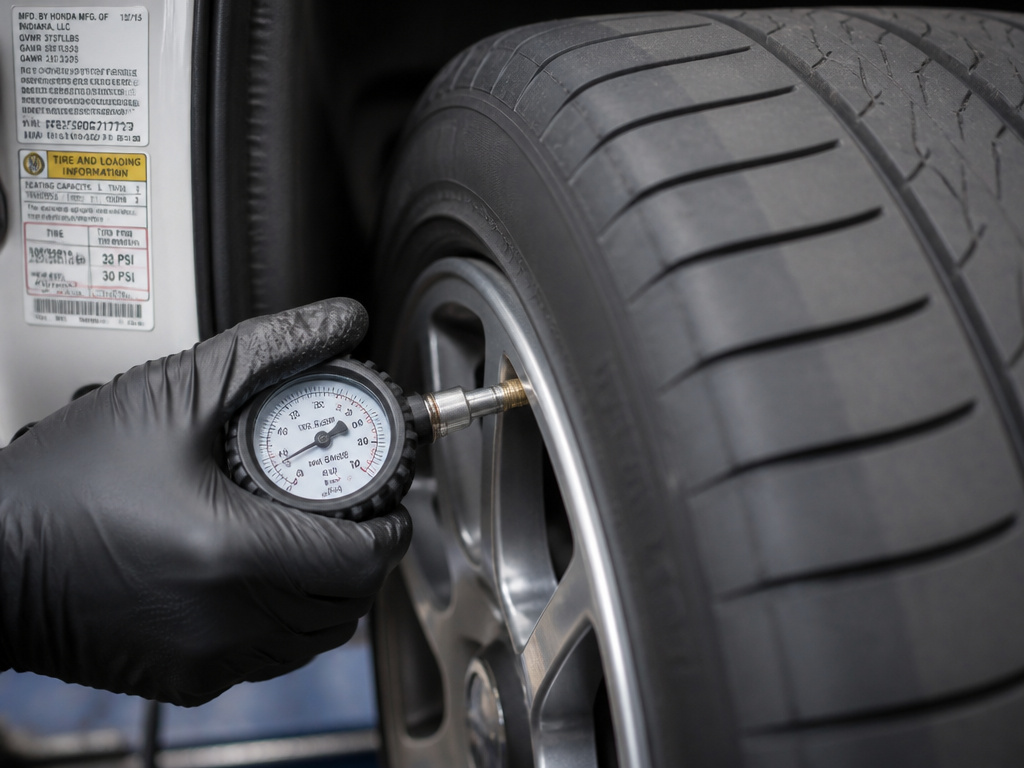
This isn’t just about handling. It’s about compliance and liability. In the U.S., Title 49 of the Code of Federal Regulations (S4.4.1) mandates that rims must be suitable for use with the tires as listed by the tire manufacturer. In Canada, Transport Canada’s Technical Standards Document 110 mirrors this.
Continental Tire’s PSIB 06-03 document states plainly: “Continental Tire North America… Does not approve the use of any tire size – rim width combination outside of the applicable standards such as TRA, ETRTO or JATMA.”
If your combination isn’t on the tire maker’s approved list, a shop mounting it may be violating federal safety regulations. More directly for you, it voids your vehicle’s warranty for any related component.
Think beyond the tire. If your altered rolling circumference causes a transmission controller error, that powertrain warranty claim is denied. If a stretched tire leads to a wheel bearing failure, the suspension warranty is gone. The dealership’s first move is to check tire size against the door jamb sticker.
Step-by-Step: How to Check If a Wider Tire Fits Your Stock Rim
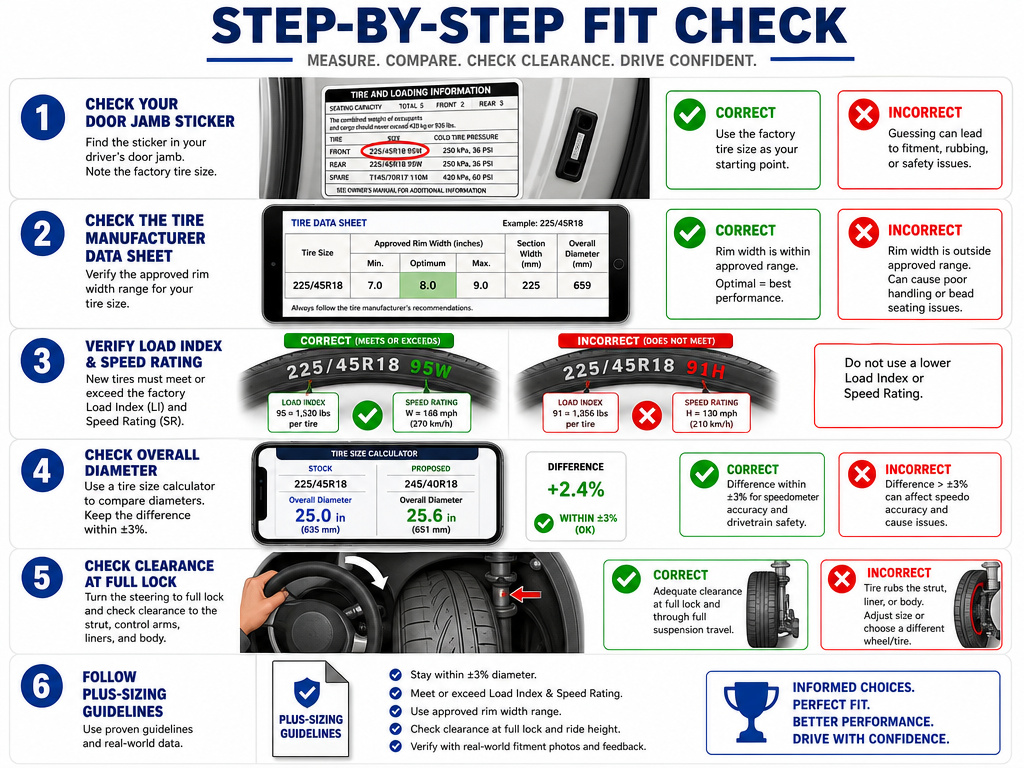
Don’t guess. Follow this sequence. Skipping a step is how you own a set of tires you can’t use.
- Find Your Stock Spec. Locate the tire size, load index, and speed rating on your driver’s door jamb sticker. Note your stock rim width (e.g., 17x7J). It’s often in the owner’s manual or stamped inside the wheel.
- Consult the Tire Data Sheet. For your desired wider tire model, find the manufacturer’s official data sheet online. Verify your stock rim width falls within its “approved rim width range.”
- Compare Critical Ratings. Confirm the new tire’s Load Index and Speed Rating meet or exceed your stock tire’s ratings. Never accept a lower number.
- Calculate Rolling Circumference. Use an online tire size calculator. Ensure the new tire’s overall diameter is within ±3% of the original.
- Perform a Physical Test. If possible, borrow a single mounted tire from a friend or shop. Install it on your car. Turn the steering wheel fully left and right. Check clearance to the strut, fender liner, and any brackets. Push down on the suspension to check for rubbing at full compression.
- Review Plus-Sizing Guidelines. If you’re also increasing wheel diameter, reference the Continental Tire PSIB 06-03 document. It outlines the need to maintain inflation pressure relationships, especially for all-wheel-drive vehicles.
This process takes an afternoon. It beats the alternative: spending hundreds on tires that rub, wear unevenly, or get your warranty claim rejected.
So, What’s the Verdict?
For the vast majority of daily drivers, moving up one width size (e.g., 225 to 235) on the stock rim is feasible, if you do the homework. The rim width usually falls within the approved range, and the performance trade-off is minimal. This is the territory of a cautious, informed upgrade.
The moment you step outside that lane, the risks compound. Going two sizes wider, mixing and matching tires on an AWD system, or ignoring load ratings turns a simple swap into a vehicle dynamics experiment. Your car’s computers are not designed for that experiment.
If you want one answer for a typical sedan or crossover: yes, you can often fit a slightly wider tire on your stock rims, but you must use the tire maker’s spec sheet as your bible, not a forum post. Start with a model like the Michelin Pilot Sport All Season 4 or the Continental ExtremeContact DWS06 Plus, check their fitment guides religiously, and always keep the stock tire’s critical ratings as your minimum floor.
Frequently Asked Questions
Will wider tires on stock rims improve handling?
They can, but not always. A wider tire on the proper rim width increases the contact patch, which can improve dry grip. However, if the rim is too narrow, causing ballooning, handling becomes vague and less predictable. The improvement depends entirely on staying within the tire’s designed rim width range.
Can I put 235 tires on 225 rims?
It depends on the specific rim width. If your 225 tires are on a 7-inch wide rim, a 235 tire might be within its approved range for that 7-inch rim. You must check the 235 tire’s manufacturer data sheet. Never assume compatibility based on the size difference alone.
Do I need an alignment after putting on wider tires?
Yes. Any tire change is a good time to check alignment. Wider tires can be less tolerant of incorrect toe or camber settings, leading to accelerated or uneven wear. It’s a minor cost that protects your larger investment in the new tires.
How does tire width affect fuel economy?
Wider tires generally increase rolling resistance, which can reduce fuel economy by 1-3%. The effect is small but measurable over time. The trade-off is often accepted for the benefit of improved traction or aesthetics.
Are there insurance implications for running non-standard tires?
Potentially, yes. If an insurance adjuster determines that non-OE tire sizes contributed to an accident, for example, by causing ABS failure or reduced stability, your claim could be denied. It’s a remote risk, but it exists. Your policy may require notification of vehicle modifications.
