
Can You Put 235 Tires on 225 Rims: The Critical Bead Pinch
This post contains affiliate links. As an Amazon Associate, we earn from qualifying purchases.
You can put 235 tires on 225 rims, but only if the rim’s actual width in inches falls within the Tire and Rim Association’s approved range for a 235mm tire: minimum 6.5 inches, measuring rim 7.5 inches, maximum 8.5 inches. A rim made for a 225mm tire is often a 7.0-inch width, half an inch under the T&RA minimum for 235mm. That mismatch creates a “pinched” or balloon fitment, risking poor handling, uneven wear, and in extreme cases, bead unseating.
The 7.0-inch width is the trap. That’s the measuring rim for a 225mm tire, but it’s at the absolute floor of the acceptable range for a 235mm tire. Mounting a wider tire on that rim forces the sidewalls to bulge outward because the bead seats are too close together. The tire mounts, and it holds air. The car drives. But the geometry is wrong from the moment the bead seats.
The rest walks the difference between a safe swap and a gamble. We’ll cover the T&RA numbers, the specific risks of pinching a 235mm tire on a 7.0-inch rim, and how to check your own wheel’s stamped width, not the tire size it came with, before you buy.
Key Takeaways
- The rim’s inch width, not the old tire size, decides compatibility. A “225 rim” is usually a 7.0-inch wide wheel.
- The T&RA says a 235mm tire needs a rim at least 6.5 inches wide, with 7.5 inches as the ideal. A 7.0-inch rim is the bare minimum.
- Pinching a 235mm tire on a 7.0-inch rim rounds the tread, concentrates wear in the center, and increases sidewall flex. Hard cornering can unseat the bead.
- Always check the tire manufacturer’s specific data sheet. Their approved range can be narrower than the T&RA standard.
- A mismatched load rating between tire and wheel is a separate, critical failure point many guides miss.
The Math Doesn’t Lie: 235 vs 225 Rim Width Ranges
Forget millimeters for a second. Wheels are measured in inches, and the Tire and Rim Association (T&RA) publishes the industry standards. Their chart is the starting point for any swap.
Mounting a 235mm tire on a 7.0-inch rim sits at the absolute minimum of the T&RA-approved range. The sidewall must bow inward sharply to meet the bead seat, which rounds the tread crown, narrows the contact patch, and concentrates load at the center. One inch of rim width change alters a tire’s measured section width by roughly 5mm.
Here’s the T&RA data that defines the safe zone:
| Tire Section Width | Min Rim Width | Measuring Rim Width | Max Rim Width |
|---|---|---|---|
| 225mm | 6.0 inches | 7.0 inches | 8.0 inches |
| 235mm | 6.5 inches | 7.5 inches | 8.5 inches |
This table reveals the problem. The measuring rim for a 225mm tire is 7.0 inches. That’s the width the tire was designed around. If you’re moving from a 225mm tire to a 235mm tire on the same wheel, that wheel is almost certainly 7.0 inches wide.
But 7.0 inches is half an inch narrower than the measuring rim for a 235mm tire (7.5 inches). It’s also just 0.5 inches above the absolute minimum rim width for a 235mm tire (6.5 inches). You are mounting the new tire at the extreme narrow edge of its acceptable range.
The rule of thumb is that rim width should be 70–90% of the tire’s section width in inches. A 235mm tire is about 9.25 inches wide. Seventy percent of that is 6.5 inches, the T&RA minimum. Ninety percent is 8.3 inches. A 7.0-inch rim sits at 76%. It’s within the math but at the pinched end of the spectrum.
Manufacturers like Michelin, Bridgestone, and Goodyear publish their own approved rim widths for each specific tire model. These can be narrower than the T&RA range. Always check the data sheet for the exact tire you’re buying. A performance summer tire might demand an 8.0-inch minimum, while a touring all-season might tolerate 7.0 inches. This is why a generic tire selection guide is only a first step.
What Happens If the Rim Is Too Narrow? (Balloon Fitment)
Mounting a tire on a rim below its recommended width is called a balloon fitment. The sidewalls bulge outward because the bead seats are too close together. For a 235mm tire on a 7.0-inch rim, the effects are measurable and progressive.
First, the contact patch changes. The tread rounds, so the tire rides on its center. Shoulder grip drops. You’ll feel this as less precise turn-in and a mushier steering response. The car leans more in corners because the sidewall flexes excessively.
Next, wear patterns shift. Center tread wears faster. After 5,000 miles, you might see a smooth strip down the middle while the shoulders still have visible sipes. This uneven wear accelerates the tire’s end-of-life.
Finally, the bead is at risk. The bead seat is the tire’s mechanical lock to the wheel. Under hard lateral load, a fast freeway ramp, an emergency swerve, the flexing sidewall can lever the bead off the seat. A sudden, complete loss of air pressure follows. It’s rare, but it’s documented in extreme mismatches.
Where this goes sideways: Assuming a “225 rim” is wide enough for a 235mm tire because it’s only a 10mm difference. The rim width hasn’t changed. You’re asking the new tire’s bead and sidewall to perform on a foundation it wasn’t designed for.
The physical mechanism is leverage. The sidewall acts like a curved spring. On a properly wide rim, the spring is compressed, holding the tread flat. On a too-narrow rim, the spring is stretched, letting the tread crown rise. All the force during cornering works against that stretched spring, stressing the bead where it hooks into the wheel.
A real-world case involved a Honda Civic. The owner fitted a 235mm tire on a 225-spec rim. Within a few months, they reported significant vibration and uneven wear on the inner shoulder. The fix was a new set of wheels with the correct width.
The Critical Checks Before You Mount 235 Tires
Swapping tire sizes isn’t a guessing game. Three checks decide if a 235mm tire will work on your current wheels.
1. Find Your Wheel’s Stamped Width. Look on the inside of the rim, near the valve stem or on the spokes. You’re looking for a marking like 17x7J or 18x7.5. The second number is the rim width in inches. If it’s unreadable, measure the distance between the inside bead seats, not the outside lips. This is your rim width.
2. Pull the Tire Manufacturer’s Data Sheet. Go to the brand’s website. Michelin, Continental, Pirelli, and find the spec sheet for the exact tire model you want (e.g., Michelin Pilot Sport 4S in 235/45R18). It will list the approved rim width range. If your wheel’s stamped width falls within that range, you have the manufacturer’s blessing. If it doesn’t, no reputable shop should mount it.
3. Verify Clearance and Load Ratings. A 235mm tire is taller as well as wider. Use a tire size calculator to see the new diameter. Jack up the car and test-fit the wheel at full lock both ways. Check clearance to the strut and fender liner. Also, match the load rating on your old and new tires. A mismatch here can void the tire’s warranty and overload the sidewall.
The process for changing tire size always involves these three steps. Skipping the data sheet check is how people end up with a vibrating Civic.
235/45R18 vs 225/45R18: A Real-World Comparison
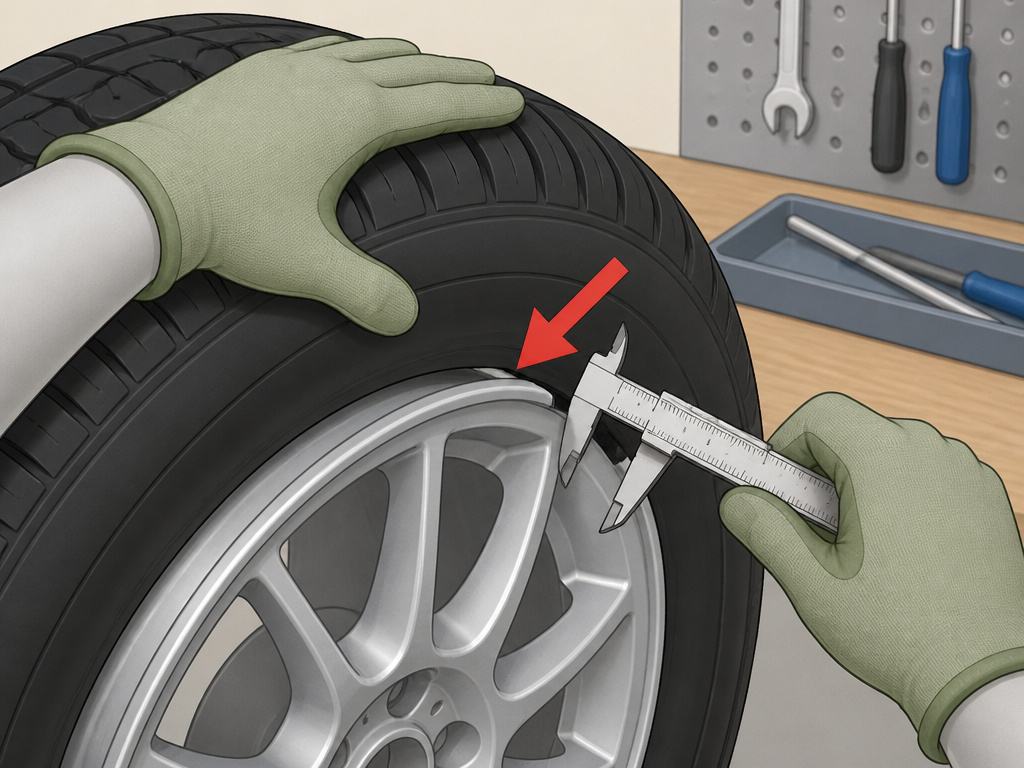 Let’s make it concrete. A common upgrade is from a 225/45R18 to a 235/45R18. The rim is often 18×7.5 or 18×8. The differences are small but systemic.
| Specification | 225/45R18 | 235/45R18 | Consequence of the Swap |
|---|---|---|---|
| Section Width | 225mm | 235mm (+10mm) | Tire is 10mm wider. May rub on inner strut or fender if clearance was minimal before. |
| Sidewall Height | 101.25mm (225 * 0.45) | 105.75mm (235 * 0.45) | Sidewall is 4.5mm taller. |
| Overall Diameter | 26.0 inches | 26.3 inches (+0.3 inches) | Speedometer reads ~1.2% slow. Odometer undercounts mileage. |
| Tread Width | ~7.5 inches | ~7.9 inches | Contact patch is wider, potentially improving dry grip. |
| Ideal Rim Width | 7.0–8.0 inches (7.0 inches is measuring rim) | 7.5–8.5 inches (7.5 inches is measuring rim) | An 18×7.5 wheel is perfect for the 235mm tire. An 18×7.0 wheel is at the narrow limit. |
The 0.3-inch diameter increase is why your speedometer will read slow. At an indicated 60 mph, your true speed is closer to 60.7 mph. Most modern stability control systems can handle a deviation under 3%, but it’s a factor.
The wider tread can improve dry-weather cornering and braking. But the trade-off is potentially worse hydroplaning resistance, as a wider tire must displace more water. This is why simply installing wider tires isn’t always a net positive.
The Load Rating Mismatch Everyone Misses
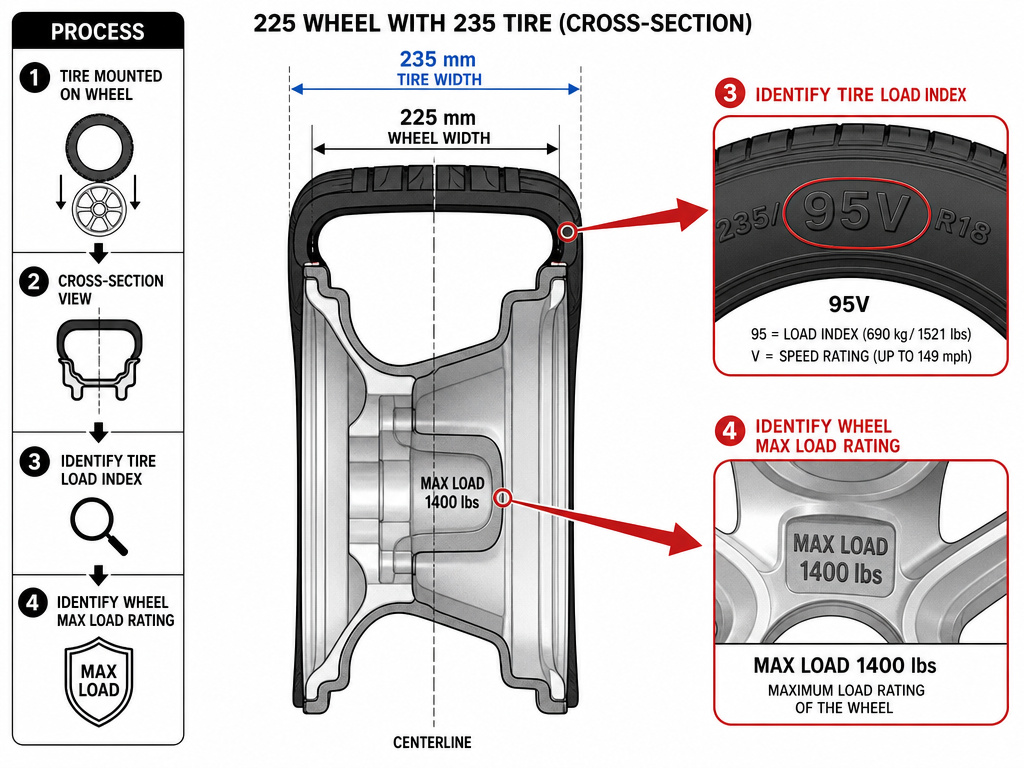 The numbers molded on the sidewall include a load index, like 91H or 95V. This is the maximum weight the tire can carry at its maximum safe speed. The wheel has a load rating too, often stamped near the hub.
A 235/40R18 tire might have a load index of 91 (1,356 lbs). The original 225/45R18 wheel might be rated for 1,400 lbs. That’s fine. But if the new tire has a lower load index than the wheel’s capacity, you’ve created a weak link. The tire will fail before the wheel.
More critically, if you’re upsizing tires for a truck or SUV and the new tire’s load rating is below the vehicle’s Gross Axle Weight Rating (GAWR), you’ve built a legal liability. A failure in that scenario isn’t just a blowout, it’s a demonstrated negligence.
Always match or exceed the OE tire’s load index when swapping sizes. The load rating is a certification, not a suggestion.
When a 235 Tire on a 225 Rim Actually Works
It’s not always wrong. There are scenarios where the swap is safe and even beneficial.
Your “225 Rim” is Actually an 8-Inch Wheel. Some manufacturers mount 225mm tires on 8-inch-wide wheels for a sportier, flatter profile. If your wheel is stamped 18×8, it’s well within the ideal range for a 235mm tire. The tire will sit square, with supported sidewalls.
You’re Moving to a Lower-Profile Tire. If you change the aspect ratio, the math shifts. Going from a 225/50R18 to a 235/45R18 might result in nearly identical overall diameter. The shorter, stiffer sidewall of the 45-series tire compensates for some of the flex induced by a slightly narrow rim.
The Tire Model is Forgiving. Some all-season touring tires have broad approved rim widths. A model like the Continental PureContact LS might list 7.0–8.5 inches for a 235mm size. In that case, the manufacturer has certified the fit.
The principle is the same: the wheel’s inch width and the tire maker’s data sheet are the final arbiters. This is true whether you’re considering wider tires on same rims or a full aftermarket wheels and tires package.
The Bottom Line
Can you put 235 tires on 225 rims? Only if the rim’s inch width, found stamped on the wheel itself, meets the Tire and Rim Association minimum of 6.5 inches and, preferably, lands near the 7.5-inch measuring rim width. The common 7.0-inch “225 rim” is the danger zone. It creates a pinched fitment that wears tires unevenly, dulls handling, and in a worst-case scenario, risks bead separation.
Before you buy, do two things: measure your wheel’s width and download the tire manufacturer’s spec sheet. If the numbers align, the swap is sound. If they don’t, you’re not upgrading, you’re compromising. The right tire and rim combo is a matched set, not a forced fit.
Frequently Asked Questions
Does a 235 tire fit a 7-inch rim?
Technically, yes, if the tire manufacturer lists 7.0 inches within its approved rim width range. According to the T&RA, 7.0 inches is 0.5 inches above the absolute minimum for a 235mm tire. However, it is half an inch below the ideal measuring rim width of 7.5 inches. The fit will be pinched, increasing sidewall flex and center wear. Always check the specific tire’s data sheet.
What is the actual width difference between 225 and 235 tires?
The section width difference is 10 millimeters, or about 0.4 inches. However, the functional difference is greater because the tire’s shape changes based on rim width. A 235mm tire on its proper 7.5-inch rim will have a flatter, wider contact patch than a 225mm tire on its proper 7.0-inch rim. The perceived increase in grip comes more from this shape change than the mere 10mm of extra rubber.
Can wrong rim width damage tires?
Yes, and predictably. A rim that is too narrow causes center wear and excessive sidewall flex, leading to premature fatigue and heat buildup. A rim that is too wide stretches the sidewall, exposing it to impact damage and causing shoulder wear. Both conditions move the tire outside its engineered load-carrying geometry, which can void the warranty and lead to sudden failure.
Will 235 tires rub on my car if I keep the same rims?
Possibly. A 235mm tire is wider and often slightly taller. Even if the rim width is compatible, the tire’s extra bulk needs physical space. Check clearance at the strut, inside the fender well, and at full steering lock. The risk is higher if your current 225/55R18 tires have minimal gap now.
Is speedometer error a big deal with this swap?
For a 225 to 235 swap with the same aspect ratio, the speedometer error is typically 1–2%. At highway speeds, you might be going 1–2 mph faster than your gauge shows. This is usually within the tolerance of modern vehicle electronics. However, errors above 3% can interfere with ABS and stability control calibration, so it’s a factor to note.
