
Are EV Tires More Expensive | The Real Cost vs. Regular Tires
This post contains affiliate links. As an Amazon Associate, we earn from qualifying purchases.
EV tires cost 10–30% more than comparable regular tires upfront, but the full expense comes from accelerated wear (20–40% faster), a higher average load requirement, and the compound engineering needed to handle instant torque. The price premium pays for reinforced sidewalls, acoustic foam for noise reduction, and low-rolling-resistance tread designs that can preserve range.
That 10–30% figure is the sticker shock. The real bill arrives every 15,000 to 30,000 miles when the tread vanishes, a timeline documented by Consumer Reports and a fleet of frustrated owners online. This isn’t about a luxury markup. It’s about physics.
Three factors decide your actual five-year tire spend: the vehicle’s weight, your driving style, and whether you trust the “EV-specific” label. What follows: the manufacturer specs that matter, a head-to-head test that overturned conventional wisdom, and the one spec on the sidewall that stops you from buying the wrong tire.
Key Takeaways
- EV tires carry a 10–30% price premium over equivalent regular tires, largely due to reinforced construction, acoustic foam, and specialized low-rolling-resistance compounds.
- They wear 20–40% faster than tires on comparable gas vehicles due to instant torque and higher curb weight, often needing replacement before 30,000 miles.
- The critical safety spec is load index. Using a regular tire at or near its maximum load rating on a heavy EV risks overheating and premature failure.
- Not all “EV-ready” or “EV-marketed” tires are worth the premium; some standard XL-rated all-season tires match or exceed the performance of EV-specific models in wet weather and tread life.
- Tire pressure management is non-negotiable. Underinflation by just 3 PSI can accelerate shoulder wear and cut range; overinflation degrades ride quality and wet grip.
What Makes an EV Tire Different?
It’s not a marketing gimmick. The differences are stamped into the rubber and woven into the sidewall. They exist to solve three problems inherent to electric vehicles: weight, torque, and silence.
EVs are heavy. A Tesla Model Y Long Range tips the scales around 4,400 pounds. A similarly sized gas SUV might be 600 pounds lighter. That mass sits on the same four contact patches. An EV tire uses a reinforced sidewall and often a stiffer casing to handle that load without excessive flexing, which generates heat and wears the rubber faster.
Where this goes sideways: Mounting a standard tire on an EV that pushes the tire to its maximum load rating. The sidewall overheats on a long highway drive, the cord bonds weaken, and a blowout follows within the next thousand miles. That’s not a hypothetical. It’s the predictable outcome of ignoring the load index.
Instant torque is thrilling and destructive. A gas engine builds power through revs; an electric motor delivers its full twist from zero RPM. That shock loads the tire’s contact patch, scrubbing rubber off the tread blocks with every enthusiastic launch. EV tire compounds are formulated to be more torque-resistant. They’re often harder in the center of the tread to handle the straight-line acceleration stress.
Finally, there’s noise. With no engine rumble to mask it, tire roar becomes the dominant cabin sound. Many EV-specific tires include a layer of acoustic foam bonded to the inside of the tread. It dampens the cavity resonance, the drum-like sound waves that bounce inside the tire, dropping interior noise by as much as 10 decibels.
| Feature | EV Tire Design Response | Consequence If Missing |
|---|---|---|
| High Weight | Reinforced sidewalls, higher load index | Overheating, accelerated wear, blowout risk |
| Instant Torque | Harder, more tear-resistant center tread compound | Rapid center wear, chunking, reduced tread life |
| Cabin Quietness | Internal acoustic foam layer | Noticeably louder highway drone, especially on rough pavement |
| Range Priority | Low-rolling-resistance tread pattern & compound | 3–8% range penalty at steady highway speeds |
The Physics That Justifies the Price
The price gap isn’t arbitrary. It pays for engineering that addresses fundamental physical challenges. Let’s break down where your money goes.
Material Costs. The specialized rubber compounds that balance low rolling resistance with high load capacity and torque resistance are more expensive to formulate and produce. The polyurethane acoustic foam isn’t free, and neither is the automated process of gluing it evenly inside the casing.
Structural Reinforcements. Adding material to the sidewall and under the tread increases the amount of raw material per tire. This isn’t just more rubber; it’s often a different weave or composition of belts and plies to handle the load without sacrificing ride quality.
Testing and Certification. Developing a tire that meets the conflicting demands of an EV, grip, quietness, efficiency, longevity, requires extensive R&D and validation. Gaining an OEM approval from a manufacturer like Tesla (resulting in a T0, T1, or T2 marking) involves another layer of testing and often a production allocation.
The load index is your tangible proof. This two- or three-digit number on the sidewall indicates the maximum weight each tire can carry. A typical midsize EV might require a load index of 100 or higher. A standard all-season tire for a similar-sized gas car might be rated at 94. That difference represents real, added material and structure. Ignoring it and installing a tire with a load index that barely meets the vehicle’s weight is like using a garden hose for a house’s main water line. It might work at low pressure, but stress it and it fails.
A 2024 Oak Ridge National Laboratory study on electric vehicle range loss found that replacement tires, on average, have a 23% higher rolling resistance than original equipment tires. That translates directly to lost miles per charge, a hidden cost of choosing the wrong replacement.
Are EV Tires Worth the Premium? The Owner Debate
This is where theory meets the pavement, and the answers get messy. A vocal segment of the EV owner community says no.
Take the case from TorqueNews. A Kia EV9 owner, who previously worked in tire installation, installed Kumho EV-labeled tires on his EV9 and standard high-load tires on his Ford Mustang Mach-E. After 5,000 miles, the EV9’s rear tires were significantly worn, while the Mach-E’s tires looked brand new. He reported “zero differences” in noise or range and called the EV tire premium a “$700 racket.” His conclusion was to buy a good set of high-load tires instead.
His experience highlights a critical point: the “EV” label alone guarantees nothing. It’s a marketing category, not a performance standard. A well-chosen standard XL-rated all-season tire with a sufficient load index and a robust tread compound can often outlast a soft, range-optimized OEM EV tire.
However, dismissing all EV-specific tires based on one bad experience is also a mistake. The Bridgestone Turanza EV or the Hankook Ion Evo AS are engineered from the ground up for EVs. They incorporate lessons from early failures. The key is to look past the label to the actual specs and reviews.
- For range anxiety and quiet commutes: A true EV tire with acoustic foam and a low-rolling-resistance rating is likely worth it. The cabin peace and the extra miles are tangible.
- For longevity and all-weather safety: A top-rated standard all-season tire with a high load index might be the smarter buy. You’ll often get better wet and snow traction and longer tread life for less money.
- For performance driving: An ultra-high-performance all-season tire, like the Michelin Pilot Sport All Season 4, will offer superior grip and handling, though with a likely range penalty.
Common mistake: Assuming all tires marketed for EVs are created equal. One might be a range-optimized, soft compound that wears quickly; another might be a durability-focused, harder compound that hurts efficiency. Read the specific test results for the model you’re considering.
A Real-World Tire Test That Changed My Mind
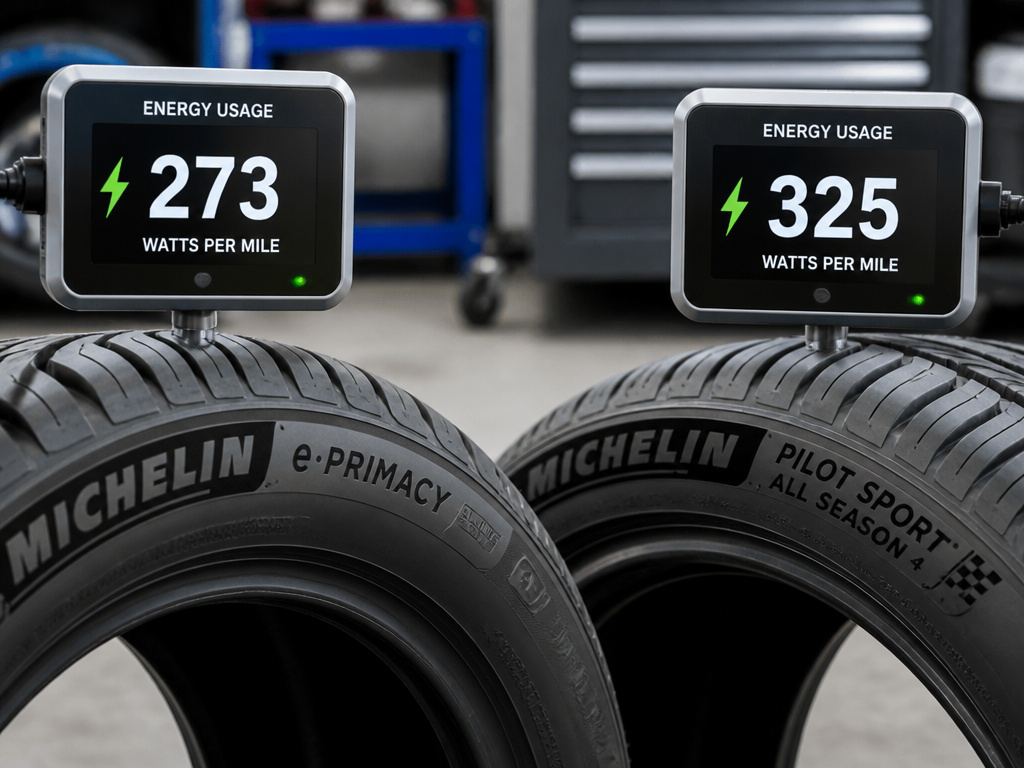
YouTube creator Daddy Chill ran a 4,000-mile test on his Tesla Model Y, comparing the efficiency and performance of new EV-specific Michelin e-Primacy tires against the non-EV Michelin Pilot Sport All Season 4s he had been running.
The results were counterintuitive. The EV-specific e-Primacies were quieter, as expected. But the overall efficiency gain was minor, only about an 8 MPGe improvement. The real shock came in long-distance highway driving. The Pilot Sport All Season 4s, a performance-oriented tire, posted a brutal 325 watts per mile on a 1,300-mile trip. The e-Primacies, on a shorter 500-mile trip, managed a far better 273 watts per mile.
The takeaway? The performance trade-off is real. The e-Primacy sacrificed dry grip and deceleration regeneration strength for that efficiency. The Pilot Sport AS4 sacrificed efficiency for tenacious grip and shorter braking distances. Neither is “better.” They are tools for different jobs.
This test underscores why the blanket statement “EV tires are better” fails. You must match the tire to your priority:
- Priority: Maximum Range & Quietness → Choose a dedicated EV tire like the Michelin e-Primacy or Bridgestone Turanza EV.
- Priority: Long Tread Life & All-Weather Safety → Choose a highly-rated standard all-season tire with a high load index, like the General Altimax RT45.
- Priority: Handling & Grip → Choose a performance all-season tire like the Michelin Pilot Sport All Season 4, and accept the range hit.
Your driving style decides the winner. A gentle, highway-focused commuter will benefit from an EV tire. Someone who enjoys back roads or needs confidence in rain and snow might find a conventional tire a better, cheaper fit.
Tesla Tires: A Special Case of T-Marks and Acoustic Foam
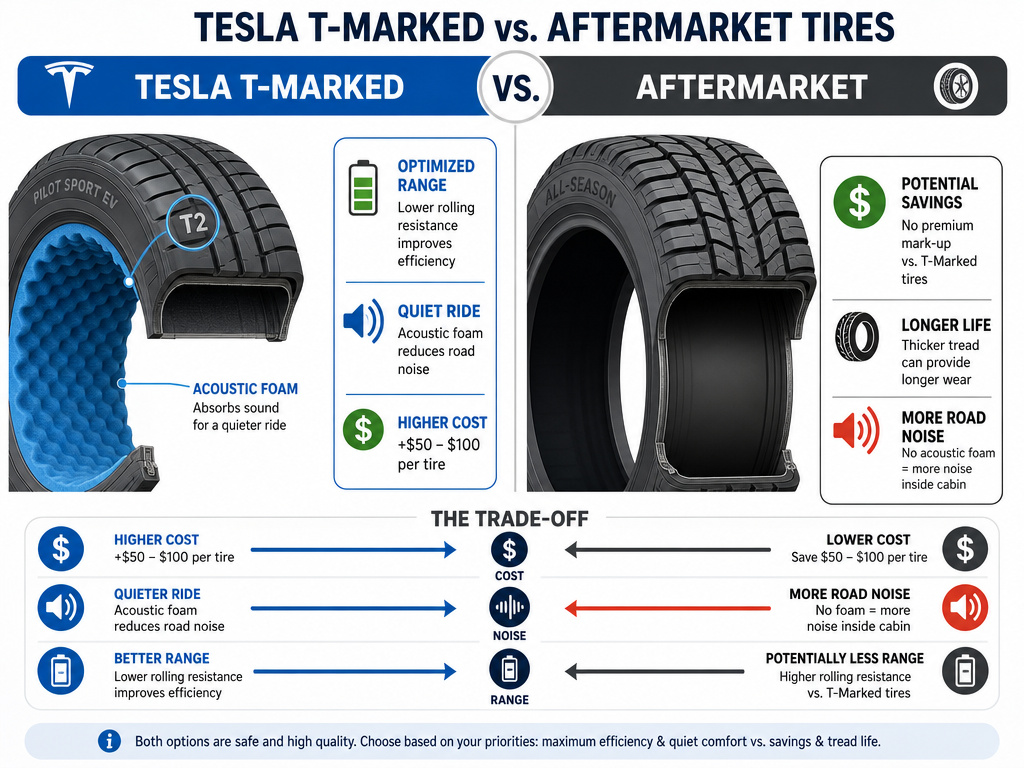
Tesla owners navigate an extra layer of complexity: T-marks and factory-fitted acoustic foam. It’s a perfect case study in the cost versus benefit analysis of OEM-specific parts.
Tesla approves specific tire models and assigns them a “T-mark” (T0, T1, T2). This indicates the tire’s generation within Tesla’s specifications. A Continental ProContact RX T2 is newer than a T0 version, with Tesla claiming up to a 10-mile EPA range improvement. These tires come with acoustic foam and are optimized for the specific noise and efficiency profiles of Tesla models.
Replacing them opens a dilemma. 1. Buy the exact Tesla-approved replacement. You get guaranteed compatibility, optimized range, and factory-level quietness. You also pay the highest price, often $50–$100 more per tire, and commit to a tread compound designed for efficiency, not longevity. 2. Buy a high-quality aftermarket tire without foam. You might save money, gain longer tread life, or get better wet grip. You will likely notice more road noise, especially on coarse pavement, and may see a slight dip in rated range.
For partial replacements on staggered setups (different front/rear sizes), Tesla’s manual is strict: if replacing 1–3 tires on a 21-inch setup already using a specific T0 tire, you must use that same T0 tire, not the newer T1 generation. This prevents handling quirks from mixing different tire models and construction.
The part nobody mentions: That acoustic foam can complicate repairs. Some tire shops are reluctant to patch a foam-lined tire, pushing for a more expensive replacement. It’s a hidden cost of the quiet cabin.
How to Make Any Tire Last Longer on Your EV
You can’t change the physics, but you can mitigate the wear. These practices are mandatory, not optional, for EV owners.
- Rotate religiously. EVs, especially rear- or all-wheel-drive models, wear rear tires faster due to acceleration torque. Tesla recommends rotation every 6,250 miles. Skipping this leads to replacing rears twice as often.
- Check pressure monthly when cold. For every 10°F drop in ambient temperature, tire pressure drops 1–2 PSI. Driving on underinflated tires increases rolling resistance (hurting range) and causes dangerous shoulder wear. Overinflation wears the center tread and degrades ride quality.
- Use Chill or Eco mode. This isn’t just for range. It remaps the accelerator pedal to deliver torque more gradually, reducing the shock load on the tread with every start. It’s the single biggest driver-controlled factor in extending tread life.
- Get a four-wheel alignment annually. EVs’ weight and torque can stress suspension components differently. Misalignment kills tires silently, often wearing the inside edges of the front tires long before the tread depth indicator is reached.
- Consider downsizing wheels. If your EV has optional larger wheels (e.g., 20″ or 21″), the smaller factory size (e.g., 19″) will have tires that are cheaper to replace, last longer, provide a more comfortable ride, and usually offer better range. This is a crucial tire size decision made at purchase time.
Following these steps can stretch a 25,000-mile tire to 35,000 miles. Ignoring them can burn through a set in under 15,000.
The Bottom Line
Are EV tires more expensive? Yes, at the register. The real question is whether they are more expensive for you.
If you value a silent cabin, maximize every watt-hour of range, and drive gently, the premium for a true EV-specific tire like the Bridgestone Turanza EV is justified. You are paying for specialized engineering that delivers a specific experience.
If your priority is out-of-pocket cost, all-weather security, and long tread life, a top-tier standard all-season tire with a high load index, like the Michelin Pilot Sport All Season 4 or the General Altimax RT45, is likely the smarter financial choice. You’ll forego some range and quietness for tangible savings and performance.
Before you buy any tire, find your vehicle’s weight and check the door jamb for the recommended tire pressure. Then, look at the sidewall of any potential replacement. That load index number is your contract. Honor it. Everything else, the foam, the T-mark, the “EV” stamp, is a feature. Some are worth paying for. Some are just noise.
Frequently Asked Questions
Can I use regular tires on my EV?
Yes, you can, but you must select a tire with a load index that meets or exceeds your EV’s weight requirement. Using a standard tire at its maximum load capacity risks premature failure. Many high-quality “XL” (Extra Load) rated all-season tires are suitable. However, you may sacrifice some range and experience more road noise compared to an EV-specific model.
How much faster do EV tires wear out?
Industry data from Michelin and testing by Consumer Reports indicates EVs wear tires 20–40% faster than comparable internal combustion vehicles. This means a tire rated for 50,000 miles on a gas car might deliver only 30,000–40,000 miles on an EV. Heavy-footed driving or very heavy EVs (like trucks) can see even shorter life, sometimes under 20,000 miles.
What is the most important spec when buying EV tires?
The load index is the non-negotiable safety spec. It must be high enough to safely carry your vehicle’s weight. After that, decide your priority: low rolling resistance for range, all-weather traction for safety, or a performance compound for handling. You cannot optimize for all three.
Are the OEM tires that came on my EV the best?
Not necessarily. Automakers often choose original equipment tires to optimize for quietness, range, and initial ride quality, not long tread life. Many new tires from the factory also have a mold release coating that can make them slippery for the first few hundred miles. There are often better, longer-lasting aftermarket choices for your needs.
Do winter tires for EVs cost even more?
Yes, EV-specific winter tires exist and carry a similar premium. They are engineered with the same high-load and low-rolling-resistance principles, but with a soft, cold-weather compound. For severe winter climates, a dedicated set of winter tires is always worth the investment for safety, regardless of the vehicle’s powertrain.
