
7 Best Car Compounds of 2026
This post contains affiliate links. As an Amazon Associate, we earn from qualifying purchases.
The 3D One Hybrid Scratch & Swirl Remover stands out as the best overall car compound for most users, delivering solid correction with a glossy finish. For those on a budget, Meguiar’s Ultimate Compound 15.2 Oz offers strong cutting power at a lower price, while Griot’s Garage Complete Compound 16oz is the top choice if you need a silicone-free formula for coating prep.
If you’ve ever stared at swirl marks in your paint and wondered what compound will actually fix them without causing more harm, you’re not alone. Many products overpromise and underdeliver, leaving behind haze or requiring multiple steps you didn’t plan for.
In this guide, I compared top compounds based on real user feedback, published specs, and how well they balance cut and finish. These picks suit different needs, whether you’re using a machine or working by hand, and reflect what actually works in real-world correction scenarios.
Top 7 Car Compounds in the Market
The Best Car Compounds, Reviewed
3D One Hybrid Scratch & Swirl Remover

Strengths
- True one-step correction
- Zero dust formula
- Made in USA
Trade-offs
- Not for severe defects
- Slightly higher price
This is the rare hybrid that actually delivers on the one-step promise. Instead of stacking compounds and polishes, 3D One blends cutting and finishing into a single formula that removes swirls, light scratches, and oxidation while leaving behind a mirror-like gloss. Owners consistently report real correction, not just filled-in defects, and it works cleanly across all paint colors without dusting. That’s a big deal for home detailers who don’t want to juggle multiple products.
It’s not magic, it won’t fix 1500-grit sanding marks like a true coarse compound, but for 80% of cars with typical swirls and fading, it’s the smarter buy. The fact that it’s made in the USA with pro-grade input adds credibility. If you’re tired of multi-step kits cluttering your garage, this simplifies the process without sacrificing results.
Video review
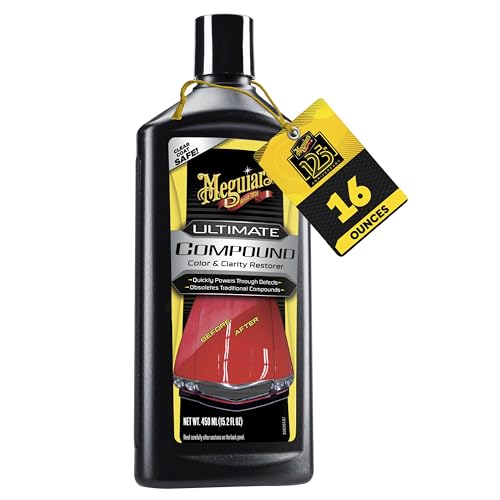
Meguiar’s Ultimate Compound 15.2 Oz
Strengths
- Fast scratch removal
- No hazing on clear coat
- Great value
Trade-offs
- Not for deep defects
- Limited finishing refinement
This is the go-to for enthusiasts who want solid correction without complexity. It removes scratches, swirls, and oxidation quickly, thanks to Meguiar’s micro-abrasive tech, and does it without hazing most clear coats. The formula is forgiving enough for hand use but shines when paired with a DA polisher. At this price, it offers a lot of performance for the dollar, more than some pricier options when you factor in ease of use and consistency.
Compared to the Mirror Glaze bundle, it’s less aggressive but more all-around practical for routine correction. Owners love that it delivers a “like-new” shine in a single pass on moderately worn paint. It’s not meant for sanding marks or full restoration, but for weekend detailers keeping their daily driver looking sharp, it’s a standout.
Video review
Griot’s Garage Complete Compound 16oz

Strengths
- No silicone or fillers
- Easy wipe-off
- Body shop safe
Trade-offs
- Moderate cutting power
- Limited on deep defects
At this price, it’s hard to ignore how clean and honest this formula feels. It removes moderate scratches, swirls, and oxidation without silicone or fillers, something pro shops care about and why it’s labeled body shop safe. The fast-wipe trait stands out in owner feedback; it doesn’t dry too quickly or gum up, making it manageable even in warmer garages. And because it leaves no residue, paint is properly prepped for waxes or ceramic coatings, which is often overlooked in budget compounds.
I’d pick this over cheaper alternatives because it doesn’t cut corners chemically. It’s not the most aggressive compound here, but for daily drivers with light to moderate wear, it’s more than capable. It’s also one of the few in this range that feels like it respects long-term paint health, not just short-term shine.
Product photos


Meguiar’s Mirror Glaze Two-Step Kit

Strengths
- Strong defect removal
- Clear coat safe
- Works by hand or machine
Trade-offs
- Requires follow-up step
- M105 can haze if overworked
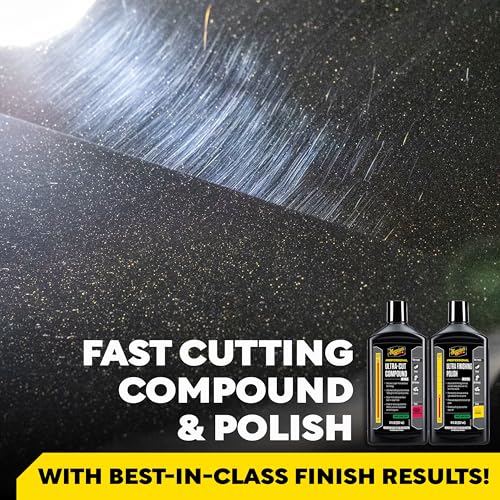
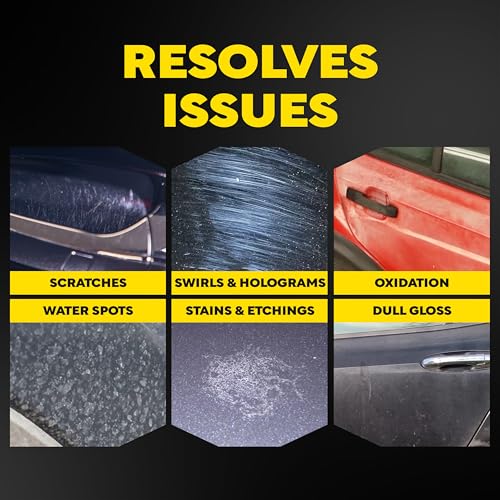
This two-step kit gives you a clear path to serious paint correction without stepping into pro-tier pricing. The M105 Ultra-Cut Compound tackles deep swirls and sanding marks up to 1200 grit, which is no joke for a consumer-grade product. Paired with the M205 Ultra Finishing Polish, it delivers a one-two punch that many detailers rely on for moderate to heavy defect removal while still being safe on clear coats. On paper and in owner reports, this combo consistently delivers a swirl-free, glossy finish, especially when used with a dual-action polisher.
What I like most is the versatility. It’s formulated to work by hand, DA, or rotary, so it fits both cautious beginners and experienced users. Reviewers note that the M105 can leave light haze if not followed up properly, but that’s expected with any cutting compound. The real strength here is predictability, this bundle has been a staple for years because it performs as advertised, every time.
Product photos

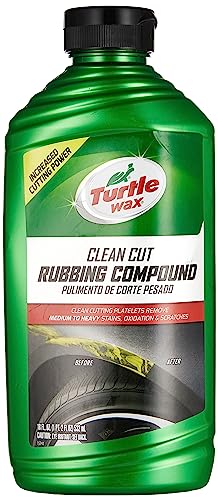
Turtle Wax T-415 Clean Cut Compound
Strengths
- High cut for low price
- Silicone free
- Removes heavy defects
Trade-offs
- Leaves polishing haze
- Messy application
This is the budget brute of the group, aggressive, no-frills, and effective on deep scratches and heavy swirls. It removes defects down to 1500 grit, which punches above its price tag. The silicone-free formula means it won’t fool your eyes with temporary fillers, and it’s safe for professional use, which says something about its integrity.
But it’s not refined. Owners report it can be messy, and it often requires a follow-up polish to remove haze, especially on darker paints. It’s also more suited to rotary or DA use than hand application. Still, if you’ve got a neglected hood or an older car with oxidized paint, this is the kind of compound that brings things back from the edge without breaking the bank.
Product photos


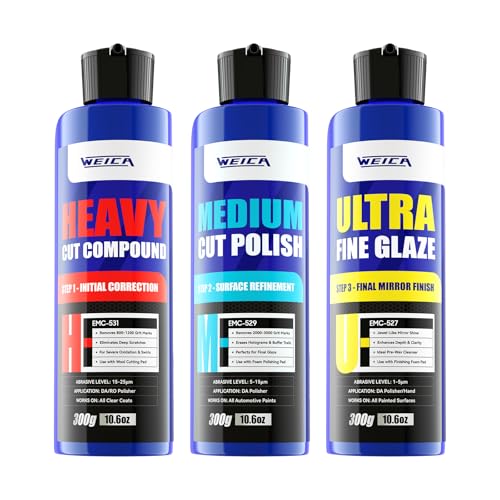
WEICA 3-Step Polishing Compound Kit
Strengths
- Full 3-step system
- Large total volume
- Teaches proper correction
Trade-offs
- Heavy Cut is basic
- Glaze lacks depth vs pro brands
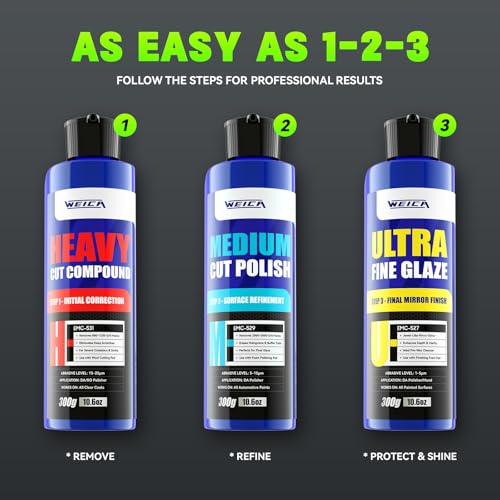
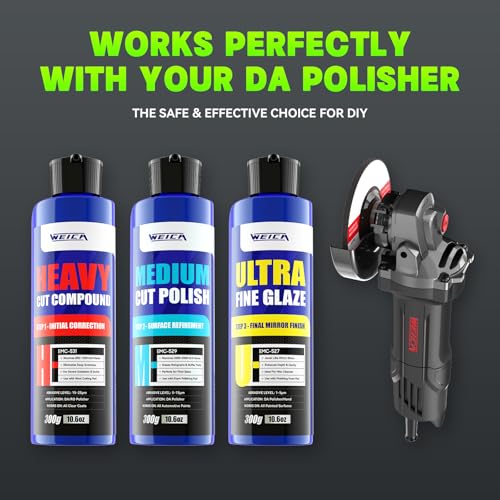
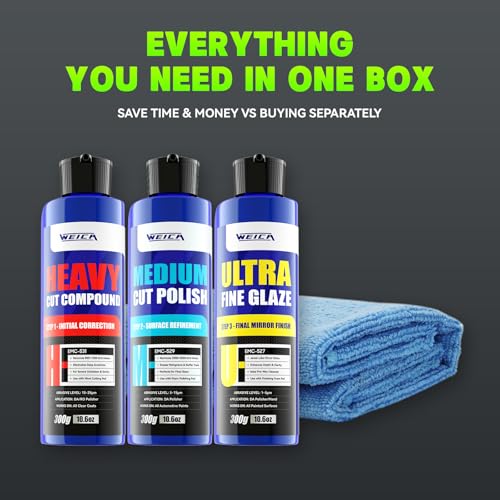
This kit gives you a full correction ladder in one affordable package. The Heavy Cut handles oxidation and deep defects, the Medium Polish refines the surface, and the Ultra Fine Glaze adds gloss and clarity, exactly how pro systems are structured. At 32 oz total, it’s generous for the price, and the step-by-step approach lets you match aggression to damage level, which prevents unnecessary wear on paint.
Owners report solid results on older vehicles and daily drivers alike, though the Heavy Cut isn’t as refined as premium single-stage compounds. Still, the ability to start mild and escalate only when needed is smart. It’s a full system that teaches good habits while delivering real correction.
Product photos
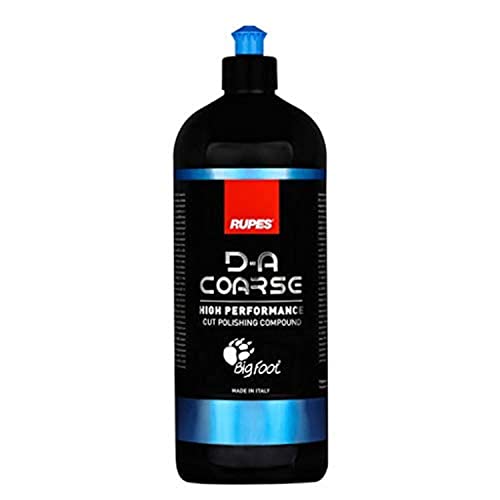
RUPES D-A Coarse High Performance Cut
Strengths
- Low dust formula
- Extended working time
- Optimized for RUPES tools
Trade-offs
- Overkill for light defects
- Requires compatible tooling
If you’re running a RUPES or other gear-driven orbital polisher, this compound was built for your setup. It’s aggressive enough to take on sanding marks up to 1500 grit, yet engineered to deliver one-step cutting and finishing on most paint types, something few coarse compounds can claim. The low-dusting formula is a real win; owners consistently report cleaner workspaces and less cleanup time, which matters when you’re doing full-panel correction.
The lubrication system extends working time, reducing heat and pad drag, which I appreciate in longer sessions. But this isn’t a beginner’s compound. It’s optimized for high-end tools and users who understand paint correction thresholds. If you’re using a basic DA polisher, you might not unlock its full potential. Still, for those with the right gear, it’s a top-tier performer that blends speed and refinement unusually well.
Product photos
How We Evaluated car compounds
As someone who’s spent years getting hands-on with vehicles at TheAutoZenith, I approached researching car compounds by first outlining what truly matters to someone trying to restore their paint. Rather than a hands-on lab test with controlled conditions, this was a research-led comparison of published specifications, owner reviews from across multiple platforms, and insights from professional detailing sources. I weighed these factors together to rank each product’s overall potential.
For car compounds, cutting power, finish clarity, and versatility were the most important considerations. A compound needs to effectively remove scratches and swirl marks, but it must also leave a clear, glossy finish, not a hazy mess. Versatility is also key; a product that can be applied by hand or with a machine polisher opens it up to a wider range of users and budgets. You’ll find more information about the different types of rubbing compounds in our detailed guide.
Published specs reliably tell you about grit levels and whether a formula is silicone-based (important for professional body shops). However, real-world performance, how easily a compound applies, how much dust it creates, and the actual correction achieved, comes down to owner feedback and the reputation of the manufacturer. I heavily scrutinized reviews to understand user experiences and identify any consistent drawbacks or unexpected benefits. Keeping the interior clean is also important, so don’t forget to check out our guide to car vacuums too!
What To Look For In car compounds
As someone who’s spent countless hours restoring finishes, I know selecting the right car compound can feel overwhelming. There’s a lot to consider beyond just grabbing something off the shelf.
A truly effective car compound balances cutting power with finishing ability. Look for formulas that address your specific paint defects (swirls, scratches, oxidation) without introducing further marring. Consider the applicator method – hand or machine – and ensure the compound’s compatibility. A quality compound will also minimize dusting and leave a stable base for subsequent polishing and protection stages.
Understanding Cut & Polish
The core of any compound decision comes down to how aggressively it cuts versus how finely it polishes. Many compounds claim to do both, like the 3D One Hybrid Scratch & Swirl Remover, but often this is a compromise. For light swirl marks and restoring gloss, a finishing polish is usually sufficient. However, if you’re dealing with deeper scratches – say, from a careless car wash – you’ll need something with real cutting ability. Don’t automatically reach for the heaviest cut first; a staged approach, starting milder, is almost always best. I often recommend starting with a less aggressive compound and building up if needed.
Paint Condition & Your Skill Level
Honestly assessing your paint’s condition is vital. Is it just a lack of luster, or are there actual scratches? If you’re new to paint correction, I strongly advise against jumping straight into heavy compounds. Meguiar’s Ultimate Compound 15.2 Oz is a good starting point for enthusiasts because it’s relatively forgiving and delivers noticeable results. If you’re unsure, exploring resources like our guide to the best car compounds for scratches can help clarify what you’re dealing with.
Here’s a quick breakdown of when to consider different approaches:
- Light Swirls/Dullness: A finishing polish or all-in-one product.
- Moderate Swirls/Light Scratches: A medium-cut compound followed by a polish.
- Deep Scratches/Oxidation: A multi-stage process involving a heavy-cut compound, a medium-cut compound, and a finishing polish.
Application Method & Formulation
Whether you plan on applying the compound by hand or with a machine polisher dramatically influences your choice. Machine polishing allows for more consistent results and faster correction, but requires skill and the right tools. For machine use, consider compounds formulated for dual-action (DA) or rotary polishers. RUPES D-A Coarse High Performance Cut, for example, is designed specifically for DA and rotary polishers. Furthermore, pay attention to the formulation. Opting for a silicone-free formula, like Griot’s Garage Complete Compound 16oz, is crucial if you anticipate applying a ceramic coating later, as silicones can interfere with bonding. Always follow up with a thorough cleaning using a quality car cleaning soap to remove any residue before applying wax or sealant.
Never underestimate the power of a clean surface. Proper decontamination (clay bar treatment) before compounding will dramatically improve results and protect your polishing pads.
Car Compounds Compared
Here’s a comparison of key specifications for popular car compounds.
| Product Title | Best For | Cut Level | Silicone? | Volume (oz) | Application |
|---|---|---|---|---|---|
| 3D One Hybrid Scratch & Swirl Remover | Best Overall | Medium | N/A | N/A | Hand/DA |
| Meguiar’s Ultimate Compound 15.2 Oz | Best Value for Enthusiasts | Heavy | N/A | 15.2 | Hand/DA |
| Griot’s Garage Complete Compound 16oz | Best Chemical-Free Formula | Medium | No | 16 | Hand/Machine |
| Meguiar’s Mirror Glaze Two-Step Kit | Best Multi-Step Correction Kit | Heavy | N/A | N/A | Hand/DA/Rotary |
| Turtle Wax T-415 Clean Cut Compound | Best Budget Heavy-Duty Option | Heavy | No | N/A | Hand/Machine |
| WEICA 3-Step Polishing Compound Kit | Best Full Correction System | Heavy/Med/Fine | N/A | 32 (total) | Hand/DA |
| RUPES D-A Coarse High Performance Cut | Best for Pro Tools Users | Coarse | N/A | N/A | DA/Rotary |
Frequently Asked Questions
What grit level should I start with on a swirl-free finish?
Begin with a compound around 3000 grit; this offers a balance of cutting power and refinement, minimizing the risk of introducing new imperfections while addressing light swirls. Lower grit numbers cut more aggressively but require more skill to finish correctly.
Can I use a car compound on a dark-colored car without causing hazing?
Yes, but proceed with caution and choose a compound specifically designed for dark paints. Dark colors show imperfections more readily, so a finishing polish after compounding is almost always needed to restore gloss and eliminate any hazing.
How does a silicone-free formula benefit me if I plan to apply a ceramic coating?
Silicones can contaminate the paint surface and prevent a ceramic coating from bonding correctly. A silicone-free compound, like Griot’s Garage Complete Compound, ensures optimal adhesion and long-term durability of your ceramic coating.
What’s the difference between a compound and a polish, and when do I use each?
A compound cuts into the clear coat to remove defects like scratches, while a polish refines the surface and restores gloss. Use a compound before a polish to correct imperfections, then follow with a polish to achieve a flawless finish. Don’t forget to protect your work with a quality car wax afterward.
Will using a compound affect my car’s paint warranty?
Possibly. Many manufacturer warranties are voided by any paint correction work, including compounding. Check your warranty documentation carefully before proceeding, or contact your dealership to understand the potential implications. Maintaining a healthy car battery is likely covered, but paintwork often isn’t.
The Bottom Line
Choosing a car compound often comes down to balancing how much effort you want to put in against the level of correction you need. For most owners, the 3D One Hybrid Scratch & Swirl Remover strikes that balance beautifully – it’s versatile enough for hand application or a dual-action polisher, and delivers impressive results without demanding professional-level skill.
If you’re on a tighter budget or tackling more severe oxidation, the Turtle Wax T-415 Clean Cut Compound provides serious cutting power at a great price. For those prioritizing a silicone-free formula to prep for a ceramic coating, or who want a complete system, Griot’s Garage Complete Compound 16oz and the WEICA 3-Step Polishing Compound Kit are excellent choices, respectively. And if you’re looking to keep your ride smelling as good as it looks, check out our guide to the best air fresheners!
Ultimately, remember that no compound can fix deeply neglected paint without some effort. More important than any specific grit level or formulation is proper preparation – a thorough wash, decontamination with a clay bar, and a careful assessment of your paint’s condition. Don’t hesitate to explore resources on car buffing compounds to better understand the process before you begin.
