
Are Motorcycle Insurance Rates Higher Than Car Insurance?
This post contains affiliate links. As an Amazon Associate, we earn from qualifying purchases.
Motorcycle insurance rates are not higher than car insurance rates, they are, on average, 80% cheaper. The national average for full coverage is about $399 per year for a bike versus $2,100 for a car. Liability-only coverage shows an even starker gap: roughly $141 a year for motorcycles against $511 for cars. This massive difference hinges on lower expected repair costs and less frequent use. However, that average collapses for specific riders: a young person on a new sport bike in a high-cost state can easily pay more than a typical car policy.
That 80% headline is a statistical truth, not a personal guarantee. It describes a 45-year-old rider on a mid-value cruiser in Iowa, not a 22-year-old on a financed Suzuki GSX-R600 in New Jersey. The real question isn’t about the average, it’s about which of the five high-leverage variables in your profile push your premium toward car-like territory, or even past it.
What follows: the exact numbers that define the gap, the five rider-and-bike factors that erase it, and the specific coverage choices that keep you protected without paying a car premium for two wheels.
Key Takeaways
- Motorcycle insurance is cheaper 80% of the time. Full coverage averages $399/year for bikes vs. $2,100 for cars, largely due to lower vehicle values and seasonal riding.
- Sport bikes break the rule. Insurers price high-performance models like the Kawasaki Ninja ZX-10R as a separate high-risk category, often costing 3–4 times more than a cruiser of equal value.
- Your driving record hits harder on two wheels. A single at-fault accident can increase motorcycle premiums by 40–80% for 3–5 years, a steeper penalty than for cars due to the higher injury risk.
- Use “lay-up” provisions if you store your bike. Riders in cold climates can suspend liability and collision coverage for winter months, saving $200–$500 annually while keeping comprehensive active.
- Standard policies often exclude custom parts. If you add an aftermarket exhaust or custom paint, you need separate Custom Parts and Equipment (CPE) coverage; most base policies only cover the manufacturer’s original value.
The Core Numbers: Average Rates for Bikes vs. Cars
Forget anecdotes. The price difference between insuring a car and a motorcycle is quantified in large-scale industry data. On a pure cost-to-insure basis, cars are the more expensive vehicle nearly every time.
The most telling comparison is full coverage, which includes liability, collision, and comprehensive. According to aggregator data, the national average annual premium for full coverage motorcycle insurance is $399, or about $33 per month. For cars, that average jumps to $2,100, or $175 per month. That’s a difference of roughly 80%. The gap for liability-only coverage is even more dramatic: $141 per year for motorcycles versus $511 for cars.
Motorcycle vs. Car Insurance. Average Annual Premiums
Coverage Type Motorcycle Car Difference Liability Only ~$141 ~$511 ~72% cheaper Full Coverage ~$399 ~$2,100 ~80% cheaper
These figures assume a standard rider profile: mid-40s, clean record, and a bike like a Honda Rebel 500. The averages are pulled down by the vast number of cruisers and standard bikes on the road. They are also shaped by exposure, many bikes are ridden for only 5–7 months a year, while cars log daily miles regardless of season.
This creates the first major misunderstanding. People hear “motorcycle insurance is cheaper” and assume it applies to every bike and rider. It doesn’t. The average is a starting point, not a destination. Your final quote is a negotiation between your profile and the insurer’s risk model, and for some profiles, that model screams “car-like risk.”
The Five Factors That Flip the Script
The 80% cheaper rule has five major exceptions. If two or three of these apply to you, your motorcycle insurance rates can meet or exceed what you’d pay for a typical car policy.
1. Your Bike’s Type and Value
This is the single biggest variable. Insurers don’t just see a motorcycle; they see a category with a statistically proven claims cost.
Sport bikes and supersports, especially those over 600cc, are in their own high-risk tier. A study from Nexuora notes that a 25-year-old on a Kawasaki Ninja ZX-10R can expect to pay 3–4 times more than the same rider on a Honda Shadow of equivalent market value. Why? Higher theft rates, more expensive repair costs for fairings and frames, and a strong correlation with aggressive riding behavior that leads to claims.
Where this goes sideways: Assuming a cheap bike means cheap insurance. A used Suzuki GSX-R600 can be bought for a few thousand dollars, but its insurance category is “supersport.” Your premium will be calculated as if you’re riding a much more valuable bike, because the expected claim cost is that of a sport bike.
Conversely, cruisers, touring bikes, and scooters fall into lower-rated categories. A Vespa Primavera 50 often costs less to insure than a basic liability-only car policy. The bike’s original MSRP matters, but its design category matters more.
2. Your Age and Riding Experience
Inexperience is expensive. If you’re under 25 or have less than three years of riding experience, prepare for a major surcharge. Insurers view this demographic as the highest risk for at-fault accidents. A 20-year-old with a new license riding a performance bike in a state like New Jersey or Michigan can see quotes exceeding $250 per month, that’s more than many families pay for full coverage on a sedan.
The discount for experience is real and substantial. A rider with five or more clean years can see premiums drop by 30% or more compared to a new rider with an identical bike. This is one area where time is literally money.
3. Your Location and Garage
Your ZIP code is a non-negotiable rating factor. Insurers price for geographic risk: theft density, traffic congestion, accident rates, and even local weather patterns. Urban areas with high theft rates will always cost more. A bike kept on a street in Philadelphia costs more to insure than the same bike in a locked garage in a rural Iowa town.
Comprehensive coverage, which covers theft, is where this hits hardest. Motorcycle theft rates are about four times higher than automobile theft rates per vehicle, and less than 30% of stolen bikes are recovered. Storing your bike in a locked garage can cut your comprehensive premium by 15-20%. Adding a certified anti-theft device like a GPS tracker can shave off another 10%.
4. Your Driving Record and Credit
Your record on four wheels follows you onto two. An at-fault car accident, a DUI, or multiple speeding tickets will devastate your motorcycle insurance quote, often with a harsher multiplier than for car insurance. Insurers reason that a high-risk driver is an even greater danger on a more vulnerable vehicle.
A single at-fault accident can increase motorcycle premiums by 40–80% for 3–5 years. A DUI can double your premium for 5–7 years. The financial cost of one violation, in increased premiums alone, regularly exceeds $2,000 over the surcharge period.
Most insurers also use a credit-based insurance score. While the weight varies by state, a lower credit score can directly increase your premium. Maintaining good credit is one of the few passive ways to keep your insurance costs in check.
5. Your Annual Mileage and Usage
How you use the bike directly affects the price. A policy for “pleasure use” with an annual mileage under 3,000 is the cheapest. Commuting daily or using the bike for business (like deliveries) pushes the premium up significantly, sometimes by 25% or more. More miles mean more exposure to risk, and insurers charge for it.
This is where the lay-up provision becomes a powerful tool for seasonal riders. If you store your bike from November through March, companies like Progressive and Dairyland allow you to suspend liability and collision coverage while keeping comprehensive active for theft or fire. This can save $200–$500 per year. It requires planning, but it’s the fairest way to pay for only the months you ride.
How Coverage Differs (And Where Gaps Appear)
The basic building blocks, liability, collision, comprehensive, are the same. But the details and default levels are not. A motorcycle policy is leaner, which helps keep the base price low but can create coverage gaps if you don’t read the fine print.
Liability limits are often lower by default on motorcycle policies. State minimums for bikes can be less than for cars. This is a false economy. Given the severe injury potential in a motorcycle crash, carrying higher bodily injury liability limits (think 100/300) is one of the smartest upgrades you can buy.
Custom Parts and Equipment (CPE) is the most common gap. A standard policy typically covers only the manufacturer’s original equipment value. If you add a $2,000 exhaust, a custom seat, or aftermarket suspension, it’s not covered unless you add CPE. Some providers cap this at $3,000; others offer up to $30,000. If you customize, you must declare it.
Uninsured/Underinsured Motorist (UM/UIM) and Medical Payments (MedPay) are critical for riders. Motorcycle accidents with uninsured drivers are common, and injury rates are high. UM/UIM covers you if the at-fault driver has no insurance. MedPay covers your medical bills regardless of fault. If you have a high-deductible health plan, MedPay is essential.
The Sport Bike vs. Cruiser Breakdown
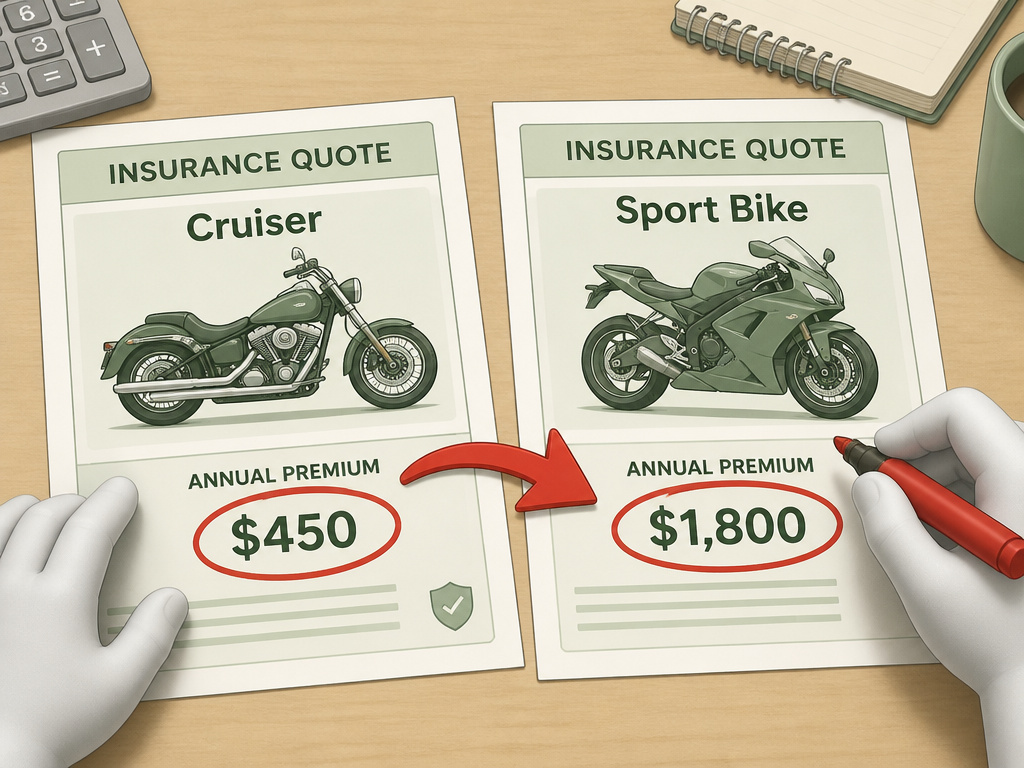 A direct comparison shows how dramatically bike type overrides everything else. Let’s take two riders, both 30 years old with clean records, living in the same Ohio suburb.
| Factor | Rider A (Cruiser) | Rider B (Sport Bike) |
|---|---|---|
| Bike Model | Honda Rebel 500 ($5,645 MSRP) | Kawasaki Ninja 400 ($4,555 MSRP) |
| Annual Mileage | 2,500 (pleasure) | 2,500 (pleasure) |
| Storage | Locked garage | Locked garage |
| Estimated Annual Premium (Full Coverage) | $450 – $600 | $1,200 – $1,800 |
The Ninja 400 is actually less expensive to buy than the Rebel 500. Yet, Rider B pays at least double. The entire difference is the sport-bike surcharge, a direct reflection of the insurer’s historical loss data for that category. For a liter-class sport bike like a ZX-10R, the premium could be triple Rider A’s cost, easily pushing past $1,800 a year.
Strategies to Keep Your Premium in Check
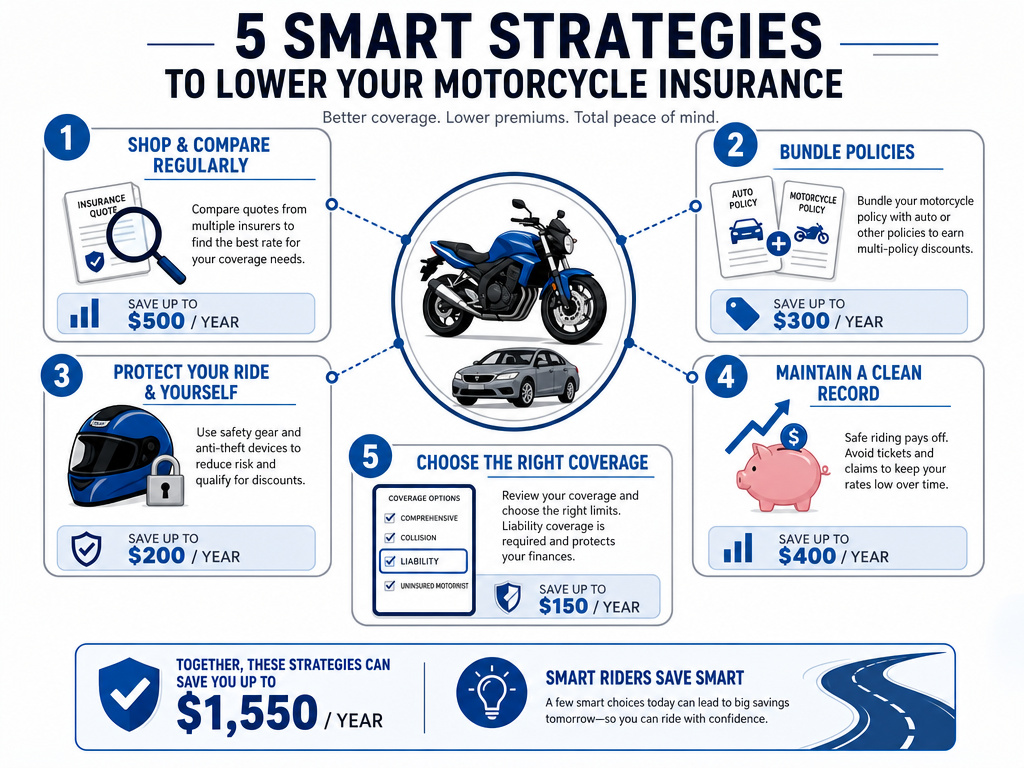 You can’t change your age or your bike’s category overnight. But you can control how insurers see you.
- Shop Your Policy Every 2–3 Years. Insurers reprice risk constantly. Your loyalty is rarely rewarded with their best new-customer rate. Get fresh quotes from at least three companies, including specialists like Dairyland for non-standard drivers and Progressive for broad market coverage.
- Bundle, But Verify. Bundling your motorcycle policy with your car insurance from the same company (like GEICO or State Farm) usually nets a 10–15% discount. But always run the numbers separately, sometimes the bundled discount is smaller than the savings you’d get from a different, cheaper bike insurer.
- Invest in Safety and Security. Completing a Motorcycle Safety Foundation (MSF) course can earn a 5–15% discount with many insurers. A locked garage and an installed anti-theft device are not just good ideas; they are discount qualifications you report to your agent.
- Raise Your Deductible Judiciously. If you have the cash reserves, increasing your collision deductible from $500 to $1,000 can lower your annual premium by 10–20%. Just be sure you can cover that larger out-of-pocket cost if you need to file a claim.
- Be Strategic with Coverage. If you ride an older bike with a low market value, consider dropping collision coverage altogether. The annual premium might exceed the bike’s worth within a few years. Always keep high liability limits and UM/UIM, however, those protect you from financial ruin.
Frequently Asked Questions
Is motorcycle insurance cheaper for a new rider?
No, it is significantly more expensive. A new rider (under 25 or with less than 3 years’ experience) is the most expensive demographic to insure, often paying double or triple the rate of an experienced rider on the same bike. The lack of a riding history forces insurers to price for the highest possible risk.
Can a DUI affect my motorcycle insurance?
Yes, and the impact is severe and long-lasting. A DUI conviction will likely double your premium for 5–7 years. You will also need an SR-22 certificate, a form filed by your insurer to prove you carry the state-mandated minimum coverage. After a DUI, your best options are typically Progressive for the most affordable major insurer quote or Dairyland if other companies decline to cover you.
Do I need insurance if I only ride in the summer?
Legally, yes, if the bike is registered. Practically, you can use a lay-up provision. During winter storage months, you can suspend liability and collision (the expensive parts) while keeping comprehensive coverage active for a few dollars a month. This keeps your policy continuous and avoids a coverage gap, which itself would raise future rates.
Why is my sport bike insurance so much higher than my car?
Sport bikes are rated in the highest risk category due to statistical loss data: higher theft rates, more frequent and severe accidents, and more expensive repairs involving specialized fairings and frames. Your car insurance costs are based on a different, generally lower-risk vehicle category. The premium isn’t about you personally; it’s about the actuarial table for your bike model.
What’s the most important coverage to have on a motorcycle?
Bodily Injury Liability and Uninsured/Underinsured Motorist coverage are non-negotiable. In an accident, medical bills are the fastest path to financial disaster. State minimums are almost always too low. Carry as much as you can afford, 100/300/100 is a solid target. This is more critical than on a car because your injury risk is 29 times greater per mile traveled.
The Bottom Line
Motorcycle insurance is cheaper than car insurance, until it isn’t. The 80% savings figure is real for the average rider on a standard bike. But “average” is a fragile concept shattered by a sport bike, a young rider, a DUI, or a high-theft ZIP code.
Your mission is to know which camp you’re in before you get a quote. If you’re eyeing a supersport, budget for a car-like premium. If you’re a new rider, expect to pay for your inexperience. And no matter what you ride, never skimp on liability and uninsured motorist coverage. The savings from cutting those corners won’t cover your first hour in the emergency room.
For one answer: if you’re over 30, have a clean record, and ride a cruiser or standard bike, your insurance will be a fraction of your car bill. For everyone else, shop aggressively, use every discount, and remember, the price of freedom on two wheels is calculated by a spreadsheet you’ll never see.
