
Zip Codes & Car Insurance: How Your Location Affects Rates
This post contains affiliate links. As an Amazon Associate, we earn from qualifying purchases.
Car insurance rates are often based on your zip code, a practice known as territorial rating. Insurers use historical loss data, claim frequency and severity, from each zip code to set base rates, arguing it predicts risk. However, this method is under regulatory scrutiny and is being banned in states like Hawaii for potentially being unfairly discriminatory.
The zip code on your policy is more than a mailing address; it’s a primary signal in an insurer’s risk model. This geographic signal gets blended with your personal details, driving record, vehicle, and sometimes your credit score, to produce your final premium. The practice is widespread, but its foundations are being questioned not just by consumers, but by state insurance commissioners.
What follows is a breakdown of how zip code rating works, the hard data behind it, and the growing regulatory push to move beyond postal boundaries. We’ll look at the specific studies regulators cite, the alternative methods on the horizon, and what this means for your next renewal notice.
Key Takeaways
- Zip codes are a primary rating factor used by insurers to group risks based on local claim history, traffic density, and theft rates.
- Regulators are actively restricting the practice. Hawaii has banned zip code-based rating effective October 2026, calling it potentially unfairly discriminatory.
- The disparity is documented. Studies show premiums can be hundreds of dollars higher in majority-minority zip codes compared to adjacent, majority-white areas with similar driving risks.
- Alternatives like geocoded rating use precise latitude/longitude grids for more granular risk assessment, but legacy system costs hinder adoption.
- Your rate is a blend. While zip code sets a territorial base, your final premium is shaped by your driving record, vehicle, coverage choices, and insurance deductible.
The Mechanics of Zip Code Rating
Insurance isn’t about guessing; it’s about pooling similar risks and pricing them based on expected losses. Territorial rating is the tool for the geographic piece of that puzzle. Insurers analyze years of historical data, how many claims were filed (frequency) and how much they cost (severity), within each zip code.
This data isn’t pulled from thin air. Regulators like the California Department of Insurance have published detailed methodologies, such as the California Private Passenger Auto Frequency and Severity Bands Manual, which standardizes how zip code-level loss data is grouped and credibility-adjusted. The goal is to create stable base rates for each territory.
A territory’s indicated rate is developed by smoothing zip-level loss experience, clustering zip codes with similar risk profiles, and adjusting for non-geographic effects like a driver’s age or vehicle type. This process is outlined in industry guides like the NAIC geographic rating summit materials.
The variables fed into this model go beyond fender-bender counts. Insurers look at traffic density, road quality, population density, rates of uninsured drivers, and even vehicle theft and vandalism statistics, all of which can cluster geographically. An urban zip code with congested streets and high theft rates will show a different loss pattern than a quiet suburban one, justifying a different base rate in the insurer’s model.
Where this goes sideways: The system assumes everyone in a zip code shares the same risk environment. It can’t distinguish between a careful driver on a quiet cul-de-sac and a reckless one three blocks away on a busy arterial road. Both pay the same territorial base rate. This granularity problem is at the heart of the criticism.
Why Regulators Are Questioning Zip Codes
The core issue isn’t that geography matters, it does. The issue is whether a zip code, a unit designed for postal efficiency, is the right tool for measuring insurance risk. A 2026 memorandum from the Hawaii Insurance Division put it bluntly: “ZIP code boundaries are designed and maintained for the facilitation of postal delivery purposes, without consideration of insurance risk.”
Their conclusion? The use of zip code-based factors may produce premium differentials among otherwise similar risks without a credible actuarial relationship to expected loss. Where rate differentials aren’t reasonably related to demonstrable risk differences, the resulting rates are “unfairly discriminatory.” That’s the legal term that triggered Hawaii’s ban, effective for new and renewal policies starting October 1, 2026.
This concern is echoed in studies like the FIO auto insurance market report, which analyzes affordability in “AP ZIP Codes”, areas where low-to-moderate income or majority-minority populations are concentrated. The data reveals a persistent pattern: premiums are disproportionately higher in these areas. A Maryland zip code rate report found that a zip code in Baltimore that is 95% African American paid an average annual premium over $1,000 more than a similar-risk zip code in Silver Spring with a more diverse population.
The regulatory push isn’t to ignore geography, but to demand more justification. Can the premium difference between two bordering zip codes be explained solely by differences in crash data and theft rates? Or are historic patterns of segregation and socioeconomic disparity being baked into insurance prices through a postal code? That’s the question on the table in states beyond Hawaii.
Zip Code vs. Geocoded Rating: The Technical Divide
The debate is leading to a technical fork in the road: stick with zip codes or move to coordinate-based systems. The traditional method uses the zip code as the smallest geographic unit. The modern approach, called geocoded rating, uses your home’s precise latitude and longitude.
The difference isn’t minor. As detailed in the personal lines insurance pricing guide from the NAIC, zip codes are oddly shaped, vary massively in size (from a city block to hundreds of square miles), and their boundaries can change. A large rural zip code can smooth over unique high-risk areas within it. Geocoded grids, by contrast, can be uniform half-mile squares. This allows for hyper-local risk assessment, your premium could be based on your immediate neighborhood’s characteristics, not those of a larger, heterogeneous postal zone.
Geocoded rating defines risk by latitude and longitude, enabling uniform grid sizes and boundaries that don’t change. This allows enhanced risk matching and more gradual premium differences between neighbors, unlike the sharp cliffs often seen at zip code borders.
Why hasn’t everyone switched? Legacy systems. Most insurer pricing engines are built around territorial codes, not map coordinates. The cost and complexity of migrating decades of data and rewriting rating algorithms is a massive barrier. For now, the superior granularity of geocoded rating remains a theoretical advantage for most consumers, highlighted in academic auto insurance pricing papers but not yet in their premium bills.
The Real-World Impact on Your Premium
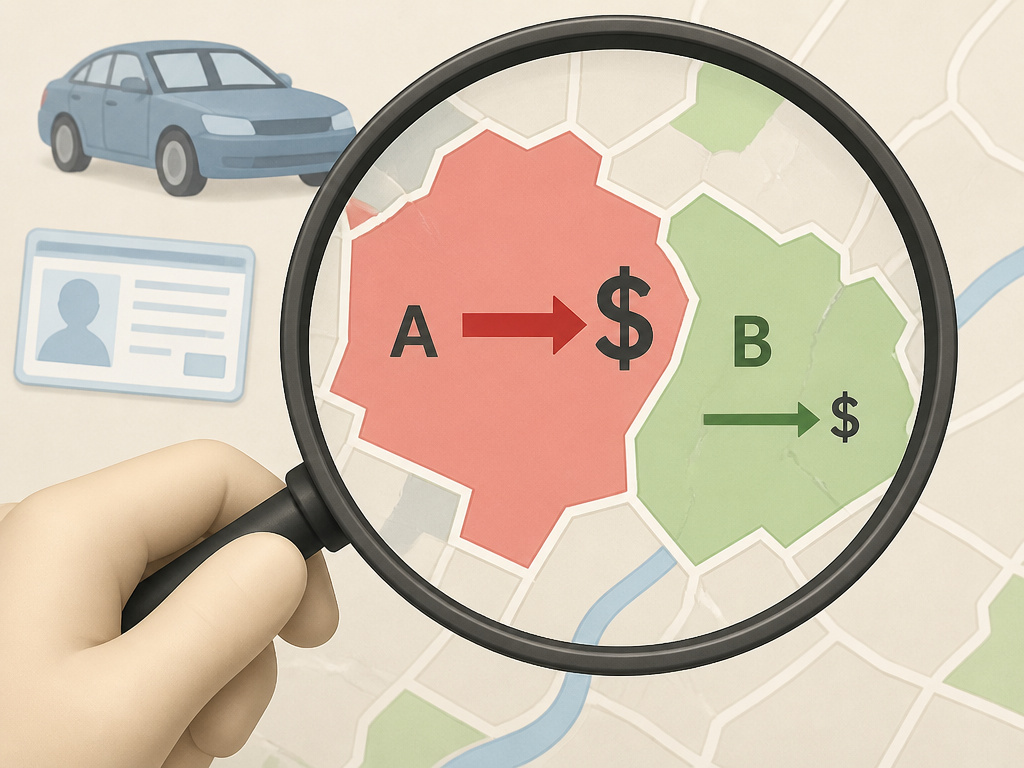
So how much does your zip code actually cost you? The answer is: it sets the floor. Your zip code determines the territorial base rate, which is then multiplied by a series of factors specific to you.
Think of it like this: if the base rate in Zip Code A is 1.2 and in Zip Code B it’s 0.9, every other rating factor (your age, your car’s symbol, your driving record) gets applied to that higher or lower starting point. A perfect driver in a high-cost territory will still pay more than a perfect driver in a low-cost territory. This is why shopping for insurance companies within your area is crucial, they may weigh your zip code differently.
| Factor | How It Interacts with Zip Code | What You Can Control |
|---|---|---|
| Territorial Base Rate | Sets the starting premium multiplier for your location. | You can’t change your garaging address, but some insurers may offer discounts for low-mileage drivers via usage-based insurance. |
| Driver Profile | Your age, record, and credit score are applied on top of the base rate. | Maintain a clean driving record and a good credit history where permitted. |
| Vehicle | Your car’s theft rate, repair cost, and safety rating are evaluated within your territory’s context. | Choose a vehicle with lower insurance symbols when shopping. |
| Coverage Choices | Your limits, deductibles, and add-ons (like rental reimbursement) are calculated based on the territorial rate. | Adjust your coverage needs and deductible to balance protection and premium. |
Common mistake: Assuming a move one town over won’t change your rate. Cross a zip code line into an area with a higher claim severity history, and your base rate can jump 20% or more overnight, even if your driving habits don’t change. Always get new online quotes when you move.
The Regulatory Shift Away from Zip Codes
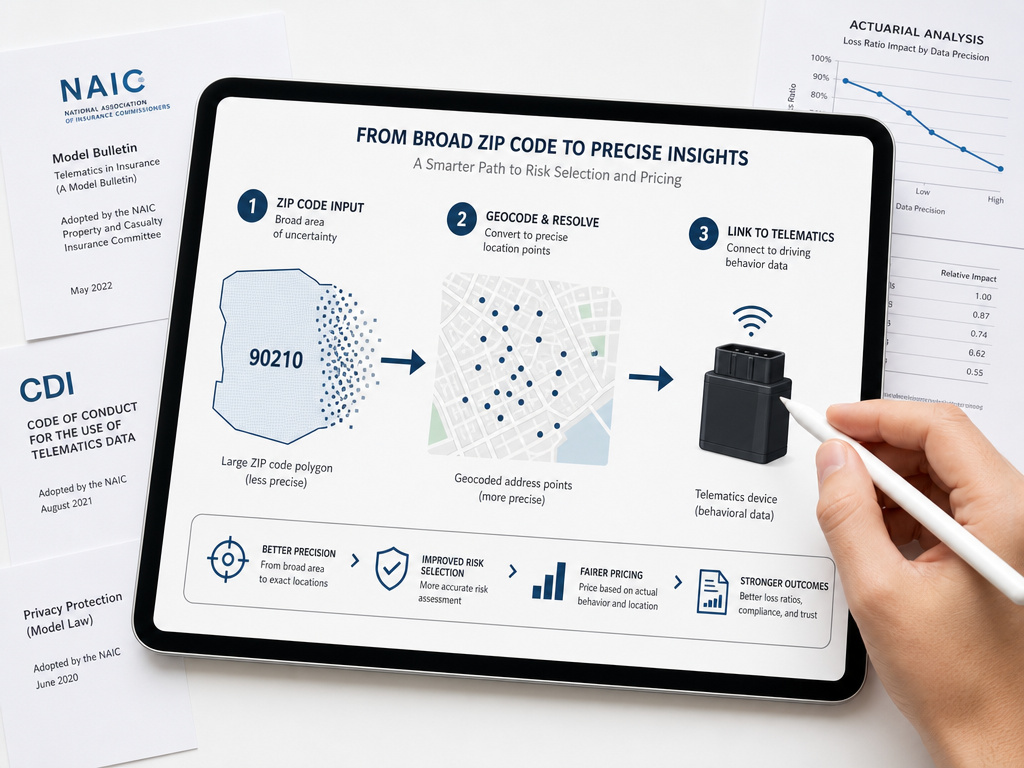
Hawaii’s move is the clearest signal of a changing landscape, but it’s not alone. California’s Proposition 103 has long restricted the use of zip codes, mandating that territorial factors be based on grouping zip codes or census tracts and that they must be approved by the Department of Insurance. The Maryland Auto Insurance Fund findings show an internal tension, using an “affordability index” to cap rates in certain zip codes while the regulator questions the practice.
The trend is toward greater scrutiny and a demand for actuarial justification. Regulators are asking insurers to prove that the risk differential between zip code A and zip code B is real, significant, and based on driving-related factors, not just a reflection of historic socioeconomic patterns.
This doesn’t mean geography will become irrelevant. Instead, the methods are evolving. The future points toward more granular, dynamic models. Telematics insurance programs, which use driving behavior data, could eventually diminish the weight of a static garaging address. Similarly, wider adoption of geocoded rating could break the monopoly of the zip code. For now, the relationship between credit and car insurance and your driving record remain the most powerful personal levers you have to offset a high-territorial base rate.
Frequently Asked Questions
Is it illegal for car insurance to use zip codes?
No, it is currently legal and standard practice in most states. However, it is heavily regulated. State insurance departments must approve the territorial rating plans, and insurers must justify them with actuarial data. Hawaii has passed a ban effective October 2026, making it the first state to prohibit the practice outright.
Can two people with identical profiles pay different rates based solely on zip code?
Absolutely. If one lives in a zip code with high historical claim frequency and severity, and the other lives in a low-cost territory, their base rates will differ. All other personal rating factors (same car, same record, same coverage) are then applied to those different bases, resulting in different final premiums. This is the essence of territorial rating.
How can I fight a high rate due to my zip code?
You can’t argue with the insurer’s approved territorial plan. Your practical options are to shop aggressively among different car insurers, as each company’s territorial map and base rates vary. You can also explore discounts that reduce the overall premium, like those for bundling policies, being a good student, or enrolling in a pay-as-you-drive program. Ensuring your insurance coverage is tailored to your actual needs can also eliminate unnecessary cost.
Will my rate change if my zip code’s boundaries change?
It could. If the postal service redraws boundaries and your home is assigned a new zip code, your insurer will update their records. Your new premium will be based on the loss experience and base rate of the new territory. This is a rare but possible event.
What’s the alternative to zip code rating?
The leading alternative is geocoded rating, which uses precise location coordinates for more granular risk assessment. The future may also see increased use of telematics insurance, where your driving behavior and actual routes matter more than your garaging address. For now, these are emerging trends, not industry standards.
Before You Go
Your zip code is a powerful, often unchangeable factor in your car insurance bill. It’s a proxy for a complex set of local risks, but it’s an imperfect one, a postal tool asked to do an actuarial job. The regulatory winds are shifting toward more justification and fairness, evidenced by Hawaii’s ban.
Your best move is knowledge. Understand that your rate is a blend of this geographic base and your personal factors. Use that knowledge to shop wisely, leveraging tools like accurate estimates from online quoters to find companies that weigh your specific zip code more favorably. And keep an eye on your state’s insurance department; the rules governing how your address affects your premium are starting to evolve.
