
What’s the Difference Between Bumper Pull and Gooseneck?
This post contains affiliate links. As an Amazon Associate, we earn from qualifying purchases.
The difference between a bumper pull and a gooseneck is the connection point: bumper pull hitches mount behind the rear axle, while gooseneck hitches mount in the truck bed over the axle. That single change transforms capacity, stability, and required truck. Bumper pull suits general hauling under 12,000 pounds GVWR. Gooseneck handles heavy equipment over 12,000 pounds with superior control, but requires a 3/4-ton or 1-ton pickup with a bed-mounted hitch.
The physics of that pivot point dictate everything that follows, from how much weight you can legally tow to how the steering feels at 65 mph. It’s not about preference once the loads get serious. It’s about matching the hitch geometry to the job your truck’s frame was built to do.
What follows breaks down the three specs that matter most, the exact weight where the math flips, and the real-world handling differences that don’t show up on a spec sheet. By the end, you’ll know which system fits your trailer, your truck, and your typical haul.
Key Takeaways
- The 12,000-pound rule: For consistent loads under 12,000 pounds Gross Vehicle Weight Rating (GVWR), a bumper pull is usually adequate. Cross that threshold, and the gooseneck’s over-axle connection becomes a stability and safety necessity.
- Front-end lift is real: A bumper pull applies tongue weight behind the axle, acting as a lever to unweight the front tires. This leads to vague steering and longer stopping distances under heavy loads.
- Goosenecks turn sharper: The pivot point over the axle allows a gooseneck trailer to jackknife nearly 90 degrees, making it superior for tight job-site maneuvering despite its larger size.
- No adapters, ever: You cannot safely tow a gooseneck trailer with a bumper hitch. The geometry is incompatible, and any homemade adapter creates a catastrophic leverage point on the truck’s frame.
- Truck commitment: A gooseneck hitch is permanently installed in your pickup bed, tying that trailer to that truck. A bumper pull offers flexibility to tow with different vehicles.
The Core Difference: Physics of the Pivot Point
Head design changes the entire process. Look at the business end of your trimmer.
A bumper pull hitch bolts to the frame at the very rear of the truck, several feet behind the rear axle. A gooseneck hitch installs in the center of the pickup bed, positioned directly over or just ahead of the rear axle.
The Core Mechanical Principle: A bumper pull connection creates a lever, with the rear axle as the fulcrum. Tongue weight pushing down behind the axle tries to lift the front of the truck. A gooseneck connection places the load directly on top of the fulcrum, pushing the truck straight down.
This isn’t a minor detail. It’s the fundamental equation that determines your rig’s behavior. The distance from the axle to the hitch ball is the lever arm. The longer that arm, the more mechanical advantage the trailer has to upset the truck’s balance.
| Connection Point | Acts As | Primary Effect | Truck Sensation |
|---|---|---|---|
| Bumper Pull | Long lever behind axle | Lifts front end, promotes sway | Light steering, “tail-wag” in crosswinds |
| Gooseneck | Direct load over axle | Presses rear down, plants front end | Firm steering, truck feels anchored |
The industry standard SAE J2638 outlines the design criteria for these hitches, specifying that a gooseneck ball and coupler must allow for at least 8 degrees of pitch and roll. This engineered articulation is why a gooseneck can handle uneven ground without transferring shock directly into the truck’s frame, a benefit a bumper pull doesn’t share.
Where this goes sideways: Exceeding your bumper pull’s tongue weight capacity. The front-end lift isn’t gradual. Add a few hundred pounds past the limit, and the steering goes from light to dangerously vague within the first highway on-ramp. You’ll feel it in the wheel long before you see it in the mirrors.
Capacity and Truck Requirements: The Numbers That Bind You
Your truck’s door jamb sticker is the final authority. The advertised “max towing capacity” is a best-case scenario for a bare truck. Once you add passengers, fuel, and gear in the bed, your real-world capacity, the payload, shrinks fast.
Bumper pull capacities are divided into classes. Most half-ton and some three-quarter-ton trucks max out at Class IV or V.
- Class III: Up to 8,000 lbs GTW / 800 lbs tongue weight
- Class IV: Up to 10,000 lbs GTW / 1,000 lbs tongue weight
- Class V: Up to 20,000 lbs GTW / 2,000 lbs tongue weight (requires a weight distribution hitch)
A weight distribution hitch is mandatory for heavier bumper pull loads. It uses spring bars to transfer some of the tongue weight back to the trailer’s axles and forward to the truck’s front axle. It’s a band-aid for the lever-arm problem, not a cure.
Gooseneck hitches bypass these classes entirely. They are rated by the truck’s frame and axle strength. A properly equipped one-ton truck like a Ford F-350 or Ram 3500 can routinely handle 30,000 pounds or more with a gooseneck. The load is borne by the truck’s strongest points.
Common mistake: Matching trailer weight to truck tow rating but ignoring payload. Tongue weight counts against payload. A 10,000 lb bumper pull trailer puts about 1,200 lbs on the hitch. If your truck’s payload is 1,800 lbs, you have only 600 lbs left for people and cargo, it adds up instantly.
The 12,000-pound GVWR threshold isn’t arbitrary. It’s the point where bumper pull tongue weight (typically 1,400–2,000 lbs) creates enough lever force to make front-end lift a constant, fatiguing concern. This is the primary reason experienced haulers cite for switching to a gooseneck. For a deep dive on what your truck can actually handle, our guide on truck towing capacity breaks down the numbers.
Stability and Highway Handling: The Feel of the Road
Wind direction decides whether the head feeds or jams.
On a smooth, straight road with no wind, a properly loaded bumper pull feels fine. Introduce crosswinds, passing semis, or uneven pavement, and the difference screams at you.
The bumper pull’s lever arm allows side-to-side forces to amplify. The trailer can start a slow sway, and the hitch, acting from behind the axle, can’t dampen it quickly. You correct with the steering, often over-correcting, leading to the dreaded “tail wag.” A sway control hitch helps, but it’s another add-on to manage a fundamental geometry flaw.
A gooseneck is inherently stable. The pivot point is directly over the axle, minimizing the lever arm for sway to develop. The truck and trailer move as a more unified unit. The result is confidence in heavy winds and when being passed by large vehicles. The driver spends less mental energy managing the trailer and more on the road ahead.
This stability is why goosenecks are the default for hotshot trucking, where predictable handling with time-sensitive loads is non-negotiable. If that’s your world, our review of the best trailers for hotshot covers the gooseneck models built for that life.
Turning and Maneuvering: The Surprising Advantage
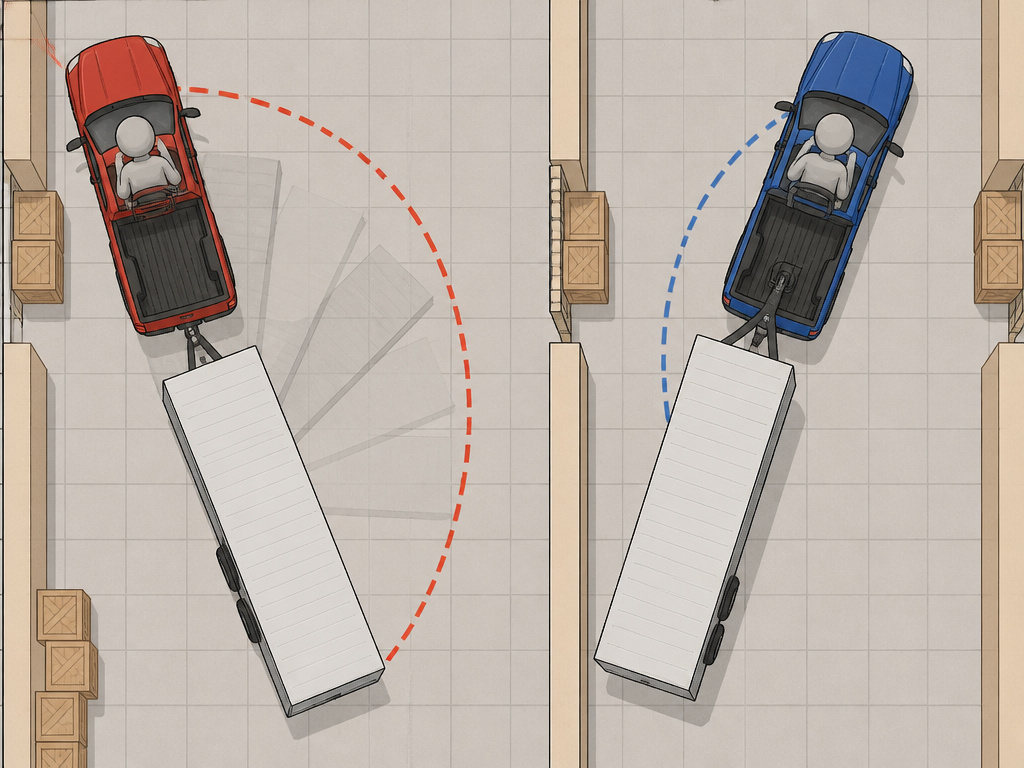
Most people assume a massive gooseneck trailer is harder to maneuver. The opposite is true.
Because the gooseneck pivots over the axle, it can turn much sharper. You can nearly jackknife it without the trailer neck hitting the truck cab. This allows for backing into impossibly tight spots on a job site or farm. The trailer follows the truck’s path more directly when backing, offering finer control.
A bumper pull has a much larger turning circle. The hitch point behind the bumper limits how sharply you can turn before the trailer contacts the truck’s side. In a wide-open lot, it’s a non-issue. In a crowded lumberyard or a narrow barn alley, it’s a constant headache.
| Scenario | Bumper Pull | Gooseneck |
|---|---|---|
| Backing into a tight shed | Requires multiple pull-ups, risk of clipping door frame | Tighter turn-in, often one smooth motion |
| Navigating a crowded yard | Wide, sweeping turns needed | Can cut corners sharply, uses less space |
| 90-degree alley turn | May be impossible without detaching | Usually achievable with careful spotting |
This maneuverability makes the gooseneck the preferred choice for hauling equipment like ATVs and UTVs in and out of confined trailheads or work sites.
Hitch Setup, Flexibility, and Cost
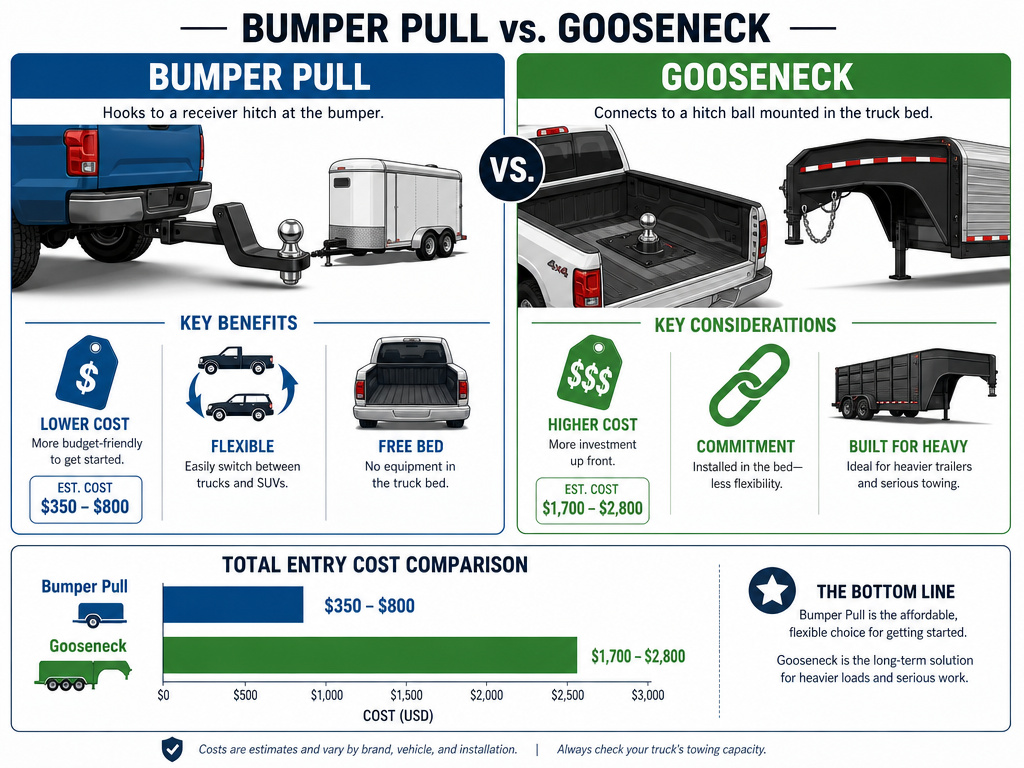
Here’s where the bumper pull wins outright for casual users.
A bumper pull requires a simple receiver hitch and ball mount. Nearly any truck or large SUV can be fitted with one. You can swap trailers easily, loan your trailer to a friend with a different truck, and keep your entire truck bed free for cargo.
A gooseneck requires a permanent, bed-mounted hitch. Brands like B&W and Curt make reliable under-bed turnover ball systems. Installation is more complex and costly. When the ball is installed, it occupies bed space. This commits the trailer to that specific truck.
Cost comparison is straightforward:
- Bumper Pull: Lower trailer cost + low hitch cost = lower total entry cost.
- Gooseneck: Higher trailer cost + significant hitch installation cost = higher initial investment for higher capability.
For those needing the ultimate in flexibility, a fifth wheel to gooseneck adapter can allow a fifth wheel-ready truck to pull a gooseneck, but that’s a niche solution. And when your heavy trailer is parked, a good set of gooseneck trailer locks is a mandatory security buy.
Can You Use an Adapter? A Hard No.
This question pops up constantly. The answer from engineers is absolute: no.
A gooseneck coupler is designed to sit high, connecting to a ball in the bed. A bumper ball sits too low and too far rearward. Even if you fabricated a towering adapter to bridge the gap, you would create a massive lever. The twisting force on the bumper hitch and frame would be immense, almost guaranteeing a structural failure. There are no DOT-approved adapters because the concept is inherently unsafe.
Never block a wool-acrylic blend above 60°C. By 70°C the acrylic deforms permanently and the garment will not recover its shape, even after re-blocking.
Towing a gooseneck with a bumper hitch is physically impossible and catastrophically dangerous. The leverage would likely shear the hitch from the frame. Don’t look for shortcuts here.
Which One Is Right For Your Job?
Make your decision with these four questions.
1. What is your typical loaded trailer weight?
- Under 12,000 lbs GVWR: Bumper pull is likely sufficient, especially for local hauls.
- Over 12,000 lbs GVWR or long-distance highway towing: Gooseneck is strongly recommended.
2. What are you towing with?
- Half-ton truck (F-150, Silverado 1500): You’re limited to bumper pull. Check your specific payload.
- 3/4-ton or 1-ton truck (F-250/350, Ram 2500/3500): You have a choice. Your frequency and load weight decide.
3. Where will you be maneuvering?
- Open areas, simple backing: Bumper pull is fine.
- Tight job sites, farms, crowded lots: Gooseneck’s turning radius is a daily advantage.
4. Do you need vehicle flexibility?
- Yes, you tow different trailers or use multiple vehicles: Bumper pull’s standard hitch wins.
- No, you have a dedicated truck for heavy hauling: Gooseneck’s performance benefits outweigh the lost bed space.
For most general hauling, moving furniture, taking a riding mower to the shop, a weekend camping trip with a pull behind campers, a quality bumper pull is all you need. When your livelihood involves moving skid steers, mini-excavators, or other heavy equipment, the gooseneck isn’t an upgrade. It’s the right tool. For those in the hotshot lane, the specialized gooseneck trailers for hotshot are built to endure the miles.
Frequently Asked Questions
Can a half-ton truck pull a gooseneck trailer?
Rarely, and not safely with any meaningful load. Half-ton trucks lack the frame strength, payload capacity, and factory support for a bed-mounted gooseneck hitch. They are engineered for bumper pull towing. Attempting a gooseneck installation on a half-ton typically voids warranties and exceeds the vehicle’s structural limits.
Is a gooseneck safer than a bumper pull?
Within their respective design limits, both are safe. However, for loads above 12,000 pounds, a gooseneck is safer due to its superior stability and control. It minimizes sway and prevents front-end lift, two major factors in towing loss-of-control incidents.
Do you need a special license to tow a gooseneck?
In most states, no special license is required for personal use if the combined Gross Vehicle Weight Rating (GVWR) of the truck and trailer is under 26,001 pounds. Commercial use or heavier combinations may require a Commercial Driver’s License (CDL). Always check your local Department of Motor Vehicles regulations.
Can you put a gooseneck hitch in any pickup truck?
No. The truck must be a 3/4-ton or 1-ton heavy-duty pickup (e.g., Ford Super Duty, Ram HD, Chevy/GMC HD) with a frame and payload capacity rated for the intended load. The manufacturer must also offer a gooseneck hitch prep package or approved aftermarket installation points. You cannot install one on a unibody SUV or a light-duty truck.
What about fifth wheel trailers? How do they compare?
Fifth wheel trailers use a similar over-the-axle connection as goosenecks but with a different coupling mechanism (a kingpin and jaws). They are the standard for large fifth wheels and offer similar stability benefits. The choice between fifth wheel and gooseneck often comes down to the trailer type (RV vs. Flatbed) and personal preference for hitch systems.
The Bottom Line
Choose the hitch your truck’s frame was built for. For occasional, sub-12,000-pound hauls, a bumper pull’s simplicity and lower cost make sense. When weight, distance, and stability converge, the gooseneck’s physics are undeniable. It turns your truck into a proper hauler, not just a vehicle with something dragging behind it. That difference isn’t in the price tag. It’s in the steering wheel at mile 300 of a long haul.
