
What Size ATV is Best for Adults? The 48-Inch Rule Explained
This post contains affiliate links. As an Amazon Associate, we earn from qualifying purchases.
The best ATV size for an adult is a machine approximately 48 inches wide, 83–90 inches long, with a seat height between 33–39 inches, powered by a 400cc to 750cc engine. This core utility size fits most riders, transports in a standard pickup bed, and complies with the common 50-inch trail width restriction.
That width number is the gatekeeper. It decides where you can ride before you ever turn the key. A machine over 50 inches at its widest point locks you out of a significant portion of public trail systems marked for narrower vehicles.
What follows is a breakdown of the three physical dimensions that matter, width, seat height, and length, and the engine displacement that turns those dimensions into useful power. We’ll match specs to real models like the Honda Rancher and Can-Am Outlander, and show you where the manufacturer’s age and size guidelines come from.
Key Takeaways
- Width is law. The common 48-inch ATV width is a deliberate design to stay under the 50-inch trail restriction. Measure your actual machine with tires and accessories; guessing wrong means a closed gate.
- Seat height is about control, not comfort. Your boots must plant flat on the ground when stopped. A seat over 36 inches demands longer legs; under 33 inches sacrifices ground clearance.
- Engine size scales with weight and task. A 150-pound rider on flat trails is over-motored on a 750cc machine. That same 750cc is underpowered for a 250-pound rider towing a loaded trailer up a hill.
- Youth and Transition models have strict age ceilings. ANSI/SVIA Category Y (Youth) and Category T (Transition) ATVs are engineered for smaller, lighter operators. Putting an adult on one is a safety and liability failure.
- Dry weight and curb weight are different. Dry weight is the machine alone. Curb weight includes all fluids and a full tank. Use curb weight for transport and towing calculations.
The 48-Inch Width & The 50-Inch Trail Rule
Forget engine size for a moment. The first number that can end your ride before it starts is your ATV’s width, measured from the outside of the left tire to the outside of the right tire at the widest point.
Most adult utility ATVs cluster around 48 inches wide. The Honda FourTrax Rancher is 47.4 inches. The Polaris Sportsman 570 is 48 inches. The Can-Am Outlander 700 is 48.1 inches. This isn’t a coincidence. It’s a design target to comply with a widespread land-management rule.
Many public trails, especially those managed by the U.S. Forest Service, are designated “Open to vehicles 50 inches or less in width.” Your machine must be 50 inches or less at its widest point to legally enter.
The rule measures the vehicle as it sits, with its stock tires. If you add wider aftermarket tires, wheel spacers, or bulky accessory boxes, you push past the limit. A machine that specs at 48 inches from the factory can easily hit 52 inches with aggressive tires. That extra two inches is the difference between a full day on the trail and turning around at the trailhead.
| ATV Model | Width (in) | Fits 50″ Trail? (Stock) | Risk If You Widen |
|---|---|---|---|
| Honda Rancher | 47.4 | Yes | Low — minimal tire bulge. |
| Polaris Sportsman 570 | 48.0 | Yes | Moderate — common to up-size tires. |
| Can-Am Outlander MAX | 48.5 | Yes, but tight | High — width leaves little margin for error. |
| Kawasaki Brute Force 750 | 46.5 | Yes | Low — narrower chassis allows for wider tires. |
The takeaway is simple. If you ride on public land, know your trail width restrictions. Choose a machine that starts under 50 inches, and be cautious with modifications. For the majority of adult riders, sticking with a standard 48-inch-wide utility ATV is the safest bet for unimpeded access. This principle is as critical as selecting the right ATV tire size for your terrain.
Seat Height: Control Over Comfort
Seat height determines whether you can safely control the ATV when it’s not moving. It is not a comfort suggestion. It’s a stability metric.
When you come to a stop, you need to put one or both feet flat on the ground to balance the machine. If you’re tiptoeing, you lack the leverage to prevent a tip-over on uneven ground. The sweet spot for most adult riders is between 33 and 36 inches.
Where this goes sideways: Choosing a tall seat for ground clearance without the inseam to match. You’ll fatigue quickly from bracing, and a simple off-camber stop can become a drop.
Manufacturers design models for different priorities. The Honda Rancher has a 33.7-inch seat, making it low and approachable for a wide range of riders. The Can-Am Outlander 700 has a 38-inch seat, prioritizing 12 inches of ground clearance for rocky terrain. You trade ease of mounting for obstacle clearance.
Here’s how to check fit: Wear your riding boots. Sit on the machine. Can you place the balls of both feet firmly on the ground? Can you shift your weight to one side and plant that foot flat while keeping the other on the peg? If yes, the seat height works. If not, look at a different model or a suspension lowering kit. Your control is non-negotiable.
Length, Wheelbase & Weight: The Transport Equation
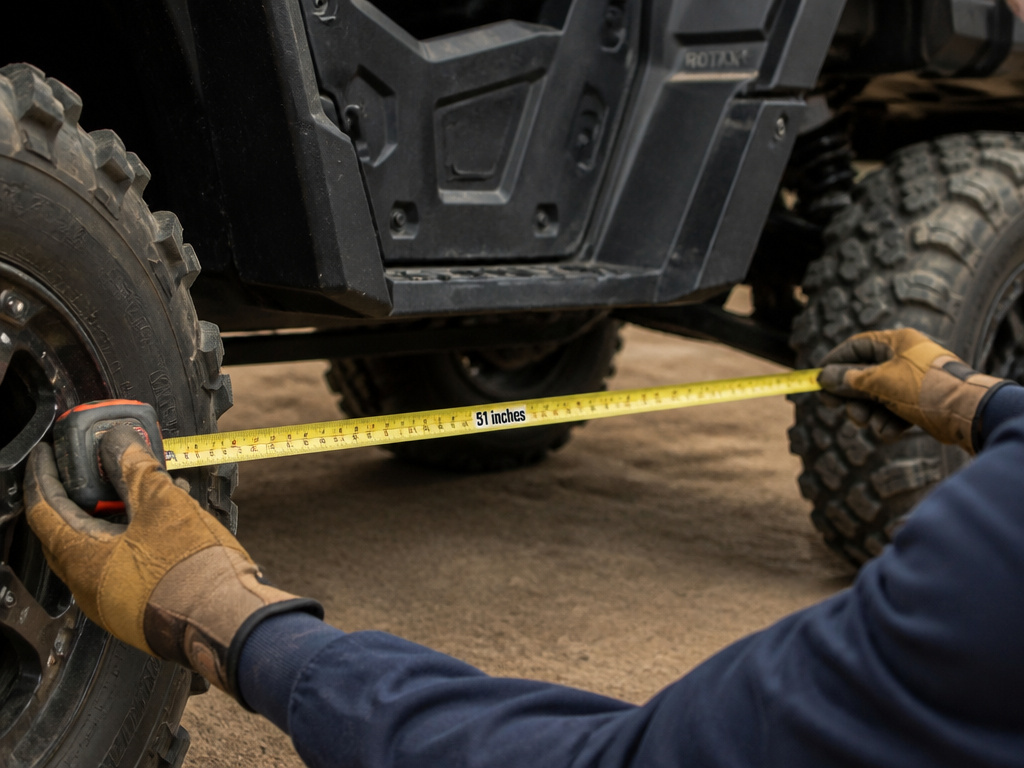
Overall length and wheelbase impact stability and, more practically, how you get the ATV from your house to the trail. Weight determines what you need to carry it.
A typical utility ATV is between 83 and 90 inches long. A Honda Rancher is 82.8 inches. A Polaris Sportsman 570 is 83 inches. The longer Can-Am Outlander 700 is 89.9 inches. Wheelbase follows a similar range, from about 50 to 53 inches.
Why wheelbase matters: A longer wheelbase makes the ATV more stable in a straight line and at speed. It also smooths out bumps. A shorter wheelbase makes the machine more nimble and easier to turn in tight woods. For general trail and work use, a mid-range wheelbase around 51 inches offers a good compromise.
Weight has two key figures: dry weight and curb weight. * Dry Weight: The weight of the ATV with no fluids (no fuel, oil, coolant). Manufacturers use this for spec sheets. * Curb Weight: The weight ready to ride, with all fluids and a full tank of fuel. This is the real number.
For example, a spec sheet might list a dry weight of 580 lbs. The curb weight could be 630 lbs or more. You must use the curb weight, or an educated estimate, when calculating if your pickup truck’s payload or your trailer’s Gross Vehicle Weight Rating (GVWR) can handle the load. Overloading either is a direct safety hazard.
Engine Displacement: Matching CCs to Your Reality
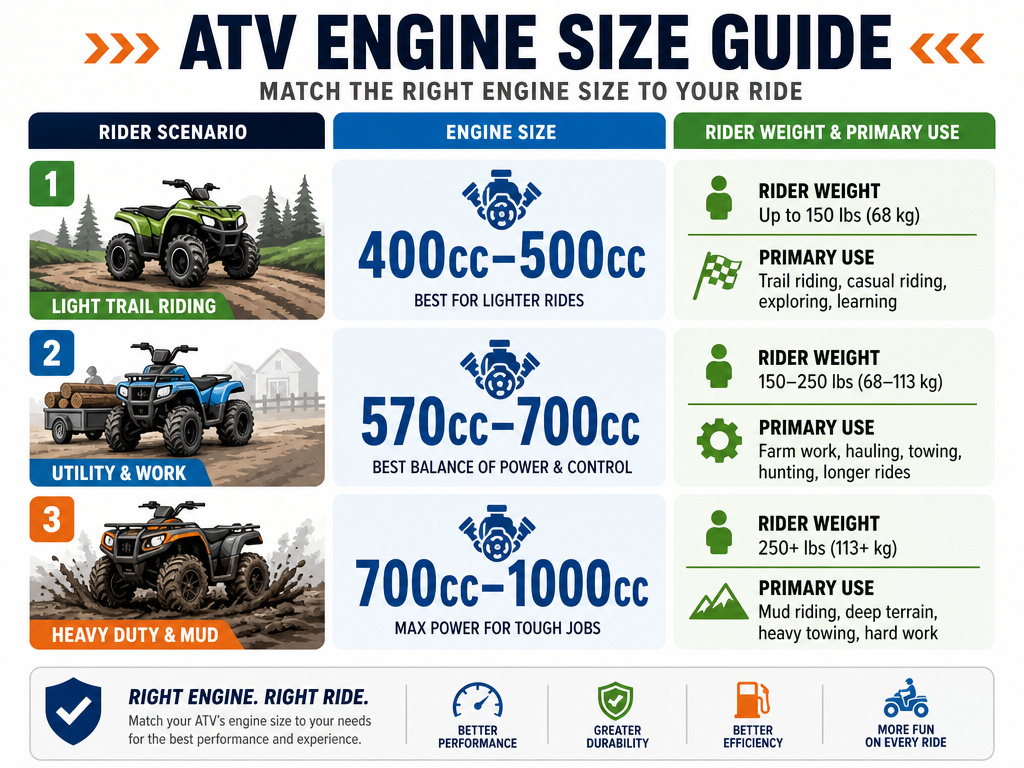
Engine displacement, measured in cubic centimeters (cc), is the most discussed but often misunderstood spec. It is not a direct measure of skill. It is a measure of potential power that must be matched to the rider’s weight and the task’s demands.
The common “400cc to 750cc for adults” range exists because it covers the broad middle. A 400cc engine in a light machine like a Honda Rancher 420 has enough torque for light trail riding and chores. A 750cc engine in a Kawasaki Brute Force 750 provides the grunt for heavy towing, deep mud, or carrying a larger rider.
Common mistake: Choosing engine size based on ego or “future-proofing.” A 1000cc ATV is excessive for flat field mowing and becomes a liability in the hands of an inexperienced rider. The power is harder to manage, and the machine is heavier and more expensive to run.
The ANSI/SVIA 1-2017 standard, which underpins safety regulations, categorizes ATVs partly by engine size in relation to age. It states that ATVs with engines over 90cc are recommended only for operators aged 16 and older. This is a starting point, not a finish line. A 16-year-old novice and a 200-pound adult farmer both qualify for “over 90cc,” but they need vastly different machines.
| Rider Scenario | Recommended CC Range | Why It Fits | Example Model |
|---|---|---|---|
| Light trail riding, rider < 160 lbs | 400cc – 500cc | Adequate power without overwhelming weight or throttle response. | Honda Rancher 420 |
| General utility, towing, rider 160-220 lbs | 570cc – 700cc | Balances power for work with manageable size. | Polaris Sportsman 570, Can-Am Outlander 700 |
| Heavy work, mud, steep terrain, rider 220+ lbs | 700cc – 1000cc | High torque needed for demanding loads and conditions. | Kawasaki Brute Force 750, Can-Am Outlander 1000R |
For most adults, a machine in the 570cc to 700cc range represents the best balance of capability and daily usability. It’s enough for serious work without being needlessly intimidating or wasteful. This is the category where you’ll find many of the best adult four-wheelers for sale.
The Standards: ANSI/SVIA Age & Category Labels
Those “Y-12+” or “Category G” labels on an ATV aren’t marketing. They are legally defined classifications from the ANSI/SVIA 1-2017 standard, adopted by organizations like the Canadian Off-Highway Vehicle Distributors Council.
These categories exist to match machines to operator size and experience. Ignoring them is a primary cause of accidents. * Category Y (Youth): For operators under 16. Sub-categories like Y-12+ are for ages 12 and older. These machines have lower top speeds, smaller dimensions, and less power. * Category T (Transition): For operators 14+ with supervision, or 16+ alone. A bridge between youth and full-size adult ATVs. * Category G (General Use): For recreational and utility use by operators aged 16 and older. This is the category for all standard adult ATVs.
An adult has no business on a Category Y machine. It is physically too small, lacks the suspension and brake capacity for an adult’s weight, and its speed restrictor will frustrate any real use. Conversely, putting a youth on a Category G ATV is profoundly dangerous. The standards are there for a reason. When evaluating any ATV, its category tells you the first and most important thing about who it’s for. This foundational knowledge helps when researching the most reliable ATV brand, as reputable manufacturers adhere strictly to these guidelines.
How to Choose: A Step-by-Step Fit Guide
- Define Your Primary Use. Be specific. Is it “plowing a 100-foot driveway” or “exploring mountain trails”? Your answer dictates engine size, drive system, and weight. For plowing, you’ll want a model known for its ATV plow capabilities.
- Measure Your Trail Access. Check the width restrictions for the trails you plan to ride. If they say 50 inches, your target ATV width is 48 inches or less, stock.
- Perform the Seat Test. If possible, sit on candidate models. Can you flat-foot it? Can you reach all controls comfortably? If buying online, compare your inseam to the listed seat height.
- Calculate Transport Needs. Measure your truck bed or trailer. Compare the ATV’s length and curb weight to your vehicle’s payload and dimensions. A 90-inch ATV won’t fit in a 5-foot bed with the tailgate up.
- Match Engine to Load. Use the rider/task table above. If you’re between categories, choose the smaller engine. It’s easier to upgrade later than to deal with too much machine now.
- Verify the Category. Ensure the ATV is a Category G (General Use) model. This confirms it’s designed for an adult operator.
Following these steps moves you from guessing to knowing. It turns a subjective question into a series of objective checks.
Frequently Asked Questions
What is the most common ATV size for adults?
The most common physical size is approximately 48 inches wide, 83 to 90 inches long, with a seat height of 33 to 36 inches. The most common engine displacement range is 570cc to 700cc. This combination fits the average rider, fits in a standard pickup truck, and complies with common trail width rules.
Can a large adult ride a 500cc ATV?
Yes, but with limitations. A 500cc ATV can carry a large adult for light trail riding on flat terrain. It will struggle with heavy towing, climbing steep hills, or navigating deep mud. The rider may also feel the suspension is soft and the power delivery is strained. For frequent or demanding use, a 700cc or larger machine is a better fit.
What happens if my ATV is too wide for the trail?
If your ATV exceeds the posted width limit (e.g., 50 inches), you are not permitted to enter that trail. Land managers enforce these rules to prevent trail damage, erosion, and conflicts with other user groups. You will be turned around, and repeated violations can result in fines or loss of riding privileges.
Is a longer wheelbase better?
Longer wheelbase provides greater stability at speed and a smoother ride over bumps. A shorter wheelbase offers quicker, more agile handling in tight spaces like woods. For most adult riders doing a mix of trail riding and utility work, a wheelbase between 50 and 53 inches, common on mid-size utility ATVs, offers the best compromise.
How important is dry weight vs. Curb weight?
Curb weight is critically important; dry weight is nearly irrelevant for the owner. Always use curb weight (or estimate it by adding 50-75 lbs to the dry weight) for calculating trailer loads, truck payload, and towing capacity. Overloading your transport vehicle based on the dry weight figure is a common and dangerous error.
The Bottom Line
Stop looking for the “best” size and start matching numbers to your body, your trailer, and your local trail signs. The right adult ATV is the one that lets you plant your boots flat on the ground, fits between your truck’s wheel wells, and passes through the trailhead gate without a second thought.
For a single answer that covers the majority: a 48-inch wide, 570cc utility ATV like a Polaris Sportsman 570 or Honda Rancher. It’s the default for a reason. It works. From there, scale up to a 700cc class machine if your chores are heavier or your terrain is meaner, or consider a 2WD vs 4WD ATV system based on your traction needs. But never scale down below the specs that keep you in control and on the right side of the trail rules.
