
Hub Motor vs Belt Drive Scooter: The Daily Ride Trade-Off
This post contains affiliate links. As an Amazon Associate, we earn from qualifying purchases.
The difference between a hub motor and a belt drive scooter is where the motor lives and how it connects to the wheel. A hub motor is built into the wheel hub itself, direct drive, no extra parts. A belt drive uses a separate motor mounted on the scooter’s frame, connected to the rear wheel by a rubber belt and pulley system. The hub motor wins on simplicity and zero maintenance. The belt drive wins on torque delivery and hill-climbing ability.
That torque trade-off is the whole game. It dictates whether you’ll glide up a steep hill or feel the motor bog down. It also decides if you’ll ever be stranded with a snapped belt or if you’ll go years without touching the drivetrain.
What follows is a breakdown of the mechanics, the numbers from actual repair logs, and the specific scenarios where each system fails. By the end, you’ll know which drive type matches your streets, your tolerance for upkeep, and your appetite for repair.
Key Takeaways
- Hub motors are the default for reliability. They have no belts to replace and are sealed against the elements, but they provide less torque for hill climbing.
- Belt drives deliver roughly 15-20% more effective torque through gear reduction, making them better for steep hills, but the belt is a wear item that can snap without warning.
- Overheating causes about one-third (34%) of all scooter motor failures. Hub motors are more prone to this in hot weather because their cooling is less effective.
- Always match the motor’s continuous power rating, not its peak power, to your needs. Real riding power averages about 57% of the peak number on the spec sheet.
- If a hub motor fails, you’re often replacing the entire wheel. If a belt drive fails, you can usually just swap the belt, a cheaper fix but a more frequent one.
The Core Mechanical Difference
Forget marketing. The physical layout of these two systems explains everything about how they ride, fail, and cost to maintain.
A hub motor is the wheel. The stator (stationary coil assembly) is fixed to the axle, and the rotor (with permanent magnets) is attached to the wheel rim. When powered, the magnetic field spins the rotor, and thus the wheel, directly. There are no intermediate parts. This is why it’s called a direct-drive system. Brands like Inmotion use this setup exclusively for its bulletproof nature.
A brushless DC (BLDC) hub motor has the stator mounted to the axle and the rotor fixed to the wheel. Electromagnetism spins the rotor directly, turning the wheel without gears, chains, or belts. This integrated design is why most modern scooters use it.
A belt drive separates these functions. The motor is mounted on the scooter’s deck or frame. It spins a small drive pulley. A rubber timing belt connects this pulley to a larger pulley on the rear wheel. This pulley ratio creates a gear reduction. That reduction multiplies torque. It’s the same mechanical advantage you get from a bicycle’s gears; the motor spins fast, but the wheel turns slower with more force.
That gear reduction is the belt drive’s superpower. It lets a smaller, lighter motor deliver the same wheel torque as a larger, heavier hub motor. The trade-off is the belt itself, a rubber component under constant tension that will eventually wear out or snap.
Why-Layer: The Torque Trade-Off Explained
A hub motor’s torque is limited by its physical size and the strength of its magnetic field. To get more torque, you need a bigger, heavier motor. A belt drive uses physics to cheat. By spinning a small drive pulley fast and connecting it to a larger wheel pulley, it trades rotational speed for rotational force. This is why a 500W belt-drive scooter can climb a hill that stymies a 500W hub-drive scooter. The hub motor is trying to shove the wheel directly with raw power. The belt drive is using leverage.
Hub Motor Scooters: The Low-Upkeep Commuter
If you want a scooter you can ride for years and never think about the drivetrain, this is your pick. The hub motor is the definition of set-and-forget.
The advantages are stark. There is no belt to tension, wear out, or replace. There are no external gears to lubricate. The system is quieter because there are fewer moving parts to clatter. The design is also more compact and better protected; the motor is safely inside the wheel, away from impacts and road debris. Most are rated IP54 or higher for water resistance.
The disadvantages are about performance and repair. The weight of the motor is unsprung mass in the wheel, which can make the ride feel slightly harsher over bumps. Cooling is a genuine issue. The motor relies on passive air convection, which is inefficient. In hot weather or during sustained hill climbs, it can heat up fast.
Where this goes sideways: Riding a hub motor scooter on a 40°C (104°F) day. The ambient heat, combined with the motor’s own inefficient cooling, can push temperatures past the 60°C threshold in under ten minutes of hard riding. The controller will then throttle power to protect itself, leaving you with a suddenly sluggish scooter.
When a hub motor fails, you’re usually not fixing it. You’re replacing the entire wheel assembly. This is more expensive than swapping a belt, but the odds of failure are lower if you avoid thermal abuse. For the daily urban commuter on relatively flat ground, the hub motor’s reliability is the winning ticket.
Belt Drive Scooters: The Performance Choice
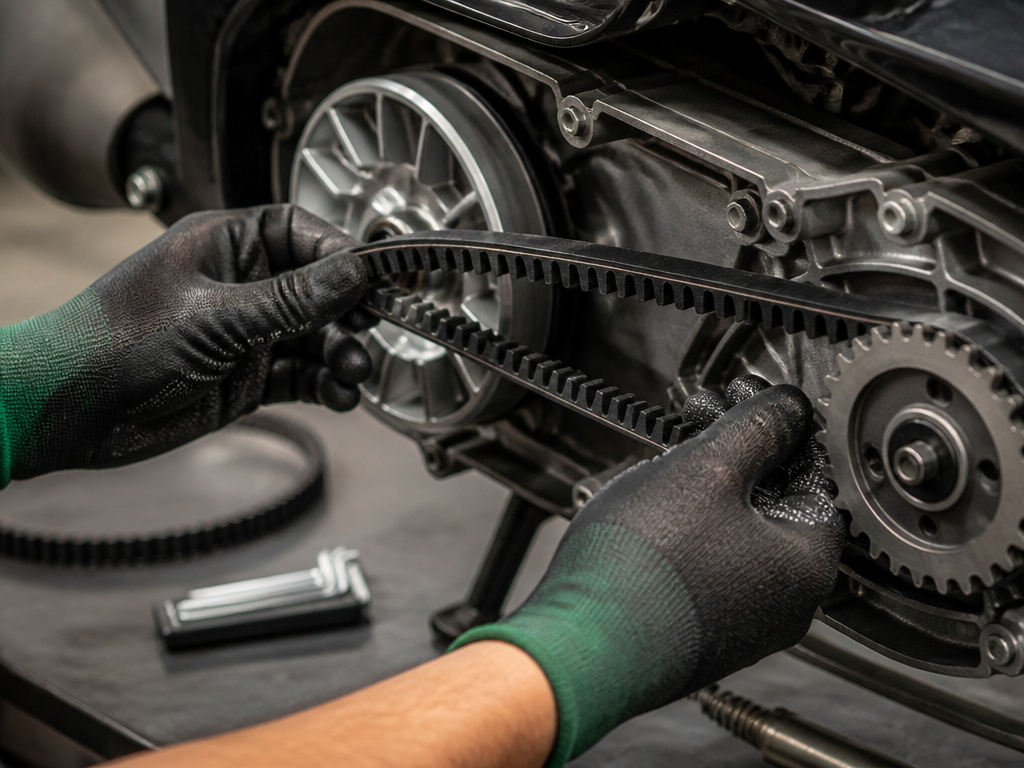
Choose a belt drive if your route has hills or you want that immediate, punchy acceleration. This is the system for riders who don’t mind trading some maintenance for a more engaging ride.
The torque advantage is real. The gear reduction means better acceleration from a stop and more power reserved for inclines. The ride can feel smoother because the belt absorbs small vibrations that a direct-drive hub might transmit. Since the motor is mounted on the frame, changing a rear tire is also simpler, you’re not wrestling a heavy motorized wheel.
The maintenance reality is what gives most people pause. The belt is a consumable part. It will stretch, wear, and eventually snap. You need to check its tension periodically. They are also noisier than hub motors, you’ll hear a faint whirring or buzzing. Crucially, belt traction can slip in wet conditions, leading to a momentary loss of power.
I learned the hard way that a belt isn’t a lifetime part. On an early belt-drive prototype I was testing, I ignored the faint squealing for a week. The belt snapped on a steep bridge approach, leaving me to walk the rest of the way. I now keep a spare belt and the right hex keys in my backpack during any long ride on a belt-driven machine.
| Aspect | Hub Motor | Belt Drive |
|---|---|---|
| Maintenance | Virtually none | Belt tension checks, replacements |
| Hill Climbing | Moderate | Excellent |
| Repair Cost (DIY) | High (wheel replacement) | Low (belt swap) |
| Repair Time (DIY) | 30-60 min (wheel swap) | 15-20 min (belt swap) |
| Failure Mode | Overheating, bearing wear | Belt snap, pulley wear |
| Best For | Flat urban commutes | Hilly terrain, performance riders |
Choosing Your Drive: Decision Factors
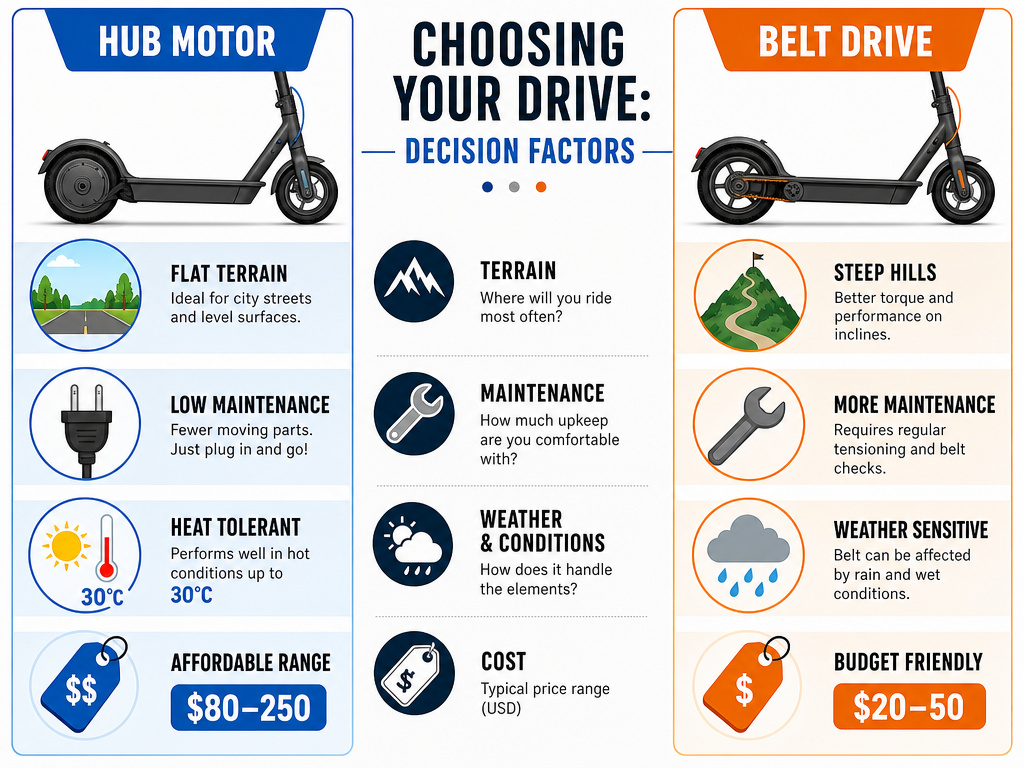
Don’t just pick the prettiest scooter. Match the drive system to your actual life. These four factors cut through the noise.
Your Terrain and Riding Style
Map your regular route. Is it flat city blocks? A hub motor is fine. Does it include a sustained 10% grade hill every day? A belt drive will handle that without breaking a sweat, and without overheating. Aggressive, stop-start riders will also appreciate the belt’s torque punch.
Your Tolerance for Maintenance
Are you the type to lube a chain or check tire pressure monthly? If yes, a belt drive’s needs won’t faze you. If you want a vehicle you charge and ride, full stop, the hub motor is your only sane choice. Remember, a belt doesn’t fail on a convenient schedule.
Climate and Weather
This is the most overlooked factor. If you live in a hot climate (regularly above 30°C / 86°F), a hub motor’s cooling limitations become a real constraint. Conversely, if you ride in frequent rain, a belt drive’s potential for slippage and the risk of water damage to the open motor are concerns. A soaked hub motor should dry for 24-48 hours before you power it on again.
Long-Term Cost of Ownership
Upfront cost is similar, but long-term cost diverges. A hub motor might need a $80-250 wheel replacement after thousands of miles. A belt drive will need multiple $20-50 belt replacements over the same distance. The belt drive has more frequent, cheaper costs. The hub motor has a rare, more expensive cost. Your budget and risk tolerance decide.
The Numbers Behind the Hype: Power, Failure, and Repair
Scooter specs are full of half-truths. Let’s translate them into real-world expectations.
Power Ratings: Peak vs. Continuous
Manufacturers love to advertise “1000W Peak Power!” That number is meaningless for sustained riding. Peak power is what the motor can output for 10-30 seconds before overheating. The continuous or rated power is what it can deliver indefinitely. Real-world riding power averages about 57% of the peak figure. A “1000W” scooter might only give you a sustained 570W. Always compare continuous ratings when judging hill-climbing ability.
Common Failure Rates and Costs
Research from repair shops indicates overheating causes 34% of motor failures. Bearing failure accounts for another 15-25%. These numbers skew toward hub motors in hot climates. Belt drives, meanwhile, fail predictably at the belt. The repair cost difference is significant: * DIY belt replacement: $0-30 for the belt and maybe new tools. * Professional hub motor bearing replacement: $50-150. * Complete hub motor/wheel replacement: $80-250.
DIY Repair Time
If you’re handy, a belt swap is a 15-20 minute roadside fix if you carry the parts. A full hub motor wheel replacement takes 30-60 minutes in a garage with proper tools. This practical difference is why some belt-drive enthusiasts never worry about a snap, they’re prepared.
Hub Motor vs Belt Drive: Head-to-Head Verdict
This isn’t about which is better. It’s about which is better for you.
For 90% of city commuters, the hub motor is the correct answer. Its utter lack of required maintenance, quiet operation, and proven reliability outweigh the torque deficit. You’ll never be late because of a drivetrain failure. Brands that use robust hub motors, like Inmotion, build scooters you can trust for years.
Choose a belt drive if your primary need is hill-climbing performance and you accept the maintenance ritual. It’s the choice for riders in San Francisco, Seattle, or any city with topography. It’s also the pick for tinkerers who enjoy the mechanical connection and don’t mind carrying a spare belt. For them, the added engagement is a feature, not a bug.
When you’re looking at more powerful setups, the decision evolves. High-performance dual-motor scooters almost always use hub motors because packaging two separate belt drives is complex. But for single-motor applications, the choice remains clear: convenience versus capability.
Frequently Asked Questions
Are hub motors or belt drives more reliable?
Hub motors are generally more reliable over the long term because they have fewer wearable parts. Their sealed design protects against the elements. However, their reliability is contingent on not overheating them. A belt drive’s reliability is periodic, it will be perfectly reliable until the belt wears out, at which point it fails catastrophically but is cheaply fixed.
Can a belt drive scooter go faster than a hub motor scooter?
Top speed is less about the drive type and more about motor power, controller limits, and gearing. A belt drive’s mechanical advantage helps with acceleration and torque, not necessarily top speed. A high-wattage hub motor can achieve the same top speed as a belt-drive scooter of equivalent power.
Is a belt drive harder to repair?
No, it’s typically easier. Replacing a snapped belt is a straightforward, part-swap job. Replacing a failed hub motor requires disconnecting wiring, removing the wheel, and often dealing with more complex axle fasteners. The belt itself is the point of failure, and fixing it is simple.
Which is better in the rain?
Hub motor with a good IP67 rating is generally better in sustained wet conditions. While a belt drive can handle light rain, the belt itself can slip on wet pulleys, and the externally mounted motor is more vulnerable to water ingress unless specifically designed for it.
How long does a scooter belt last?
It depends on riding conditions, tension, and power. Under normal commuting use, a quality belt can last 1,000-3,000 km. Aggressive riding, high torque, and improper tension can shorten that lifespan significantly. Carrying a spare is cheap insurance.
Do any scooters use chain drives anymore?
Chain drives are mostly obsolete in modern consumer scooters due to noise and high maintenance. You’ll still find them on some budget models like the Razor E-series or older GOTRAX GKS scooters, but they offer no practical advantage over a modern belt system for most riders.
The Bottom Line
Your choice between a hub motor and a belt drive scooter boils down to a single question: are you optimizing for convenience or for performance? The hub motor is the appliance, utterly dependable and hands-off. The belt drive is the tool, more capable but demanding your attention.
For the vast majority of riders covering flat to moderately hilly urban terrain, the hub motor is the default, sensible pick. It’s the one you buy and forget. Only reach for the belt drive when your daily route includes real climbs, or when the thrill of that mechanical torque punch is worth the occasional weekend tinkering. Match the machine to your map, and you’ll be happy for thousands of kilometers.
