
The Best UTV for Hunting: Key Factors for Your Outdoor Rig
This post contains affiliate links. As an Amazon Associate, we earn from qualifying purchases.
The best UTV for hunting is a utility-focused side-by-side that balances quiet operation, high ground clearance, practical cargo space, and reliable 4×4 traction. It’s not the most powerful machine, but the one that gets you, your gear, and your game in and out without spooking wildlife or getting stuck. For most hunters, that means a model like the Polaris Ranger, Can-Am Defender, or Kawasaki Mule, chosen for its specific combination of rack capacity, cab noise, and low-speed control.
Forget horsepower as the primary metric. The hunting rig that fails is the one you can hear from a ridge away, or that bottoms out on a hidden stump three miles from the truck. The right choice turns on four physical specs you can measure before you buy: decibel levels at trail speed, inches of ground clearance, cubic feet of usable cargo, and the type of front differential.
What follows is a breakdown of those four specs, drawn from OEM sheets and real-world tests, plus a direct comparison of the top contenders. By the end, you’ll know whether you need a two-seater with a winch or a six-seater with a dump bed, and which models actually deliver in the field.
Key Takeaways
- Noise is the first filter. A cab reading over 90 decibels at 10 mph will telegraph your position; aim for models tested under 80 dB.
- Ground clearance under 12 inches is a liability in rocky or stump-filled terrain, leading to constant undercarriage strikes.
- Cargo capacity is about shape, not just weight. A shallow bed is useless for a dog box; a deep, narrow bed won’t fit decoy bags.
- Locking front differentials (like Visco-4Lok) beat open diffs in slick clay or sidehill situations where one wheel loses traction.
- Sport UTVs sacrifice utility for suspension travel. Their low cargo weight limits and lack of bed space make them poor primary hunting rigs.
The 4 Non-Negotiable Specs for a Hunting Rig
Look past the marketing about camo patterns and integrated gun scabbards. A UTV’s fitness for hunting is decided by four numbers printed on the spec sheet. If one of these is wrong, the rest of the features won’t matter.
Ground clearance was the best in the test at nearly 13 inches, as was towing capacity at 2,000 pounds, thanks to its 999cc twin-cam, liquid-cooled engine. But you’d be hard-pressed to believe the Pioneer’s engine is capable of so much power when you’re riding in it—primarily because it sounds as if there is no engine at all. Because engine noise registers only 76 decibels in the cab at 20 mph, you hear the tires on the trail rather than the buzz of an engine.
That blockquote from an Outdoor Life test of the Honda Pioneer 1000-5 LE captures the two most critical specs in one passage. You need the clearance, but you also need the quiet.
Noise Level (Decibels in Cab). This is the most overlooked spec. A loud machine spooks game and ruins the peace of the hunt. Test data shows a staggering spread. * The Honda Pioneer 1000-5 measured 76 decibels at 20 mph. * The Challenger 750, in the same test, topped 98 decibels at just 10 mph.
That 22-decibel difference is the gap between stealth and a rolling announcement. For reference, 80 dB is like city traffic inside a car. 98 dB is approaching a motorcycle at full throttle. When comparing best UTV models for farming, noise matters less. For hunting, it’s a deal-breaker.
Ground Clearance. This is your insurance policy against the trail. Manufacturer specs are reliable here. The 2026 Can-Am Outlander PRO Hunting Edition lists 13 inches. The Polaris Ranger 500, an older but still relevant model, offered 9.75 inches. That 3.25-inch gap is the difference between gliding over a buried log and hanging your frame on it. For mixed terrain, treat 12 inches as the absolute minimum.
Cargo Capacity. You must separate rack capacity from payload capacity. Rack capacity is what the front and rear racks can hold (often 120 lb front / 240 lb rear on an ATV). Payload capacity is what the entire vehicle can carry, including passengers and cargo in the bed. The 2026 Polaris RANGER XP 1000 has a 1,500 lb payload. More important is the bed itself. A dump bed is non-negotiable for hauling gravel, feed, or gutted game. A shallow bed won’t secure a large cooler or dog kennel.
Traction System. Not all 4×4 is equal. An open front differential sends power to the wheel with less traction. A locking differential, like Can-Am’s Visco-4Lok, locks the front axles together, forcing both wheels to turn even if one is in the air or mud. For hunting in wet fields or on loose forest slopes, a locking diff is the difference between driving out and digging out.
| Spec | Ideal for Hunting | Red Flag | Consequence of Missing It |
|---|---|---|---|
| Cab Noise | ≤ 80 dB at 20 mph | ≥ 90 dB at 10 mph | Spooks game within 300+ yards, fatiguing over long days. |
| Ground Clearance | ≥ 12 inches | < 10 inches | Frequent undercarriage damage, high-centering on obstacles. |
| Cargo Bed | Dump bed, ≥ 48″ L x 42″ W | Fixed bed, shallow sides | Can’t unload heavy items, gear falls out on trails. |
| Front Differential | Locking or limited-slip | Open differential | Loss of forward motion with one lifted wheel, requires winch. |
Head-to-Head: Top Contenders for the Woods
This isn’t about brand loyalty. It’s about which machine’s factory configuration solves the most hunting-specific problems. Here’s how the front-runners stack up on the critical dimensions.
Polaris Ranger. This is the default answer for a reason. The Ranger line is built as a tool. The RANGER XP 1000 series offers high payloads, true dump beds, and often the best accessory ecosystem for hunters (think: windshield, roof, gun holders). Its engine note is present but not obtrusive. Where it sometimes loses is in sheer refinement; the ride can be rougher than a Defender’s, and the cab can be louder. It’s a tractor that can also be a truck.
Can-Am Defender. Think of the Defender as the Ranger’s more polished cousin. It often features plusher seating, better sound dampening, and innovative traction tech like Visco-4Lok. The Defender HD5 from a past test managed a 1,200 lb payload and 1,500 lb towing. Its weakness can be price and, for some, overly complex dashboards. It’s for the hunter who values a comfortable, capable ride all day long.
Kawasaki Mule / KRX4. The Mule is the utilitarian. It’s often less expensive, famously durable, and devoid of flash. The new Kawasaki KRX4 Blackout Edition, as profiled by RideApart, is a fascinating hybrid: a sport-utility machine with serious off-road chops and factory hunting accessories. It may not have the largest bed, but its capability in “rough, jagged” terrain like Oregon’s lava rock is proven. It’s for the technical-terrain hunter.
Honda Pioneer. Honda’s reputation for reliability is the main draw. The Pioneer 1000-5’s legendary quietness (76 dB) and excellent 13-inch ground clearance make it a stealth specialist. Its downside is often a lower payload rating compared to a same-sized Ranger and a transmission that some find less intuitive than a standard CVT. It’s the “set it and forget it” choice.
Where this goes sideways: Choosing a model based on its power plant alone. A 1000cc engine is useless if the machine is too loud to get within a quarter-mile of your stand, or if its low cargo capacity forces you to leave essential gear at camp.
Utility vs. Sport: The Hunting Compromise
This is the single biggest mistake buyers make. A sport UTV—like a Polaris RZR or Can-Am Maverick—is designed for high-speed trail riding and dune jumping. Its long-travel suspension soaks up whoops, but its cargo bed is usually a tiny, shallow afterthought.
A utility UTV—the Ranger, Defender, Mule, Pioneer—is designed to carry and tow. Its suspension is tuned for stability under load, not for landing jumps.
| Feature | Utility UTV (e.g., Polaris Ranger) | Sport UTV (e.g., Polaris RZR) | Winner for Hunting |
|---|---|---|---|
| Primary Design Goal | Carry payload, work at low speeds. | High-speed handling, suspension travel. | Utility. |
| Cargo Bed | Large, often with dump function. | Small, lightweight, often fixed. | Utility. |
| Suspension Travel | Moderate (8-10 inches). | Long (14-20+ inches). | Sport (for comfort), but… |
| Payload Capacity | High (1,000-1,500+ lbs). | Low (often 300-600 lbs). | Utility. |
| Noise Level | Typically moderate. | Often higher (performance exhaust). | Utility. |
The sport machine’s long suspension is more comfortable on a bumpy trail. But its pathetic payload means you, a partner, and a single cooler might max it out. Add a deer? You’re overloaded. The utility machine’s firmer ride is the trade-off for being able to haul your entire camp. For 90% of hunters, the utility category is the only sane starting point. This fundamental difference between ATV and UTV design philosophy is critical to understand before you shop.
Accessories Are Not Afterthoughts
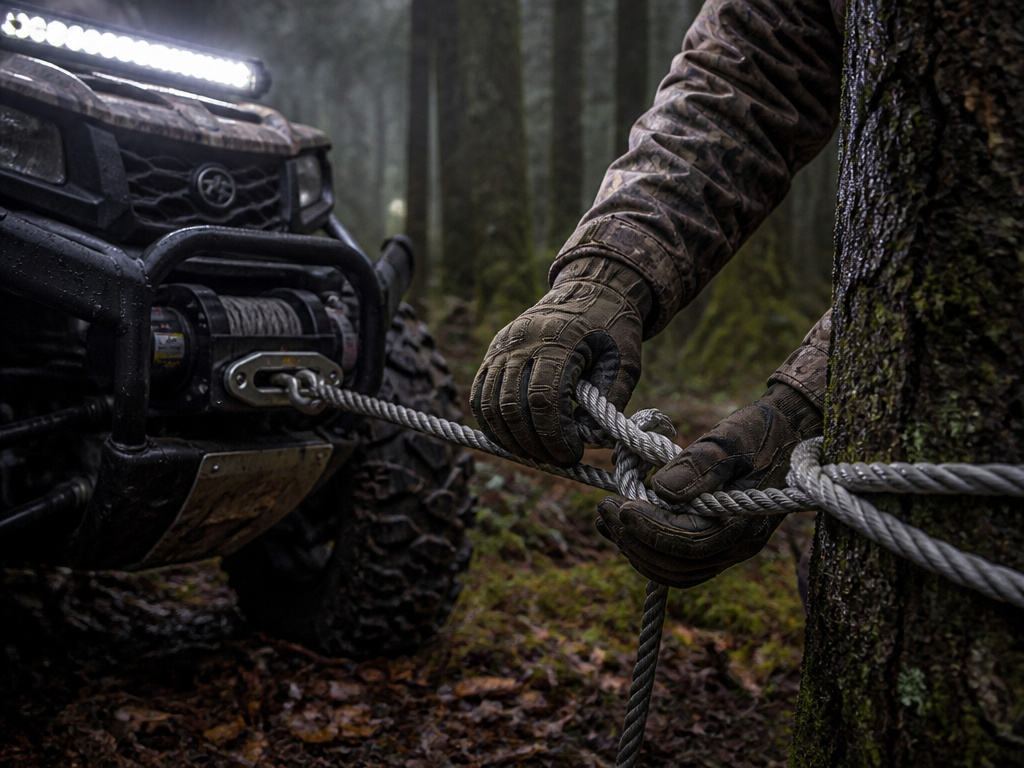
The right UTV is a platform. The right accessories make it a hunting rig. Budget for these from the start; they are as important as the machine itself.
Winch. This is your self-recovery insurance. A 3,500-lb capacity winch, like the Can-Am HD3500 that comes on the Hunting Edition models, is the baseline. Synthetic rope is lighter and safer than steel cable. Never head into remote territory without one, and understand its use as part of your overall UTV recovery strategy.
Lighting. Stock headlights are for getting back to the barn. Dedicated off-road LED light bars or pods are for navigating trails in pre-dawn darkness or field-dressing after sunset. Look for a combination of spot and flood beams.
Protection. Skid plates and A-arm guards are not optional in rocky terrain. The Can-Am Hunting Edition includes a full skid plate and 5mm HMWPE A-arm protection. This armor prevents a sharp rock from puncturing your transmission case or bending a suspension arm, leaving you stranded.
Storage. Factory storage is always insufficient. A glove box with a USB charger (like on the Can-Am) is great for phones and GPS. Add an overhead console, under-seat storage bags, or a rear-seat storage box to keep gear organized, dry, and out of the bed. This organization is as crucial as picking the right UTV attachments for the job.
Tires. The stock tires on a “Hunting Edition” are usually a good compromise. The Can-Am comes with 26-inch XPS Trail King 6-ply tires. For severe mud or sharp rock, you may need to upgrade to a more aggressive tread or a higher ply rating. Your choice in best UTV tires directly impacts traction and puncture resistance.
The Electric Question and Used vs. New
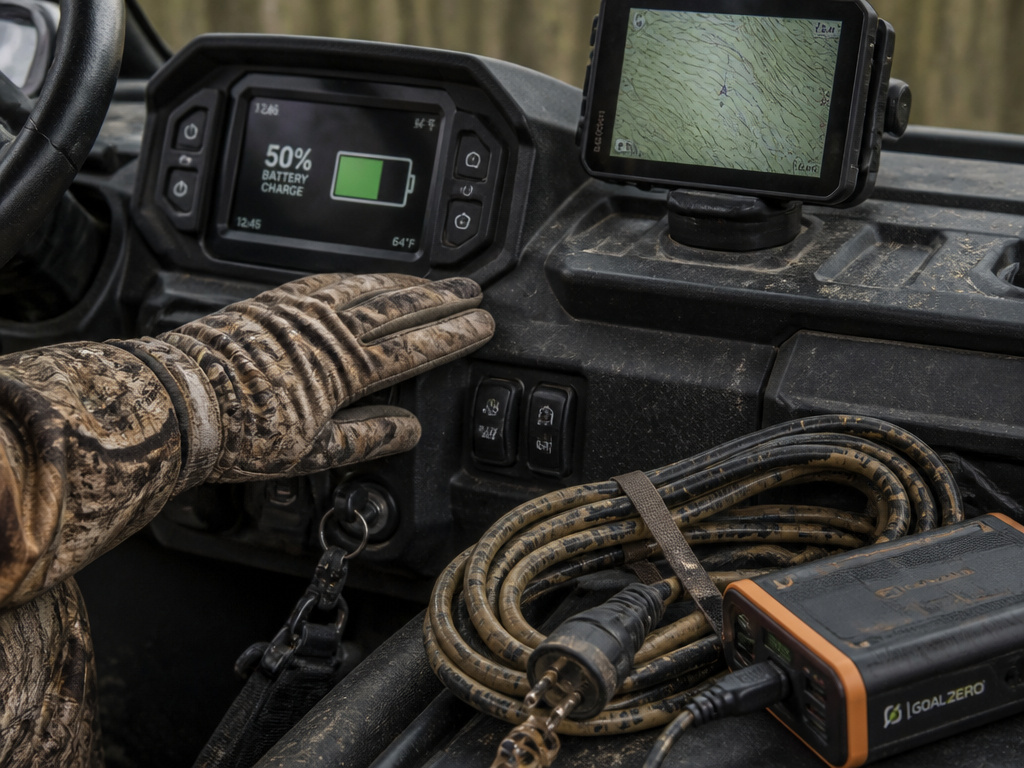
Electric UTVs are entering the conversation. Their near-silent operation is a massive advantage for hunting. The trade-off is range, recharge time in the field, and towing capacity. Current electric work UTVs are fantastic for short-range, predefined tasks on a property. For a multi-day, deep-woods hunt where you might cover 50 miles a day, the charging logistics are still a significant hurdle. They’re a compelling future option, not quite the universal present one.
Used vs. New. A used utility UTV from a reputable brand can be an outstanding value. These machines are built for hard work, and a well-maintained 5-year-old Ranger will still have years of service left. The advantage of new is the latest features (like better noise dampening, improved locking diffs), a full warranty, and knowing the exact maintenance history. Your budget decides this one, but inspect any used machine for frame rust, CV boot tears, and engine hours like you would a used truck.
Frequently Asked Questions
What is the most reliable UTV brand for hunting?
There’s no single most reliable brand; models and model years vary. Honda and Kawasaki have historically built reputations for bulletproof mechanicals. Polaris and Can-Am offer more features and models, which can introduce more potential complexity. The most reliable UTV for you is the specific model that has a proven service record for your desired engine size, is maintained meticulously, and isn’t ridden beyond its design limits.
Is a UTV or an ATV better for hunting?
UTV (side-by-side) is almost always better for hunting if you carry a passenger or significant gear. It offers protected seating, a dedicated cargo bed, and often more stability. An ATV is better for a solo hunter on extremely tight, narrow trails where the smaller physical size is a legal requirement. The ATV and UTV comparison ultimately comes down to passenger needs and trail width.
How important is a dump bed on a hunting UTV?
It’s critical if you haul anything dense: gravel for road maintenance, corn for baiting, or a harvested animal. Lifting hundreds of pounds over the side of a fixed bed is a great way to injure your back. The dump mechanism is a simple hydraulic cylinder that saves your body and your time.
Can a sport UTV like a RZR be used for hunting?
It can, but poorly. You sacrifice virtually all practical cargo space and most of your payload capacity for suspension performance. You’ll be forced to tow a trailer for any serious gear, negating the agility advantage. It’s a compromised choice unless your “hunting” is simply accessing a remote cabin on fast, smooth trails.
What’s the first accessory I should buy?
Winch**. Not for you, for the guy you’re hunting with who will inevitably get stuck. After that, a quality UTV cover to protect your investment from weather, followed by a good GPS for trail riding to mark stands and blood trails.
The Bottom Line
Stop looking for the “best” UTV. Start matching specs to your land. Map your tightest trail width. Weigh your typical gear load. Listen to the engine note on a test drive at 15 mph.
The winner is the machine you don’t notice. The one that doesn’t scare the deer, doesn’t hang up on the creek bank, and has room for your dog and your elk quarter. For most, that’s a mid-size utility model like a Polaris Ranger Crew or Can-Am Defender HD7, fitted with a winch, good tires, and a layer of mud from honest use. Everything else is just a ride.
