
What Is a Hoverboard? How the Self-Balancing Scooter Works
This post contains affiliate links. As an Amazon Associate, we earn from qualifying purchases.
A hoverboard is a two-wheeled, self-balancing electric scooter. You control speed by leaning forward or backward and steer by twisting your feet. It works through a network of gyroscopes, accelerometers, and pressure sensors that feed data to a central processor, which instantly adjusts two independent motors to keep the platform level under the rider.
That self-balancing act is the whole game. It’s not magic; it’s a fast, continuous correction loop running on cheap, mass-produced electronics. The name “hoverboard” is a marketing misnomer, these devices roll on solid rubber tires, they don’t levitate. Early models from 2014-2015 earned a dangerous reputation for battery fires, leading to massive recalls and the creation of the UL 2272 safety standard. Modern, certified boards are far safer, but the core balancing technology remains a clever application of control theory.
What follows is a breakdown of the gyroscopes and motors that make it possible, the lithium-ion battery that powers it all, and the specific safety certifications that separate a reliable ride from a potential hazard. By the end, you’ll be able to read a spec sheet and know exactly what you’re getting into.
Key Takeaways
- The balancing system relies on a gyroscope and accelerometer feeding data into a PID control loop that adjusts the motors hundreds of times per second.
- UL 2272 certification is non-negotiable for safety; it rigorously tests the battery and electrical system against fires, drops, and water.
- Early hoverboards (pre-2016) were prone to catastrophic battery fires, leading to over 1.1 million units recalled in the US alone, including fatal incidents.
- A board’s 36V lithium-ion battery pack contains 20-24 individual cells; improper chemistry or manufacturing in any one can cause thermal runaway.
- Even a degraded hoverboard that can’t support a rider has value; its motors and control boards can be repurposed for robotics projects, as documented in engineering studies.
The Core Components: What’s Actually Inside?
Open up any hoverboard and you’ll find a compact, interconnected system. It’s not just a battery and two motors. The magic, and the risk, is in how these parts talk to each other.
First, the foot pads. These aren’t simple platforms. Each pad has two pressure sensors, making four total. When you step on, these sensors tell the main board a rider is present and ready. They also detect the subtle shift in pressure when you twist your feet to turn.
Beneath the pads sits the control board, the device’s brain. This board receives constant data from the inertial measurement unit (IMU), which houses the gyroscope and accelerometer. The gyroscope measures rotational tilt, while the accelerometer measures linear movement. Together, they tell the board exactly how the platform is oriented in space, hundreds of times per second.
The board’s processor runs a Proportional-Integral-Derivative (PID) control algorithm. This is the same math used to stabilize drones and cruise missiles. It calculates the difference between the desired upright position and the current tilted position, then determines how much power to send to each motor to correct it. This happens in a continuous, invisible loop.
Finally, the two 350-watt hub motors in each wheel execute the commands. They are independent, allowing for the tight, zero-degree turning radius some models boast. Everything is powered by a 36V lithium-ion battery pack, typically with a 4300 mAh capacity like the one in the Sharper Image Model 207208.
The Sharper Image Model 207208 uses a 36V, 4300 mAh lithium-ion battery, two 350W motors, and specifies a strict charging temperature range of 50°F to 77°F for safety and battery longevity.
How Does a Hoverboard Actually Balance?
The balancing act feels intuitive, but the mechanics are precise. When you step onto a powered-on board, the sensors activate and the PID control loop begins.
Think of it as a high-speed negotiation between your body and the machine. You lean forward. The gyroscope and accelerometer instantly detect this forward pitch. The PID algorithm processes this error signal. It calculates that the front of the board is dipping and needs to be raised. To raise the front, the motors must spin the wheels forward. So, it commands the motors to drive forward, moving the wheels under your center of gravity until the platform is level again.
The process for leaning back is the reverse. For turning, the system reads the differential pressure on the four footpad sensors. More pressure on the right side of the left pad tells the board you want to turn left. It then slows the left wheel relative to the right wheel, causing the board to pivot.
Where this goes sideways: Leaning too aggressively on an incline. The motors have a maximum torque, usually rated for a 15° climb. Exceed that on a hill, and the motors can’t provide enough corrective force. The board stops balancing, the platform dips, and you fall forward. It’s not a software error; it’s a physical power limit.
This entire stabilization system can’t guarantee lateral (side-to-side) stability during turns. The manual for the Sharper Image Model 204257 explicitly states this. You must actively shift your weight to counter centrifugal force. The machine manages front-back balance; you manage the lean in a turn.
The Power Source and Its Checkered History
The hoverboard is powered by a rechargeable lithium-ion battery pack. According to UL’s press kit, a typical pack contains 20 or 24 individual lithium-ion cells. These cells store a lot of energy in a compact space, but the chemical paste inside is highly flammable.
This design led to a notorious safety crisis. Volume manufacturing began in China around 2014. By late 2015, the U.S. Consumer Product Safety Commission (CPSC) had launched an investigation after reports of units overheating, sparking, and catching fire. They ultimately linked the fires to poorly manufactured battery packs and charging systems.
The timeline is stark: * July 2016: The CPSC recalled over 500,000 units from eight manufacturers. * March 2017: A hoverboard fire in Harrisburg caused a fatal house fire. * April 2022: A fire in Hellertown, Pennsylvania, killed two sisters; the board was later recalled in March 2023. * Total Recalls: By 2016, 23 official recalls had affected approximately 1,115,200 units.
The problem wasn’t the lithium-ion chemistry itself, but its execution. Cheap cells, lacking internal protective circuits, could short-circuit. If the thin plastic separator between the positive and negative chemistries was punctured or flawed, the resulting reaction could heat up so rapidly it caused thermal runaway, an uncontrollable chain reaction ending in fire or explosion.
| Battery Safety Failure Mode | Cause | UL 2272 Test Designed to Catch It |
|---|---|---|
| Internal Short Circuit | Flawed separator inside cell | Blunt Nail Test – punctures separator to simulate failure |
| Cell Venting / Explosion | Overheating causes pressure build-up | Projectile Test – heats cell inside a wire screen |
| External Damage | Board is dropped, cracking casing | Drop Test – evaluates integrity after impact |
| Water Ingress | Riding through puddles or rain | Submersion Test – checks circuitry after water exposure |
Modern, certified boards use higher-quality battery management systems (BMS) that monitor cell voltage and temperature, cutting power if anything is out of spec. This is why certification is critical.
The Critical Role of Certification: UL 2272
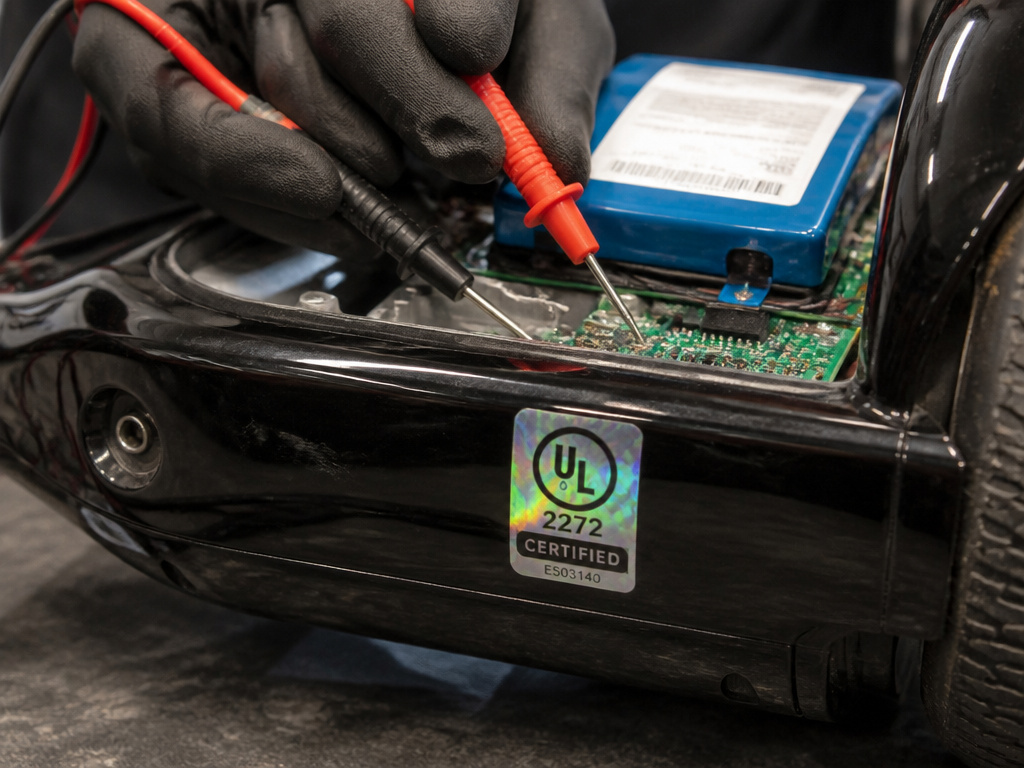 After the fire epidemic, the industry needed a enforceable safety benchmark. Underwriters Laboratories created UL 2272, the “Standard for Electrical Systems for Self-Balancing Scooters.”
This certification is not about performance or durability. It is a fire and electrical safety standard. A UL 2272 certification mark means the product’s complete electrical drive train, battery, charger, motor controllers, and wiring, has survived a brutal test regimen.
The tests are physical and deliberate. The Locked Rotor Test, for example, jams the motors to simulate a stick caught in the wheel. The system must safely shut down without overheating. The Blunt Nail Test forcibly shorts a single battery cell to see if it explodes or if its internal protections contain the failure.
UL 2272 covers the electrical drive train system, including the battery, charger system and electrical wiring. The standards do not evaluate the performance or reliability of these devices due to human error.
When shopping for best hoverboards, the UL mark is the first thing to verify. It’s usually a holographic sticker on the board itself. This certification is why major retailers now refuse to stock uncertified models. It transformed the market from a wild west of flammable gadgets into a consumer product with defined safety rules.
Hoverboard Types and Capabilities
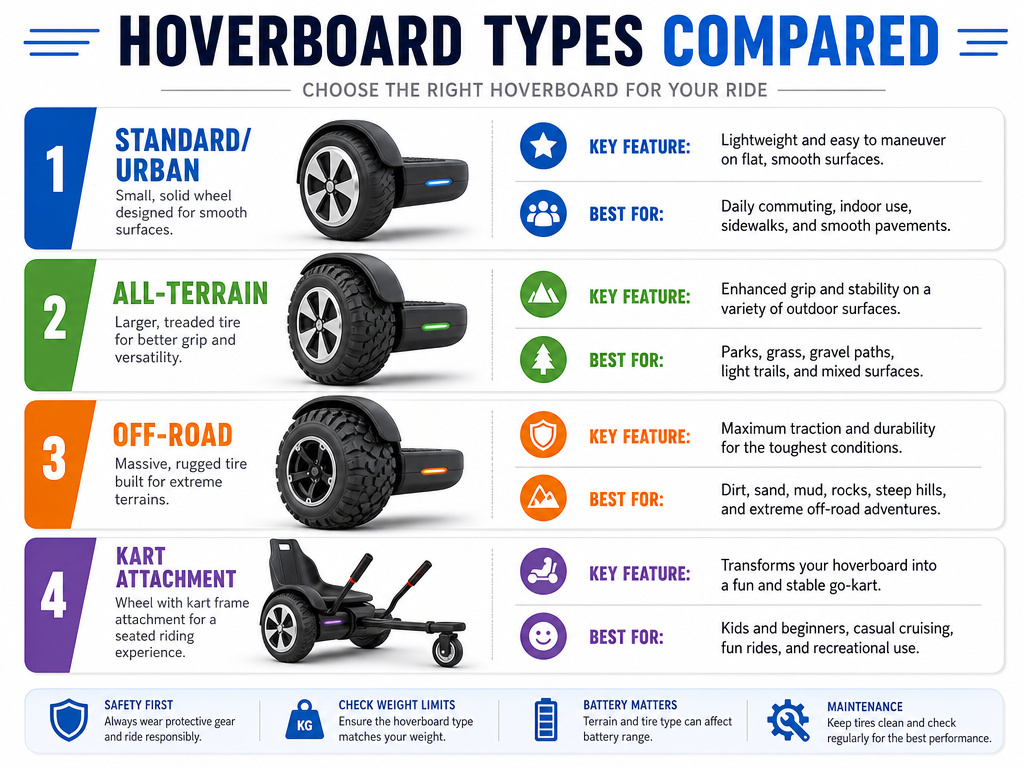 Not all hoverboards are built for the sidewalk. Capabilities diverge based on wheel size, motor power, and battery design.
The most common type is the standard urban model with 6.5-inch solid rubber tires. It’s built for smooth pavement, has a top speed around 6-7 mph, and a range of 6-12 miles. These are typical hoverboards for kids or casual riders.
For rougher surfaces, you move into all-terrain hoverboards. These feature larger 8.5-inch or 10-inch air-filled tires with tread patterns. The increased ground clearance and traction handle grass, gravel, and dirt paths. They are the obvious choice for all-terrain hoverboards meant for park or trail use.
Off-road models take it further, with even more powerful motors (500W+ each) and ruggedized frames. They can tackle steeper inclines and more demanding terrain, blurring the line with other utility electric vehicles like utility ATVs.
There are also specialized models. Some hoverboards for adults prioritize higher weight limits (up to 220 lbs) and longer range. Others integrate Bluetooth speakers or app connectivity for metrics, a feature explored in Springer automatic balance modeling research on IoT integration.
| Hoverboard Type | Key Feature | Best For | Limitation |
|---|---|---|---|
| Standard / Urban | 6.5″ solid tires, ~350W motors | Smooth pavement, beginners | Rough terrain, grass |
| All-Terrain | 8.5″+ air-filled tires, tread | Parks, packed dirt, gravel | Maximum speed is often lower |
| Off-Road | 10″ tires, 500W+ motors, robust frame | Hills, uneven ground, trails | Heavier, more expensive |
| Kart Attachment | Compatibility with seated kart frame | Recreational racing, longer rides | Requires separate purchase |
Your choice should mirror where you’ll actually ride. Buying a powerful off-road board for indoor use is overkill, just as using a standard model on wet grass is a quick way to stall and fall.
A Second Life: Repurposing Old or Broken Boards
A hoverboard that no longer holds a charge for a full ride isn’t necessarily trash. Its core components, especially the matched pair of motors with integrated drivers and the gyro/accelerometer board, are a treasure trove for DIY robotics.
This isn’t speculation. A PMC reverse engineering study detailed the process. Researchers found that even a degraded battery, which could no longer support an 80 kg rider, still had enough capacity to power a lightweight robotic platform. The study’s focus was creating a stabilized, modular base for applications like transporting supplies.
The hard part is reverse-engineering the motor driver boards. They need to be flashed with new firmware to accept commands from an external microcontroller like an ESP32 or Arduino, bypassing the original footpad sensors. Once that’s done, you have a ready-made, self-balancing mobile platform. It’s a complex project, but it demonstrates the underlying value of the technology beyond its original consumer purpose.
This tinkering potential connects the hoverboard to a broader world of enthusiast modification, similar to the culture around throttle e-bikes or custom bicycle repair stands projects.
Frequently Asked Questions
Are hoverboards safe to use now?
Modern hoverboards that are UL 2272 certified are significantly safer than the uncertified models sold before 2016. The certification mandates rigorous battery and electrical system tests to prevent fires. However, they are still personal transportation devices with inherent fall risks. Always wear a helmet and protective gear, and ride in safe, open areas.
What is the difference between a hoverboard and a Segway?
The core difference is the control interface. A Segway (or its modern equivalents like Ninebot S) uses a vertical handlebar with a leaning control column. A hoverboard has no handlebar; control is entirely through foot pressure and body leaning. This makes hoverboards more compact and portable, but generally less stable for beginners. Both use similar self-balancing technology.
Can hoverboards get wet?
Most hoverboards have an IP rating for water resistance, but it’s usually low (e.g., IP54). This means they can withstand light splashes from puddles but are not waterproof. Submerging a hoverboard, riding in heavy rain, or through deep puddles can short-circuit the electronics and void the warranty. The UL 2272 submersion test checks for safety after water exposure, not for operational integrity.
How long does a hoverboard battery last?
Single charge typically provides 6 to 20 miles of range, depending on rider weight, terrain, and speed. The battery pack itself has a lifespan of 2 to 3 years under normal use, or roughly 300-500 full charge cycles, before you’ll notice a significant reduction in range. Storing it in extreme heat or cold accelerates this degradation.
Why are they called hoverboards if they don’t hover?
The name is a marketing misnomer that stuck. It was borrowed from the levitating skateboards in the “Back to the Future” films. When these self-balancing scooters exploded in popularity in 2015, the catchier name “hoverboard” was widely adopted by media and marketers, despite the lack of hovering. The more accurate term is “self-balancing scooter” or “two-wheeled personal transporter.”
Before You Go
A hoverboard is a clever piece of consumer robotics, not a sci-fi levitator. Its real genius is in the gyroscope and PID control loop that makes balancing feel effortless. Its real history is a cautionary tale about lithium-ion battery safety, now largely addressed by the UL 2272 standard.
If you’re buying one, the certification mark is non-negotiable. Decide between a standard model for pavement or an all-terrain version for parks. And remember, even when its riding days are over, the guts of a hoverboard can live on as the foundation for a robot, proof that the engineering inside is more enduring than the trend it created. For specific model recommendations, check our guides on top hoverboard models and safe hoverboards for children.
