
Choosing Between a Road Bike and a Mountain Bike Guide
This post contains affiliate links. As an Amazon Associate, we earn from qualifying purchases.
A road bike is built for speed and efficiency on paved roads, with a stiff, light frame, narrow tires, and a geometry that puts you in an aerodynamic position. A mountain bike is built for control and traction on rough terrain, with a durable frame, wide tires with aggressive tread, suspension, and a geometry that keeps you stable and upright. The choice isn’t about which is better, but which fits the ground you’ll actually ride. Get that wrong and you’ll fight the bike every mile.
That difference in purpose is not marketing. It’s stamped into every millimeter of the frame geometry, every gram of material choice, and every dollar of component spec. A road bike’s short wheelbase and steep head tube angle make it twitchy on a dirt trail. A mountain bike’s slack angles and added weight make it feel sluggish on a smooth tarmac climb. Picking the wrong one means you’re either underbiked and terrified, or overbiked and working too hard.
What follows: a breakdown of where each bike’s design actually delivers, drawn from current manufacturer specs and documented long-term tests. We’ll cover the three non-negotiable specs, the service realities behind the price tags, and the one question that decides it all.
Key Takeaways
- Road bike geometry prioritizes an aerodynamic, forward-leaning position for pavement speed, while mountain bike geometry prioritizes an upright, stable position for control on unpredictable surfaces.
- Tire clearance is the single best indicator of intended use. A road bike maxes out around 32-40mm; a mountain bike starts at 2.0 inches (50mm) and goes much wider.
- The $6,000 price gap between a Specialized S-Works Tarmac SL9 and a Canyon Ultimate CFR is largely about dealer network support and warranty service, not just component quality.
- Ignoring a bike’s intended terrain leads to immediate, measurable downsides: a road bike on roots will pinch-flat within minutes, and a mountain bike on pavement will burn through its tire tread twice as fast.
- For a single-bike solution that must handle both worlds poorly, a gravel bike or an aggressive endurance road bike is the compromise. For doing either job well, pick the specialist.
The Core Difference Is Geometry
Look at the numbers stamped on a manufacturer’s geometry chart. A road bike’s head tube angle will be between 72 and 74 degrees. A mountain bike’s will be between 64 and 68 degrees. That 6-10 degree difference is the entire story. The steeper road bike angle makes the front wheel respond instantly to steering input. It’s precise. The slacker mountain bike angle slows that response, increasing stability at speed and preventing the bars from being ripped from your hands by trail impacts.
Where this goes sideways: Putting a road bike with a 73-degree head angle on a rocky descent. The front end is too nervous, the wheelbase is too short, and you’ll either crash or walk the section. The opposite, a 65-degree mountain bike on a group road ride, leaves you fighting to hold a wheel because the steering feels vague and the bike won’t hold a tight line in a fast paceline.
The other geometric dictator is stack and reach. Road bikes have a lower stack (vertical height to the bars) and a longer reach (horizontal distance to the bars), forcing your body into a low, stretched, aerodynamic profile. Mountain bikes have a higher stack and a shorter reach, bringing the bars closer and higher for a more upright, controllable stance where you can easily shift your weight over the wheels.
| Geometry Metric | Typical Road Bike | Typical Mountain Bike | Consequence of Swapping |
|---|---|---|---|
| Head Tube Angle | 72° – 74° (steep) | 64° – 68° (slack) | Road: twitchy/unstable off-road. MTB: sluggish/unresponsive on-road. |
| Wheelbase | ~990mm – 1010mm (short) | ~1150mm – 1250mm (long) | Road: less stable at speed on rough ground. MTB: harder to maneuver in tight corners on pavement. |
| Stack | Low (500mm – 600mm) | High (600mm – 650mm+) | Road: aggressive, aero torso position. MTB: upright, control-focused position. |
| Tire Clearance | 28mm – 40mm | 2.0″ (50mm) – 2.6″ (65mm)+ | Road: limited traction/compliance off-road. MTB: high rolling resistance on pavement. |
This isn’t a suggestion. It’s physics. A bike designed around one set of numbers will fight you if you ask it to perform in the other’s environment.
Suspension: Road Plush vs MTB Plunge
Road bikes and mountain bikes manage bumps in fundamentally different ways. A road bike uses frame material compliance and sometimes minimal front-end suspension to filter out high-frequency vibrations from chip-seal or cracked pavement. A mountain bike uses actual suspension forks and rear shocks with inches of travel to absorb large impacts from rocks, roots, and drops.
The Specialized Roubaix SL8 with its Future Shock 3.0 is the peak of road suspension. It offers 20mm of stiction-free travel at the stem to keep your hands steady while the rigid rear triangle maintains pedaling efficiency. Specialized’s own data claims it reduces impacts at the bars and saddle by 53% versus the nearest competitor. This is for pavement irregularities.
A mountain bike like the Cannondale Moterra LT has 170mm of front travel and 165mm in the rear. This isn’t for vibration, it’s for swallowing whole rocks and allowing the wheels to track the ground independently of the frame. The bike’s Bosch Performance Line CX motor helps you pedal back up after using all that travel on the descent. The systems are not interchangeable. Put a Roubaix on a mountain bike trail and the Future Shock will bottom out violently. Put a Moterra on the road and its suspension will bob with every pedal stroke, wasting energy.
The compliance in a frame like the Cannondale Synapse’s SAVE system works by letting the rear triangle flex vertically. It’s engineered to smooth out a washboard country lane, not a rock garden. The distinction matters when you’re miles from home.
The Component Divide: From Tires to Gearing
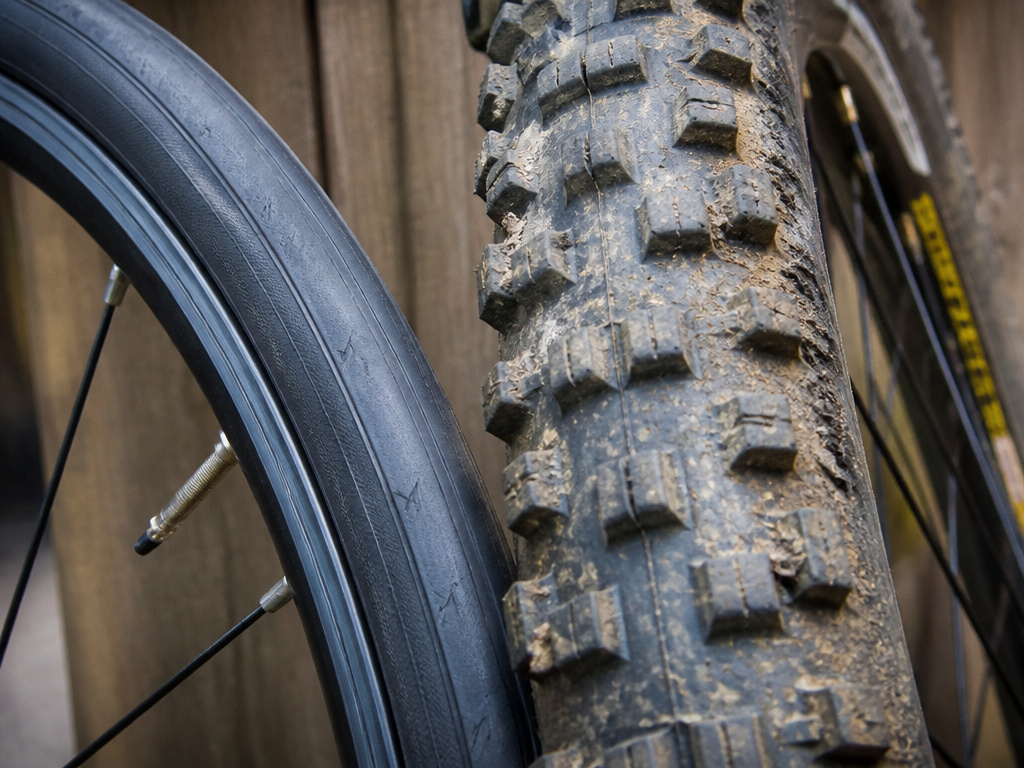
Every component, from the ground up, is chosen for the task. This is where the “why” becomes concrete.
Tires and Wheels
Road bike tires are narrow (25mm-32mm), smooth, and inflated to high pressures (80-100 PSI) to minimize rolling resistance. Mountain bike tires are wide (2.2″-2.6″), knobby, and run low pressures (20-35 PSI) to conform to the ground and provide traction. Using a mountain bike tire on pavement sounds like a swarm of angry bees and will wear the knobs flat within a few hundred miles. Using a road tire on a mountain bike trail guarantees a pinch flat or a sliced sidewall on the first sharp rock.
Gearing
Road bike gearing is tall, designed for maintaining high speeds on flats and climbing paved gradients. A typical setup is a 50/34T chainring with an 11-34T cassette. Mountain bike gearing is low, designed for crawling up steep, technical pitches. A common setup is a 32T or 34T single chainring with a massive 10-52T cassette. You simply cannot climb a 20% dirt hill on a road bike’s gearing, you’ll stall. You’ll also spin out on a flat road on a mountain bike, pedaling furiously just to keep up with casual riders.
Brakes
Both now use hydraulic disc brakes, but the demands differ. Road brakes need consistent power for long descents with occasional hard stops. Mountain bike brakes need immense, modular power and heat dissipation for repeated, aggressive slowing on steep, rough descents. A mountain bike brake set is overkill on the road; a road bike brake set can overheat and fade quickly on a mountain descent.
The Real Cost: Purchase Price vs. Ownership Cost

The price tag is only the first number. The ongoing costs and service realities diverge sharply.
The $6,000 Warranty Gap
Look at the Specialized S-Works Tarmac SL9 ($14,000) and the Canyon Ultimate CFR ($8,000). The Canyon has a comparable spec, a T47 bottom bracket, and a UDH hanger. The $6,000 difference isn’t all profit; a large portion pays for Specialized’s global dealer network. If your Tarmac frame cracks, you walk into a local shop and they handle the warranty. If your Canyon frame cracks, you package it, ship it, and wait. For some, that safety net is worth the premium. For others, the direct-to-consumer savings fund better wheels or a season of racing.
Maintenance Intensity
Mountain bikes cost more to maintain. The suspension requires regular fork and shock service (often every 50-100 riding hours). The drivetrain gets coated in abrasive mud and grit, wearing out chains and cassettes faster. The tires are more expensive and wear quicker if you ride pavement to the trailhead. A road bike’s maintenance is largely cleaning, lubrication, and the occasional tire rotation-like replacement of consumables like brake pads and chains, which wear slower in a clean environment.
The Used-Bike Caveat: The Shimano Recall
If you’re buying a used road bike with 11-speed Shimano Dura-Ace or Ultegra, you must check for the Shimano Hollowtech crank recall for models produced before July 2019 (FC-9000, FC-R9100, FC-6800, FC-R8000). A bonding separation issue can lead to sudden failure. A reputable seller will have had it inspected at a dealer. This is a non-negotiable safety check that many private sellers overlook, turning a bargain into a hazard.
Road Bike vs Mountain Bike: Which Is Right For You?
This is the only question that matters. Answer it by looking at your tires 90% of the time.
Choose a Road Bike If:
- Your riding is 90%+ on paved roads, bike paths, or smooth gravel.
- You prioritize speed, distance, and efficiency over comfort on rough ground.
- You participate in group rides, sportives, or want to train for speed.
- You have a secure place to store a lightweight, high-value bike.
- The default pick: For most tarmac-focused riders, an endurance road bike like the Cannondale Synapse or Specialized Roubaix SL8 offers the best blend of speed and comfort. The Synapse’s integrated SmartSense radar is a genuine safety upgrade for solo road riders.
Choose a Mountain Bike If:
- Your riding is on singletrack, fire roads, rocky paths, or any unpaved, technical terrain.
- You prioritize control, traction, and fun over outright speed.
- You enjoy technical challenges, jumps, or exploring off the beaten path.
- You need a bike that can handle being knocked around and dirty.
- The default pick: For a versatile trail bike, a full-suspension mountain bike with 120-150mm of travel, like many Trek Fuel EX or Specialized Stumpjumper models, handles most trails. For dedicated downhill or enduro, you’d look at bikes like the Cannondale Moterra LT.
The Compromise Zone:
If your riding is truly 50/50, neither specialist will feel right. This is the territory of gravel bikes (drop-bar bikes with MTB-like tire clearance) or aggressive flat-bar hybrids. Know that a compromise bike will be slower on the road than a road bike and less capable on the trail than a mountain bike. It does both adequately, neither excellently.
Frequently Asked Questions
Can I put mountain bike tires on a road bike?
No. The frame and fork lack the clearance. Even if you physically forced a 2.0-inch tire into a road frame designed for 32mm tires, the tire would rub the frame under any load or cornering, causing immediate damage. The brake calipers wouldn’t clear it either.
Is a mountain bike much slower than a road bike?
On pavement, yes, significantly. The knobby tires create enormous rolling resistance, the upright posture creates wind drag, and the suspension saps pedaling energy. A fit rider on a mountain bike might average 14-16 mph on a road ride. The same rider on a road bike could easily average 18-22 mph with less effort.
Can a road bike handle light gravel or dirt paths?
It depends on the road bike. An endurance road bike like the Specialized Roubaix SL8 with 38mm tire clearance can handle packed gravel and smooth dirt roads competently. A pure race bike with 25mm tires and no compliance will be harsh and risky. The limiting factors are tire width and frame comfort, not strength.
Do I need suspension on a mountain bike?
For smooth dirt paths, a rigid or hardtail (front suspension only) mountain bike is fine. For rocky, rooty, or technical trails, full suspension is not a luxury, it’s what allows you to maintain control, traction, and speed while keeping the bike intact and your body less fatigued.
Which is better for exercise?
Both provide excellent exercise but in different ways. Road biking tends toward sustained, steady cardiovascular effort. Mountain biking provides intense bursts of power coupled with technical skill, engaging more core and upper body muscles. You’ll get fit on either; the mountain bike might feel more like play.
Before You Go
The choice between a road bike and a mountain bike is a choice between two different sports. One is about the pure, efficient translation of effort into forward motion on a smooth surface. The other is about the managed chaos of navigating unpredictable terrain. Your local trails, paved or unpaved, dictate the answer more than any review can. Invest in the tool that matches the job 90% of the time, and accept that it will be the wrong tool for the other 10%. That’s why many enthusiasts end up with one of each.
