
The Correct Way: How to Lock an Electric Scooter Properly
This post contains affiliate links. As an Amazon Associate, we earn from qualifying purchases.
To lock an electric scooter properly, you must secure its frame to a permanent fixture using a short-shackle, hardened steel lock. The scooter’s stem or a dedicated latch point is the target; the front wheel or fender is a guaranteed loss. A Kryptonite New York Mini U-lock is the benchmark. Pair this with the scooter’s electronic lock, and never leave it outside in temperatures below 14°F (-10°C) where both battery and lock metal become brittle.
The frame-first rule concerns physics, not just theft. A scooter differs from a bicycle.Its wheels, fenders, and sometimes even its handlebars are designed for quick release or are made of plastic that snaps under leverage. Lock the wrong part, and you’ve donated a $800 machine for the price of a $15 hex key set.
What follows is the method that works on a Segway ES1, an Apollo City, or a generic commuter model. We’ll break down the four non-negotiable steps, explain why your lock’s shackle length matters more than its brand, and show you how to read your own scooter’s frame like a mechanic would. By the end, you’ll know the one spot to avoid every single time.
Key Takeaways
- Lock the frame, never just a wheel. Front wheels often have quick-release levers; rear wheels can be unbolted in seconds. The frame is the only non-removable structure.
- Use the shortest lock shackle that fits. A Kryptonite New York Mini gives thieves almost no room to insert a jack or cutter. A long, loose chain is an invitation.
- Integrate electronic and physical security. Always engage your scooter’s app-based lock or key lock. It won’t stop a thief from carrying it away, but it turns a quick grab into a complicated, noisy ordeal.
- Temperature changes everything. Store a scooter outside in winter, and the lock’s hardened steel can become more brittle. Below 14°F (-10°C), the plastic fenders and trim also snap easily.
- The deck latch is a hidden asset. Models like the Apollo City 2022 have a reinforced handle at the rear designed as a locking point. It’s the strongest spot you’re not using.
Why a Scooter Isn’t a Bike (And Your Lock Knows It)
You can’t use bicycle logic on an electric scooter. The weight distribution, the material choices, and the construction priorities are different. A bike thief needs bolt cutters. A scooter thief often just needs a screwdriver.
Where this goes sideways: Locking through a plastic fender or a quick-release front fork. The fender cracks with one firm pull. The fork drops out with a lever flip. Your locked scooter is now two separate pieces, and the expensive half is gone.
Scooter frames are built for portability and weight savings, not for resisting shear force. Aluminum alloys are common, but the joints, where the stem meets the deck, are stress points. A good lock anchors between two immovable objects, so the force is on the lock’s shackle, not your scooter’s welds. Pick the wrong anchor point on the scooter, and you turn that joint into the failure point.
The manual for the Segway KickScooter ES1 series warns that modifications or using non-approved parts can void the warranty and cause failure. Forcing a lock around a thin tube not meant for it is a modification. The stress can crack paint, weaken aluminum, and lead to a stem failure at 15 mph. That’s a hospital visit, not just a theft.
The 4-Step Locking Method (Frame First)
This is a sequence, not a list of options. Skip a step, and you create the exact opportunity a thief looks for.
Step 1: Identify Your Scooter’s “Bone Structure”
Get on the ground. Look at your scooter from below. You’re searching for a closed loop of metal that is structurally part of the main chassis. On most scooters, this is the gap where the stem connects to the deck. On models like the Apollo City 2022, it’s the solid steel deck latch at the rear.
What happens if you skip this: You lock through a removable bolt-on component. The thief removes four bolts, leaves your lock attached to a $30 wheel, and walks off with the $700 rest of the machine. This takes 90 seconds.
Step 2: Choose the Lock That Fits That Space (Exactly)
Measure the gap inside your target frame loop. Now subtract an inch. That’s the maximum internal shackle length you should buy. A lock that fits snugly, like the Kryptonite New York Mini, gives attackers no room to insert a hydraulic jack, the primary tool for popping U-locks.
| Lock Type | Best For | The Compromise |
|---|---|---|
| Short U-Lock | Daily commuting, known secure racks | Limited flexibility; must fit your exact spot. |
| Folding Lock | Riders needing portability & security | More moving parts that can fail with dirt & rust. |
| Heavy Chain | Maximum flexibility for odd anchors | Weight; a thick, secure chain weighs over 5 lbs. |
A U-lock’s shackle should be made of hardened performance steel, at least 13mm thick. The Kryptonite New York Standard uses a 14mm shackle, that extra millimeter doubles the time needed for a battery-powered angle grinder.
Step 3: Anchor to Immovable, Not Just Convenient
The bike rack is your first choice. A permanent signpost cemented into the ground is second. Avoid wooden fences, thin metal railings, and anything that can be cut or unbolted faster than your lock. Give the object a solid shake. If it moves, find another.
The one question to ask: “Can a person lift this object over the top of what it’s attached to?” If yes, like with some parking meter posts, your scooter can be lifted off. This happens more than you think.
Step 4: Engage Electronic Security Every Single Time
Turn on your scooter’s electronic lock via the key, fob, or app. This activates the motor lock and alarm on most modern scooters. It turns a simple grab-and-go into a loud, wheel-dragging struggle. It’s not a primary defense, but it’s a critical layer.
Common mistake: Relying solely on the electronic lock. The manual for a common M2 scooter states its app lock “can only ensure that the vehicle cannot run normally.” It admits the lightweight vehicle can be removed with tools. Physical security is non-negotiable.
What Not to Lock (The Quick-Detach Trap)

Your scooter has built-in theft assists. Knowing them is half the battle.
| Part to AVOID | Why It Fails | Time to Defeat |
|---|---|---|
| Front Wheel/Fork | Often uses a quick-release lever. | 2–5 seconds |
| Rear Fender | Almost always plastic; snaps or unbolts. | 10 seconds (with hands) |
| Handlebars | Collapsible stem mechanism or simple bolts. | 30 seconds (hex key) |
| Kickstand | Thin, bolted-on metal; bends easily. | 15 seconds (lever) |
The front wheel is the most deceptive. It looks solid. It’s also the easiest part to remove on many models for transport or tire changes. A thief practices this move. You won’t even see them bend down.
How Temperature and Environment Weaken Your Setup
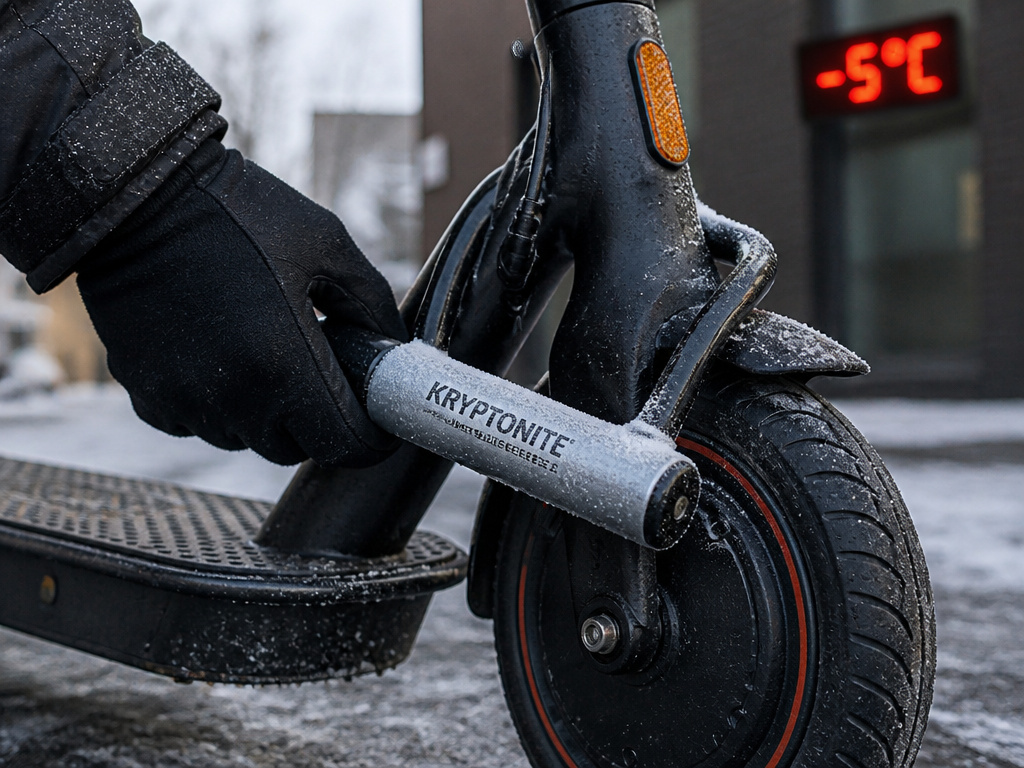
Security isn’t static. The same lock that holds up in a 70°F garage behaves differently in a Chicago winter or a Phoenix summer.
The Segway ES1 manual specifies an operating temperature range of 14–104°F (-10–40°C). Riding outside that range limits performance. More critically, storing or locking a scooter outside accelerates aging. Plastic components become brittle in the cold. In extreme heat, adhesives in grip tape and rubber seals can soften.
Worth knowing before you start: Using a battery at temperatures below 32°F (0°C) can cut its range in half. At -4°F (-20°C), the range can be just 50% of normal. A thief isn’t riding it away, but your battery’s health pays the price for outdoor storage.
Your lock is also vulnerable. Hardened steel is strong but can become more brittle in sustained sub-freezing cold, making it slightly more susceptible to sharp, percussive blows. This is why winter storage for your scooter involves bringing it inside, not just covering it.
Lock Types Decoded: U-Lock vs. Chain vs. Folding
You need one primary lock. The choice defines your daily routine.
- U-Locks (D-Locks) are the gold standard for security. The Kryptonite New York series is the benchmark. Their short, thick shackles of hardened steel resist bolt cutters and grinders longer than anything else. The downside is portability and inflexibility. They only secure to larger-diameter posts.
- Folding Locks offer the best balance. Brands like ABUS make robust folding locks that are easier to carry on a scooter’s frame or in a backpack. They provide good security against hand tools, though the pivoting joints are potential weak points for sustained attacks.
- Chain Locks mean weight for flexibility. A true, high-security chain, like those paired with a Squire padlock, is immensely versatile. You can lock to almost anything. But a chain tough enough to resist bolt cutters (16mm links or thicker) weighs a ton. It’s for secure home storage, not a daily commute.
For the daily rider, the decision often comes down to a mini U-lock or a high-end folding lock. Review the specific lock models and best locks to see which fits your specific scooter’s frame geometry.
Cable locks are not a primary lock. They are a secondary deterrent, easily cut with handheld snippers. Use one only to secure a helmet or as an extra visual obstacle alongside a real lock.
Integrating Security into Your Ride Routine
Good habits beat perfect gear every time. Build this checklist into your stop.
- Before you leave home: Ensure your primary lock is mounted on your scooter or in your bag. Check that your safety gear, including your helmet, is ready.
- Approaching your stop: Scan for a proper anchor before you dismount. A dedicated bike rack is ideal. Avoid shady alleys or isolated spots.
- The locking sequence: Frame first, then anchor. Thread the lock through the scooter’s secure point, then around the immovable object. Pull tight to eliminate slack.
- The final tug: Physically try to lift the scooter up and away from the anchor. Try to slide the lock. If anything moves, re-seat it.
- Walk away: Engage the electronic lock. Take your essential add-ons like your display or phone mount if they’re removable.
This routine takes 45 seconds once it’s automatic. That’s 45 seconds that places your scooter in the bottom 10% of theft targets because you didn’t take the easy, wrong path.
Frequently Asked Questions
Can’t I just use the electronic lock on the app?
No. App or key locks disable the motor, but they don’t prevent physical theft. As one OEM manual plainly states, the lightweight vehicle can be “removed with corresponding tools.” The electronic lock is a critical layer, but it’s like locking your car doors without closing the windows. Always use a physical lock.
What’s the single worst place to lock a scooter?
The front wheel. It’s the fastest removable part on most models. A thief sees a lock on a front wheel and knows you’ve done half the work for them. They detach the wheel and walk off with the frame, deck, and motor. Your lock is left clipped to a useless wheel.
Are folding locks really as secure as U-locks?
For most opportunistic thefts, yes. A quality folding lock like an ABUS Bordo uses hardened steel links that resist bolt cutters. Its weakness is the riveted joints, which can be targeted with a focused grinding attack over time. For maximum security in a high-theft area, a short U-lock is still superior. For balanced daily use, a folding lock is an excellent, portable choice.
How do I lock my scooter if there’s no bike rack?
Look for solid, municipal infrastructure. A permanent signpost set in concrete, a sturdy fence post connected to a building, or a dedicated parking meter (check that the scooter can’t be lifted over the top). Never lock to private property, temporary structures, or trees, which can damage the tree and is often illegal.
Does a more expensive lock guarantee safety?
It guarantees more time. No lock is unbreakable. A $30 lock might be cut in 10 seconds with bolt cutters. A $100 Kryptonite New York lock might take 2 minutes with an angle grinder, a loud, spark-filled two minutes most thieves won’t risk in public. The goal is to make your scooter the hardest target on the rack.
The Bottom Line
Locking an electric scooter properly is a mechanical exercise. Find the frame, marry it to an immovable object with a short, stout lock, and never deviate from the sequence. The security practices for e-scooters are settled. Your scooter’s design manual and common sense point to the same spots.
Invest in one proper lock, a short U-lock or a reputable folding model. Pair it with your scooter’s built-in electronic security. This combination addresses theft protection from both the grab-and-go artist and the prepared thief. The goal is to make theft too troublesome to be worthwhile, rather than impossible.
