
Do Heated Steering Wheels Work with Steering Wheel Covers?
This post contains affiliate links. As an Amazon Associate, we earn from qualifying purchases.
Do steering wheel covers work with heated steering wheels? Yes, but most block the heat. The system requires direct, efficient heat transfer. A cover’s thickness and material conductivity decide whether you feel warmth or just insulation. Thin, conductive materials like specific Alcantara or TPE can work; thick Neoprene or silicone will cut delivered temperature by 4 to 7 degrees Celsius and delay warmth by over a minute.
That temperature drop is the measured outcome when a factory-set 38°C surface has to push through a millimeter of insulating material. The factory heating element is fighting a losing battle against physics, not a design flaw.
What follows is a breakdown of the three specs that decide compatibility: thermal conductivity, thickness, and fit. We’ll name the materials that pass the test, document the ones that fail, and explain the permanent damage a poorly chosen cover can inflict on your factory wheel.
Key Takeaways
- Material and thickness are everything. A cover’s thermal conductivity (measured in W/m·K) and its thickness in millimeters directly predict how much warmth you’ll lose. Thick Neoprene is a near-total block.
- Manufacturers explicitly warn against covers. Kia and Ford owner’s manuals state that grip covers may impair the heated steering wheel function and, for individuals with reduced pain sensation, could pose a burn risk even at low temperatures.
- Poor fit causes permanent damage. A cover that shrinks in the cold exerts constant inward pressure, which can create permanent ring-shaped indentations and wrinkles in your factory steering wheel leather.
- The right cover is ultra-thin and conductive. If you must use one, aim for an Alcantara or TPE (Thermoplastic Elastomer) cover under 1.5mm thick. These materials have the best chance of allowing usable heat transfer.
- Heat-up time is a real tell. Without a cover, you should feel warmth in 15-30 seconds. A poorly compatible cover can delay that sensation to 90 seconds or more, which is often where drivers give up and assume the heater is broken.
The Manufacturer’s Stance: A Clear Warning
Open any modern vehicle owner’s manual with this feature. The guidance is not ambiguous.
Kia’s manual for the 2027 LQ2AH model states, “Do not install any type of grip cover for the steering wheel, it may impair the function of the heated steering wheel system.” It couples this with a burn warning, noting the wheel may cause burns even at low temperatures, especially with prolonged use. The manual also specifies that the strong (2nd) heating level automatically steps down to weak after about 30 minutes, a safety feature that works less predictably with an insulating layer.
Kia Owner’s Manual (2027 LQ2AH): “Do not install any type of grip cover for the steering wheel, it may impair the function of the heated steering wheel system. The heated steering wheel may cause burns even at low temperatures, especially if used for a long time.”
This is a direct statement of cause and effect. A cover changes the thermal dynamics the system’s safety sensors are calibrated for.For individuals with conditions that reduce pain sensitivity, such as advanced age, diabetes, or spinal cord injury, this mismatch between surface temperature and felt sensation is where the risk lies. Ford’s documentation highlights this group specifically, urging caution.
The warning extends to cleaning. Kia prohibits organic solvents like paint thinner or alcohol on heated wheels, as they can damage the surface and, by extension, the underlying heating elements. The system is integrated, not just a sticker on the rim.
The Physics of Heat Transfer: Why Thickness and Material Matter
Your heated steering wheel is a 45-watt personal heater wrapped in a circle. Its job is to raise the surface temperature to a set point, often around 38°C, as quickly as possible and maintain it. A cover is a barrier in that path.
The two properties that define this barrier are thermal conductivity and thickness. Conductivity (measured in watts per meter-kelvin, W/m·K) is how readily a material moves heat. Thickness is the distance the heat must travel through that material. Together, they create thermal resistance.
Think of it like pushing water through a sponge. A thin, open-cell sponge (high conductivity) lets water through easily. A thick, dense sponge (low conductivity) soaks it up and blocks the flow. Your steering wheel heater is the water pump; your hands are waiting on the other side.
| Material | Typical Thickness | Thermal Conductivity (W/m·K) | Effect on Heat |
|---|---|---|---|
| Alcantara (Suede) | ~1.5 mm | ~0.045 | Moderate blocker. Can drop final hand temperature by 3-5°C. |
| TPE (Thermoplastic Elastomer) | ~2.0 mm | ~0.30 | Best performer for a cover. Minimal heat loss (<10%). |
| Silicone | 3.0 – 3.5 mm | 0.20 – 0.25 | Significant blocker. Thickness offsets decent conductivity, dropping heat 4-5°C. |
| Neoprene | ~4.0 mm | <0.03 | Near-total insulator. In cold tests, surface temp may barely reach 18°C. |
| Factory PU Leather | <1.0 mm | N/A | Reference point. Designed for minimal resistance. |
The numbers tell the story. Neoprene, the wetsuit material, is a fantastic insulator with conductivity below 0.03 W/m·K. At 4mm thick, it might as well be a winter glove permanently strapped to your wheel. You’ll get almost nothing.
Even a “good” material fails if it’s too thick. That’s the silicone trap. Its conductivity isn’t terrible, but market-standard covers are 3.5mm thick for durability. That thickness creates a thermal resistance of about 0.014 m²·K/W, which decays surface thermal energy by roughly 4.5°C before it reaches your skin.
And then there’s the air gap. No cover fits perfectly. A microscopic air layer between the cover and the wheel acts as another insulator. ASTM International standard D1518 notes that a still air layer just 0.5mm thick has a heat-blocking effect equal to 2.5mm of solid wood. In a system pushing 45 watts, about 12 watts can be lost just crossing this gap.
Material Breakdown: From Best to Worst for Heat Transfer
If you’re determined to use a cover, you must choose based on these physical properties. The category of “steering wheel covers” is useless. You need the sub-category of “thin, thermally conductive steering wheel covers.”
Thermoplastic Elastomer (TPE) covers are the best compromise. With a conductivity around 0.30 W/m·K, they transfer heat better than traditional rubber or silicone. At a common 2.0mm thickness, they allow the surface temperature to climb to a usable 28°C within 150 seconds in freezing conditions. The heat loss curve is gradual, keeping efficiency loss under 10%. This is the material to look for if warmth is a priority.
Thin Alcantara or suede covers can be conditionally acceptable, but you must check the specs. The Alcantara material itself has low conductivity (~0.045 W/m·K) due to its micro-pores trapping air. However, aftermarket covers marketed as “ultra-thin” (under 1.5mm) can mitigate this. The goal is to minimize the thickness of the insulating layer. A thick Alcantara cover is a decorative insulator.
Silicone and Neoprene covers are functional blockers. They are designed for grip or extreme cushioning, not thermal compatibility. As the table shows, their physical properties work directly against the heating system. You install these knowing you are sacrificing the heated wheel function entirely. Many heated steering wheel covers on the market use these materials for their grip, not their thermal performance.
Knit, wool, or faux-fur covers are absolute non-starters. They are literal winter apparel for your steering wheel. Their entire purpose is to insulate. You will feel zero heat from your wheel. These are for unheated wheels only.
Where this goes sideways: Choosing a cover for its “warm look” like knit or faux fur. These materials are thermal insulators by design. You will block 100% of the heat, and after a 30-minute commute your hands will be cold while your $500 heating element works overtime against a blanket.
The real-world test is simple. Turn on your heated wheel. If you don’t feel distinct warmth through the cover within 45 seconds, the cover has failed the compatibility test. Your system is on; the cover is just soaking up the energy.
The Hidden Risk: Permanent Damage to Your Factory Wheel
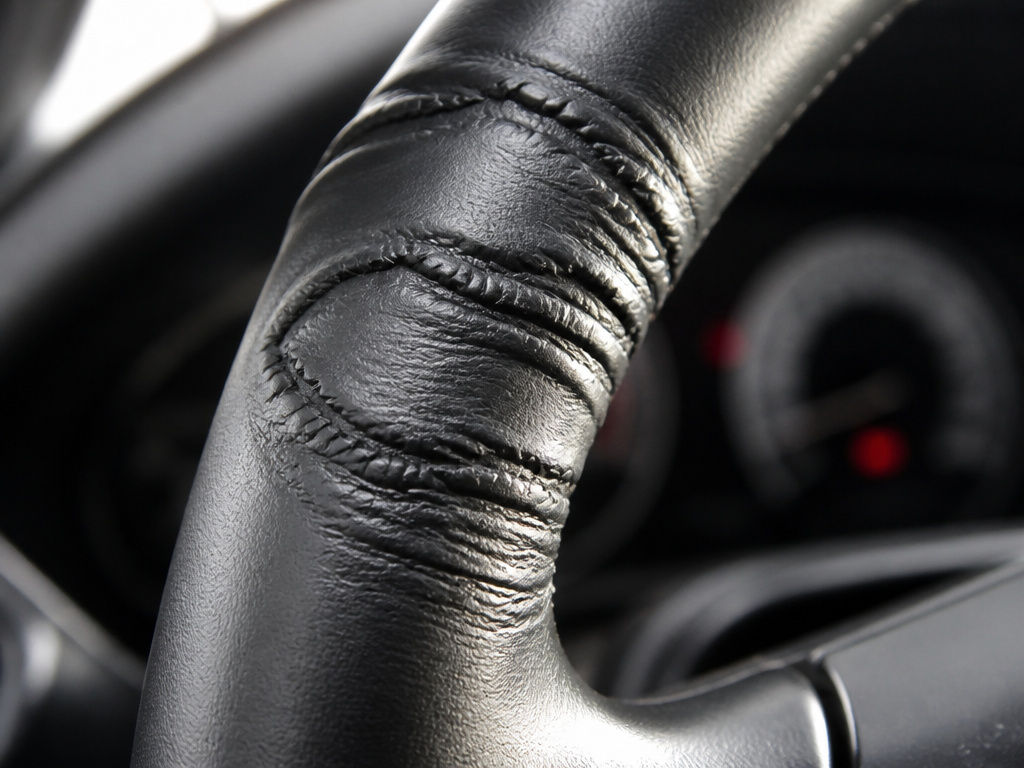 A functional mismatch is one thing. Physical damage is another. This is the part most buyers discover months later.
A steering wheel cover must fit tightly to not slip. In cold climates, materials contract. Silicone, for example, has a cold shrinkage rate up to 2.5% at -15°C. This means a 362mm diameter cover is constantly applying inward squeezing stress, around 14 Newtons of force, on your factory steering wheel rim.
Under this sustained, cyclic pressure, the factory vegan leather or polyurethane surface develops permanent indentations. When you remove the cover in the spring, you’ll find ring-shaped mechanical wrinkles etched into the wheel. These are compression scars from the cover’s grip.
Furthermore, the friction from installing and removing a tight cover, or the micro-movements during use, can wear down the steering wheel’s original finish. This is especially true for leather steering wheel covers with rough internal stitching. You traded a bit of wear for what you thought was protection, but instead accelerated the damage.
How to Choose a Cover If You Must Use One
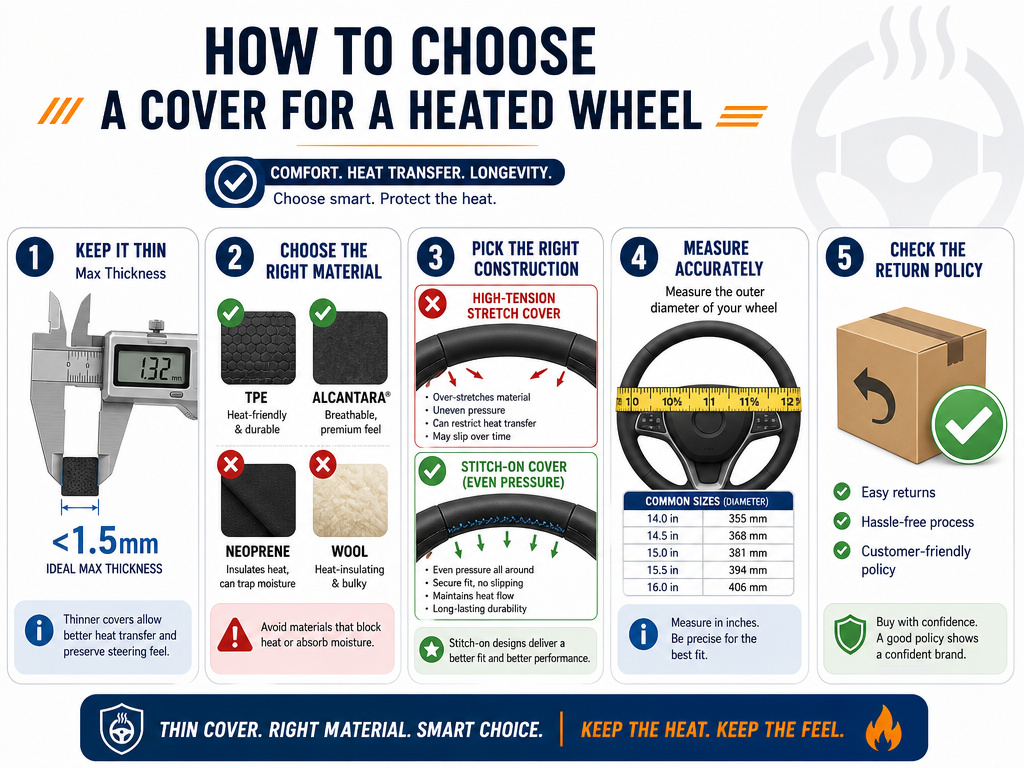 Ignore marketing that says “compatible with heated wheels.” Look for the data. Follow this checklist.
- Verify Thickness: Aim for under 2.0mm, and ideally under 1.5mm. This is often in the product specifications or Q&A. If it’s not listed, assume it’s thick.
- Identify the Material: Seek out TPE or specifically “ultra-thin Alcantara.” Actively avoid Neoprene, thick silicone, knit, and wool.
- Check the Fit Method: Avoid covers that rely on extreme tension or a silicone inner lining to grip. These are the ones that cause cold-shrink damage. A stitch-on cover, while permanent, applies more even pressure and is less likely to shrink destructively.
- Measure Your Wheel: This is non-negotiable. A cover for a 14.5″ wheel stretched onto a 15″ wheel will be under massive tension. Consult a guide on steering wheel sizes to get it right.
- Buy from a Return-Friendly Retailer: The only true test is in your car, in the cold. If the heat doesn’t come through convincingly in under a minute, return it.
Your alternative is to embrace the heated wheel as designed. Keep it clean with a damp microfiber cloth (no solvents). If the rim is wearing, consider a professional re-wrap instead of a cover, a permanent solution that doesn’t sabotage the heating system. For those seeking heat where none exists, adding a heated steering wheel via an aftermarket kit is a complex but viable project.
Frequently Asked Questions
Do any steering wheel covers work with heated steering wheels?
Yes, but the category is very small. It consists exclusively of covers made from thin, thermally conductive materials like specific TPE (Thermoplastic Elastomer) or sub-1.5mm Alcantara. The vast majority of covers, especially popular silicone, Neoprene, or knit styles, will significantly block heat transfer.
How much heat do you lose with a steering wheel cover?
The loss is quantifiable. On a system like the Tesla Model 3 Highland, a standard synthetic leather cover over 2mm thick can reduce the final temperature felt by your palms by 4°C to 7°C. A 4mm Neoprene cover can prevent the surface from even reaching 20°C in below-freezing weather, making the heating feature functionally useless.
Why do car manuals say not to use a steering wheel cover?
Manufacturers warn against covers for two primary reasons. First, they impair the designed function of the heating system, leading to driver dissatisfaction and potential warranty complaints. Second, and more critically, they disrupt the thermal safety profile. The system’s sensors and timers are calibrated for direct skin-to-wheel contact. A cover can create a scenario where the wheel core is hotter than the surface, posing a burn risk for individuals with reduced sensitivity, even if the covered surface feels only warm.
Can a steering wheel cover damage the heating elements?
Direct damage to the wiring is rare from a cover alone. The more common damage is to the steering wheel rim itself from the constant pressure of a tight-fitting cover, especially one that contracts in the cold. This can leave permanent indentations and wrinkles. However, using sharp objects or excessive force during installation could potentially puncture the wheel surface and damage the elements beneath.
Are there heated steering wheel covers you can add?
Yes. Instead of trying to pair a passive cover with your factory heater, you can install an active aftermarket heated steering wheel cover. These are wireless heated covers or 12V-powered units that have their own heating elements. They bypass the factory system entirely and are a good solution for vehicles not equipped with a heated wheel.
The Bottom Line
The engineering answer is clear. A heated steering wheel and a standard steering wheel cover are opposing concepts. One is designed to emit heat efficiently; the other is designed to provide a layer of material between you and the wheel.
If you value the comfort of your heated wheel, the best cover is no cover. Use it as the engineers intended. If you must have one for grip or aesthetics, your search is not for a “steering wheel cover” but for a “thermally conductive, sub-2mm TPE or Alcantara sheath.” Anything else is a compromise that ranges from disappointing to destructive.
Your hands will tell you the truth within the first minute of your drive. Listen to them.
