
Are There Different Steering Wheel Sizes? A Sizing Guide
This post contains affiliate links. As an Amazon Associate, we earn from qualifying purchases.
Yes, steering wheel sizes vary dramatically. Passenger cars typically use 14 to 15-inch diameters, high-performance models drop to 11.5–13 inches, and heavy-duty trucks exceed 20 inches. The exact size is an engineered balance of cabin space, steering effort, and intended use, governed by the leverage equation (Force x Distance). Federal regulation 49 CFR 393.209 even sets specific lash limits based on wheel diameter and steering type.
That leverage equation isn’t academic. It’s the physical law that decides how hard you have to pull the wheel. A one-inch increase in diameter cuts steering effort by roughly 10 percent. That’s why a semi-truck’s massive wheel feels manageable and why swapping to a tiny racing wheel makes your arms burn without power assist.
What follows: the sourced specs that prove the range, the right way to measure yours (most people get it wrong), and the single biggest mistake you can make when buying an aftermarket cover. We’ll also walk through why your 2005 Mustang has a different grip than a 2024 model and what that means for your driving experience.
Key Takeaways
- A 1/4-inch measurement error is the difference between a secure cover and one that spins dangerously in your hands during a turn.
- Steering effort changes by 10% per inch of diameter because of the leverage equation, smaller wheels are quicker but heavier to turn.
- Federal commercial vehicle rules (49 CFR 393.209) allow over 4 inches of lash (free play) in power-steering wheels under 16 inches, a tolerance unthinkable in a passenger car.
- Model generations change subtly. A 1995 Toyota Tacoma wheel is 15.5 inches across; a 2023 model is 15 3/8 inches. “Universal” 15-inch covers often fail because of this.
- The clock spring is non-negotiable. Any steering wheel swap that doesn’t preserve its alignment will kill your airbag and horn.
How Wide Is a Standard Steering Wheel, Really?
Forget a single number. The industry uses a 14 to 15-inch range as a baseline for modern passenger cars because it balances leverage with cabin space. This is the target for most aftermarket steering wheel covers sold as “universal.” Step outside that bracket, and you’re in specialized territory.
Where this goes sideways: Assuming “standard” means 15 inches exactly. A cover marketed for a 15-inch wheel is engineered to stretch between 14.5 and 15.5 inches. If your wheel is 15 5/8 inches, you’re in the “Large” category (15.5–16.5 inches). Forcing a standard cover on stretches the seams, compromises the internal grip wire, and the cover can slip rotationally under hard steering within a week.
High-performance and racing wheels dive down to 11.5 to 13 inches. The reduced diameter means less hand movement for a full lock-to-lock turn, enabling faster corrections. The trade-off is massively increased steering effort, a physical reality of the shorter lever arm. This is why most street cars with small aftermarket wheels require a power steering system in perfect health.
On the other end, heavy-duty commercial vehicles use 18 to 22-inch diameters. The longer lever arm provides the mechanical advantage needed to manage high axle weights, even with hydraulic assistance. This size difference is so critical it’s codified in federal safety regulations for allowable free play, or “lash.”
The Physics Behind the Diameter
The steering wheel is a simple lever. The leverage equation (Force x Distance) governs everything. The distance is the radius of the wheel, half the diameter. Double the distance from the center (the fulcrum), and you halve the force needed to create the same turning torque at the column.
A 1-inch increase in diameter can reduce steering effort by approximately 10%. Engineers calculate this torque-to-diameter ratio to ensure the vehicle remains drivable if the power steering fails. A modern full-size truck with a 20-inch wheel and dead power steering is just heavy. The same truck with a 15-inch wheel would be nearly immovable.
This is also why sports car designers flirt with D-shaped or flat-bottom wheels. They maintain a wide horizontal axis (say, 14 inches) for leverage on turn-in, while the flattened bottom section provides crucial thigh clearance. You get the turning advantage of a larger wheel without the ergonomic penalty.
| Vehicle Type | Typical Diameter Range | Primary Engineering Goal |
|---|---|---|
| Formula/Race Car | 11.5″ – 13″ | Minimize hand travel for speed |
| Sports Car | 13″ – 14.5″ | Balance response with cabin space |
| Passenger Car | 14″ – 15″ | Optimize comfort and leverage |
| SUV/Truck | 15″ – 16.5″ | Increase leverage for larger tires |
| Semi-Truck | 18″ – 22″ | Maximum mechanical advantage |
Are There Different Steering Wheel Sizes by Model? A Tale of Two Fords
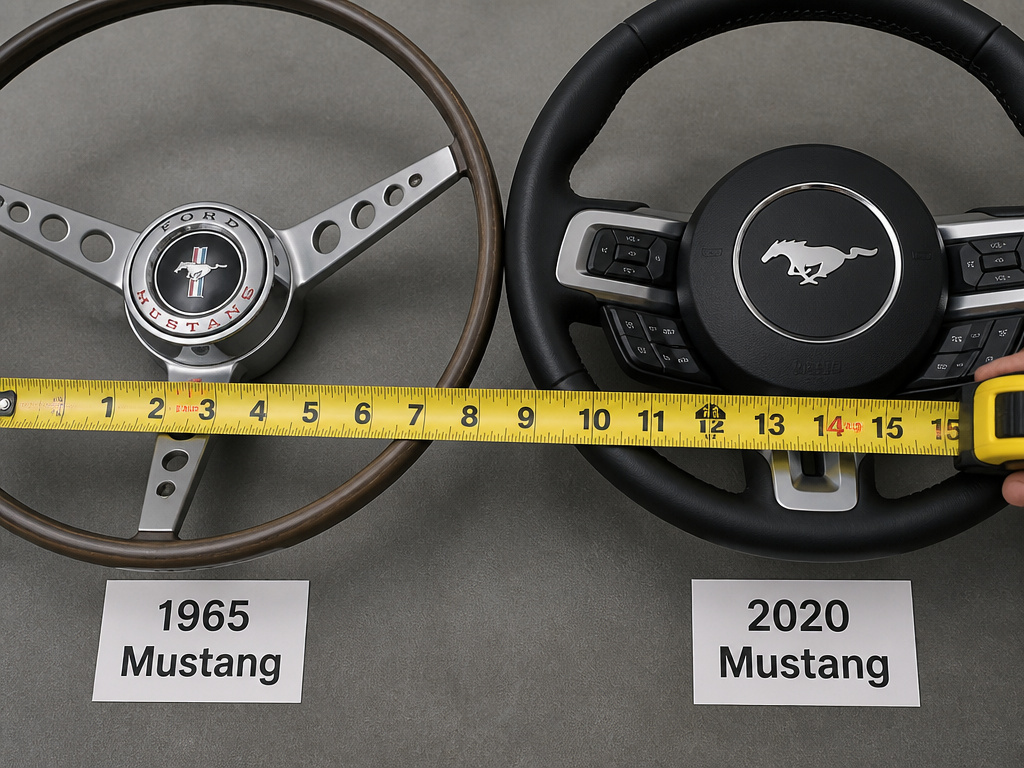
Absolutely. Sizes evolve with design trends, safety regulations, and interior packaging. Look at the Ford Mustang over six decades.
The 1965-1983 Mustang used a 15 1/2-inch wheel. By the 1994-2004 generation, it was down to a 15-inch diameter. The current S550 chassis (2015-2020) shrunk it further to 14 1/2 inches. This isn’t random. Each step reflects a move toward a sportier, more responsive feel and a design prioritizing instrument panel visibility and airbag packaging.
The Toyota Tacoma tells a similar story of refinement. The first generation (1995-2002) had a 15 1/2-inch wheel. The third generation (2016-2020) also used 15 1/2 inches, but the grip circumference grew significantly, from 3 3/4 inches to 4 5/8 inches. That’s a much thicker, more substantial feel in hand, aimed at comfort during long drives.
These generational shifts are why a guide to the best steering wheel covers will always ask for your specific make, model, and year. A “one-size-fits-most” cover for a 15-inch wheel will be loose on a 14.5-inch modern Mustang and dangerously tight on a 15.5-inch classic.
The Federal Rulebook: Commercial Vehicle Lash Limits
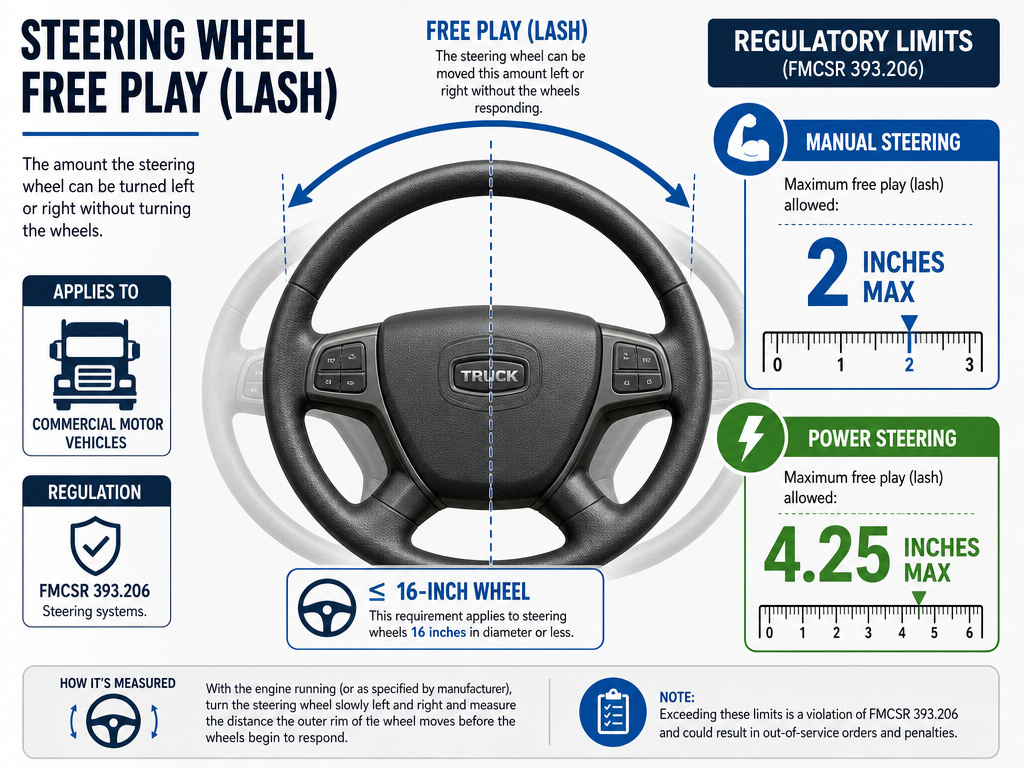
For passenger cars, free play is a sign of wear. For commercial trucks, it’s regulated. 49 CFR 393.209 sets the maximum allowable steering wheel “lash” (free movement at the rim without turning the wheels) based on diameter and steering type.
The rule is precise. For a steering wheel 406 mm or less (16 inches or less): * Manual steering system: 51 mm (2 inches) of lash maximum. * Power steering system: 108 mm (4 1/4 inches) of lash maximum.
A power-steering system on a commercial vehicle with a 16-inch wheel can have over four inches of free play at the rim and still be legally compliant. That same amount in your sedan would indicate severe wear in the steering rack or tie rods.
For diameters not listed in the table, the regulation switches to angular limits: 14 degrees of rotation for manual systems, 30 degrees for power systems. This framework exists solely for heavy vehicles where component flex and system tolerances are greater. It underscores that size standards are dictated by function.
How Do You Measure a Steering Wheel Correctly?
You need one tool: a flexible tape measure. The critical measurement is the Outer Diameter (OD), the distance across the wheel’s face from one outer edge to the opposite outer edge, passing through the center of the hub.
Do not measure the inside of the rim or the grip circumference for sizing purposes. The OD is the number manufacturers and aftermarket part suppliers use. Grip circumference matters for comfort and choosing ergonomic steering wheel covers, but not for basic fitment.
Here is the correct sequence, which is also the first step in any steering wheel replacement project:
- Ensure the wheels are straight. This centers the wheel, giving a true measurement.
- Place the tape’s end at the top outer edge of the rim (usually around the 12 o’clock position).
- Stretch the tape across the center hub to the bottom outer edge (6 o’clock). The tape must be straight and cross the exact center point.
- Read the measurement in inches. Record it to the nearest 1/8th of an inch. This precision is what prevents a 1/4-inch measurement error.
Common mistake: Measuring at a slight angle or from the inside edges of the rim. This can under-report the true OD by a quarter-inch or more, leading you to buy a cover that’s too small. A too-small cover won’t seat fully and will slip.
What about the grip? Wrap the tape around the thickest part of the rim where your hands grip. This circumference number, often between 3.5 and 4.5 inches, helps you select covers for comfort and grip that won’t feel bulky or too thin.
Can You Change Your Steering Wheel Size?
Yes, but it’s not a simple bolt-on. Swapping to a smaller or larger aftermarket wheel involves technical and safety considerations far beyond fitment.
The hub adapter must align with the clock spring. This coiled ribbon cable behind the wheel maintains electrical connection to the airbag, horn, and any steering wheel controls as you turn. Misalignment during the process to replace a steering wheel will snap the clock spring’s wires, disabling the airbag, a critical safety failure.
A smaller wheel increases steering effort. As per the leverage equation, reducing diameter makes the steering heavier. This adds stress to the power steering pump and your forearms. It can also partially obscure the instrument cluster.
A larger wheel might not fit. It can contact your legs or the dashboard trim at full lock. The change in leverage can also make the steering feel unnaturally light and less responsive.
For these reasons, a new steering wheel installation is often best left as a style update within the same diameter class. If you’re considering a heated steering wheel retrofit or adding audio controls, those projects integrate with the existing wheel size and are more about wiring and module programming.
The 1/4-Inch Rule for Aftermarket Covers
This is the single most important practical takeaway. Aftermarket covers are sold in three generalized sizes: Small (13.5-14.5″), Medium (14.5-15.5″), and Large (15.5-16.5″).
Your measured OD must fall comfortably within the middle of a cover’s stated range, not at its extreme edge. If your wheel is 15 1/8 inches, a Medium cover (14.5-15.5″) is fine. If your wheel is 15 5/8 inches, you must buy a Large cover. Stretching a Medium cover that extra 1/8 inch over its intended maximum is asking for failure.
| Your Wheel’s OD | Correct Cover Size | Risk of Choosing Wrong |
|---|---|---|
| 14.25 inches | Small | Medium will be loose, may spin |
| 15.0 inches | Medium | Safe in middle of range |
| 15.75 inches | Large | Medium will be overstretched, seams may split |
| 16.5 inches | Large (at upper limit) | May need specialty cover |
This rule is why generic parts store covers often disappoint. They hedge toward the Medium range, leaving owners of older trucks with 16-inch wheels or modern sports cars with 14-inch wheels struggling. For a perfect fit, seek out premium leather covers or hot weather wheel covers designed for your specific vehicle model.
Frequently Asked Questions
What is the most common steering wheel size?
The most common steering wheel size for modern passenger cars is between 14.5 and 15 inches in outer diameter. This range provides a balance of steering leverage, cabin space, and compatibility with airbag systems.
Do all cars have the same size steering wheel?
No. Steering wheel size varies significantly by vehicle type, model, and year. Compact cars may use 14-inch wheels, full-size trucks often use 15.5-16.5 inch wheels, and race cars can be as small as 11.5 inches. Always measure your specific vehicle.
How much does it cost to replace a steering wheel?
The cost is highly variable, depending on whether you’re buying a simple cover, a replacement OEM wheel, or a custom aftermarket racing wheel. Labor for professional installation, which is crucial for maintaining airbag system safety, adds to the total. For a basic cover, you’re looking at a simple accessory purchase; for a full OEM changing your steering wheel with airbag, it becomes a significant service procedure.
Can I put a smaller steering wheel on my car?
Technically yes, with a proper hub adapter. However, it will make the steering heavier, may trigger airbag warning lights if the clock spring isn’t perfectly aligned, and could violate vehicle safety regulations in some regions. It’s a modification that affects drivability and safety systems.
What is steering wheel lash?
Steering wheel lash, or free play, is the amount the rim can be turned left or right before the front wheels begin to move. A small amount is normal, but excessive lash (over 1-2 inches in a passenger car) indicates wear in the steering linkage, rack, or gearbox. Commercial vehicles have federally defined, much higher lash limits.
The Bottom Line
Steering wheel size is a deliberate engineering choice, not an accident. That choice dictates how your car feels in your hands, its heaviness, its quickness, its connection to the road. The 14 to 15-inch standard is just a common midpoint in a spectrum that runs from go-kart small to school-bus large.
Before you buy any accessory, from anti-theft steering wheel locks to a simple cover, grab a tape measure. Find your true outer diameter to the eighth of an inch. That number is the key to a purchase that fits, functions, and lasts. Ignore it, and you’re left with a loose, spinning cover or a security device that doesn’t lock down tight. The difference is a quarter-inch, and that’s all it takes.
