
Can You Mount Gravel Tires on a Road Bike? Check Frame Fit
This post contains affiliate links. As an Amazon Associate, we earn from qualifying purchases.
You can put gravel tires on a road bike if your frame, fork, and brakes have enough clearance, if your rims are wide enough to support them, and if you accept a trade-off in speed and aerodynamics. The main limiting factor is physical space; a road bike built for 25mm tires often cannot physically accept a 35mm or 42mm gravel tire. Even if it fits, mismatching the tire to a narrow rim creates a lightbulb shape that ruins handling and risks the bead rolling off the rim on a hard corner. The STEVENS user manual explicitly limits its road racing bikes (Category 2) to paved surfaces and tires no wider than 32mm, running wider gravel tires on such a bike voids that safety certification.
That gap between “fits” and “works safely” is where riders get into trouble. Your road bike might be a Category 2 machine by design, engineered around a specific tire width and riding surface.
Check your frame’s maximum clearance, match the tire to your rim’s internal width, and know your bike’s intended-use category. Gravel riding on a road bike is possible, but it’s a compromise, not a conversion.
Key Takeaways
- Clearance is king. Measure the gap between your current tire and the frame seat stay, chain stay, and fork crown. You need at least 4mm of space on all sides for a new, wider tire.
- Rim width dictates tire width. A 17mm internal width rim safely supports a 25mm to 32mm tire. For a 35mm gravel tire, you need a rim closer to 19mm wide.
- Caliper brakes are the biggest blocker. They physically limit tire width, often to 28mm. Disc brakes provide far more clearance, making a swap more feasible.
- Gravel tires change everything. Expect slower speeds on pavement, more weight, and twitchier handling. They also accelerate rim wear in wet, gritty conditions.
- It’s a gateway, not a destination. If you find yourself constantly reaching for the gravel turn, a dedicated gravel bike is the next logical step.
What Does Frame Clearance Actually Mean?
Frame clearance is the measured air gap between your current tire and the frame or fork. It is the absolute physical limit inside which a new tire must sit, not a guess or a manufacturer’s optimistic suggestion.
Find the tightest spots. For the rear wheel, check the seat stay bridge and the chain stay near the bottom bracket. For the front, check the fork crown and the inside of the fork legs. Gravel tires are not just wider; their tread blocks are taller and often have side knobs that extend outward. A tire that clears the frame statically can rub under load when you’re pedaling hard or cornering, which will shred the sidewall and your paint.
You need at least 4mm of clearance on all sides with the new tire mounted. Static clearance of 2mm will become zero under power or when mud sticks to the tread.
The process is straightforward. Deflate your current tire slightly. Slide a 4mm Allen key between the tire and the frame. If it fits easily everywhere, you have a starting point. Now, check your bike’s official specs online or in the manual. Many manufacturers list a maximum tire size. A STEVENS Road Racing bike, for example, is capped at 32mm under its ISO 4210-2 Category 2 rating. Ignoring that is not just a warranty issue; it’s a mismatch of the frame’s engineering to its load.
The 0.080 vs 0.095 Trade-Off That Burns Out Motors
Tire diameter is just one number. The width is what matters for clearance, but the construction is what decides whether you have a comfortable gravel cruiser or a wobbly, dangerous mess.
Road tires are designed for low rolling resistance. Their casings are smooth, and their rubber compounds are hard. Gravel tires add knobs for grip and often use softer, more puncture-resistant rubber. That softer rubber wears faster on pavement. It also creates more rolling resistance, which you feel as a slower, more sluggish ride on the road.
The real trade-off is control versus predictability, not comfort versus speed. A wide tire on a narrow rim balloons out, creating a rounded profile.This makes the tire feel vague and less responsive when you lean into a corner on pavement. On gravel, that same shape can allow the tire to squirm under you, reducing confidence when you need it most.
Where this goes sideways: Choosing a gravel tire based on width alone, without checking its recommended rim width. A 40mm tire on a 17mm rim is unstable; the sidewalls bulge out at a weak angle, increasing the chance of a bead roll-off during a hard, fast turn.
This is why rim internal width guidelines exist. They ensure the tire sits correctly on the rim bed, creating a stable platform.
| Rim Internal Width | Minimum Tire Width | Maximum Tire Width |
|---|---|---|
| 15 mm | 23 mm | 28 mm |
| 17 mm | 25 mm | 32 mm |
| 19 mm | 28 mm | 35 mm |
A 35mm gravel tire is the absolute ceiling for a 19mm rim. If your road bike has narrow, classic box-section rims with a 15mm or 17mm internal width, you are limited to 28mm or 32mm tires respectively. For a proper gravel tire, you likely need new, wider wheels, which changes the entire cost equation.
Caliper Brakes vs. Disc Brakes: The Clearance Choke Point
Your braking system is the most common hard stop. Traditional caliper brakes are a single, forged piece that wraps around the tire. The space between the brake arms is fixed.
Most dual-pivot calipers max out at 28mm of tire width. Some long-reach models might allow 30mm or 32mm if you’re lucky. There is no adjustment. If the tire won’t fit through the brake arms, the project is over unless you change the entire braking system.
Disc brakes change everything. The caliper is mounted to a separate bracket on the frame or fork, out by the hub. It never interacts with the tire. All clearance issues shift to the frame and fork design. This is why modern endurance road bikes and all gravel bikes use disc brakes, they unlock tire size.
If your road bike has calipers, your gravel tire options are severely limited. You might find a 30mm file-tread tire that just fits, but it’s a far cry from a true 38mm gravel tire. This single design feature is the reason many older road bikes cannot be converted.
Common mistake: Assuming a “gravel” tire labeled 32mm will fit a caliper-brake road bike rated for 28mm. Tire brands measure differently. A true 32mm tire from one brand can inflate to 34mm on your specific rim, instantly causing brake rub. Always test fit before cutting the label off.
The Rim Wear Timeline and Why It Speeds Up
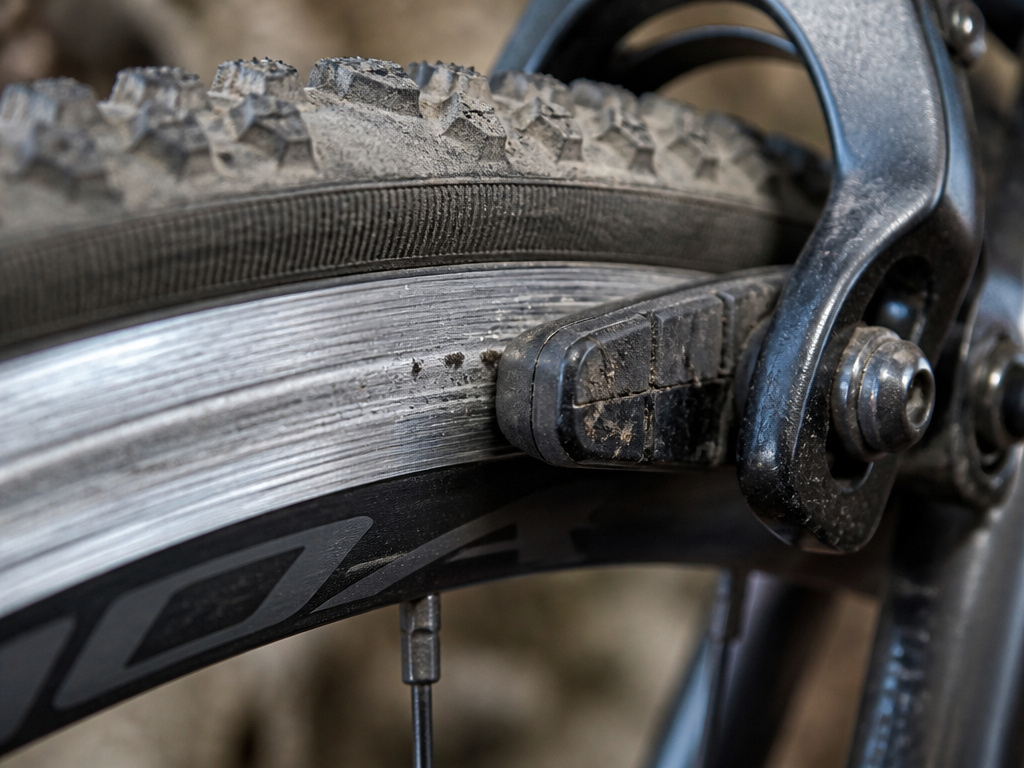
This is the part most guides skip. Wider, knobbly tires accelerate wear on your wheels, especially if you have rim brakes.
Braking on a gritty, wet surface grinds aluminum. The STEVENS manual warns that “frequent rides in rain and soiling hasten wear on rim brake pads and rims.” Gravel riding is the definition of soiling. The dust, grit, and small stones that get embedded in your tread are then pressed against the rim surface every time you brake. It’s like running fine-grit sandpaper on your brake track.
The manual gives a specific timeline: check rim thickness after wearing through your second set of brake pads. Some rims have wear indicators, small holes or strips that become visible when the rim is too thin. Once that critical abrasion point is reached, the rim can fail under tire pressure. The result is a sudden, catastrophic blowout that will lock the wheel or cause a crash.
Switching to gravel tires on a rim-brake bike directly shortens this timeline. You are putting a more abrasive, wider contact patch into a dirtier environment. Plan on inspecting your rims twice a season if you ride gravel regularly with rim brakes. Disc-brake bikes avoid this entire failure mode, as the rotor takes the wear, not the rim.
The Aerodynamic Penalty Nobody Talks About
Road bike wheels are an aerodynamic system. The rim, tire, and fork are designed to work together. Modern rims are shaped so that a 25mm or 28mm tire sits flush with the rim’s outer width, creating a smooth, aerodynamic profile.
When you mount a gravel tire that is wider than the rim, it balloons out. It forms a “lightbulb” shape that disrupts airflow. This creates significant drag, slowing you down far more than the added tire weight or rolling resistance alone.
On a long road section during a mixed-surface ride, this penalty is real. You will work harder to maintain the same speed as your friends on proper road tires. For casual exploring, it doesn’t matter. If you’re trying to keep pace on a group ride that transitions to gravel, you’ll feel it.
The fix is to use a tire width that matches your rim’s external width. If your rim is 25mm wide externally, a 28mm tire will be nearly flush. A 35mm tire will not. This is a hidden cost: to run gravel tires properly, you often need wider, gravel-specific wheels.
A Realistic Step-by-Step Compatibility Check
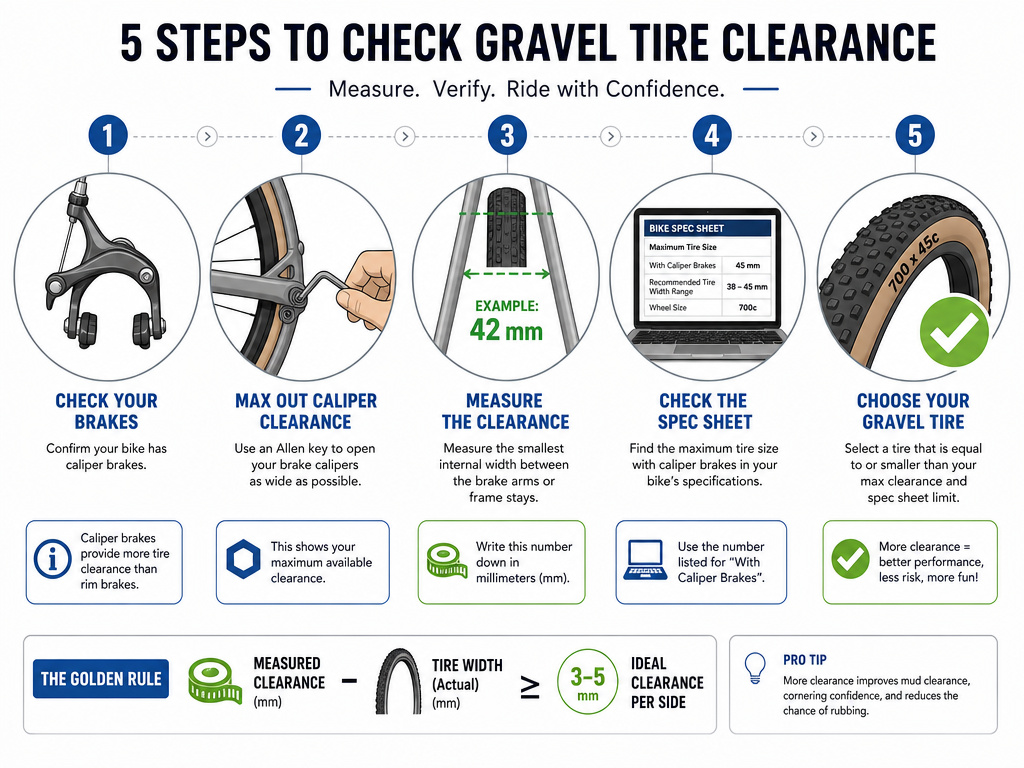
Don’t buy tires first. Work through this list in order.
- Identify your brake type. Caliper or disc? If caliper, measure the gap between the brake arms with the quick-release open. That’s your absolute width limit.
- Measure your current clearance. Use the 4mm Allen key method at all critical points (seat stay, chain stay, fork crown).
- Find your rim’s internal width. This number is often stamped on the rim itself, inside the tire bed. If not, check the wheel manufacturer’s website. This number determines your safe tire width range from the table earlier.
- Check the manufacturer’s max tire size. Look up your specific bike model year. The official number is your legal and engineering limit.
- Pick a tire that fits ALL constraints. Your final tire must be narrower than your brake clearance, narrower than your measured frame clearance minus 4mm, within the range for your rim width, and at or under the manufacturer’s limit.
If you pass all five checks, you can proceed. Most people fail at step one or three.
When To Stick With Road Tires and Lower Pressure
For many, the goal is just handling the occasional dirt road or smooth gravel path, not a full gravel conversion. In that case, a tire swap is overkill.
Start with your existing road tires. Drop the pressure significantly. If you normally run 90 psi, try 65-70 psi on hard-packed gravel. This increases the contact patch and lets the tire conform to the surface, improving grip and comfort. A puncture-resistant tire like the Continental Gatorskin in a 28mm or 30mm size can handle this perfectly.
This approach works for well-maintained gravel, canal towpaths, and hard-packed dirt. It fails when the surface gets loose, chunky, or muddy. That’s when you need actual tread blocks to dig in. But for 80% of “light gravel” riding people imagine, wider road tires at low pressure are the correct and simplest answer. You avoid all the compatibility headaches, cost, and performance penalties.
The Bottom Line
Fitting gravel tires on a road bike is a technical puzzle with a simple answer: maybe. It depends entirely on your bike’s hardpoints, brake type, frame clearance, and rim width. For a bike with disc brakes and an endurance-oriented frame, a swap to 32mm or 35mm gravel tires is often straightforward and unlocks new routes. For a classic race bike with caliper brakes and narrow rims, it’s usually impossible without changing major components, which rarely makes financial sense.
If you’re curious about gravel, try your road bike first. Install the widest tires your frame allows, drop the pressure, and go explore a local dirt road. You’ll learn what you like and what you need. That experience will tell you whether to invest in a second wheelset, a dedicated gravel bike, or just to enjoy the roads you already have.
Frequently Asked Questions
What is the minimum tire width for gravel riding?
You can ride on 25mm tires, but it’s harsh and slippery. 28mm is the practical minimum for any real comfort or control. The sweet spot for a road bike doing mixed-surface riding is 30mm to 32mm, wide enough to help, narrow enough to fit most modern road frames.
Will putting gravel tires on my road bike damage it?
It won’t damage the frame if it fits correctly. It will accelerate wear on the drivetrain, tires, and especially the rims if you have rim brakes. Grit acts as grinding paste. Clean your bike thoroughly after every gravel ride.
Is a 35mm tire too wide for a road bike?
For many road bikes, yes. It exceeds the clearance of most caliper brake systems and the rim width recommendations for standard road wheels. For a disc-brake road bike with an endurance geometry, 35mm is often the maximum allowed size. Check your bike’s specs.
Can I use tubeless gravel tires on my road bike rims?
Only if your rims are labeled “tubeless ready” or “hookless.” Converting standard road rims to tubeless is risky and not recommended. The tire bead may not seal correctly, leading to sudden air loss, a condition known as “burping.”
Are gravel bikes slower than road bikes on pavement?
Yes, generally. The wider tires have higher rolling resistance, and the frames are often heavier and less aerodynamic. On smooth pavement, a road bike will be faster for the same effort. On rough gravel, a gravel bike with wide tires will be faster and more comfortable.
