
17 Inch Tires on 18 Inch Rims: The Essential Safety Guide
This post contains affiliate links. As an Amazon Associate, we earn from qualifying purchases.
No. You cannot safely mount a 17-inch tire onto an 18-inch rim. The tire’s bead is designed to seal against a specific rim diameter, and a mismatch creates a gap that prevents proper seating. This leads to immediate air loss, catastrophic bead unseating, and tire failure. To change wheel size, you must change the tire size as well, selecting a lower-profile 18-inch tire that maintains your vehicle’s original overall tire diameter, load rating, and speed rating.
The gap is mechanical, not theoretical. The tire bead is a reinforced lip that hooks under the rim’s safety hump. On an 18-inch rim, a 17-inch tire’s bead sits slack against a surface that’s an inch larger in circumference. It cannot create the tension needed to seal. Even if you somehow force air in, the first hard corner or pothole impact will pop the bead off the rim. The conversation should never be about forcing a mismatch. It should be about the precise math of swapping both wheel and tire as a matched set.
What follows is the breakdown of that math: how to calculate the correct 18-inch tire size to replace your 17s, the three specs that will break your car if you ignore them, and the one mistake that voids your tire warranty before you even leave the shop.
Key Takeaways
- Diameter is everything. A tire’s first job is to be the right diameter for its rim. A 17-inch tire belongs on a 17-inch rim, period.
- Swapping wheels requires swapping tires. To go from 17-inch to 18-inch wheels, you must buy new 18-inch tires with a lower aspect ratio to keep the overall rolling diameter within 3% of original.
- Load rating is non-negotiable. The new tire’s load index must meet or exceed your vehicle’s Gross Axle Weight Rating (GAWR). A lower-rated tire will overheat and fail under load.
- Bolt pattern and offset are dealbreakers. An 18-inch wheel must match your vehicle’s bolt pattern exactly and have an offset within ±10mm of factory spec to avoid suspension damage and rubbing.
- Speedometer and safety systems depend on diameter. An overall diameter change beyond ±3% skews your speedometer, odometer, and can disrupt ABS and traction control.
The Golden Rule: Maintain Overall Diameter
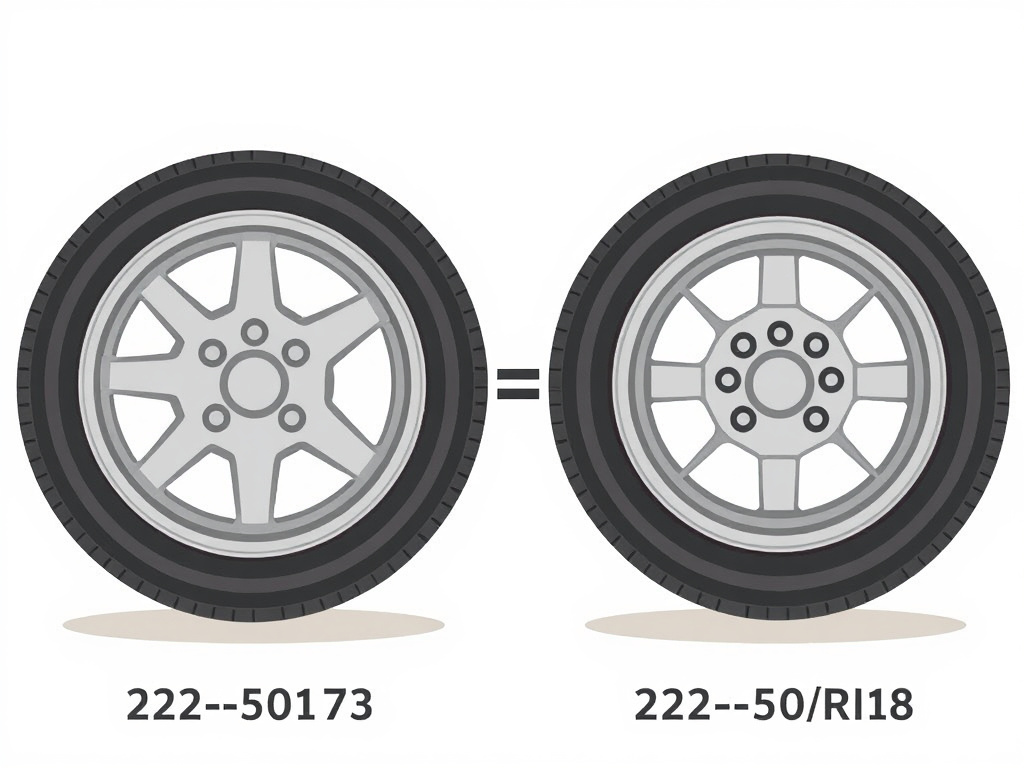
The only way to put 18-inch wheels on a car designed for 17s is to pair them with shorter-sidewall 18-inch tires. The goal is to keep the combined height of the wheel and tire, the overall diameter, as close to the original as possible.
When increasing rim diameter, you must decrease tire sidewall height proportionally. For example, going from a 17-inch to 18-inch wheel requires reducing the tire’s aspect ratio to maintain a similar overall diameter. This is critical because significant changes affect speedometer readings, transmission shifting points, and even ABS/traction control system operation.
Think of it like swapping shoes for boots. Your foot size (the overall diameter) stays the same, but the boot’s sole (the wheel) is thicker, so the inner padding (the tire sidewall) must be thinner. The math is precise. If your original setup is 225/60R17, the “60” is the aspect ratio: the sidewall height is 60% of the tire’s 225mm width. To find an 18-inch match, you need a lower aspect ratio, like 225/50R18 or 245/45R18.
| Original 17″ Setup | Target 18″ Setup | Aspect Ratio Change | Overall Diameter Difference |
|---|---|---|---|
| 225/60R17 | 225/50R18 | -10% (60 to 50) | +0.3% |
| 235/55R17 | 245/45R18 | -10% (55 to 45) | -0.8% |
| 205/65R17 | 225/55R18 | -10% (65 to 55) | +0.2% |
All these examples keep the diameter shift under 1%, which is ideal. A variance beyond ±3% is where you enter dangerous territory for your drivetrain and safety systems. An online calculator like the one at Tire Rack is non-negotiable for this step.
The short version: Don’t guess. Calculate. Your vehicle’s handling, fuel economy, and safety electronics rely on the tire’s revolutions per mile staying consistent.
Where This Goes Sideways: Bead Seating and Load Rating
The bead is the tire’s anchor. It’s a steel-cable-reinforced lip that must snap into the rim’s bead seat area and lock under the safety humps. A 17-inch tire’s bead circumference is simply too small for an 18-inch rim’s bead seat.
Common mistake: Trying to stretch a smaller tire onto a larger rim. Even if the bead seems to hold air initially, it’s sitting in the wrong groove. The first significant lateral force, a fast lane change or hitting a curb, can roll the bead off the rim, causing instantaneous air loss and a loss of vehicle control.
The load rating is your second invisible failure point. Every tire has a load index, a code that corresponds to a maximum weight capacity in pounds. Your vehicle’s Gross Axle Weight Rating (GAWR) dictates the minimum load index your tires must have.
| Tire Size | Common Load Index | Max Load Capacity (per tire) |
|---|---|---|
| LT235/80R17 | 121 | 2,700 lbs |
| LT275/70R17 | 123 | 3,000 lbs |
| LT315/70R17 | 124 | 3,500 lbs |
If you move from a 17-inch LT tire to a standard-passenger 18-inch tire, you might accidentally drop the load index. A tire that can’t carry the weight heats up rapidly. The sidewall flexes excessively, the tread separates, and a blowout follows within a few hundred miles of loaded driving. Always match or exceed the factory tire’s load index; never go lower.
The Three Dealbreaker Specs Beyond Diameter
Getting the diameter right is just the first box to check. Three other vehicle-specific measurements will stop your upgrade cold if they’re wrong.
1. Bolt Pattern (PCD): This is the number of lug nuts and the diameter of the circle they form, like 5×114.3 (5 lugs on a 114.3mm circle). An 18-inch wheel must have the exact same bolt pattern as your hub. There are no adapters that make this safe for daily driving. A mismatch means the wheel won’t mount.
2. Wheel Offset: Measured in millimeters, offset is the distance from the wheel’s mounting surface to its centerline. Factory engineers set this number to position the tire within the fender and clear the suspension. – A change beyond ±10mm can cause the tire to rub against the fender liner or suspension components. – A 2020 Toyota Camry has a 60.1mm center bore. A 2020 Honda Accord’s hub is 64.1mm. Putting Camry wheels on the Accord leaves a 4mm gap, causing wheel vibration even with the lug nuts torqued to spec.
3. Wheel Width: The new wheel must accommodate your chosen tire width. A tire that’s too wide or narrow for the rim will wear abnormally and handle poorly. The rule of thumb is to stay within half an inch of your factory wheel width when changing sizes.
These aren’t suggestions. They are physical limits defined by your vehicle’s blueprint. Ignoring them means buying a set of wheels you can’t use.
How to Change Wheel Size Without Ruining Your Car: A 7-Step Plan
This is the sequence that avoids the back-of-the-shop headaches. Skip a step, and you’ll pay for it in returned parts or repair bills.
- Write down your stock specs. Find your factory tire size (on the driver’s door jamb sticker), bolt pattern, and offset. This is your bible.
- Use a tire size calculator. Input your stock 17-inch size. Tell it you want 18-inch wheels. The calculator will spit out compatible 18-inch tire sizes that keep the overall diameter within 3%.
- Verify load and speed ratings. Cross-reference the suggested 18-inch tires’ load indexes and speed ratings against your factory tire’s. The new numbers must be equal or higher.
- Find wheels that match. Search for 18-inch wheels with your exact bolt pattern, a center bore that matches or uses hub-centric rings, and an offset within ±10mm of stock.
- Do a test fit before mounting tires. Mount one new wheel (without tire) to check for brake caliper and suspension clearance. Spin it to ensure it doesn’t contact anything.
- Mount and balance. Once clearance is confirmed, mount the new tires on the new wheels. A professional shop will balance them correctly, don’t skip this.
- Reset your TPMS. Your Tire Pressure Monitoring System may need to be recalibrated to recognize the new sensors or wheel rotation characteristics.
The one step everyone skips is the test fit. They order online, mount the tires, and then discover the wheels don’t clear the brake calipers. Now they own a set of unusable, tire-mounted wheels that are nearly impossible to return.
What Changes When You Go from 17s to 18s
Feel the difference. This isn’t just a visual upgrade.
You’ll gain sharper steering response. The shorter, stiffer sidewalls of the lower-profile 18-inch tires deform less during cornering. Input at the steering wheel translates to direction change faster. You’ll lose ride comfort. Those same stiff sidewalls transmit more road imperfection into the cabin. A pothole that was a dull thump on 17s becomes a sharp jolt on 18s. Your road noise will increase. Low-profile tires often have a firmer, often noisier, tread compound. Combined with less sound-deadening sidewall rubber, you’ll hear more of the road. Your wheels become more vulnerable. With less rubber to absorb impacts, a hard hit against a pothole is more likely to bend a wheel rim or cause a tire bulge.
It’s a trade-off. You exchange plushness for precision. For a sports car on smooth roads, it’s worth it. For a daily driver in a city full of potholes, you might regret it.
Frequently Asked Questions
Can I put 18-inch wheels on my car if it came with 17s?
Yes, but you must buy new 18-inch tires specifically sized to maintain your vehicle’s original overall tire diameter. You cannot reuse your old 17-inch tires. The new wheel must also match your bolt pattern, offset, and hub bore.
What happens if my overall tire diameter is wrong?
Diameter difference greater than ±3% will make your speedometer and odometer inaccurate. A larger diameter tire makes your speedometer read slower than you’re actually going. It can also confuse your transmission’s shift points and potentially interfere with anti-lock brake (ABS) and traction control systems.
Do I need an alignment after changing wheel size?
Yes. Whenever you change wheels or tires, a professional alignment is recommended. The new setup can shift the vehicle’s geometry slightly, and low-profile tires are less forgiving of misalignment, leading to uneven wear.
Will switching to 18-inch wheels affect my gas mileage?
It can, usually negatively. Larger, heavier wheels and stickier performance tire compounds increase rotational mass and rolling resistance. The difference might be minor, 1-2 MPG, but it’s often noticeable over time.
Can I install the wheels myself?
You can bolt them on if you have a torque wrench and know the proper torque sequence and spec for your lug nuts. However, mounting and balancing tires requires specialized equipment. The test fit, TPMS sensor programming, and alignment absolutely require a professional tire shop.
The Bottom Line
The question isn’t “can you put 17-inch tires on 18-inch rims.” It’s “should you,” and the answer is a flat no. The mechanical mismatch guarantees failure. The real project is a coordinated wheel-and-tire upgrade.
For most daily drivers wanting a sharper look, moving from factory 17s to 18s is the safest, most sensible jump. You get the visual payoff without venturing into the extreme fitment zone that demands fender rolls and suspension overhauls. Just follow the math: diameter first, load rating second, bolt pattern third. Let the numbers decide, not the impulse. Your car’s handling, your safety, and your wallet will thank you for the discipline.
