
Uncover the Maintenance Edge Cases for BMW M3 Automobiles
This post contains affiliate links. As an Amazon Associate, we earn from qualifying purchases.
The BMW M3 is defined by its S-series engines, its adaptive chassis, and a proprietary maintenance system called Condition Based Service (CBS) that tracks oil, brakes, and brake fluid, but not everything. It also carries model-specific recalls, like the 2023 door-lock software flaw, and requires oils meeting BMW Longlife-04 spec, with earlier models demanding Castrol TWS Motorsport 10W-60.
That CBS system is the brain, but it has blind spots. It won’t remind you about spark plugs or cabin air filters. More critically, if you disconnect the battery for storage, the clock for time-based services like brake fluid stops entirely, a fact buried in the owner’s manual that can leave your fluid unchanged for years.
What follows: how CBS actually works, the two oil specs that matter, the recall every 2023 owner must check, and the three maintenance loopholes that void the system’s intelligence if you miss them.
Key Takeaways
- The Condition Based Service (CBS) system tracks engine oil, front/rear brakes, and brake fluid intervals adaptively, but does not monitor spark plugs or microfilter replacements.
- Disconnecting the battery for long-term storage pauses the CBS timer for time-based services; a dealer must manually reset it.
- Early S65/S85 engines (E9X M3, E60 M5, E63 M6) require Castrol TWS Motorsport SAE 10W-60; newer models need oil meeting BMW Longlife-04 specification.
- A 2023 recall (NHTSA #23V118000) for certain M3s involved a body control module software update to prevent doors from potentially opening in a crash.
- Maintenance scope and warranty implications vary by country; performing your own service may invalidate coverage in some regions.
What Exactly Does the BMW M3 Maintenance System Track?
The iDrive screen shows a countdown for “Engine Oil,” “Front Brakes,” “Rear Brakes,” and “Brake Fluid.” This is the Condition Based Service system at work. It uses sensors and algorithms to adjust intervals based on how you drive, not just mileage.
The BMW maintenance system indicates required maintenance work and thereby provides support in maintaining road safety and the operational reliability of the vehicle. Condition Based Service CBS takes driving conditions of the vehicle into account.
That’s the technical snippet. CBS is not a simple mileage counter. Aggressive track use can halve the oil-change interval compared to gentle highway commuting. The system measures engine load, temperature cycles, and brake wear directly.
But here is the first edge case: CBS does not cover everything. Items like the spark plugs and cabin air filter (microfilter) follow fixed mileage or time intervals set by BMW, and they will not appear on your CBS display. You must track those separately.
Where this goes sideways: Storing the car with a disconnected battery. The CBS system relies on the vehicle’s internal clock for time-based services like the two-year brake fluid change. Disconnect the battery, and that clock stops. Reconnect it months later, and the system has lost that time. The countdown will be inaccurate until a BMW service center manually resets it.
This quirk is confirmed in multiple owner’s manuals. It means a car stored over winter without a battery tender could come due for a brake fluid change without any warning light.
| CBS Monitored Item | How It’s Tracked | Fixed Interval Fallback (if no CBS) |
|---|---|---|
| Engine Oil | Engine load, temp, fuel quality | Approx. 10,000–15,000 miles / 1 year |
| Front Brakes | Wear sensor measurement | Replace pads at ≤3mm, discs if worn or damaged |
| Rear Brakes | Wear sensor measurement | Replace pads at ≤3mm, discs if worn or damaged |
| Brake Fluid | Time (24 months) | 24 months, regardless of mileage |
The 4 Things the BMW M3 Maintenance System Actually Tracks
Let’s break down the four CBS items. The system’s goal is to prevent unnecessary maintenance, but it also prevents neglect.
Engine Oil: The most adaptive item. The algorithm considers cold starts, high-RPM operation, and short trips. A car that sees only track days might get an oil-change warning at 5,000 miles. The same model used for long highway cruises might go 12,000 miles. Ignoring this warning is a direct path to increased engine wear, especially on the high-revving S65 and S55 engines.
Front & Rear Brakes: Each axle has a wear sensor embedded in one pad. When the pad material wears down, it cuts the sensor wire, triggering a dash warning. This is a hard warning, you have a small safety margin left. The CBS display gives you a percentage countdown before this point, letting you plan the replacement.
Brake Fluid: This is purely time-based. BMW mandates a change every two years to purge absorbed moisture that lowers the fluid’s boiling point. This is critical for performance driving. The CBS timer counts down from 24 months, regardless of mileage. This is the service most likely to be missed after a battery-disconnect storage period.
The system stores all this data in the vehicle’s remote control key. When you visit a dealer, they can read the key to see exactly what services are due. That’s the theory. The practice has gaps.
Oil & Fluids: The Two Specifications That Matter
Forget generic “full synthetic.” The BMW M3 has two distinct oil eras, and using the wrong one risks poor lubrication or voided warranty.
For the E9X generation M3 (2008-2013) with the S65 V8, and the contemporaneous E60 M5/E63 M6 with the S85 V10, the factory fill was Castrol TWS Motorsport SAE 10W-60. This was the only BMW-approved oil for those engines at launch. Its thick viscosity at operating temperature is designed to protect the rod bearings under extreme heat and high RPM. Switching to a common 5W-30 to save money is a known risk factor for premature bearing wear in these engines.
For the F80/F82/F83 generation (2015-2018) and current G80 models, the requirement shifts. These engines need oil that meets BMW Longlife-04 specification. This covers oils like SAE 0W-30, 0W-40, 5W-30, and 5W-40. The exact weight is less critical than the Longlife-04 approval, which certifies extended drain intervals and compatibility with emissions systems.
Common mistake: Using a generic “European” synthetic oil that doesn’t carry the specific BMW Longlife-04 approval. The certification is a verification of additive packages and shear stability, not a marketing label.
Your first stop for current recommendations should be our guide to the best motor oil for BMW engines, which breaks down the specs by model year.
For brake fluid, the standard is DOT 4, but a low-viscosity DOT 4 like ATE Typ 200 or Castrol React SRF is preferred for its higher wet boiling point. This is not a CBS-tracked item you can ignore. We detail the options in our article on recommended brake fluid for BMWs.
Scheduled Services Beyond the CBS Screen
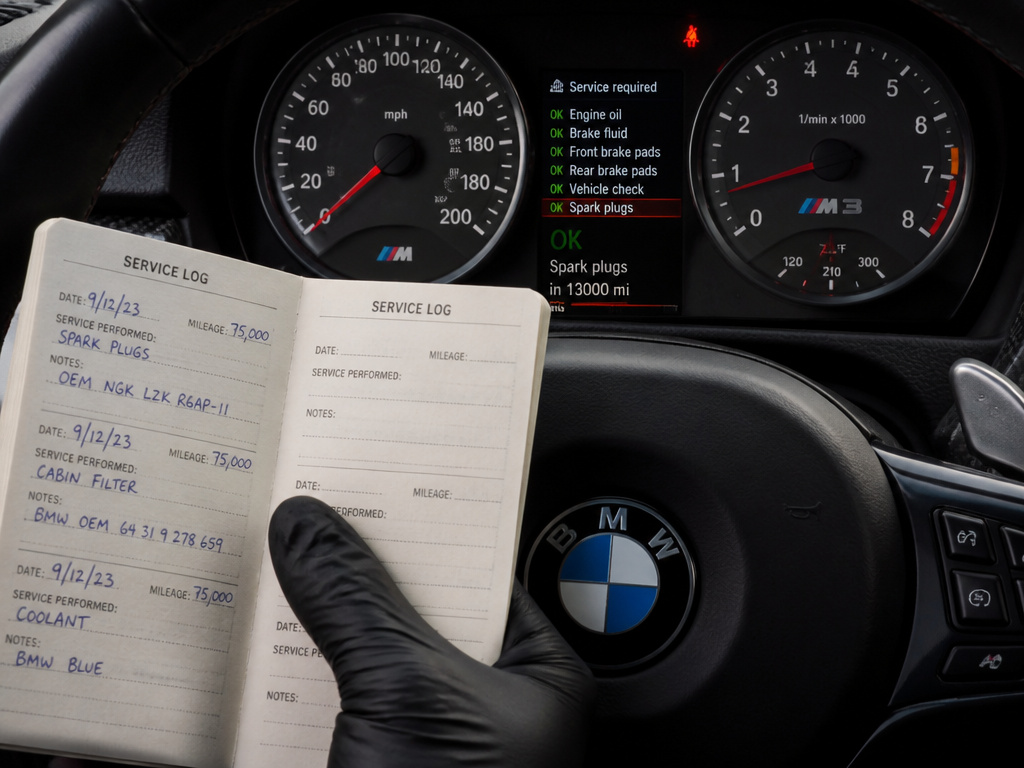
The CBS display creates an illusion of completeness. Several critical items operate on a fixed schedule you must remember.
- Spark Plugs: Typically every 60,000 miles on older models, and up to 100,000 miles on newer turbocharged engines. They are not monitored by CBS. Worn plugs cause misfires, rough idle, and reduced power.
- Cabin Air Filter (Microfilter): Usually every 15,000-30,000 miles or 2 years. A clogged filter reduces HVAC airflow and can cause musty odors.
- Engine Air Filter: Inspection/replacement intervals vary. A dirty filter restricts airflow, hurting performance and fuel economy.
- Coolant: BMW uses a long-life coolant. The factory fill can last up to 10-15 years, but it should be checked for concentration and condition periodically.
A proper BMW diagnostics tool can read deeper fault codes and reset some of these service reminders, but for the average owner, a manual logbook is the safest backup.
Recalls and Warranty: The 2023 Door-Lock Flaw

Maintenance is one thing; factory defects are another. In February 2023, BMW issued recall #23V118000 for certain 2023 M3, 330i, and other models. The issue was software in the body control module.
The consequence was straightforward: a door that doesn’t lock as intended might open during a crash. The remedy was a free ECU software update at a dealership. Owner notification letters went out in April of that year.
This highlights a necessary habit for any M3 owner: checking for open recalls. You can use your Vehicle Identification Number (VIN) on the National Highway Traffic Safety Administration (NHTSA) website. It takes two minutes.
On the topic of warranty, know your local rules. The BMW New Vehicle Limited Warranty and included maintenance program traditionally lasted 4 years or 50,000 miles. However, in some regions, performing your own oil change or brake job can be grounds for voiding related warranty claims. The policy is not global. Check your country-specific agreement.
BMW M3 vs. Standard 3 Series: Where Maintenance Diverges
This isn’t about badges. The mechanical differences dictate the maintenance reality.
The standard 3 Series uses a Condition Based Service system, too. But the intervals and components are less aggressive. An M3’s oil, brakes, and fluid are stressed to higher thermal and pressure extremes. The service schedule reflects that.
The most dramatic split is in parts. M3 brake pads, rotors, and calipers are larger and more expensive. The engine oil specification is stricter. The suspension components, tie rods, control arms, bushings, are performance-grade and wear differently under hard use. Thinking of an upgrade? Our review of best coilover kits for the BMW E90 platform covers the aftermarket path for that generation.
You also have more tire. The wider, lower-profile run-flat tires on an M3 wear faster and cost more to replace than a base model’s. Choosing the right set is crucial, which we explore in our guide to the best run-flat tires for BMW models.
The DIY Reality and Essential Tools
You can handle a lot of this yourself if you’re equipped. The basics are universal: a quality jack, jack stands, Torx and hex bit sets, and a torque wrench.
The M3-specific tool is a capable scan tool. A generic OBD2 reader will pull check-engine lights, but to read BMW-specific codes, reset CBS service lights, or code features, you need a BMW-centric tool. Options range from the BimmerLink app with a compatible adapter to dedicated units like the Autel or Creator models. For a breakdown, see our picks for the best BMW-specific scan tools.
For fluid changes, a fluid extractor is invaluable for pulling oil through the dipstick tube on many models. A brake bleeder kit is non-negotiable for the brake fluid change. And for garage-kept cars, a quality BMW car cover protects the paint between drives.
Frequently Asked Questions
Does the BMW M3 require premium gas?
Yes, exclusively. All BMW M3 models require premium unleaded gasoline with a minimum octane rating of 91 AKI (95 RON). Using lower-octane fuel can cause engine knocking, reduce performance, and trigger the check-engine light as the engine’s knock sensors pull timing to compensate.
How often should I change the differential fluid?
The rear differential fluid is often overlooked. BMW’s official stance is “lifetime,” but that’s under ideal conditions. For any car driven hard, tracked, or with high mileage, a change every 50,000 to 60,000 miles is cheap insurance against wear. The process is straightforward: remove the fill plug first, then the drain plug, drain, refill with the specified fluid (often 75W-90 GL-5), and reinstall the plugs.
What is the most common problem with the BMW M3?
It varies by generation. For the E46 M3 (2001-2006), it’s the subframe cracking. For the E9X M3 (2008-2013), it’s rod bearing wear, often accelerated by using the wrong oil or frequent cold-start short trips. For the F80 M3 (2015-2018), crank hub slippage is a known (though not universal) concern for heavily modified cars. Regular, informed maintenance is the best mitigator for all of them.
Can I use a fuel system cleaner in my M3?
It’s generally safe and can be beneficial, especially on direct-injection engines where carbon builds up on intake valves. Use a cleaner designed for modern engines and follow the dosage instructions. A bottle at every other oil change can help maintain injector performance. We’ve tested several in our roundup of recommended fuel system cleaners for BMWs.
Are aftermarket wheels okay for the M3?
Yes, but choose carefully. The fitment, offset, and hub centering must be correct to avoid vibration and stress on wheel bearings. High-quality forged wheels from brands like BBS, HRE, or Apex are popular upgrades that can reduce unsprung weight. Always ensure they clear the large M Sport brakes. For a curated selection, check out our article on the best rims for a BMW.
The Bottom Line
The BMW M3 is a machine that rewards attention. Its Condition Based Service system is clever, but it’s not omniscient. You must manually track spark plugs, filters, and remember that a disconnected battery fools the clock. Use the correct oil, 10W-60 for the older V8/V10, Longlife-04 for the newer turbos. Check for recalls, and understand that maintenance intensity and cost are a tier above the standard 3 Series.
Keep a logbook, invest in a proper BMW diagnostics tool, and don’t assume the dashboard tells you everything. That’s how you preserve the performance, the value, and the driving experience that defines the M3.
