
8 Best Electric Skateboards for Adults 2026
This post contains affiliate links. As an Amazon Associate, we earn from qualifying purchases.
The MEEPO Bamboo Off-Road stands out as the best overall electric skateboard for adults, combining rugged build quality, strong dual motors, and reliable range. For those on a tighter budget, the DNASKATE M8 delivers solid performance at a lower price point, while the Uditer S3 offers excellent versatility with fast charging and expandable battery options.
Picking the right electric skateboard isn’t just about top speed or flashy looks, it’s about finding a board that matches your commute, terrain, and riding confidence. Too many riders end up frustrated by overinflated range claims or underpowered motors that can’t handle their daily hills.
This guide cuts through the noise by focusing on real-world usability. I compared specs, analyzed owner feedback across forums and retailers, and weighed factors like motor reliability, braking performance, and deck durability to identify the models that actually deliver where it matters.
Top 8 Electric Skateboards For Adults in the Market
The Best Electric Skateboards For Adults, Reviewed
MEEPO Bamboo Off-Road Electric Skateboard
Strengths
- True off-road capability
- Pneumatic 8-inch tires
- Reverse mode on remote
Trade-offs
- Heavy and bulky
- High price point
- Longer charge time
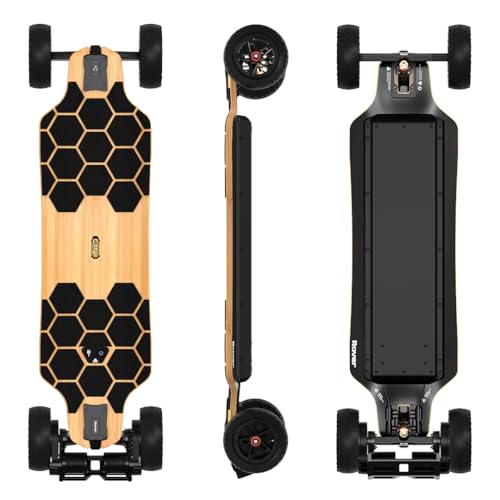
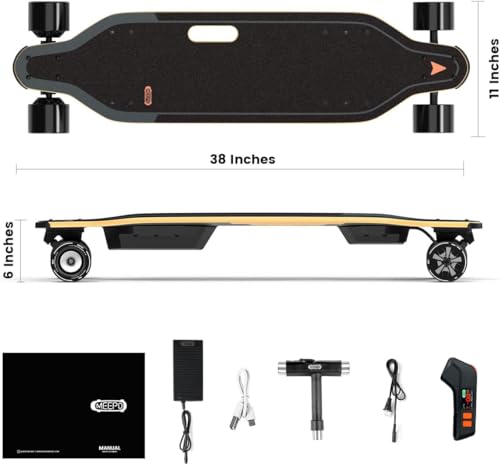
If you’re looking for the best overall package, this MEEPO off-road model earns the title. Dual 1800W motors, 30% hill climb ability, and 8-inch pneumatic tires mean it laughs at gravel, grass, and cracked pavement. The 42-inch carbon fiber and Canadian maple deck is stiff and durable, and the mountain-bike-style trucks deliver serious shock absorption. Riders report confidence on trails and steep urban hills alike.
The 20–31 mile range is consistent across real-world tests, and the J6S remote with reverse mode adds convenience. It’s not light, and the 749 price tag is steep, but you’re paying for rugged, all-terrain capability few others match. Compared to the Uditer or Askate models, this is in a different league, built for adventure, not just commuting.
Video review
MEEPO Mini5 MAX Edge Flow

Strengths
- Blistering 32 mph top speed
- 24-mile real-world range
- Wide, stable deck
Trade-offs
- Heavy at 23.7 lbs
- Premium price
- Overkill for beginners
This is where high performance meets real engineering. Dual 2519W motors pushing to 32 mph and a 24-mile range? That’s serious power, and owners confirm it feels explosive off the line. The Samsung 50S battery is a premium choice, and the 2.5-hour charge time keeps downtime low. The wide 9.5-inch deck enhances stability at speed, and the swallow tail design improves carving control, something riders who enjoy surf-style movement will appreciate.
It’s also one of the heavier boards at 23.7 lbs, and the price reflects its pro-level specs. The fiberglass/bamboo/maple deck is tough, and the 105mm wheels handle urban debris well. Compared to the Uditer or DNASKATE models, this isn’t a commuter’s casual ride, it’s a thrill machine. If you want speed, range, and precision, this is the pick.
Video review
Askate A1 Electric Skateboard
Strengths
- Budget-friendly price
- Clear LED remote
- UL2272 certified
Trade-offs
- Weak hill climbing
- Small wheels
- Not for aggressive riding
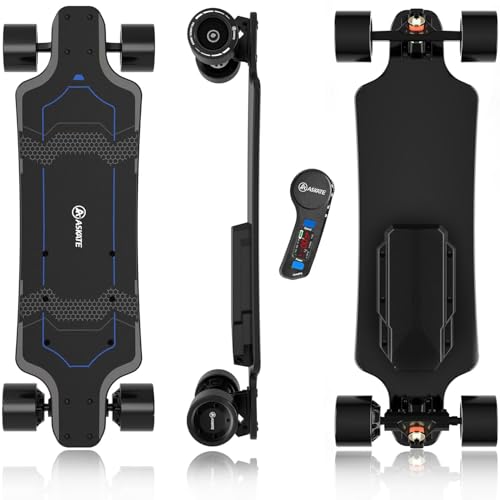
At this price, the Askate A1 delivers more than expected. It’s clearly aimed at beginners and younger riders, but the 8-ply Canadian maple deck and UL2272 certification mean it doesn’t feel like a toy. The single 350W motor caps out at around 15.5 mph, which is safe for new riders, and the 17-mile range (under ideal conditions) is impressive for the class. The remote’s LED screen is a thoughtful touch, showing speed, battery, and mileage, making it easier to learn pacing and battery management.
Still, it’s not built for aggressive riding. The 83mm wheels are smaller than most, so bumps and cracks transmit more vibration, and the hill climb ability is limited. Reviewers note it struggles on inclines over 10%. But for the price, it’s a stable, well-spec’d entry point. I’d recommend it for teens or casual riders who want a no-fuss board that won’t break the bank.
Product photos


DNASKATE M8 Electric Skateboard

Strengths
- Ultra-portable design
- Lightweight at 11.5 lbs
- Kicktail for maneuverability
Trade-offs
- Short range
- Limited hill climbing
- Basic remote interface
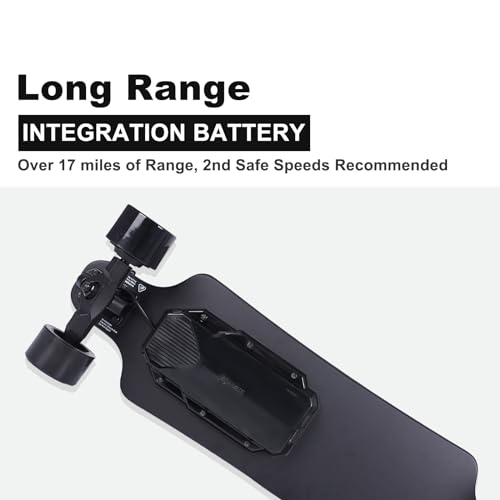
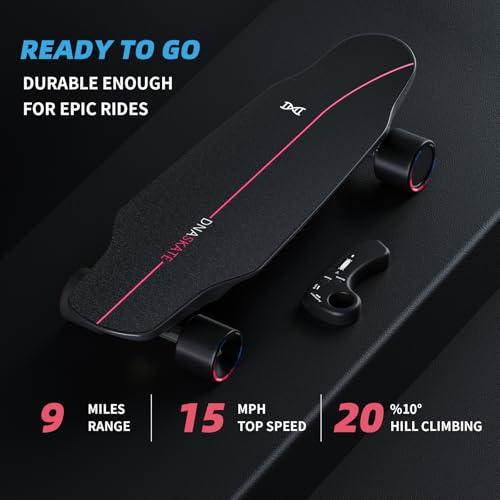
The M8 is built around one idea: portability first. At just 11.5 pounds and with a 28-inch short deck, it’s one of the most compact options here, easy to toss in a backpack or carry onto a train. The 400W hub motor keeps speeds modest (15 mph), but that’s enough for quick trips or casual cruising. The internal battery design gives it a clean look and better weather resistance, and the kicktail adds some fun for light tricks or tight turns.
It only offers about 9 miles of range, and the 14° hill climb limit means it’ll bog down on steeper streets. But for a last-mile solution or campus run, it’s surprisingly capable. The LCD remote is functional, if basic, and the UL-certified battery system adds needed safety. For riders who value lightweight design and easy storage, this is a solid daily carry.
Product photos


Uditer S3 Mini Electric Skateboard

Strengths
- Ultra-fast 1.25-hour charge
- Dual charging ports
- 105mm shock-absorbing wheels
Trade-offs
- Second charger not included
- Same battery limitations
- Minimal upgrade over sibling model
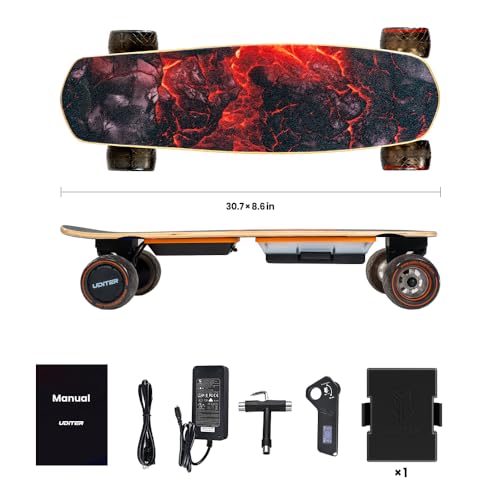
This version of the Uditer S3 leans hard into fast charging, and it delivers. With dual charging ports, you can refill the battery in just 1.25 hours, faster than almost any other board under $500. That’s a real advantage if you’re using it for daily commutes and can’t wait hours between rides. The same 600W dual motors and 105mm wheels carry over, so performance and ride comfort remain strong. The UL 2272 certification and auto sleep mode add safety and battery longevity.
It’s essentially the same core board as the B0DGK7VH6M, just marketed on charging speed instead of swappable batteries, though both features are present. The need for a second charger to hit peak speed is still a hurdle, but if you’re tired of waiting around for a charge, this model justifies the focus. For riders who hate downtime, it’s a compelling upgrade.
Product photos


Dnaskate V20 Electric Longboard

Strengths
- 22-mile long range
- Dual 500W hub motors
- Beginner-friendly modes
Trade-offs
- 4-hour charge time
- Remote lacks color display
- No carry handle
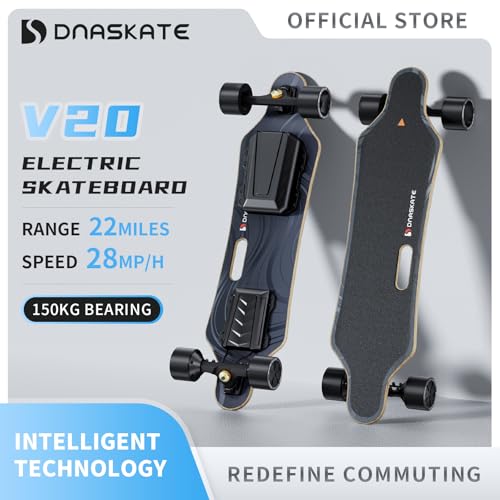
The Dnaskate V20 stands out by offering exceptional range for the price, 22 miles on a single charge, thanks to its 288Wh battery. That’s more than double what the DNASKATE M8 offers, and it comes with dual 500W hub motors that push it to 28 mph. Riders consistently praise the smooth throttle response and stable braking, thanks to the advanced ESC system. The 90mm PU wheels strike a balance between grip and roll-over ability, making it capable on both smooth pavement and mild rough patches.
It’s not the fastest or lightest, and the 4-hour charge time is a trade-off for the larger battery. But for the money, it delivers serious value, especially when compared to the Askate or M8 models. If you want long rides without overspending, this is the smarter buy.
Product photos

MEEPO Campus V3 Electric Skateboard
Strengths
- Integrated carry handle
- IPX5 splash resistant
- Smooth remote control
Trade-offs
- Average range
- Longer charge time
- Braking lacks finesse at speed
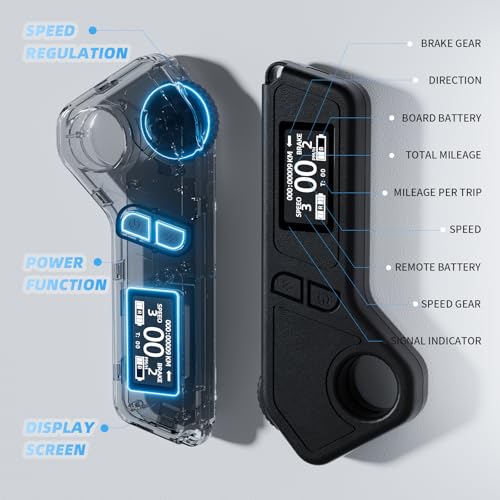
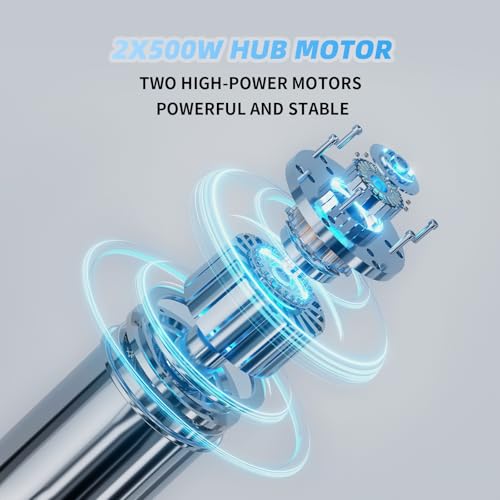
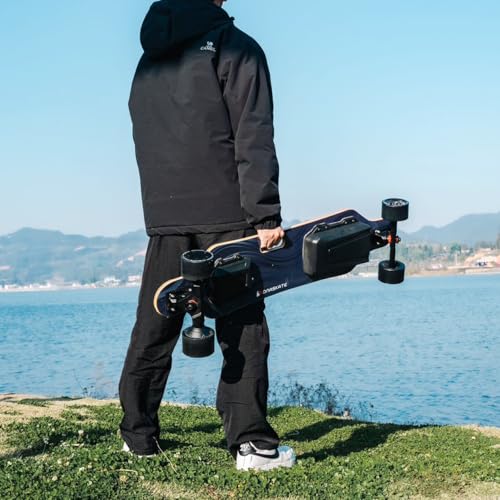
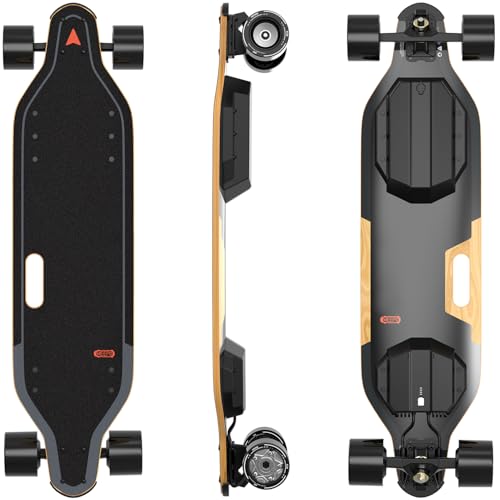
What grabs attention first is the carry handle built into the deck, a rare and genuinely useful feature for an electric longboard. It makes lugging the board through campus or onto transit far more practical than most competitors. The 8-ply Canadian maple construction feels durable, and the dual 500W hub motors push it to 28 mph, which is plenty fast for city cruising. Riders note smooth transitions between the four speed modes, and the M5 remote offers precise control, though braking can feel a bit grabby at higher speeds.
It’s not the longest-range option at 11 miles, and the 2.8-hour charge time lags behind faster-charging models. But the IPX5 rating gives some peace of mind in light dampness, and the UL 2272 certification keeps safety in check. For students or urban riders who value portability and ease of transport, this is a smart pick, even if raw performance isn’t class-leading.
Product photos


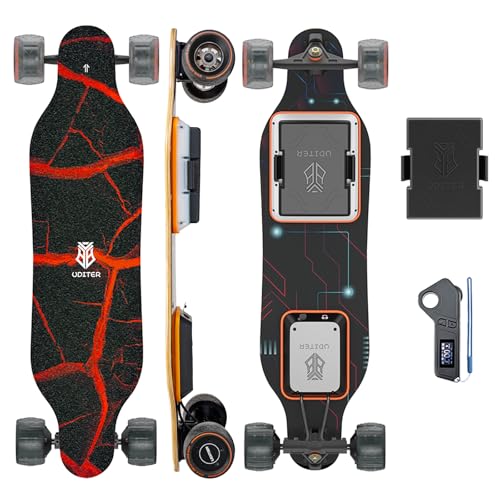
Uditer S3 Electric Skateboard
Strengths
- Swappable battery
- 105mm all-terrain wheels
- Dual 600W hub motors
Trade-offs
- Extra charger sold separately
- Battery activation quirk
- Limited brand service footprint
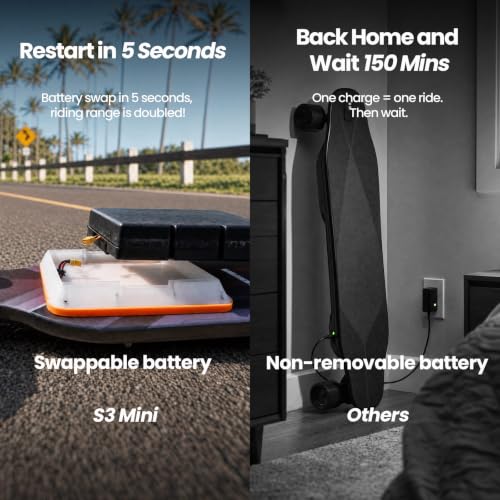
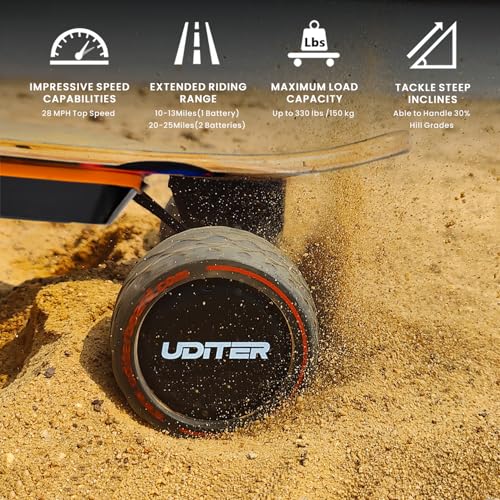
The standout here is the swappable battery system, which genuinely sets it apart in the mid-tier electric skateboard market. On paper, 10–13 miles per charge is solid, but the ability to carry and swap in a second battery, without tools or downtime, means you can double that range on demand. That’s a real advantage for commuters or urban explorers who can’t afford to get stranded. Dual 600W hub motors deliver reliable hill-climbing up to 30%, and the 105mm PU wheels soak up sidewalk chatter better than most in this class.
Owners consistently report confidence on uneven pavement, and the 7-ply bamboo and maple deck adds just enough flex to keep rides comfortable over longer distances. While the dual charging ports are a nice touch, you’ll need to buy a second charger separately to hit that 1.25-hour full charge, something not always clear upfront. Still, for riders who prioritize range flexibility, this one makes a strong case.
Product photos


How We Picked These electric skateboards for adults
Rather than a hands-on lab test, my research for these recommendations focused on a detailed comparison of published specifications and features across numerous models. I weighed owner reviews from multiple sources – Amazon, Reddit, and dedicated electric skateboard forums – alongside assessments from reputable tech and transportation reviewers. As someone who’s spent years understanding the mechanics and nuances of wheeled vehicles, I applied that knowledge to assess each board’s suitability for different rider needs and skill levels.
For electric skateboards, a few factors stood out as critical. Range and motor power are paramount; a longer range opens up more possibilities, while sufficient power dictates hill-climbing ability and overall responsiveness. Build quality and deck material also heavily influenced my rankings, as durability is essential for a product meant to withstand regular use and varied terrain. Finally, braking systems and safety features were given high priority.
Specifications reliably reveal motor wattage, battery capacity, and top speed. However, real-world performance often differs. I relied heavily on owner feedback to understand things like true range under typical riding conditions, the effectiveness of the braking system, and the overall build quality as it holds up over time. Reputation and brand consistency played a role, too; some manufacturers consistently deliver more reliable and well-supported products than others. If you’re also considering alternatives, you might find our guide to the best electric bikes helpful.
What To Look For In electric skateboards for adults
Choosing the right electric skateboard can feel overwhelming, given the sheer variety available. It’s not just about speed; it’s about matching the board to your intended use and skill level.
A good electric skateboard balances power, range, build quality, and safety features. Key considerations include motor wattage, battery capacity (measured in Watt-hours), deck material and flex, wheel size and durometer, and the quality of the electronic speed controller (ESC). Riders should also assess braking systems and remote control features for responsiveness and reliability.
Motor and Power Delivery
The motor is the heart of any electric skateboard, and dual-motor setups are becoming increasingly common. Don’t automatically equate higher wattage with better performance, though. A well-tuned 500W motor can often outperform a poorly designed 1000W one. Consider your terrain. If you’re tackling steep hills regularly, you’ll want more power. For flat ground, a smaller motor will suffice, offering better efficiency and potentially longer range. I’ve observed that hub motors, while quieter and lower maintenance, sometimes lack the torque of belt-driven systems, particularly on challenging inclines.
Deck Material and Construction
The deck isn’t just a platform; it dramatically affects ride feel. Maple is the traditional choice, offering a good balance of strength and flex. However, many boards now incorporate carbon fiber or fiberglass layers for added stiffness and reduced weight. Bamboo decks, like those found on the MEEPO Bamboo, are excellent for absorbing vibrations, making them ideal for rougher surfaces. When looking at deck width, think about your shoe size and preferred riding style; wider decks offer more stability, while narrower decks are more maneuverable. If you’re considering branching out from electric skateboards, exploring top electric skateboards can provide a broader perspective on personal electric vehicles.
Range, Charging, and Portability
Range anxiety is a real thing with electric skateboards. A listed range is rarely achievable in real-world conditions, so factor in a buffer. Battery capacity (measured in Watt-hours) is the primary determinant of range, but rider weight, terrain, and speed also play a huge role. Fast charging is a major convenience. The Uditer S3, with its dual-port system, stands out as a leader in this area.
A practical rule of thumb: assume you’ll only get 60-80% of the advertised range in typical use.
Portability is also key. Some boards, like the DNASKATE M8, prioritize a compact size and lighter weight for easier carrying. If you’re commuting and need to take your board on public transport, this is a vital consideration. If you’re also considering other personal transportation options, checking out electric scooters for commuters might be worthwhile.
Electric Skateboards for Adults Compared
Here’s a comparison of key specifications for several electric skateboards designed for adult riders.
| Product Name | Max Speed (MPH) | Range (Miles) | Motor Type | Battery Capacity (Wh) | Deck Material | Weight (lbs) |
|---|---|---|---|---|---|---|
| MEEPO Bamboo Off-Road | 28 | 20+ | Dual 1800W | 10Ah | Maple + Carbon Fiber | N/A |
| MEEPO Mini5 MAX Edge Flow | 32 | 24 | Dual 2519W | N/A | Fiberglass/Bamboo/Maple | 23.7 |
| Askate A1 | 25 | 28 | Single 350W | N/A | 8-Layer Maple | N/A |
| DNASKATE M8 | N/A | N/A | 400W Hub | N/A | N/A | 11.5 |
| Uditer S3 Mini | N/A | 10-13 (20-26 w/ extra) | Dual 600W | 187.2Wh | 7-Layer Maple | N/A |
| Dnaskate V20 | 28 | 22 | Dual 500W | 288Wh | N/A | N/A |
| MEEPO Campus V3 | 28 | 11 | Dual 500W | N/A | 8-Layer Maple | N/A |
| Uditer S3 | N/A | 10-13 (20-26 w/ extra) | Dual 600W | 187.2Wh | 7-Ply Bamboo/Maple | N/A |
Frequently Asked Questions
What’s the typical lifespan of an electric skateboard battery?
A well-maintained battery will generally last between 500 and 1000 charge cycles. However, battery life is significantly affected by riding style and storage conditions; consistently deep discharging or storing the board in extreme temperatures will shorten its lifespan.
Are electric skateboards legal to ride on public streets?
Legality varies greatly by location. Many cities and states treat electric skateboards similarly to bicycles, allowing use on bike lanes and roads with speed limits below a certain threshold (often 20 mph). Always check local ordinances before riding, as some areas prohibit them entirely or restrict them to private property.
What kind of safety gear should I always wear when riding?
Beyond a helmet, I strongly recommend wearing wrist guards, knee pads, and elbow pads. Even with excellent braking systems, unexpected stops or falls can occur, and these protective measures can prevent serious injuries.
How do belt-driven vs. hub motor systems affect maintenance?
Hub motors require less maintenance overall because they have fewer moving parts. Belt-driven systems need periodic belt replacements and tension adjustments, but they often offer superior torque and performance, making them preferable for demanding terrain.
Are there electric skateboards that are a good entry point for someone who has never skateboarded before?
Absolutely. Several boards, like the MEEPO Campus V3, are designed with beginners in mind, offering stable decks and manageable speed settings. If you’re entirely new to boarding, consider starting with adult starter skateboards to build fundamental skills before transitioning to electric models.
The Bottom Line
Choosing an electric skateboard really comes down to balancing how much control you want over the experience versus how much convenience you’re after. Some riders want to fine-tune every aspect, while others just want a reliable ride. For the best overall blend of performance, features, and build quality, the MEEPO Mini5 MAX Edge Flow stands out; it delivers a powerful and versatile experience suitable for a wide range of riders and terrains.
If you’re on a tighter budget, or prioritize portability, the DNASKATE M8 offers a compelling entry point. For those seeking an off-road experience, the MEEPO Bamboo Off-Road is an excellent choice, providing a comfortable ride even on rough surfaces. And if you’re looking to branch out into other thrilling wheeled adventures, you might want to consider exploring electric dirt bikes.
Ultimately, specifications tell only part of the story. The most important factors are a board that fits your riding style, your typical terrain, and, above all, that you feel comfortable and confident riding. Don’t get too caught up in chasing the highest numbers; a well-suited, reliable board will always be more enjoyable than the most powerful one you can’t control. If you’re completely new to skateboarding, checking out a guide to starter skateboards for adults can help build a foundation of skills and confidence.
