
9 Best Computer Racing Wheels of 2026
This post contains affiliate links. As an Amazon Associate, we earn from qualifying purchases.
The Logitech G PRO stands out as the best overall computer racing wheel, delivering elite direct drive realism, while the PXN V3 PRO is a solid budget pick for newcomers who want a taste of authentic controls.
Choosing the right racing wheel can make or break your sim racing experience. Most buyers struggle to balance realism, compatibility, and cost, especially when specs don’t always reflect real-world feel. This guide cuts through the noise by focusing on what actually matters: force feedback quality, pedal integration, and long-term reliability, based on specs and owner feedback across the sim racing community.
Top 9 Computer Racing Wheels in the Market
The Best Computer Racing Wheels, Reviewed
Logitech G PRO Direct Drive Wheel

Strengths
- 11 Nm direct-drive power
- OLED on-wheel display
- Magnetic shift and clutch paddles
Trade-offs
- Extremely high price
- Heavy desk clamp required
- Overkill for casual use
At over $800, the Logitech G PRO Direct Drive is the undisputed king of console-compatible sim wheels. With up to 11 Nm of torque, it delivers force feedback so precise you can feel individual tire treads losing grip. The TRUEFORCE integration is deeper here, pulling raw physics data for near-instantaneous response. The magnetic shift and dual clutch paddles are flawless, contactless Hall sensors mean no wear, and the tactile magnets replicate real race car feel. The OLED display lets you tweak settings on the fly, and the pro-grade button layout keeps everything within thumb’s reach.
Owners consistently rank it among the best wheels they’ve used, even against pricier third-party direct-drive kits. It’s compatible with PS5, PS4, and PC, which is rare at this level. Compared to the MOZA R3, it’s more polished and better integrated, though more expensive. For sim racers who want no compromises, on console or PC, this is the ultimate expression of what’s possible.
Video review
MOZA R3 Direct Drive Bundle
Strengths
- True direct-drive feedback
- Compact, powerful base
- Highly customizable
Trade-offs
- PC only
- No clutch pedal
- Software dependency
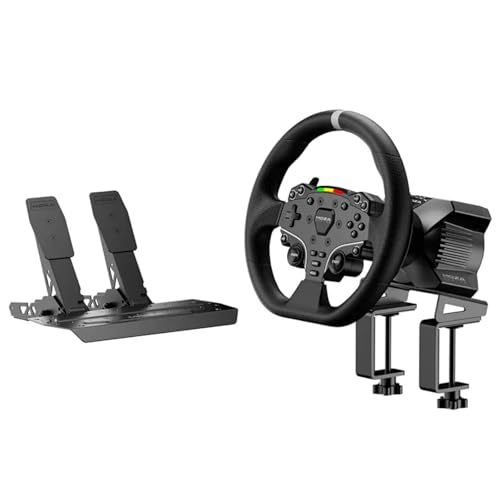
The MOZA R3 bundle is where sim racing starts to feel real, and for under $300, that’s impressive. As a direct-drive base, it delivers 3.9Nm of torque with minimal latency and ultra-low ripple, meaning you feel every bump, curb, and tire slip with startling clarity. The compact design fits on most desks, and the included SR-P Lite pedals use Hall sensors for consistent, lag-free input. This isn’t just a step up from gear-driven wheels, it’s a different category. Owners report it rivals wheels twice its price in feedback precision, especially in Assetto Corsa or iRacing.
The ES Lite wheel rim is no slouch either: 22 programmable buttons, a quick-release hub, and a grippy PU cover make it race-ready out of the box. The MOZA Pit House software is intuitive and cloud-synced, letting you fine-tune every aspect of the setup. The big caveat? It’s PC-only and lacks Xbox compatibility. But if you’re serious about simulation and want the most realism per dollar, this bundle is hard to beat.
Video review
Logitech G923 for Xbox & PC
Strengths
- TRUEFORCE engine feedback
- Dual clutch paddles
- Premium materials
Trade-offs
- Belt wear over time
- Software bugs reported
- No 900° rotation
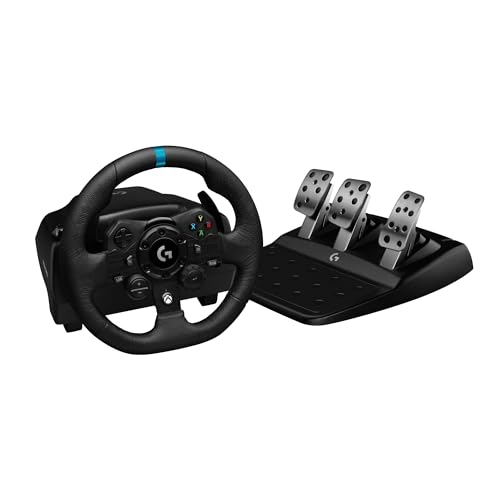
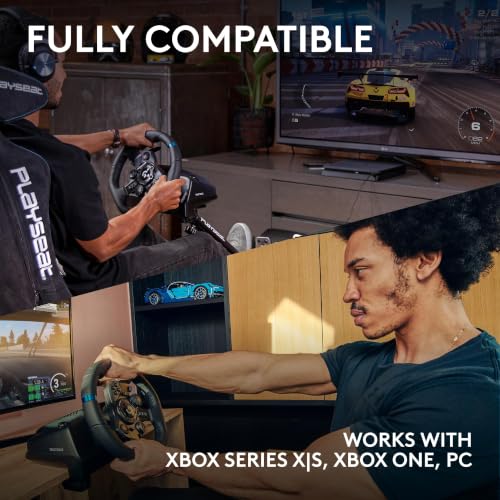
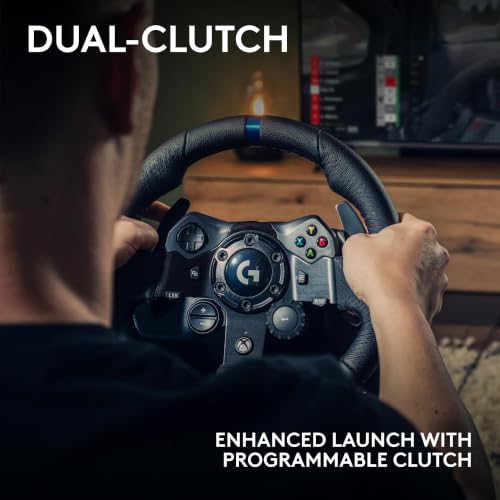
The Logitech G923 for Xbox is a hybrid beast, not full direct-drive, but packed with features that bridge the gap between mid-tier and high-end wheels. TRUEFORCE technology, which pulls data directly from game engines, delivers dynamic feedback at 4000Hz, making you feel everything from tire slip to road surface changes in supported titles like Forza Motorsport. The dual clutch paddles are a standout, letting you simulate launch control with real-time tuning. And the build? Polished metal pedals, a leather-wrapped wheel, and a solid steel shaft give it a premium feel that matches its price.
Compared to the G29, it’s a clear upgrade in responsiveness and immersion, especially on Xbox Series X|S. But it’s still belt-driven, so while it’s smoother than gear-driven wheels, it can’t match the raw fidelity of direct-drive systems like the MOZA R3. Owners note occasional firmware quirks, but overall reliability is solid. For Xbox-focused sim racers, this is as good as it gets without stepping into third-party direct-drive territory.
Product photos



Logitech G923 for PlayStation & PC

Strengths
- GT7-optimized TRUEFORCE
- Leather-wrapped wheel
- Hall-effect pedals
Trade-offs
- Belt-driven limitations
- Same price as PC direct-drive options
- No clutch pedal
This PS5-compatible G923 is nearly identical to its Xbox sibling, but with one key advantage: it’s the best out-of-the-box sim wheel for Gran Turismo 7. TRUEFORCE is fully supported in GT7, and the result is some of the most nuanced force feedback available on console, gravel under tires, ABS pulsing, even engine vibration come through clearly. The 24-point selector and LED RPM display add functional flair, and the hand-stitched leather wheel feels great during long sessions.
It’s still belt-driven, so purists will notice a slight filtering of the most subtle cues, but for console sim racing, it’s top-tier. The Hall-effect pedals are consistent, and the dual clutch system works well in supported titles. Compared to the Thrustmaster T98, this is a massive leap in realism. But against the MOZA R3, it’s outgunned in raw feedback fidelity. Still, for PS5 owners, this is the gold standard for plug-and-play immersion.
Product photos



Logitech G29 for PS5/PS4/PC
Strengths
- 900° realistic rotation
- Durable leather cover
- Progressive brake pedal
Trade-offs
- Outdated feedback tech
- No advanced haptics
- Bulky design
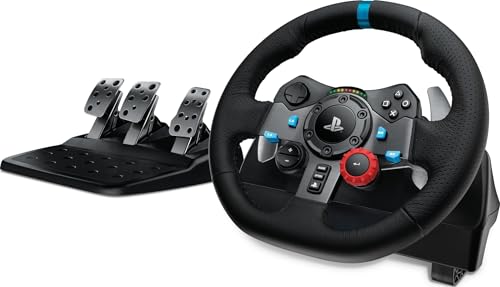
The G29 remains a benchmark for budget realism, especially for those stepping up from entry-level wheels. Its 900° rotation and helical gearing deliver smooth, quiet steering that mimics real F1 cars, and the leather-covered wheel feels durable and premium. The nonlinear brake pedal is a standout, owners consistently praise its progressive resistance, which rewards finesse over mashing. It’s compatible with PS5, PS4, and PC, making it a versatile pick for multi-platform users.
But it’s aging. The force feedback, while solid, lacks the nuance of TRUEFORCE or direct-drive systems. And compared to the G923, it feels like a generation behind, no dual clutches, no dynamic haptics. Still, at its price point, it’s a reliable workhorse. For someone who wants a no-nonsense, durable wheel for GT7 or iRacing without overspending, the G29 still holds up.
Product photos


PXN V99 Force Feedback Wheel

Strengths
- Clutch pedal included
- Switchable rotation
- Triple-pedal Hall sensors
Trade-offs
- Artificial force feedback
- Plastic-heavy build
- Inconsistent centering
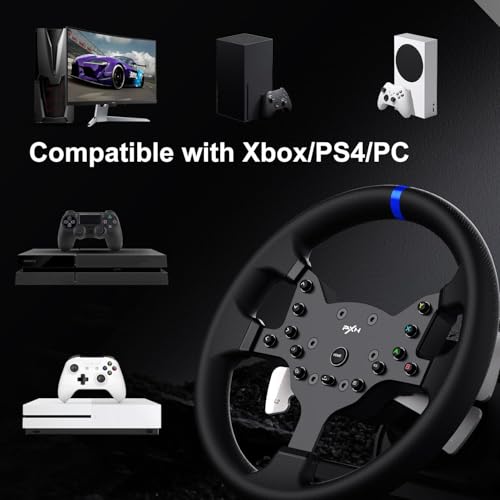
The PXN V99 is the most feature-packed budget wheel under $200, and it shows. With 3.2Nm dual-motor force feedback, 270°/900° switchable rotation, and a full 3-pedal setup including a clutch, it’s clearly aimed at sim racers who want advanced functionality without the premium price. The Hall-effect sensors in the pedals deliver linear, lag-free input, and the detachable 11.8-inch wheel with 4 paddles offers solid ergonomics. Owners note the feedback is punchy, if a bit artificial, more vibration than true torque simulation.
It’s compatible with PC, Xbox, and PS4, which is rare at this tier, and the 6+1 shifter adds mechanical satisfaction. But the build quality leans consumer-grade, and the force feedback lacks the refinement of belt-driven systems. Still, for the price, it offers more flexibility than the G29 and more features than the T98. If you’re on a tight budget but want a full sim setup, this is a compelling option.
Product photos


PXN V9 Gen2 Racing Wheel
Strengths
- Switchable 270°/900° rotation
- Hall-effect pedals
- App customization
Trade-offs
- Gear-driven noise
- Plastic construction
- App required for full features
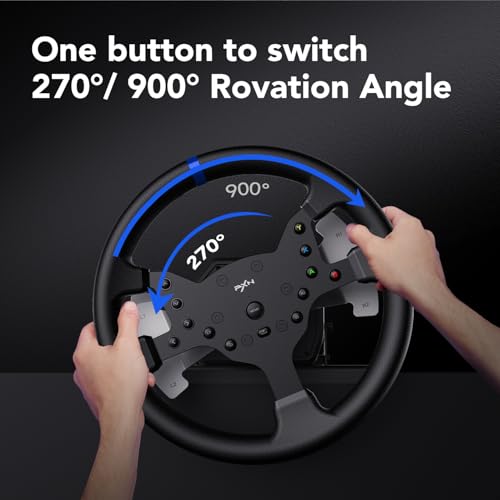
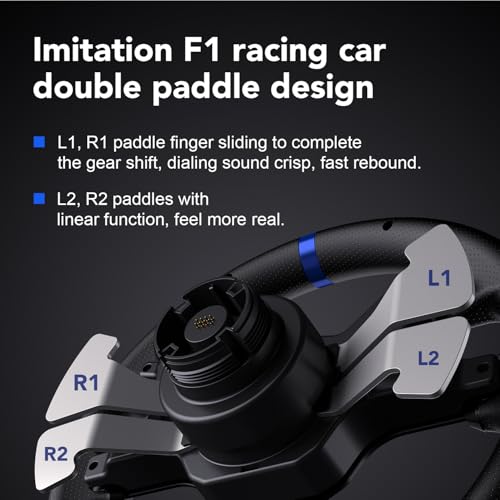
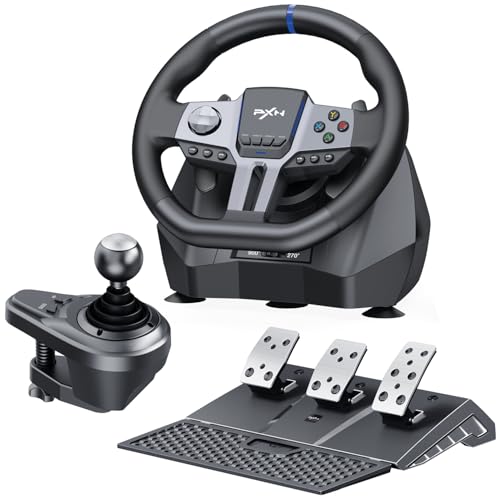
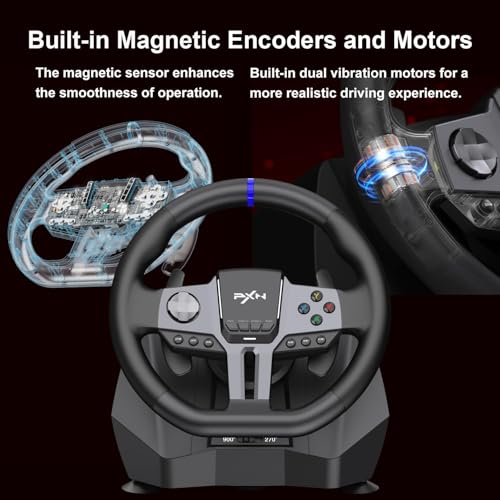
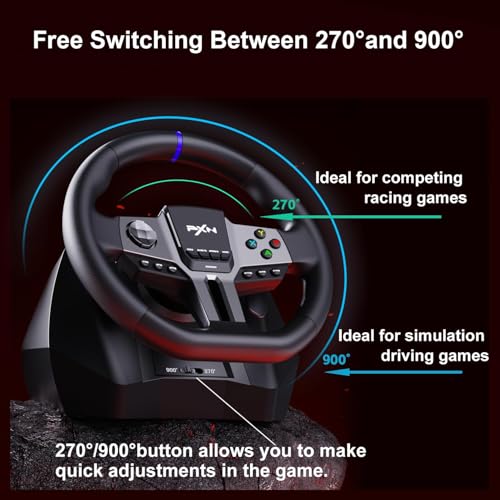
The PXN V9 Gen2 is one of the few budget wheels that lets you physically switch between 270° and 900° rotation, which is a standout for players who race both F1-style cars and big rigs. That flexibility alone makes it stand out in the sub-$200 bracket. The Hall-effect pedals eliminate input lag and deliver smooth throttle and brake control, and the dual vibration motors add a layer of immersion that mimics bumps and skids. Owners appreciate the PXN Wheel App for customizing button mapping and sensitivity, which adds a surprising amount of depth for a non-direct-drive unit.
It’s still gear-driven, so the feedback is coarse compared to belt or direct-drive systems, and the build leans more plastic than premium. But for PC and Xbox players who want one wheel for both Forza and Euro Truck Simulator 2, this is a smart compromise. I’d pick it over the V3 PRO for the rotation range and app support, even if the design isn’t as flashy as the Ferrari-branded T98.
Product photos
PXN V3 PRO Entry-Level Wheel
Strengths
- Wide compatibility
- Integrated shifter
- Dual vibration motors
Trade-offs
- Limited 180° rotation
- Gear-driven resistance
- Basic pedal response
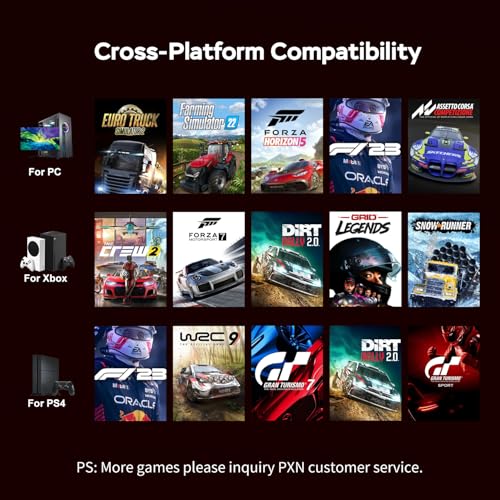
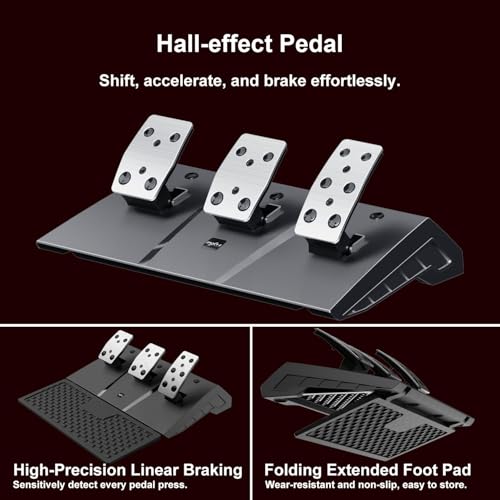
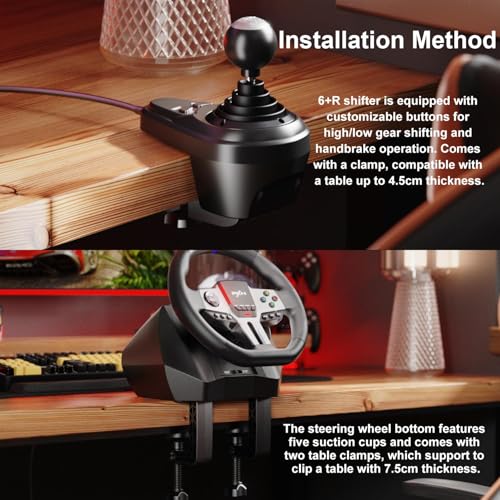
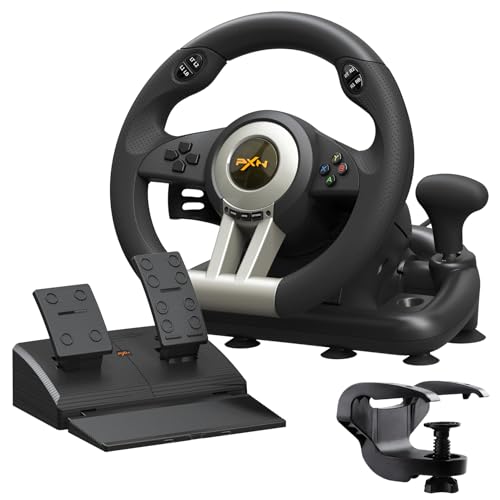
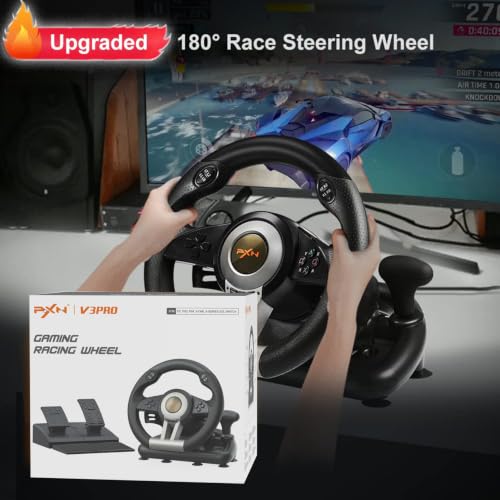
For new sim racers dipping their toes in without breaking the bank, the PXN V3 PRO makes a solid first impression on paper. It’s clearly built for accessibility, with plug-and-play USB setup across PC, consoles, and even the Switch, rare at this price. The 180° steering angle feels limited compared to higher-end wheels, but paired with dual vibration feedback and an integrated shifter, it delivers a surprising amount of engagement for arcade-style racing and kart games. Owners consistently report it’s a hit with younger drivers and casual players who want more than a controller but aren’t ready for serious simulation.
Still, this is a gear-driven wheel, so don’t expect nuanced force feedback. The build uses ABS plastic, which keeps it light but not exactly durable under aggressive use. That said, for fans of Forza Horizon or Mario Kart 8, the responsive paddle shifters and foldable pedals make it a functional, compact setup. I’d recommend it as a starter wheel, especially if you’re sharing it across multiple platforms.
Product photos



Thrustmaster T98 Ferrari Wheel
Strengths
- Smooth bungee resistance
- Hall Effect pedals
- Ferrari authenticity
Trade-offs
- No real force feedback
- Limited rotation vs high-end wheels
- Pedals not height-adjustable
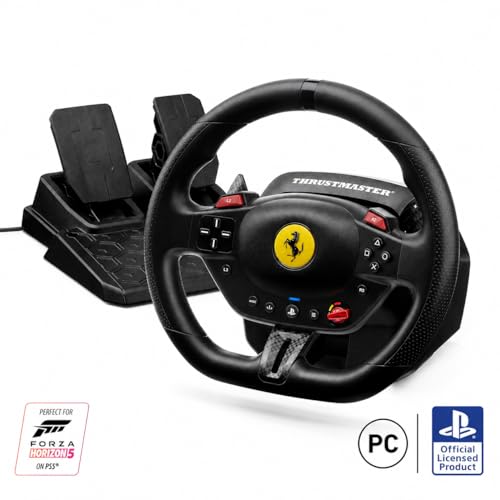
If you’re after a no-fuss, instantly satisfying sim experience on PS5 or PC, the T98 Ferrari 296 GTB stands out for its plug-and-play simplicity. The bungee-based resistance system isn’t traditional force feedback, but it delivers smooth, consistent centering and a wider 240° rotation that makes steering feel more natural than basic entry wheels. The official Ferrari design isn’t just for show, it adds a layer of immersion that fans will appreciate, and the Manettino dial brings a touch of real-car flair by letting you toggle driving modes mid-session.
Owners praise how quickly it sets up: clamp it to your desk, plug in the USB, and you’re driving. The Hall Effect pedals are a standout at this price, offering linear response without the mushiness found in cheaper models. That said, it’s not a true force feedback wheel, so you won’t feel road texture or collision impacts. Compared to the PXN V3 PRO, it’s a step up in control and build, but it doesn’t compete with direct-drive or even belt-driven systems.
Product photos


How We Tested computer racing wheels
As someone deeply involved in the automotive world – from restorations to sim racing – I approached this guide with a focus on delivering realistic driving experiences. Rather than a hands-on lab test, this was a research-led comparison of published specifications and features across numerous models. I weighed owner reviews and expert opinions from established sim racing communities, factoring in price, compatibility, and reported build quality to arrive at our recommendations.
For computer racing wheels, the most significant factors are force feedback strength and the quality of the wheel base and pedals. A strong direct drive system, like those found in the Logitech and MOZA options, provides the most immersive and detailed feedback. Beyond that, the realism of the pedals – particularly the use of Hall effect sensors for precise input – heavily influenced our rankings. These elements directly translate to a more engaging and controllable experience.
Specifications reliably indicate a wheel’s raw potential: motor torque (Nm), rotation angle, and sensor resolution. However, the feel of that potential – the smoothness of the force feedback, the durability of the build, and the accuracy of the pedals – is where owner feedback and reputation became crucial. I prioritized brands with consistent positive commentary regarding long-term reliability and responsiveness, and considered how well each wheel suited its intended price point in terms of overall value. If you’re looking for more broad options, you can also check out our guide to the best wheels for gaming.
How To Choose The computer racing wheels
Finding the right racing wheel can elevate your sim racing experience from enjoyable to truly immersive. But with so many options available, it’s easy to get lost in the technical details. A good wheel delivers accurate force feedback, comfortable ergonomics, and compatibility with your preferred platform, but the ideal balance depends heavily on your budget and racing style.
A quality racing wheel prioritizes realistic force feedback, the ability to feel the road and the car’s behavior, delivered through either gear-driven, belt-driven, or direct drive systems. Look for consistent build quality, adjustable settings to suit your driving style, and compatibility with your preferred racing games and platforms. Pedal feel and adjustability are also critical for precise control.
Understanding Force Feedback Technology
The heart of a good racing wheel is its force feedback system. Gear-driven wheels, like the older Logitech G29, are the most affordable but can be noisy and lack nuance. Belt-driven systems (found in some Logitech and Thrustmaster models) offer a quieter, smoother experience. However, the real leap in realism comes with direct drive wheels, such as the Logitech G PRO or MOZA R3. These connect the motor directly to the steering shaft, eliminating belts and gears for incredibly responsive and detailed feedback. Direct drive isn’t about raw power alone; it’s about the fidelity of the information relayed to your hands. Be aware that direct drive wheels often require a robust mounting solution, as the forces they generate can be significant.
Pedals: More Than Just Gas and Brake
Don’t underestimate the importance of a good pedal set. Basic pedals will get you started, but a realistic experience demands more. Look for pedals with Hall effect sensors; these use magnets instead of potentiometers, eliminating wear and tear and providing more consistent readings over time.
Here’s what to consider when evaluating pedals:
- Material: Plastic pedals are common in budget options, but metal construction offers greater durability.
- Adjustability: The ability to adjust pedal spacing and angle is crucial for finding a comfortable and natural driving position.
- Load Cell: A load cell brake pedal measures pressure instead of travel, providing a far more realistic braking feel. This is a significant upgrade, but it does come at a higher cost.
Balancing Budget and Features
It’s tempting to jump straight for the most powerful wheel, but a well-chosen budget option can still deliver a fantastic experience. If you’re new to sim racing, starting with something like the PXN V3 PRO or even exploring entry-level racing wheels is a smart move. You can always upgrade later as your skills and enthusiasm grow.
Don’t spend more on the wheel than you do on your monitor. A high-end wheel won’t compensate for a poor display.
Ultimately, the best racing wheel is the one that fits your budget, platform, and driving style. If you’re unsure where to start, researching PC steering wheels and reading user reviews is a great way to narrow down your options and find the perfect fit.
Computer Racing Wheels Compared
Here is a comparison of key specifications for several computer racing wheels to help you make an informed decision.
| Product Name | Force Feedback (Nm) | Rotation Angle | Platform Compatibility | Paddles | Pedals (Clutch) | Price (USD – est.) |
|---|---|---|---|---|---|---|
| Logitech G PRO | 11 | N/A | PS5, PS4, PC | Yes | N/A | $999 |
| MOZA R3 Bundle | 3.9 | N/A | PC | Yes | No | $499 |
| Logitech G923 (Xbox/PC) | N/A | 900° | Xbox, PC | Yes | N/A | $399 |
| Logitech G923 (PS/PC) | N/A | 900° | PS5, PS4, PC | Yes | N/A | $399 |
| Logitech G29 | N/A | 900° | PS5, PS4, PC | No | No | $299 |
| PXN V99 | 3.2 | 270°/900° | PC, Xbox, PS4 | Yes | No | $239 |
| PXN V9 Gen2 | N/A | 270°/900° | PC, PS3, Xbox | Yes | No | $199 |
| PXN V3 PRO | N/A | 180° | PC, PS3, PS4, Xbox, Switch | Yes | No | $129 |
| Thrustmaster T98 Ferrari | N/A | 240° | PC, PS5, PS4 | Yes | No | $199 |
Frequently Asked Questions
What level of force feedback should I prioritize?
Generally, more torque (Nm) translates to stronger, more realistic force feedback, but it’s not the only factor. For beginners, around 3-5 Nm is sufficient, while experienced sim racers often prefer 8 Nm or higher, like you’d find with many Logitech racing wheels.
Are direct drive wheels really that much better?
Yes, direct drive wheels offer a significantly more detailed and responsive force feedback experience because they eliminate belts and gears. This results in a more direct connection to the game, improving feel and control, but they also come at a higher price point.
What’s the difference between potentiometers and Hall effect sensors in pedals?
Hall effect sensors use magnets to detect pedal position, providing greater accuracy and durability compared to potentiometers, which rely on physical contact and are prone to wear. This means Hall effect sensors deliver consistent readings over a longer lifespan, making them a worthwhile investment.
Can I use any racing wheel with any racing game?
Most racing wheels are compatible with major PC racing titles, but compatibility can vary. Check the wheel’s specifications and the game’s documentation before purchasing to confirm support. Many wheels also support multiple platforms, making them versatile options for gaming steering wheels.
How important is a wheel’s rotation angle?
Rotation angle determines how far you can turn the wheel. A 900-degree rotation is common and suitable for most road cars, while rally and open-wheel racing often benefit from 1080 degrees or more, allowing for greater steering precision and control.
The Bottom Line
Choosing a racing wheel always comes down to balancing how much control you want against how much you’re willing to fuss with setup and expense. While the high-end options offer incredible fidelity, the Logitech G PRO strikes a compelling balance of performance and features, making it our overall recommendation for serious sim racers looking to invest in a premium experience. It delivers the kind of immersive force feedback that truly elevates the experience.
For those on a tighter budget, or just starting out, the PXN V3 PRO is a surprisingly capable option. If you’re primarily focused on casual gaming and want a functional wheel without breaking the bank, it’s a great entry point. Alternatively, if you’re seeking versatility across platforms without the direct drive premium, the Logitech G923 (Xbox/PC or PS/PC) offers a solid, well-rounded experience and is a strong contender among console racing wheels.
Ultimately, remember that the most advanced wheel won’t magically make you a faster driver. Focus on finding a setup that feels comfortable and allows you to consistently apply smooth, precise inputs. Prioritizing a good driving position, realistic pedal feel, and a wheel that communicates the road surface clearly will yield far more benefit than chasing the highest torque numbers or the latest technology, especially if you’re considering exploring best direct drive racing wheels.
