
7 Best Chargers for Dead Car Batteries 2026
This post contains affiliate links. As an Amazon Associate, we earn from qualifying purchases.
The NOCO GENIUS10 stands out as the best charger for dead car batteries, delivering reliable 10-amp performance with smart tech and broad battery support. For a budget-friendly option that still handles most standard batteries well, the PLXX 15A offers strong value, while the E-FAST 25A is ideal if you need high amperage and recovery boost for severely depleted systems.
Reviving a dead car battery isn’t just about brute force, it’s about doing it safely, efficiently, and in a way that doesn’t shorten your battery’s lifespan. Too many people grab the first charger they see only to find it can’t handle their battery type or fails after a few uses.
This guide cuts through the noise by focusing on real-world performance, compatibility, and durability. I compared specs and owner feedback across top models, prioritizing those that combine intelligent charging stages, multi-chemistry support, and features like desulfation and temperature compensation. These are the ones that consistently deliver when you’re facing a no-start situation.
Top 7 Charger For Dead Car Batteries in the Market
The Best Charger For Dead Car Batteries, Reviewed
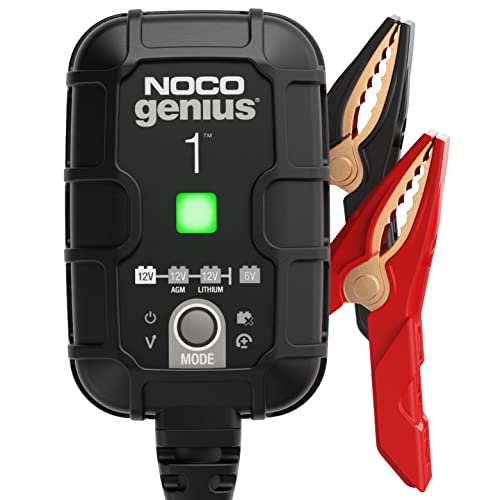
NOCO GENIUS1 1A Charger
Strengths
- Safe for indefinite use
- Revives dead batteries
- Compact and efficient
Trade-offs
- Too slow for large batteries
- No booster mode
- Low amperage
Calling this the ‘best overall’ isn’t about power, it’s about purpose. The GENIUS1 is the gold standard for battery maintenance, not fast recovery. Its 1A output is gentle by design, making it perfect for long-term float charging on classics, seasonal bikes, or stored vehicles. The thermal-sensing tech and Force Mode let it revive batteries others can’t, even at this low amperage.
What really sets it apart is reliability. Owners leave it connected for months without issue, something you wouldn’t dare with cheaper units. Against the budget 10A charger, it’s slower but far smarter and safer. It’s not for jump-starting or reviving a truck battery in a hurry, but for preserving battery health? Nothing beats it. This is the one I’d recommend to anyone with a garage full of passion projects.
Video review
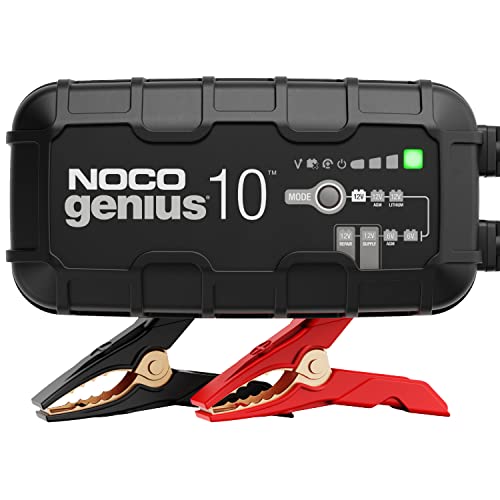
NOCO GENIUS10 10A Smart Charger
Strengths
- Charges dead batteries
- Thermal compensation
- Compact and reliable
Trade-offs
- No booster/jump function
- 10A max limits speed
- Higher cost
NOCO’s reputation isn’t hype, and the GENIUS10 proves why it’s a benchmark in smart charging. It handles batteries down to 1 volt, and even zero volts via Force Mode, better than almost any other unit in its class. That’s not just theoretical; owners regularly report bringing back batteries others labeled as junk. The thermal sensor adjusts charging in real time, which matters if you’re in a garage with wild temperature swings.
It’s not the fastest for huge batteries, but for versatility across vehicles, from classics to daily drivers, it’s hard to beat. Compared to the TowerTop, it lacks brute amperage but wins on precision, safety, and compactness. The 3-year warranty and US design add peace of mind. If you value battery health over speed, this is the smarter long-term pick.
Video review
NOCO GENIUS5 5A Smart Charger

Strengths
- 5A ideal for most cars
- Full NOCO smart features
- Compact and reliable
Trade-offs
- No jump-start function
- Not for large trucks
- Higher cost than basic models
The GENIUS5 hits the sweet spot between the GENIUS1 and GENIUS10, offering faster charging than the former without the price jump of the latter. It’s 5A output is enough to recharge most car batteries in a few hours, and it still includes all the smart features: thermal compensation, Force Mode, and pulse desulfation. For mid-sized vehicles, daily drivers, boats, ATVs, it’s the most balanced NOCO option.
Compared to the budget 10A charger, it’s better built, more precise, and safer for long-term use. Against the GENIUS10, it’s less powerful but still capable for most home users. The 3-year warranty and US design reinforce its premium feel. If you want NOCO quality without overpaying for amperage you won’t use, this is the smarter buy.
Product photos


12V 10A Smart Trickle Charger

Strengths
- 10A output
- Pulse repair function
- Wide battery compatibility
Trade-offs
- No dead battery force mode
- Basic cooling system
- Not for large batteries
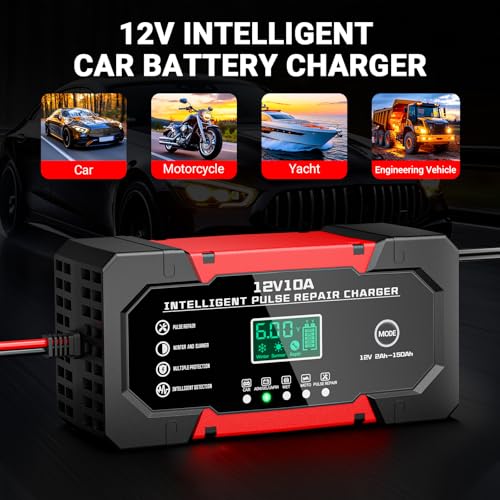
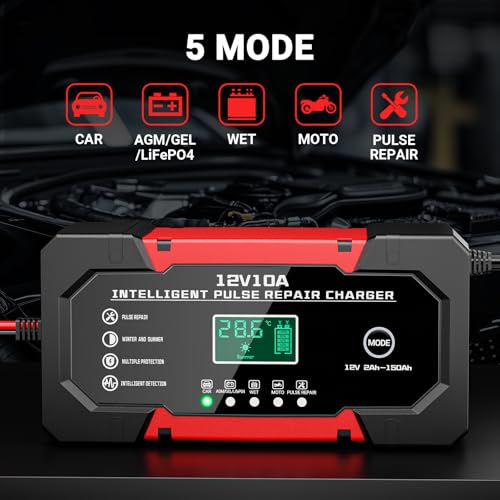
For budget-focused buyers who still want smart charging, this 10A unit delivers more than its price suggests. On paper, it covers all the basics, automatic detection, LCD feedback, and compatibility with common 12V battery types including AGM, Gel, and LiFePO4. The pulse repair function is a standout at this price, offering real value for those dealing with sulfation in older batteries. Owners consistently report success reviving dormant car and motorcycle batteries without issues.
Where it falls short is in charging speed and build quality. While 10A is decent, it lacks the higher amperage needed for quick recovery on large or deeply drained batteries. Compared to pricier models like the TowerTop or NOCO units, it doesn’t offer multi-stage precision or extreme low-voltage recovery. But for occasional use and basic maintenance, it’s a solid workhorse.
Product photos



E-FAST 25A Smart Charger
Strengths
- 25A output with 24V support
- Booster mode for jump starts
- Aluminum housing & fan cooling
Trade-offs
- LCD less detailed
- Brand less established
- No 6V charging
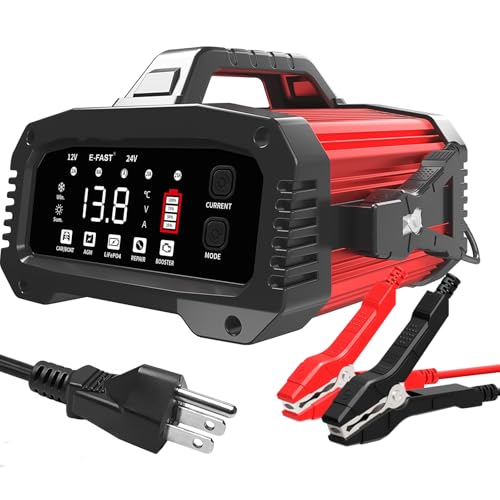
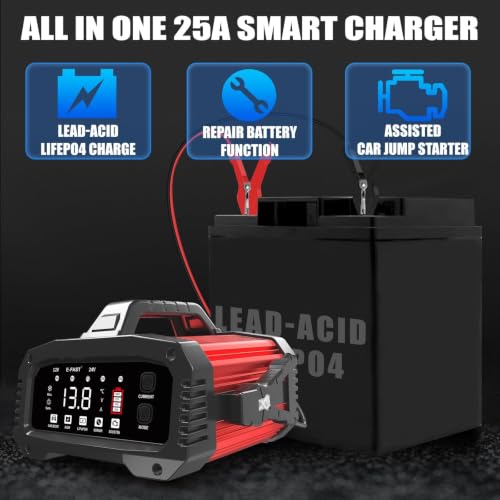
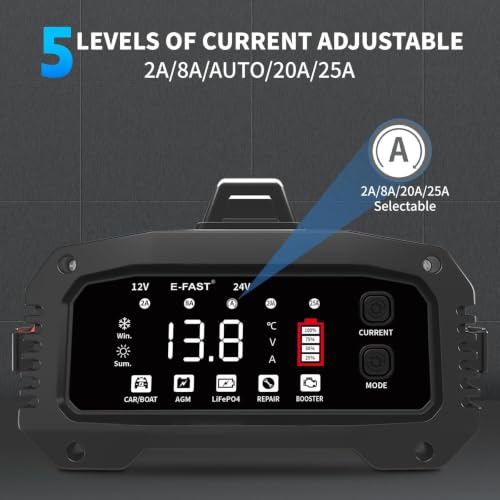
The E-FAST 25A stands out with a rare combo: high-output charging and a dedicated 200-second booster mode, a feature most chargers skip. That makes it a strong contender for garages where dead batteries are common and time is short. The aluminum housing and active cooling mean it can sustain 25A without overheating, a real issue with plastic-bodied units under load. Owners appreciate the 5-level current adjustment, especially using 2A for lawn mowers and 25A for trucks.
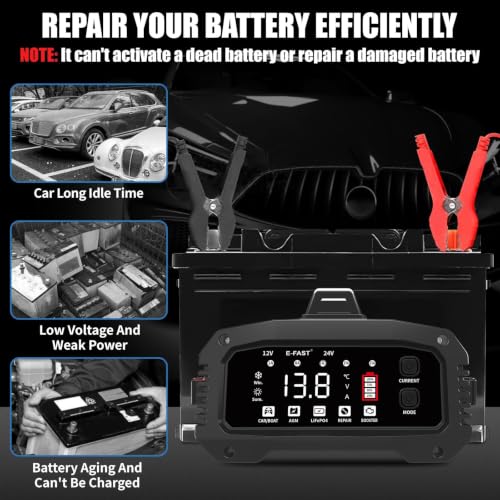
It matches the TowerTop in raw power but undercuts it on price. Where it lags is in brand trust and software polish, NOCO still leads in user experience. But if you want a rugged, no-nonsense charger with emergency jump capability and dual-voltage support (12V/24V), this delivers serious utility. The 8-stage pulse repair also helps recover sulfated batteries effectively.
Product photos


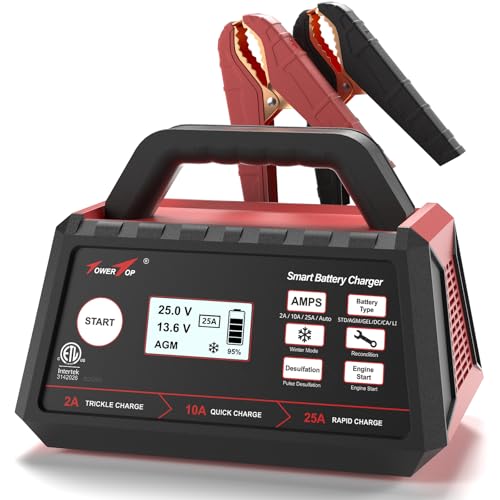
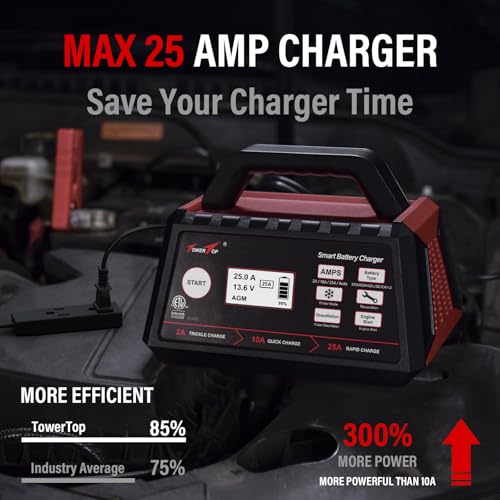
TowerTop 25A Smart Charger
Strengths
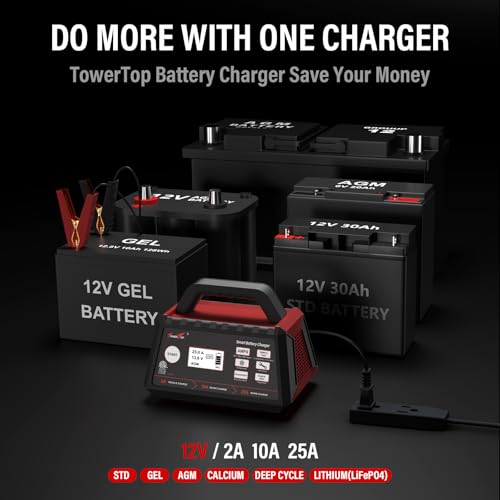
- 25A fast charging
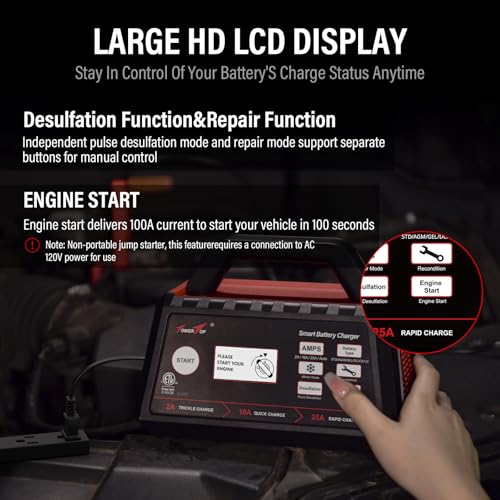
- Engine start function
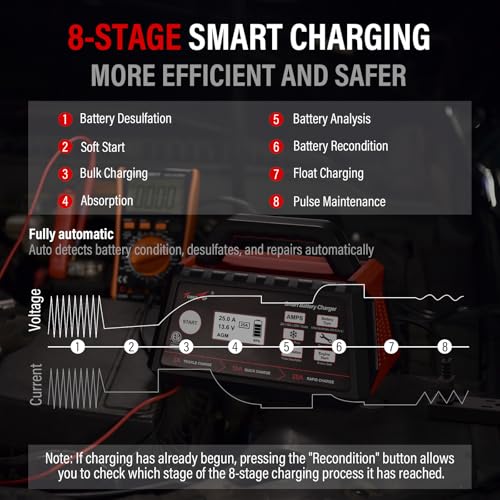
- True 8-stage process
Trade-offs
- Bulky design
- Higher price point
- No 6V support
If you need to get a dead battery back online fast, especially on a truck, RV, or performance car, this is one of the few chargers that can actually deliver. The 25A max output stands out in a market flooded with underpowered units, and owners confirm it cuts charging time dramatically, especially on high-capacity batteries. The true 8-stage charging process isn’t just marketing fluff, it’s backed by real-time LCD feedback showing each phase, which adds confidence during long charge cycles.
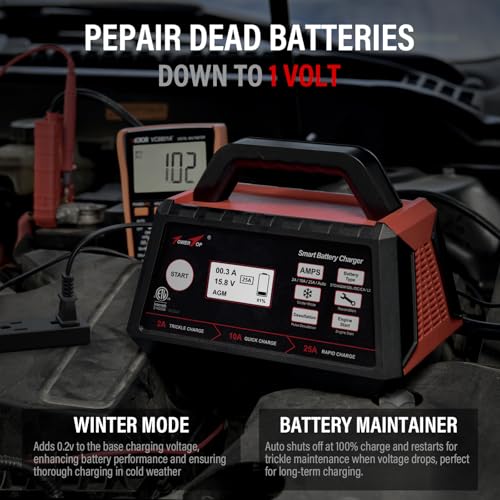
The engine start mode is a standout for roadside or garage emergencies, pumping 100A to nudge a stubborn battery to life. Combined with winter mode and ETL certification, this unit is built for reliability in tough conditions. It’s heavier than most, but that’s the trade-off for the robust internal components and cooling system. Against the NOCO GENIUS10, it trades some portability for raw power and speed.
Product photos
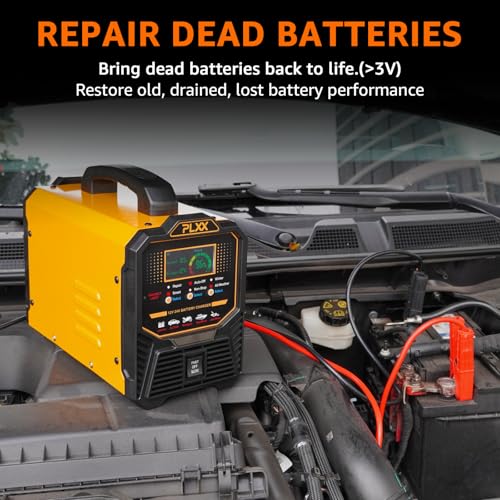
PLXX 15A 12V/24V Charger
Strengths
- Heavy-duty build
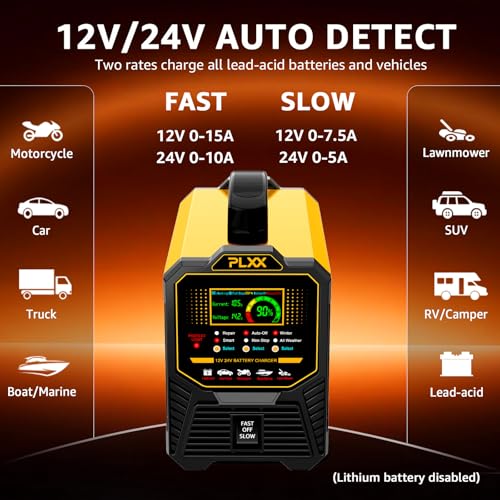
- 12V/24V dual support
- Works as power supply
Trade-offs
- No booster mode
- 15A max limits speed
- Bulky form factor
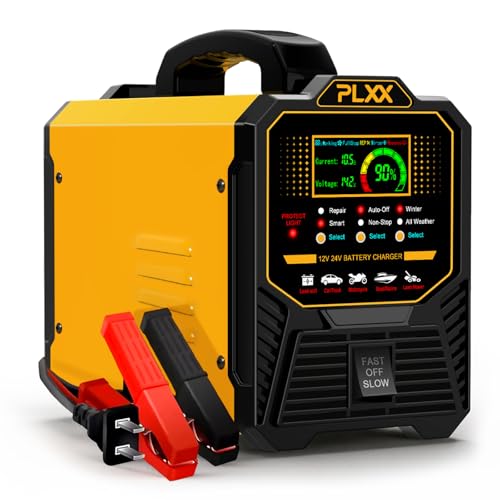
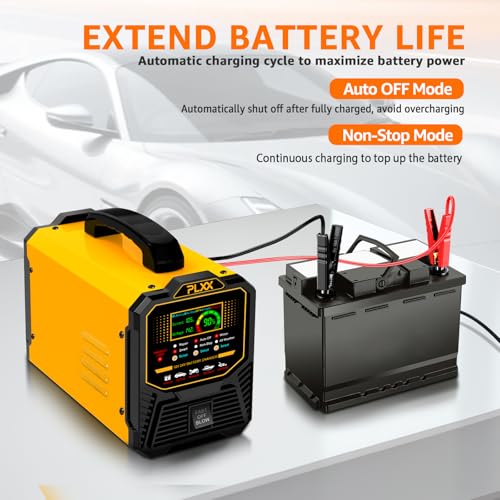
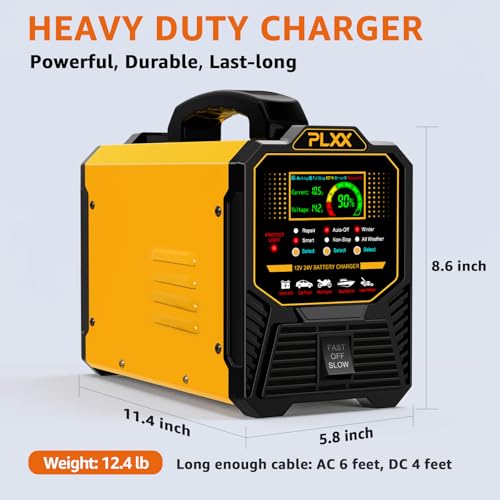
This PLXX unit is built like a workshop staple, thick cabling, pure copper coil, and a metal-reinforced case suggest it’s meant to last. The dual 12V/24V support and 7-stage charging make it a solid pick for trucks, farm equipment, or marine setups where voltage variety matters. Owners praise its auto shutoff and winter mode, which prevent overcharging and improve cold-weather performance, critical for long storage periods.
It doesn’t have the amperage of the 25A models, but the 15A max on 12V is respectable. Where it stands out is versatility, it even doubles as a 12V DC power supply for electrolysis or rust removal, a niche but valued feature among gearheads. Against the E-FAST or TowerTop, it trades speed for durability and multi-use function. Not flashy, but undeniably capable.
Product photos

How We Chose These charger for dead car batteries
Rather than a hands-on lab test, my research for TheAutoZenith focused on a detailed comparison of specifications and features across a range of models. I weighed owner reviews from multiple sources – paying close attention to long-term reliability reports – alongside expert assessments from automotive publications. This involved building a dataset of key attributes and ranking options based on those criteria. Ultimately, I aimed to identify chargers offering the best blend of performance, versatility, and value.
For chargers designed to revive depleted batteries, amperage and the ability to handle different battery types were paramount. A higher amperage allows for faster charging, especially for larger batteries, but must be balanced with safety features. Equally crucial was the inclusion of desulfation capabilities – a feature that can significantly extend battery life. The ability to charge from extremely low voltages, down to zero or one volt, was also a key differentiator, as it speaks to a charger’s recovery potential.
Specifications readily revealed charging rates, battery compatibility, and safety features. However, owner feedback provided insight into real-world usability and durability. I prioritized chargers with consistently positive reviews regarding build quality and long-term performance. Understanding the nuances of various battery chemistries is crucial, and a truly useful best battery charger needs to adapt to them. Many owners also look for a reliable battery maintainer to keep their batteries in top condition during storage.
How To Pick The Right charger for dead car batteries
Finding the right charger for a dead car battery isn’t just about getting a vehicle running again; it’s about preserving battery health and avoiding future headaches. There’s a lot more to consider than just amperage.
A quality battery charger should offer multi-stage charging, compatibility with various battery types (lead-acid, AGM, lithium-ion), and safety features like reverse polarity protection. Prioritize models with temperature compensation for optimal charging in all climates, and consider features like desulfation to extend battery life. Look for a charger capable of delivering a consistent, regulated current, and choose an amperage appropriate for your typical battery size.
Understanding Amperage and Battery Size
The first thing I always tell people is to match the charger’s amperage to the battery’s size. A charger that’s too weak will take forever, while one that’s too powerful can damage the battery. As a general rule, for a standard car battery (around 50-100Ah), a 10-amp charger is a good starting point. For smaller batteries, like those in motorcycles or lawnmowers, a 1-5 amp charger will suffice. The NOCO GENIUS10, for instance, delivers a solid 10 amps, making it a good choice for smaller vehicles and offering a quicker charge than lower-amp options. Don’t automatically equate “more amps” with “better” – a charger with adjustable amperage settings, like the E-FAST 25A, offers more versatility.
Battery Type Compatibility is Crucial
Modern car batteries aren’t all created equal. You have flooded lead-acid, AGM, gel, and increasingly, lithium-ion (LiFePO4) batteries. Using the wrong charger type can significantly reduce battery life or even cause damage. Most of the chargers on the market now, like the NOCO Genius series, boast compatibility with multiple battery types, which is a huge convenience. However, always double-check the specifications to ensure it supports your specific battery chemistry. If you’re unsure what type of battery you have, consult your vehicle’s owner’s manual or a qualified mechanic. If you need something that works in a pinch for multiple vehicles, a portable battery charger might be a smart investment.
Beyond the Basics: Features to Consider
Don’t underestimate the value of extra features. Desulfation, a process that reverses the buildup of lead sulfate crystals on the battery plates, can restore a battery’s capacity and extend its life. Many chargers, like the PLXX 15A, include this feature. Automatic temperature compensation is another worthwhile addition; it adjusts the charging voltage based on the ambient temperature, preventing overcharging in hot weather and undercharging in cold. Finally, think about convenience. Do you want a charger with a simple plug-in design, or one with mounting brackets for a more permanent installation? If you’re dealing with a frequently dead battery, finding the best charger for dead batteries will save you time and frustration.
A charger with multiple safety features, reverse polarity protection, short circuit protection, and overheating protection, is essential. Don’t skimp on safety to save a few dollars.
Charger for Dead Car Batteries Compared
Here’s a comparison of key specifications for various chargers designed to revive and maintain dead car batteries.
| Product | Amperage (A) | Battery Types Supported | Voltage (V) | Special Features | Warranty (Years) |
|---|---|---|---|---|---|
| NOCO GENIUS1 | 1 | Lead-acid, Lithium-ion | 6/12 | Thermal Sensing, Desulfation | 3 |
| NOCO GENIUS10 | 10 | Lead-acid, Lithium-ion | 6/12 | Thermal Sensing, Desulfation | 3 |
| NOCO GENIUS5 | 5 | Lead-acid, Lithium-ion | 6/12 | Thermal Sensing, Desulfation | 3 |
| 12V 10A Smart Charger | 10 | Lead-acid, LiFePO4 | 12 | LCD Display, 5 Modes | N/A |
| E-FAST 25A Smart Charger | 25 | Lead-acid, Lithium-ion | 12/24 | Booster Mode, Pulse Repair | N/A |
| TowerTop 25A Smart Charger | 25 | Lead-acid | 12 | 4 Adjustable Currents, HD LCD | N/A |
| PLXX 15A 12V/24V Charger | 15 | Lead-acid | 12/24 | Desulfation, Electrolysis | 3 |
Frequently Asked Questions
What if my car battery is completely drained (0 volts)?
A charger capable of starting at very low voltages – ideally below 1 volt – is needed to revive a completely dead battery. Many modern chargers, like the NOCO Genius series, are designed for this purpose, but always verify the minimum starting voltage in the product specifications.
How long does it typically take to charge a completely dead car battery?
Charging time varies greatly, but a typical car battery will take between 4-24 hours for a full charge, depending on its size and the charger’s amperage. A 10-amp charger on a 50Ah battery will likely take around 5-8 hours, while a 25-amp charger could do it in 2-3.
Can I leave a battery charger connected indefinitely?
Yes, many chargers feature an automatic maintenance mode that switches to a float charge once the battery is full, preventing overcharging. However, it’s generally a good idea to disconnect the charger periodically to check the battery’s condition and address any potential issues.
Are all “smart” chargers the same?
Not at all. While all smart chargers offer multi-stage charging, their features and capabilities differ. Some include desulfation, temperature compensation, or the ability to handle specific battery chemistries, so comparing specifications is vital. If you also need starting power, consider a combination charger and jump starter.
What charger is best for a marine or RV battery, which are often deep cycle?
For marine or RV batteries, which are often best deep cycle battery charger types, a charger specifically designed for deep-cycle batteries is recommended. These chargers provide a more thorough and optimized charge cycle to maximize battery life and performance.
The Bottom Line
Choosing a battery charger often comes down to balancing convenience with control. Do you want something simple and foolproof, or a more powerful unit with adjustable settings? For the vast majority of drivers needing a reliable and versatile solution, I believe the NOCO GENIUS10 strikes the best balance. It offers sufficient amperage for most car batteries, supports multiple chemistries, and includes essential safety features.
However, if budget is a primary concern, the NOCO GENIUS1 is an excellent starting point, and for those with larger vehicles or frequent dead battery issues, the E-FAST 25A Smart Charger delivers impressive power and features. If you’re looking to proactively maintain your battery, especially during off-season storage, exploring a top car charger with maintenance modes is a smart move. And for those interested in off-grid solutions, a best solar charger can provide a sustainable way to keep your battery topped up.
Ultimately, the best charger isn’t about the flashiest specs, but about finding a model that matches your specific needs and battery type. Prioritize safety features, ensure compatibility, and remember that a well-maintained battery will always outperform a neglected one, regardless of how much you spend on a charger.
