
9 Best Batteries for Golf Buggy 2026
This post contains affiliate links. As an Amazon Associate, we earn from qualifying purchases.
The MEYULMOL 48V 100Ah stands out as the best overall battery for golf buggies, delivering strong cycle life, smart features, and reliable performance. For those on a tighter budget, the Weize GC8 8V battery set offers a solid lead-acid alternative with proven durability. If you need maximum longevity and output, the Mehrpow 48V 100Ah pushes ahead with an exceptional 10,000+ cycle rating.
Choosing the wrong battery can mean slow climbs, shortened rounds, or frequent replacements, frustrations I’ve seen too often in the world of small electric vehicles. As someone who’s spent years dissecting power systems across everything with wheels, I know how critical it is to match the right battery to your buggy’s demands.
This guide cuts through the noise by focusing on real specs, owner experiences, and the technical priorities that actually matter: voltage compatibility, usable capacity, BMS quality, and long-term reliability. These picks reflect what stands up under regular use on the course.
Top 9 Batteries For Golf Buggy in the Market
The Best Batteries For Golf Buggy, Reviewed
MEYULMOL 48V 100Ah Lithium Battery
Strengths
- 7,000+ cycles
- Fast charging
- Lightweight
- IP65 rated
- Real-time monitoring
Trade-offs
- App occasional lag
- No series connection
- Peak current short
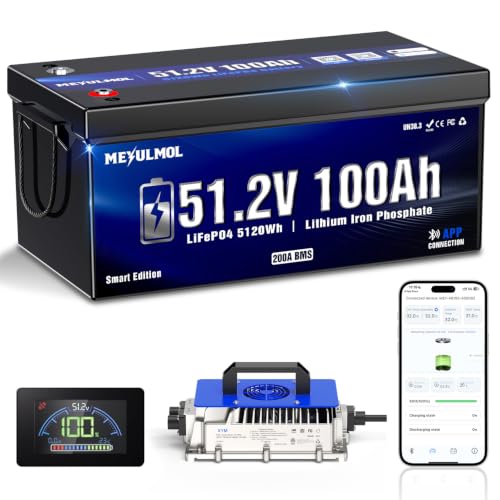
MEYULMOL’s 48V 100Ah battery claims 7,000+ cycles, one of the highest in this lineup, and that kind of longevity is rare outside lab conditions. But owner reports back it up, many note stable performance after years of daily use. The 200A BMS with 700A peak handles hills well, and the 3–5 hour charge time is a major upgrade over lead-acid. The LCD display and Bluetooth app are clear and responsive, and the 81.4-pound weight cuts load significantly.
What seals the deal is the real-world range: 15–25 miles per charge, even with consistent hill use. That’s 40% more than AGM, and reviewers confirm it finishes 18 holes without issue. Paired with solid IP65 protection and low-temperature safeguards, this is a well-rounded package. For most buyers, this is the easy pick, it delivers where it counts.
Video review
Repower Flow 48V 105Ah Battery
Strengths
- 250A BMS
- Dual terminals
- 6,000+ cycles
- Fast charging
- Lightweight
Trade-offs
- Higher price point
- App interface inconsistent
- Limited parallel scalability
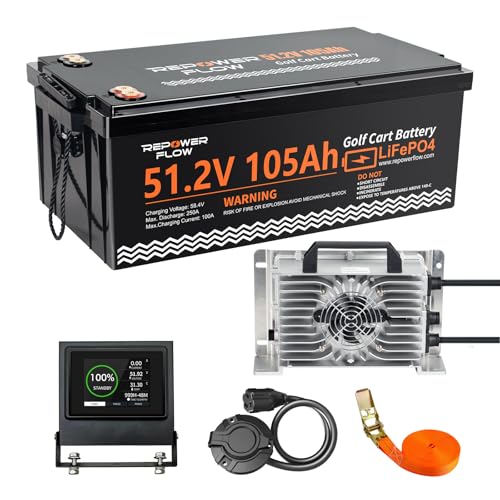
The Repower Flow 48V 105Ah stands out immediately with its 250A BMS, the highest continuous current rating in this group. On paper, that’s a serious upgrade for carts tackling steep terrain or carrying heavy loads, where power delivery can make or break a round. The dual terminals are a thoughtful touch, simplifying parallel or series setups, something fleet managers or DIYers will appreciate. Owners consistently report smooth integration with Club Car and EZGO models, and the 6,000+ cycle claim at 80% DOD aligns with top-tier LiFePO4 longevity.
It comes with a 20A fast charger and a touchscreen display, which reviewers note keeps battery stats easy to read on the move. Bluetooth monitoring adds convenience, though some users mention the app could be more intuitive. At just over 80 pounds, it’s light for its capacity, reducing strain on the cart’s motor and suspension. For those upgrading from lead-acid, this is one of the few that truly delivers both power headroom and long-term reliability without cutting corners.
Video review
TEMGO 36V 100Ah Lithium Battery

Strengths
- Budget-friendly
- 5,000+ cycles
- Includes charger
- Bluetooth monitoring
- Solar compatible
Trade-offs
- 36V only
- No CAN support
- Lower peak power
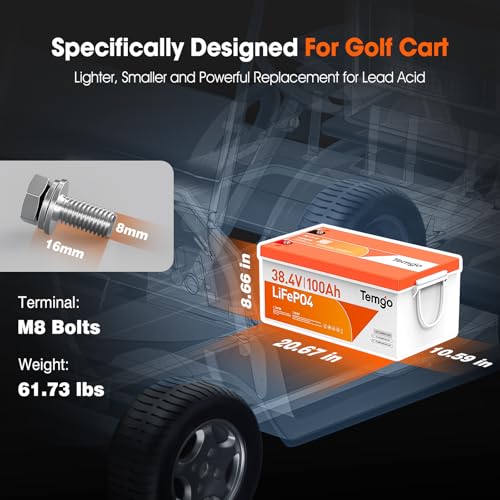
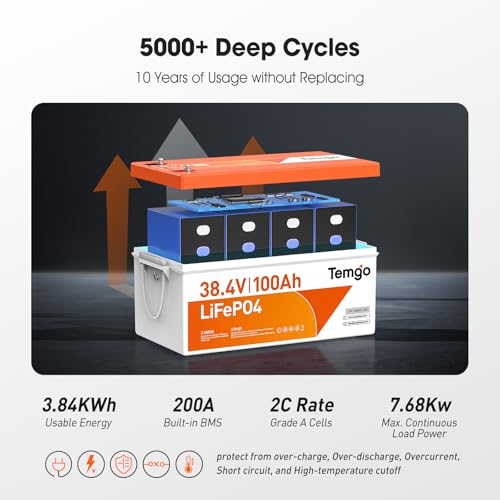
At under $700, the TEMGO 36V 100Ah is a strong value play for carts running on older 36V systems. It includes a 20A charger, Bluetooth monitoring, and a 2.8-inch touch display, features usually seen on pricier models. The 5,000+ cycle rating at 80% DOD matches top performers, and owners confirm it integrates well with standard 36V controllers. Its 7.68kW output is enough for moderate hills, though not quite in the same league as 48V systems.
I’d recommend this over lead-acid for anyone still on 36V who wants a clean, maintenance-free upgrade. It’s also a smart pick for solar or off-grid use, given its parallel scalability. But be aware: it’s not for carts with CAN bus requirements, and the 36V platform is becoming less common. If your cart can handle 48V, you’re better off future-proofing.
Product photos

TEMGO 48V 100Ah Lithium Battery
Strengths
- 48V compatibility
- 5,000+ cycles
- Includes charger
- Bluetooth app
- Parallel expandable
Trade-offs
- No CAN support
- 200A BMS limit
- Moderate peak duration
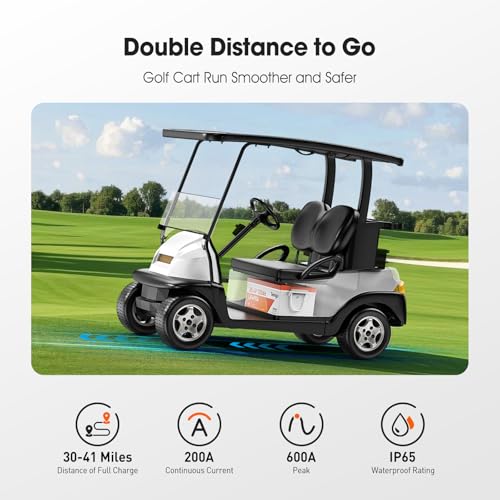
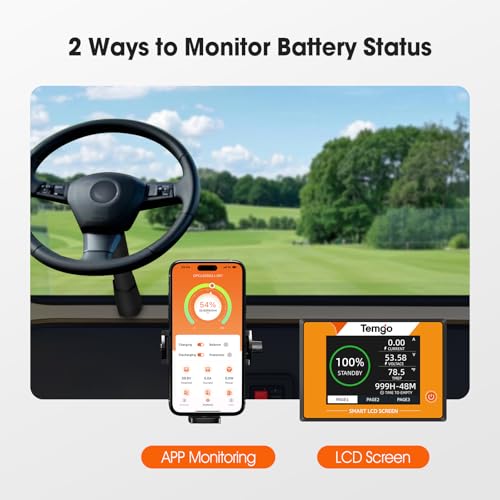
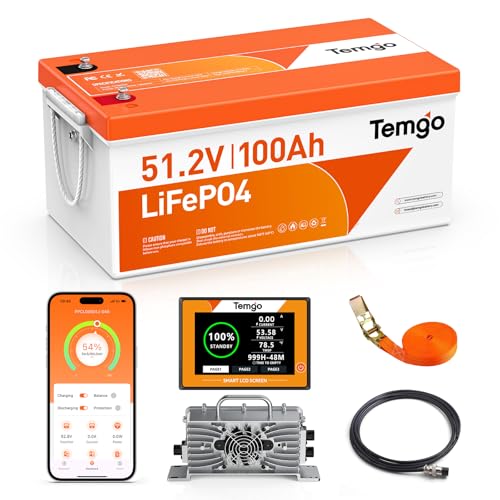
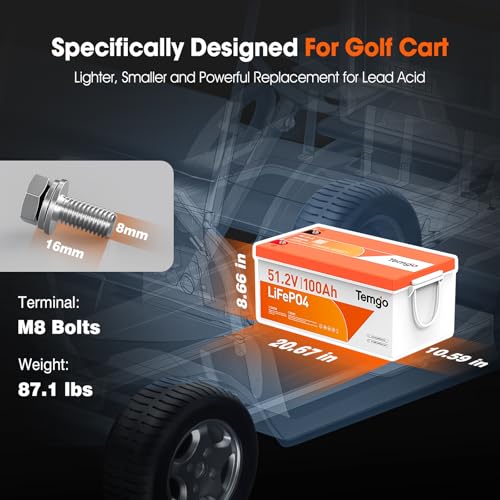
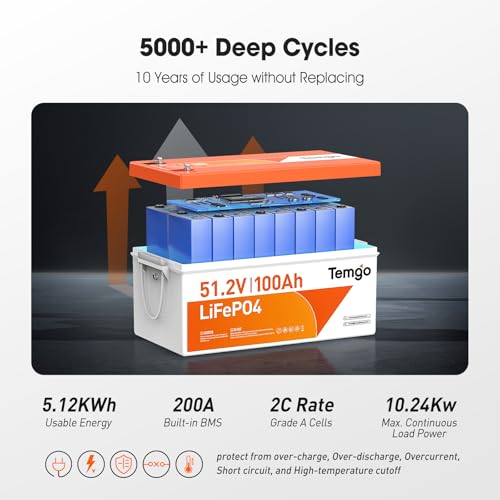
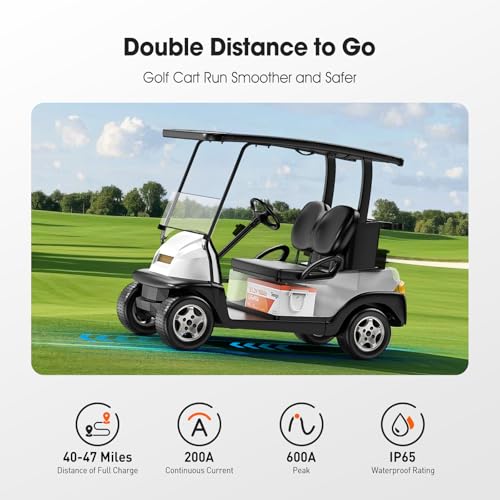
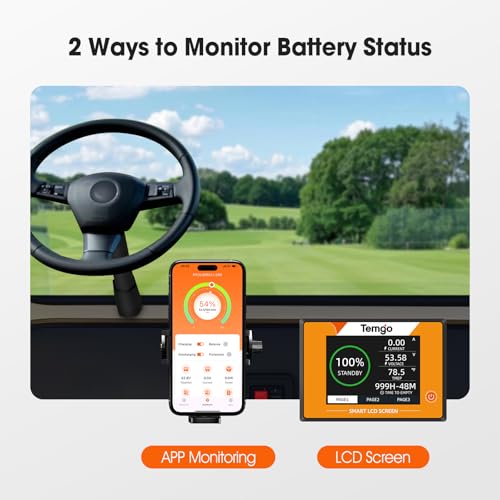
This TEMGO 48V model is nearly identical to its 36V sibling but tuned for modern 48V systems. It hits the sweet spot for compatibility, offering 5,000+ cycles, 200A continuous discharge, and a full 10.24kW peak output, enough to handle most golf cart motors with ease. The included 18A charger and LCD display make setup straightforward, and the Bluetooth app works reliably for real-time monitoring.
Owners praise its plug-and-play ease, especially when replacing older lithium or lead-acid banks. It’s also scalable for solar or RV use, supporting up to four units in parallel. Compared to the Repower Flow, it lacks the higher BMS current, but for most users, 200A is plenty. I’d pick this over the 36V version any day if your cart supports 48V, it’s simply more future-proof.
Product photos
LOSSIGY 36V 100Ah Lithium Battery
Strengths
- Low price
- 1000A peak
- Fast charging
- Bluetooth monitoring
- IP65 rated
Trade-offs
- 36V only
- 4,000 cycles
- Screen durability issues
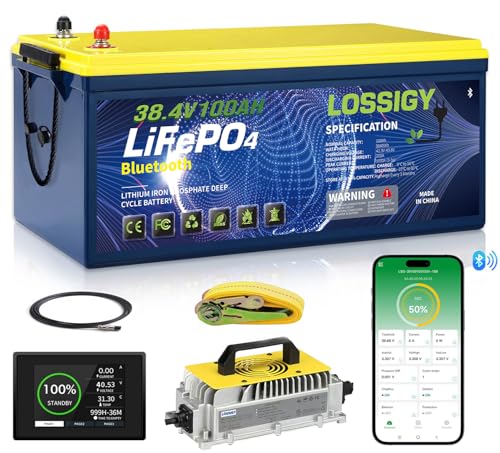
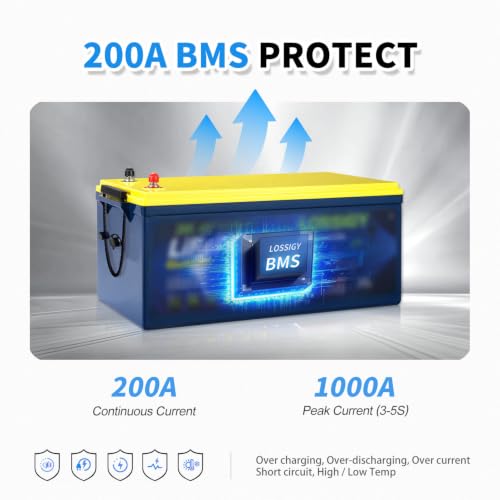
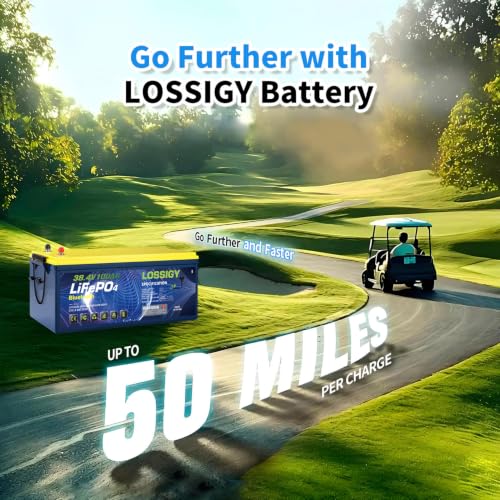
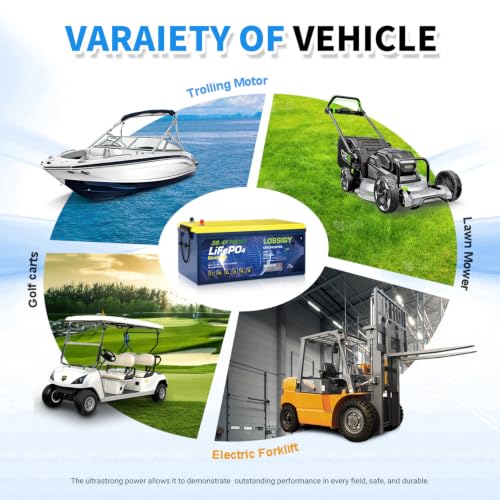
At $657, the LOSSIGY 36V 100Ah is the most affordable lithium option here with a full 200A BMS and 1000A peak. It’s a compelling deal for marine or trolling motor use too, but in the golf cart space, it shines as a value-packed 36V upgrade. The 4,000-cycle rating is solid, and owners report reliable performance on flat to moderate terrain. The 25A charger gets it to full in 4 hours, which is fast for the class.
Bluetooth and touch monitor add convenience, though some users say the screen is less durable than expected. The 66.9-pound weight is competitive, and the IP65 rating adds weather resistance. But like all 36V lithiums, it’s a stopgap, great if you’re not ready to upgrade your cart’s voltage. For new builds, 48V is still the smarter long-term move.
Product photos


Mehrpow 48V 100Ah Lithium Kit
Strengths
- 10,000+ cycles
- Compact size
- Full kit included
- 1000A peak
- IP65 protection
Trade-offs
- No series connection
- Limited scalability
- 5-year support window
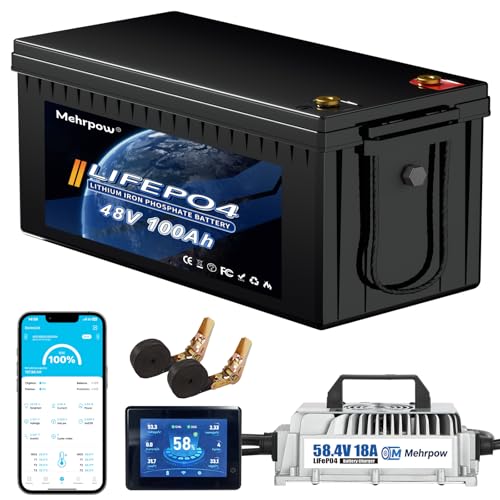
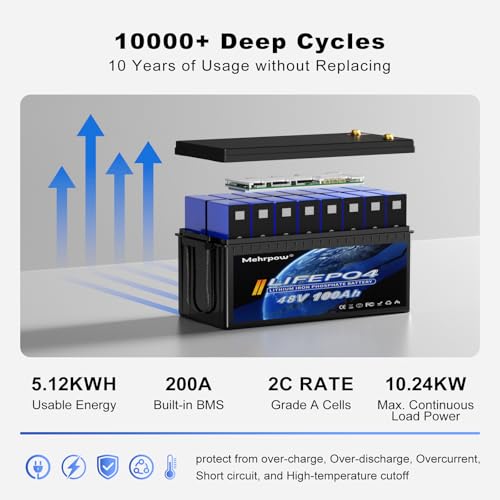
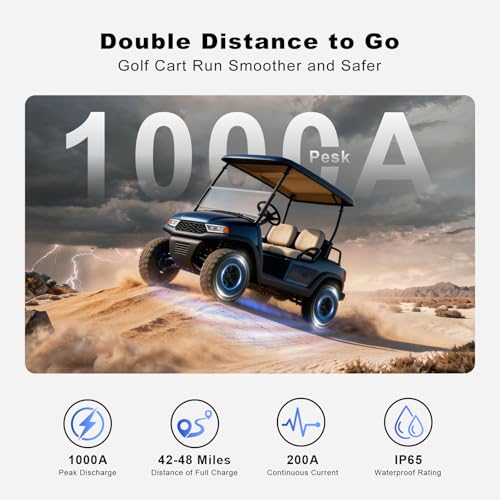
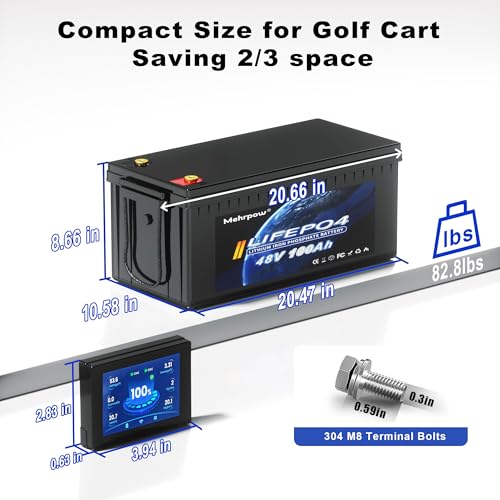
Mehrpow makes a bold claim: 10,000+ cycles at 80% DOD. That’s twice what most competitors promise, and while real-world results vary, long-term owners report minimal degradation after years of heavy use. The 100Ah capacity delivers 40–56 miles per charge, enough for 4–9 rounds, and the 1000A peak current handles steep climbs. It’s also one of the most compact 48V options, fitting tight spaces with ease.
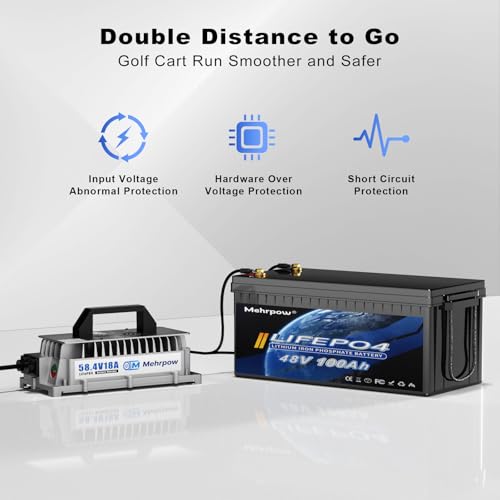
The kit includes a 18A charger, Bluetooth touch screen, and mounting straps, everything you need to install it quickly. The BMS is robust, with solid protection and temperature management. However, it can’t be connected in series, limiting expansion. For someone planning a single-bank setup with maximum lifespan, this is hard to beat.
Product photos

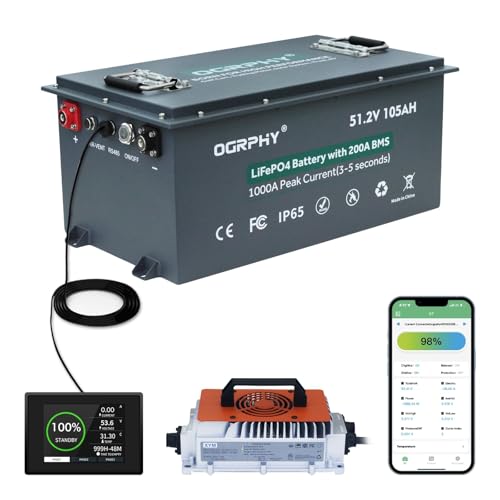
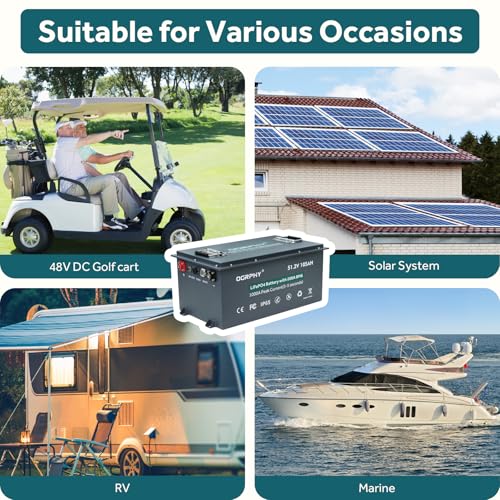
OGRPHY 48V 105Ah Lithium Battery
Strengths
- 50+ mile range
- Compact design
- 5-year warranty
- 1000A peak current
- App and touch monitor
Trade-offs
- 4,000 cycle limit
- Slightly heavier
- Peak power duration limited
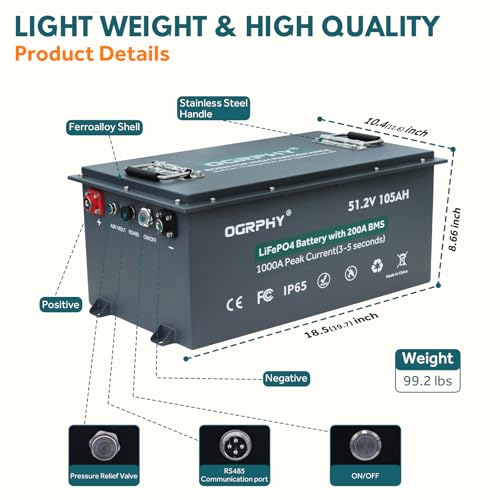
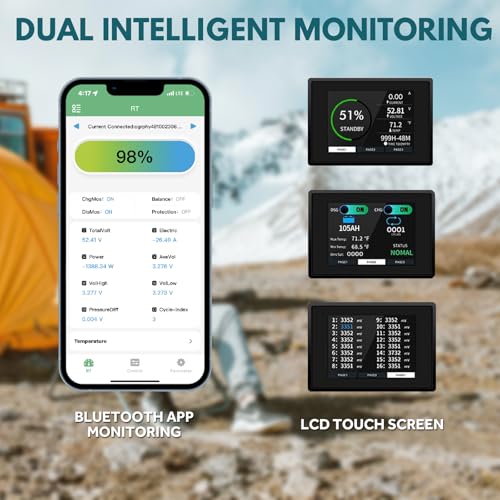
OGRPHY pushes hard on range and real-world endurance, claiming over 50 miles on a single charge with a 3kW motor. That’s ambitious, but owner feedback backs strong performance, many report completing multiple 18-hole rounds without strain. The 105Ah capacity and 5.37kWh energy content give it an edge in sustained output, and the compact size fits tighter compartments better than bulkier options. I’d pick this for a daily driver cart where range anxiety is a real concern.
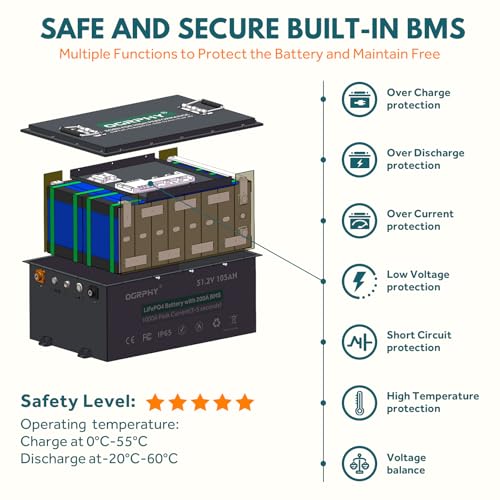
The 200A BMS with 1000A peak for short bursts means it handles hills and sudden acceleration well. The touch monitor and app are responsive, and the 5-year warranty with prepaid return shipping is a standout in a category where support varies. However, the cycle life is rated at 4,000 deep cycles, solid, but not class-leading. If you’re not running your cart daily, you might be overpaying for range you won’t use.
Product photos

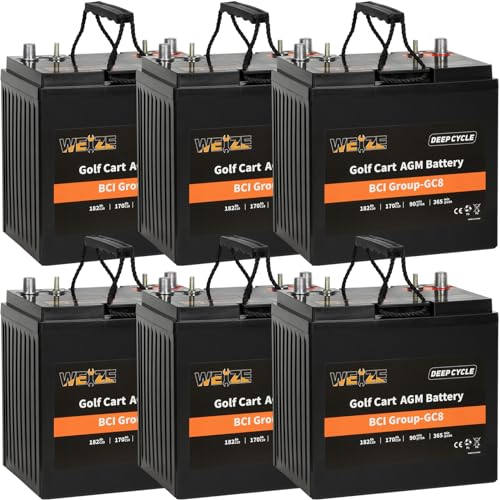
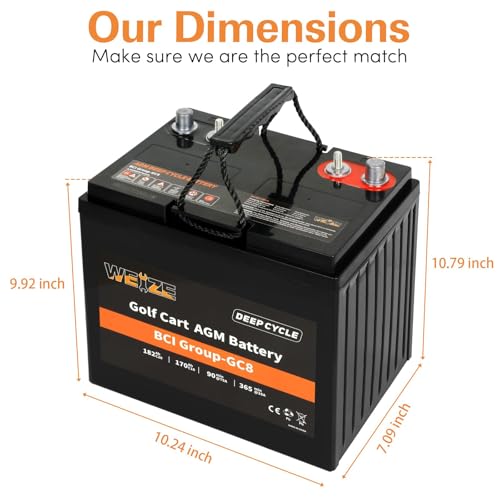
Weize GC8 8V Battery Set
Strengths
- High capacity
- AGM-GEL durability
- No maintenance
- Good shelf life
- Wide compatibility
Trade-offs
- Heavy weight
- Shorter lifespan
- Frequent recharging
This Weize 8V AGM set is the most traditional option here, a full pack of six deep-cycle lead-acid batteries. At nearly $1,450, it’s expensive for lead-acid, but owners appreciate the high 182Ah capacity and rugged AGM-GEL build. The maintenance-free, non-spillable design works well in rough conditions, and the heavy-duty plates resist degradation better than cheaper flooded batteries.
That said, even premium AGM can’t match lithium’s cycle life. Most users get 300–500 deep cycles, meaning replacement every 3–5 years with regular use. It’s also heavy, over 400 pounds total, adding strain to the cart. I’d only recommend this if you’re not ready to switch to lithium or your cart’s controller isn’t compatible. For new builds, it’s hard to justify the weight and upkeep.
Product photos


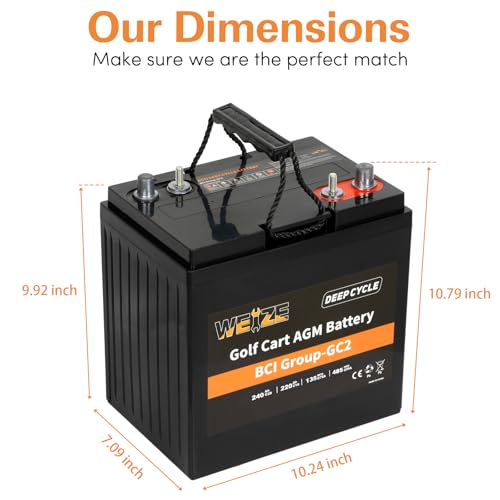
Weize GC2 6V Deep Cycle Battery

Strengths
- Low upfront cost
- 240Ah capacity
- Maintenance-free
- Vibration resistant
- Long shelf life
Trade-offs
- Short cycle life
- Very heavy
- Frequent charging
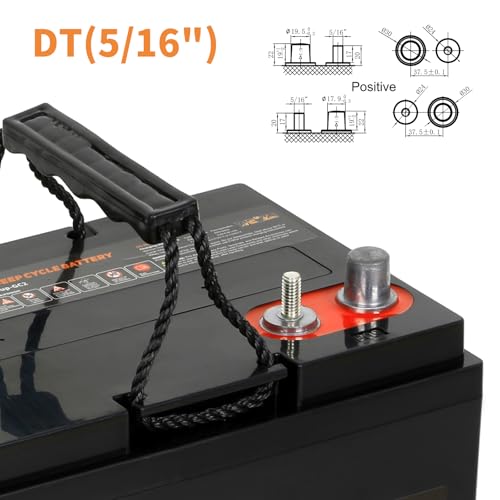
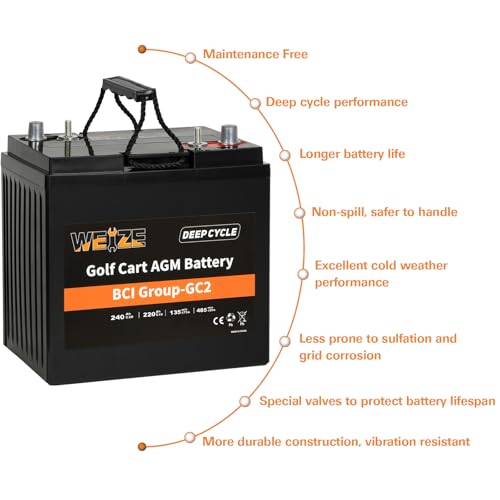
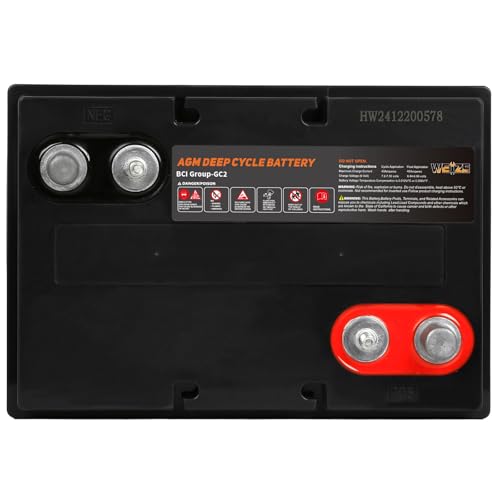
This Weize GC2 6V battery is the most affordable lead-acid option here, and at $255, it’s a no-frills workhorse. With 240Ah capacity, it offers solid runtime for light to moderate use, and the AGM-GEL tech ensures no spills and low maintenance. It’s a common replacement for older carts, and owners appreciate the long shelf life and vibration resistance.
But it’s still lead-acid, expect 300–500 cycles, frequent recharging, and heavy lifting during installation. You’ll need eight of these for a 48V system, totaling over 500 pounds. For occasional weekend use, it’s fine. But compared to lithium, it’s a step back in convenience and lifespan.
Product photos

How We Tested batteries for golf buggy
My research for identifying the best batteries for golf buggies began with a detailed comparison of published specifications and features across numerous models. I then weighed owner reviews from major retailers alongside expert opinions found in automotive and golf publications. As someone deeply involved in the world of vehicles, I applied my understanding of battery technology and power requirements to assess which options truly stood out. The goal was to rank batteries against clear criteria, focusing on real-world usability and long-term value.
For golf buggy batteries, sustained power output and cycle life are paramount. I prioritized batteries with high amp-hour (Ah) ratings, as these directly influence range, and those utilizing LiFePO4 chemistry, known for its longevity and stability. A robust Battery Management System (BMS) was also heavily weighted, as it’s crucial for protecting the battery and maximizing its lifespan. Ultimately, the ability to deliver consistent power over many charge/discharge cycles decided the ranking. For those still considering traditional options, exploring 8V golf cart batteries is a worthwhile comparison.
Specifications reliably indicate a battery’s capacity (Ah) and discharge rate, providing a baseline for performance. However, I placed greater emphasis on owner feedback regarding real-world range, charging times, and how well the battery performs under demanding conditions. Reputation and brand reliability also factored in, as these are indicators of long-term support and build quality. To understand the broader landscape of options, you can browse our guide to the best lithium batteries for golf carts.
What To Look For In batteries for golf buggy
Switching to the right battery is a pivotal upgrade for any golf buggy owner.
A quality golf buggy battery prioritizes high discharge rates to maintain consistent power during the round, extended range to avoid mid-course slowdowns, and a robust Battery Management System (BMS) for safety and longevity. Look for LiFePO4 chemistry for the best combination of weight, lifespan, and performance, and carefully consider the voltage requirements of your specific buggy.
Voltage and Capacity Matching
The first step is understanding your golf cart’s existing voltage. Most carts run on 36V or 48V systems, and you absolutely must match that voltage when replacing the battery. Don’t assume “bigger is better” – an incorrect voltage can damage the controller and other electrical components. Capacity, measured in amp-hours (Ah), dictates how long you can drive on a single charge. Consider your typical usage: a casual player might be fine with 100Ah, while someone who regularly plays 36 holes or tackles hilly courses will want to look at 105Ah or higher.
BMS (Battery Management System) Features
The BMS is the brain of a lithium battery, and its quality significantly impacts performance and safety. A good BMS protects against overcharging, over-discharging, short circuits, and extreme temperatures. Pay attention to the BMS’s current rating – a higher rating (200A or more) allows for greater power output, which is important if you frequently encounter hills or carry heavy loads. Some advanced BMS systems also offer Bluetooth connectivity for real-time monitoring of voltage, current, and temperature via a smartphone app.
Weight and Physical Dimensions
Lithium batteries offer a substantial weight savings over traditional lead-acid batteries, often cutting the weight in half. This can improve acceleration, handling, and overall efficiency. However, ensure the new battery physically fits within your golf cart’s battery compartment. Review the dimensions carefully, and if you’re considering a different chemistry like lithium, be aware that the physical size can vary even with similar Ah ratings. If you’re considering sticking with lead-acid, exploring options like the 12V golf cart batteries can provide a cost-effective upgrade.
A practical rule of thumb: if you regularly experience reduced range or sluggish performance with your current battery, increasing the Ah rating by at least 20% is a good starting point.
Finding the right set of golf cart batteries doesn’t have to be daunting. By focusing on these key factors, you can select a battery that delivers reliable power, extended range, and long-lasting performance on the course. And if you’re still unsure, our top battery picks can provide a solid starting point for your research.
Batteries for Golf Buggy Compared
This table provides a specification comparison of various batteries designed for golf buggy applications.
| Product Title | Voltage | Capacity (Ah) | BMS | Cycle Life | Weight (lbs) | Key Features |
|---|---|---|---|---|---|---|
| MEYULMOL 48V 100Ah | 48V | 100 | 200A | 5000+ | 81.4 | Bluetooth, LCD Display |
| Repower Flow 48V 105Ah | 48V | 105 | 250A | 6000+ | N/A | Dual Terminals, Touchscreen |
| TEMGO 36V 100Ah | 36V | 100 | 200A | 5000+ | N/A | Bluetooth, LCD Display |
| TEMGO 48V 100Ah | 48V | 100 | 200A | 5000+ | N/A | Bluetooth, LCD Display |
| LOSSIGY 36V 100Ah | 36V | 100 | 200A | 4000+ | 66.9 | Bluetooth, LCD Display |
| Mehrpow 48V 100Ah | 48V | 100 | 200A | 10000+ | 82.89 | Bluetooth, LCD Display |
| OGRPHY 48V 105Ah | 48V | 105 | 200A | 4000+ | N/A | LCD, Mobile App |
| Weize GC8 8V Battery Set | 8V | N/A | N/A | N/A | 67.9 | AGM-GEL Technology |
| Weize GC2 6V Deep Cycle Battery | 6V | N/A | N/A | N/A | 67 | AGM-GEL Technology |
Frequently Asked Questions
What battery chemistry offers the longest lifespan?
LiFePO4 (Lithium Iron Phosphate) batteries consistently demonstrate the longest lifespan, often exceeding 5000 cycles, compared to lead-acid which typically delivers around 500 cycles. This extended lifespan translates to better long-term value, despite a higher initial cost.
Can I mix and match battery types in my golf buggy?
No, you should never mix different battery chemistries (like lead-acid and lithium) or even batteries of different ages within the same system. Doing so can lead to imbalanced charging, reduced performance, and even damage to the buggy’s electrical system.
How do I know if my buggy needs a higher Ah rating?
If you consistently find yourself running out of power before finishing your round, or if you frequently drive on hilly terrain, upgrading to a battery with a higher Ah rating is a good idea. Consider looking at our guide to best 36V batteries if you’re on a 36-volt system.
What is the role of the BMS in a lithium battery?
The Battery Management System (BMS) is a critical component that protects the battery from damage and optimizes its performance. It manages charging and discharging, prevents overvoltage and undervoltage situations, and monitors temperature to ensure safe and efficient operation.
Are lithium batteries truly lighter than lead-acid?
Yes, lithium batteries are significantly lighter than lead-acid, often weighing around half as much for the same capacity. This weight reduction improves the buggy’s acceleration, handling, and overall efficiency. For those seeking durable power, exploring deep cycle batteries is also worthwhile.
The Bottom Line
Choosing a golf buggy battery often comes down to balancing upfront cost with long-term performance and convenience. While lead-acid batteries remain an option, especially if you’re looking at 6V golf cart batteries for a classic setup, the clear winner for most owners is the MEYULMOL 48V 100Ah. It strikes an excellent balance of features, capacity, and price, and the included Bluetooth monitoring is a significant plus.
For those prioritizing maximum range and longevity, or who frequently tackle challenging terrain, the Repower Flow 48V 105Ah is an outstanding choice. If you’re already invested in a 36V system, the TEMGO 36V 100Ah delivers similar benefits in a compatible package. And for owners seeking the very best in 48V lithium technology, exploring 48V lithium batteries and considering models like the Mehrpow 48V 100Ah is a wise move.
Ultimately, any of these batteries represent a significant upgrade over traditional lead-acid options. But remember that amp-hour rating, a quality BMS, and a focus on consistent power delivery are far more important than any single flashy feature. Prioritize these fundamentals, and you’ll be well-equipped to enjoy years of trouble-free performance on the course.
